Picking the right marketing analytics platform is one of the highest-leverage decisions a B2B SaaS marketing team can make. The wrong tool leaves you guessing which campaigns drive pipeline. The right one connects every ad click to closed-won revenue and tells you exactly where to scale.
This list ranks nine platforms based on attribution depth, integration breadth, ease of use, and fit for B2B SaaS workflows. Whether you need multi-touch attribution, server-side tracking, or AI-driven spend recommendations, there is a platform here built for your stage and stack. Each ranking considers real-world marketing use cases, not just feature checklists.
1. Cometly
Best for: B2B SaaS teams that need full-funnel attribution from ad click to closed-won revenue.
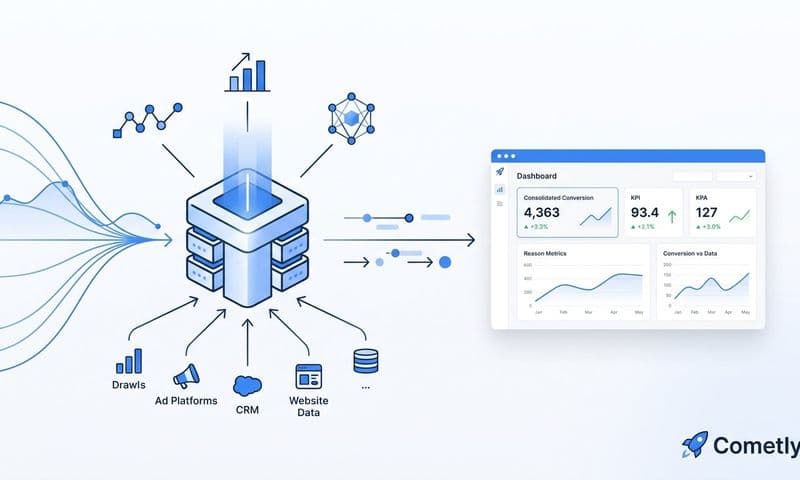
Cometly is a marketing attribution and analytics platform built specifically for B2B SaaS companies, connecting ad platforms, CRM, and website data to track the complete customer journey in real time.
 9 Best Attribution Platforms for Agencies in 2026
Where This Tool Shines
Cometly's core strength is its ability to close the loop between paid ad spend and actual revenue. Rather than stopping at lead generation, it tracks what happens after a form fill: which deals entered the pipeline, which progressed through stages, and which closed. That level of visibility is rare in tools not purpose-built for B2B.
The platform's server-side tracking and Conversion API integration mean your event data stays accurate even as browser-based tracking becomes less reliable. Combined with an AI ads manager that surfaces spend and creative recommendations, Cometly gives marketing teams both the data and the direction to act on it.
Key Features
Multi-Touch Attribution: Tracks every paid channel touchpoint across the full customer journey using flexible attribution models.
Server-Side Conversion Tracking: Captures conversion events server-side and syncs them via Conversion API to Meta, Google, and other ad platforms for more accurate optimization signals.
AI Ads Manager: Analyzes campaign performance across channels and surfaces actionable recommendations for budget allocation and creative decisions.
Pipeline and Revenue Attribution: Connects marketing touchpoints to CRM pipeline stages and closed-won revenue, including direct Stripe integration for revenue data.
Customer Journey Analytics: Shows the complete touchpoint history for every contact, making it easy to understand how buyers move from first impression to conversion.
70+ Native Integrations: Connects with major ad platforms, CRMs, and marketing tools without requiring custom engineering work.
Best For
Cometly is the strongest fit for B2B SaaS marketing teams and growth leaders who need to prove ROI across paid channels and connect ad spend directly to pipeline and revenue. It is particularly well-suited for teams running multi-channel paid programs who need a single source of truth across their entire marketing stack.
Pricing
Paid plans available with multiple tiers. Visit cometly.com/pricing for current pricing details.
2. HubSpot Marketing Hub
Best for: Teams already operating inside the HubSpot ecosystem who want seamless CRM-to-campaign attribution.
HubSpot Marketing Hub is an all-in-one marketing platform with native CRM integration, campaign analytics, and contact-level attribution reporting built into the HubSpot ecosystem.
 9 Best Ad Attribution Platforms Compared for B2B SaaS Teams in 2026
Where This Tool Shines
For teams that live inside HubSpot, Marketing Hub removes the friction of stitching together separate analytics and CRM tools. Because your contact records, deal data, and marketing activity all live in the same system, attribution reporting is more straightforward than it is with third-party integrations.
The multi-touch revenue attribution available at the Enterprise tier is genuinely useful for B2B teams, though it requires a significant investment to unlock. For teams already paying for HubSpot CRM, adding Marketing Hub can feel like a natural extension rather than a separate tool purchase.
Key Features
Native CRM-to-Campaign Attribution: Links contact records directly to marketing campaigns without requiring a third-party integration layer.
Multi-Touch Revenue Attribution: Available at Enterprise tier, this feature distributes revenue credit across all marketing touchpoints in the customer journey.
Ads ROI Reporting: Tracks performance and attributed revenue across Google, Facebook, and LinkedIn ad campaigns from a single dashboard.
Contact Timeline: Shows every marketing interaction for each contact, giving sales and marketing teams shared visibility into the buyer journey.
Email, Ads, and Content Dashboards: Centralizes performance reporting across all major marketing channels in one interface.
Best For
Marketing teams that have already adopted HubSpot as their CRM and want attribution reporting without adding another tool to their stack. Less suited for teams that need deep paid channel attribution outside the HubSpot ad integrations or that operate on non-HubSpot CRMs.
Pricing
Free tier available. Marketing Hub Starter begins at $20 per month. Professional and Enterprise tiers are priced significantly higher, with multi-touch attribution requiring Enterprise.
3. Google Analytics 4
Best for: Teams that need a free baseline for web measurement with direct Google Ads integration.
Google Analytics 4 is Google's free web analytics platform with event-based tracking, cross-device reporting, and direct integration with Google Ads and Search Console.
 11 Best Marketing Analytics Tools to Track and Optimize Campaign Performance in 2026
Where This Tool Shines
GA4 is the starting point for virtually every marketing analytics stack, and for good reason. Its event-based data model is flexible enough to track almost any user interaction, and its native connection to Google Ads makes it the most direct path to measuring search and display campaign performance.
The data-driven attribution model in GA4 uses machine learning to distribute conversion credit across touchpoints, which is a meaningful improvement over simple last-click models. Exploration reports allow analysts to build custom funnels and path analyses without needing a separate BI tool for basic questions.
Key Features
Event-Based Tracking: Replaces the session-based model of Universal Analytics with flexible event tracking for any user interaction.
Data-Driven Attribution: Uses machine learning to assign conversion credit across touchpoints based on actual contribution patterns.
Google Ads and Search Console Integration: Connects campaign performance, keyword data, and site behavior in a single reporting environment.
Cross-Device Reporting: Tracks user journeys across devices and platforms using Google signals and user ID matching.
Exploration Reports: Provides a flexible workspace for custom funnel analysis, path exploration, and cohort reporting.
Best For
Any marketing team that needs a free, reliable web analytics foundation. Particularly valuable for teams running significant Google Ads spend. Less suited as a standalone attribution solution for B2B SaaS teams with long sales cycles and CRM-dependent revenue tracking.
Pricing
Free for standard use. GA4 360, the enterprise version with higher data limits and SLAs, is available through Google Sales with custom pricing.
4. Triple Whale
Best for: Ecommerce and DTC brands running paid social campaigns across Meta, TikTok, and Google.
Triple Whale is an attribution and analytics platform built for ecommerce and DTC brands, with a focus on paid social attribution, creative analytics, and cohort-based revenue reporting.
 9 Best Marketing Analytics Platforms Ranked for B2B SaaS in 2026
Where This Tool Shines
Triple Whale was built to solve the attribution problem that ecommerce brands face when running heavy paid social spend: platform-reported ROAS rarely matches actual revenue. Its pixel-based first-party attribution gives DTC teams a more accurate view of which ads are actually driving purchases, separate from what Meta or TikTok self-report.
The creative analytics dashboard is a standout feature for teams running many ad variations simultaneously. Seeing performance data at the individual ad level, rather than the campaign level, helps creative teams iterate faster on what is working.
Key Features
First-Party Pixel Attribution: Tracks conversions across Meta, TikTok, and Google using Triple Whale's own pixel for platform-independent measurement.
Creative Analytics: Breaks down performance data at the individual ad level, enabling faster creative iteration and spend decisions.
Cohort Analysis: Tracks customer lifetime value and repeat purchase behavior over time for more accurate revenue forecasting.
Blended and True ROAS Reporting: Shows both blended ROAS across all channels and channel-specific ROAS for more nuanced spend decisions.
Sonar Post-Purchase Survey: Collects self-reported attribution data from customers at checkout to validate pixel-based attribution models.
Best For
Ecommerce and DTC brands with significant paid social budgets. Not designed for B2B SaaS companies with long sales cycles or CRM-based revenue tracking.
Pricing
Starts at approximately $129 per month; pricing scales based on store revenue.
5. Ruler Analytics
Best for: B2B teams with significant offline conversions, phone-based sales, or form-heavy lead generation.
Ruler Analytics is a B2B-focused marketing attribution platform that tracks visitor journeys across sessions, connects form fills and phone calls to their original source, and syncs revenue data back from CRM.
 8 Best Attribution Tools with Onboarding Support in 2026
Where This Tool Shines
Ruler Analytics fills a specific gap that many analytics tools miss: offline conversion tracking. When a prospect fills out a form, calls a sales line, or books a demo, Ruler connects that action back to the original marketing source, even if the journey spanned multiple sessions over weeks. For B2B teams where the phone or a sales rep is part of the conversion process, this is a meaningful capability.
The CRM revenue sync is also well-executed. When a deal closes in your CRM, Ruler pulls that revenue data back and attributes it to the marketing touchpoints that influenced the journey, giving you a cleaner picture of which channels actually drive closed business rather than just leads.
Key Features
Multi-Touch Attribution for Forms and Calls: Tracks both online form submissions and phone calls back to their originating marketing source.
CRM Revenue Sync: Pulls closed deal revenue from CRM and attributes it back to the marketing touchpoints in the customer journey.
Visitor-Level Journey Tracking: Follows individual visitors across multiple sessions to build a complete picture of the path to conversion.
Offline Conversion Import: Sends offline conversion data back into Google Ads and Meta for improved campaign optimization.
Marketing Channel ROI Reporting: Surfaces revenue-based ROI reporting by channel, campaign, and source.
Best For
B2B companies with phone-based sales processes, significant form fill volumes, or long multi-session buyer journeys. A strong fit for agencies managing lead generation campaigns for clients who need revenue-level reporting.
Pricing
Plans start at approximately $199 per month; pricing scales with the number of tracked visitors.
6. Rockerbox
Best for: Performance marketing teams managing complex multi-channel spend who need both MTA and media mix modeling.
Rockerbox is a multi-channel attribution platform that combines multi-touch attribution and media mix modeling to help performance marketing teams understand spend efficiency across all channels.
 9 Best Marketing Analytics Platforms Ranked for B2B SaaS in 2026
Where This Tool Shines
Rockerbox addresses a real tension in modern attribution: multi-touch attribution and media mix modeling each have strengths and blind spots. MTA gives you granular channel-level data but struggles with upper-funnel and offline channels. MMM captures the full picture but operates at an aggregate level. Rockerbox brings both approaches into one platform, which helps performance marketers make more confident budget decisions.
The deduplication capability is particularly useful for teams running overlapping campaigns across multiple paid channels. Without deduplication, the same conversion can be claimed by multiple channels, inflating reported performance and making it hard to know where to actually invest.
Key Features
Unified MTA and Media Mix Modeling: Combines granular multi-touch attribution with aggregate media mix modeling in a single reporting environment.
Deduplicated Conversion Reporting: Removes duplicate conversion claims across channels to give a more accurate picture of true performance.
Channel Overlap Analysis: Identifies where channels are cannibalizing each other's conversions rather than driving incremental results.
Custom Attribution Model Builder: Allows teams to configure attribution logic to match their specific business model and sales cycle.
Direct Ad Platform Integrations: Connects natively with major ad platforms and ecommerce tools for automated data ingestion.
Best For
Growth-stage and enterprise brands running significant multi-channel paid programs who need more than a single attribution model to make spend decisions. Less suited for early-stage teams or those with simpler channel mixes.
Pricing
Custom pricing; designed for growth-stage and enterprise brands. Contact Rockerbox directly for a quote.
7. Northbeam
Best for: Paid social advertisers who need cookieless, first-party attribution with a strong focus on Meta and TikTok measurement.
Northbeam is an ML-powered attribution platform focused on first-party data and cookieless tracking for paid social advertisers, with a strong emphasis on Meta and TikTok performance measurement.
Where This Tool Shines
Northbeam was built with the assumption that third-party cookies would eventually become unreliable, which has proven to be the right bet. Its cookieless tracking architecture uses first-party behavioral signals and machine learning to model attribution in a privacy-resilient way, making it less vulnerable to the tracking disruptions that have affected pixel-based tools.
For advertisers spending heavily on Meta and TikTok, Northbeam provides a more stable measurement foundation than relying on platform-reported data alone. The spend pacing and budget recommendation features also help teams stay on track with their media plans without requiring constant manual monitoring.
Key Features
Machine Learning Attribution: Uses first-party behavioral signals and ML models to assign conversion credit without relying on third-party cookies.
Cookieless Tracking Architecture: Built from the ground up for a privacy-first environment, reducing dependence on browser-based tracking.
Spend Pacing and Budget Recommendations: Monitors budget utilization in real time and surfaces recommendations to keep campaigns on pace.
Creative Performance Analytics: Breaks down performance data at the individual ad level across paid social channels.
Custom Attribution Windows and Model Comparison: Allows teams to compare performance across different attribution windows and models side by side.
Best For
Brands with significant monthly ad spend on paid social channels, particularly Meta and TikTok, who need accurate measurement in a cookieless environment. Typically suited for brands spending at scale rather than early-stage advertisers.
Pricing
Custom pricing; typically suited for brands with significant monthly ad spend. Contact Northbeam for pricing details.
8. Windsor.ai
Best for: Analysts and agencies who need a data aggregation layer to feed BI tools and custom dashboards.
Windsor.ai is a marketing data aggregation platform that connects 315+ data sources and routes marketing data into BI tools, dashboards, and spreadsheets for custom reporting.
Where This Tool Shines
Windsor.ai is less of an attribution platform and more of a data pipeline. Its strength is the sheer breadth of connectors: 315+ data sources means you can pull from virtually any ad platform, CRM, or analytics tool and route that data into Looker Studio, Power BI, Tableau, or Google Sheets without writing custom integrations. For analysts who already know how to build dashboards, Windsor.ai removes the data collection friction.
The agency-friendly multi-client account structure is a practical feature for teams managing reporting across multiple brands or clients. Automated data refresh ensures dashboards stay current without requiring manual exports or scheduled scripts.
Key Features
315+ Native Data Connectors: Pulls data from ad platforms, CRMs, analytics tools, and more into a single data pipeline.
BI Tool Routing: Sends data directly to Looker Studio, Power BI, Tableau, and Google Sheets for custom dashboard building.
Multi-Touch Attribution Modeling Layer: Applies attribution models to aggregated data, though this is less robust than purpose-built attribution platforms.
Automated Data Refresh: Keeps connected data sources current without manual intervention.
Multi-Client Account Management: Designed for agencies managing reporting across multiple clients from a single interface.
Best For
Marketing analysts, data teams, and agencies who need a flexible data aggregation layer rather than a full attribution platform. Best suited for teams that have the analytical skills to build their own reporting on top of clean, connected data.
Pricing
Plans start at approximately $19 per month; pricing scales with data volume and the number of connectors used.
9. Dreamdata
Best for: B2B companies with long, account-based buying cycles and multiple stakeholders in the purchase decision.
Dreamdata is a B2B revenue attribution platform that maps the full account-level buying journey across multiple stakeholders, connecting marketing touchpoints to pipeline and closed revenue.
Where This Tool Shines
Dreamdata was designed for a problem that most attribution tools handle poorly: B2B buying decisions rarely involve a single person. When five people from the same account interact with your marketing before a deal closes, contact-level attribution misses most of the picture. Dreamdata tracks all contacts within a buying group and attributes revenue at the account level, which is a much more accurate reflection of how B2B deals actually work.
The time-to-revenue reporting is another useful feature for B2B teams. Understanding how long different channels and campaigns take to influence closed deals helps marketing teams set realistic pipeline expectations and communicate more accurately with sales and finance.
Key Features
Account-Level Attribution: Tracks all contacts within a buying group and attributes revenue at the account level rather than the individual contact level.
Pipeline and Revenue Attribution with CRM Sync: Connects marketing touchpoints to CRM pipeline stages and closed-won revenue for full-funnel visibility.
Self-Serve Analytics: Provides campaign, channel, and content performance reporting without requiring data team support for every query.
Time-to-Revenue Reporting: Shows how long it takes for different channels and campaigns to influence closed deals, supporting more accurate pipeline forecasting.
B2B-Specific Attribution Models: Includes account-based and position-based attribution models designed for complex B2B buying journeys.
Best For
B2B companies with long sales cycles, multiple stakeholders in the buying process, and a need for account-level attribution that reflects how enterprise deals actually close. Less suited for high-volume, transactional sales motions.
Pricing
Free tier available. Paid plans start at approximately $999 per month for full attribution features.
Which Platform Is the Right Fit for Your Team?
The right marketing analytics platform depends on three things: your channel mix, your sales cycle length, and how closely you need to tie marketing activity to revenue rather than just traffic or leads.
Here is a quick-reference guide based on the most common B2B SaaS scenarios:
For B2B SaaS teams connecting ad spend to pipeline and revenue: Cometly is the strongest fit. Its purpose-built attribution engine, server-side tracking, and Stripe revenue integration give you a direct line from ad click to closed deal, which is exactly what growth-stage and scaling SaaS teams need.
For teams operating inside the HubSpot ecosystem: HubSpot Marketing Hub offers the most seamless CRM-to-campaign reporting without adding another tool to your stack.
For a free web measurement foundation: Google Analytics 4 remains the baseline, particularly for teams running significant Google Ads spend who want direct campaign-to-site performance reporting.
For ecommerce and DTC brands on paid social: Triple Whale and Northbeam are the strongest options, with Triple Whale excelling on creative analytics and Northbeam leading on cookieless measurement architecture.
For teams with phone-based sales or heavy offline conversions: Ruler Analytics is the best choice, with its visitor-level tracking and CRM revenue sync built specifically for this use case.
For performance teams managing complex multi-channel spend: Rockerbox's combination of MTA and media mix modeling makes it the most sophisticated option for teams that need more than one attribution lens.
For analysts who need a data aggregation layer: Windsor.ai is the most practical choice when you want clean, connected data flowing into your own BI tools rather than a pre-built attribution interface.
For B2B companies with long, account-based buying cycles: Dreamdata's account-level attribution and time-to-revenue reporting make it the best fit for enterprise-focused teams where multiple stakeholders influence every deal.
For B2B SaaS teams that want a single source of truth across ads, CRM, and revenue, Cometly provides the most direct path from ad click to closed deal. If you want to see how it works in practice, Get your free demo and start capturing every touchpoint across your full customer journey.