
Choosing marketing analytics software is rarely just about features. The pricing tier you land on determines what data you can actually access, how many teammates can collaborate, and whether you can connect the tools your team already relies on. For B2B SaaS marketing teams, the wrong tier often means missing attribution data, hitting integration walls, or paying for seats you do not need.
This guide breaks down nine leading platforms by pricing tier structure so you can match the right tool to your budget and growth stage. We cover what each tier unlocks, where platforms draw capability lines, and which tools offer the best value for teams focused on pipeline and revenue attribution.
How Marketing Analytics Pricing Models Actually Work
Before diving into individual tools, it helps to understand the five pricing models you will encounter across the market. Each one has real implications for your total cost as you grow.
Seat or contact-based pricing: Platforms like HubSpot charge based on the number of users or marketing contacts in your database. Attribution features are typically gated behind Professional or Enterprise tiers, which can represent a significant jump from Starter plans.
Ad spend or revenue-based pricing: Tools like Northbeam and Triple Whale price based on your monthly ad spend or gross merchandise value. This model scales with your business but can become expensive quickly for high-spend accounts.
Data volume or connector-based pricing: Supermetrics prices based on the number of data source connectors and destination tools. Teams aggregating from many ad platforms see costs rise with each additional connector.
Flat-tier subscription: Many attribution platforms use tiered flat pricing where each tier unlocks more attribution models, longer data retention windows, more integrations, or higher tracked event volumes.
Custom enterprise pricing: Platforms like Rockerbox and Northbeam often require custom quotes for larger accounts, making direct comparison difficult without a sales conversation.
With that context in place, here are the top marketing analytics platforms compared by pricing tier structure.
1. Cometly
Best for: B2B SaaS teams that need full-funnel attribution from ad click to closed-won revenue
Cometly is a marketing attribution and analytics platform built specifically for B2B SaaS companies that need to connect ad spend directly to pipeline and revenue.
 9 Best Attribution Platforms for Agencies in 2026
Where This Tool Shines
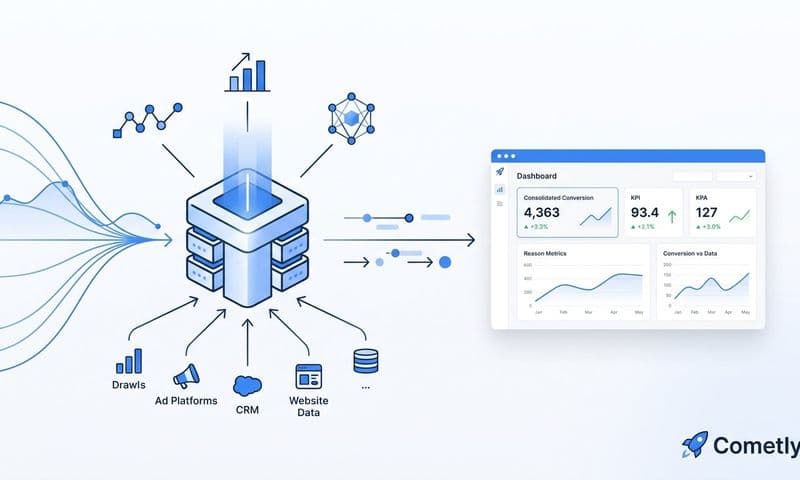
Most analytics platforms make you choose between ease of use and depth of attribution. Cometly is designed to give growth-stage and scaling SaaS teams both. It connects your ad platforms, CRM, and website to track the entire customer journey in real time, giving you a single source of truth for marketing performance.
The platform's pricing is structured to be transparent and scalable, without gating core attribution functionality behind enterprise tiers. That means teams at earlier growth stages can access multi-touch attribution, server-side tracking, and AI-powered insights without needing an enterprise contract to unlock meaningful data.
Key Features
Multi-touch attribution: Tracks every touchpoint across the full customer journey, from first ad click to closed-won revenue, across all connected channels.
Server-side conversion tracking: Conversion API integration improves data accuracy by capturing events that browser-based tracking misses due to ad blockers and cookie restrictions.
AI ads manager: Provides cross-channel performance recommendations so you can identify high-performing campaigns and scale with confidence.
Pipeline and revenue attribution: Connects directly to Stripe and CRM data so you can see which campaigns are actually driving revenue, not just leads.
70+ native integrations: Connects with major ad platforms, CRMs, and data tools so your attribution data is always complete and up to date.
Best For
B2B SaaS marketing teams and growth leaders who need revenue-level attribution without enterprise-level complexity or cost. Particularly valuable for teams running paid campaigns across multiple channels who want to know exactly which spend is driving pipeline.
Pricing
Transparent tiered pricing scaled for growth-stage and scaling B2B SaaS teams. Visit cometly.com for current plan details and to find the tier that fits your team size and attribution needs.
2. HubSpot Marketing Hub
Best for: Teams already in the HubSpot ecosystem that need CRM-connected attribution reporting
HubSpot Marketing Hub is an all-in-one marketing platform with built-in CRM, email, automation, and analytics across multiple pricing tiers.
 9 Best Ad Attribution Platforms Compared for B2B SaaS Teams in 2026
Where This Tool Shines
HubSpot's biggest advantage is the native CRM integration. For teams that already use HubSpot for sales, the closed-loop reporting between marketing activity and CRM outcomes is genuinely powerful. You can see which campaigns influenced contacts and deals without needing a third-party attribution layer.
The challenge is that meaningful attribution reporting is locked behind the Professional tier, which starts at $890 per month. The jump from Starter to Professional is steep, and teams on the Free or Starter tier are largely limited to traffic source and basic campaign reporting.
Key Features
Multi-touch attribution reporting: Available from Professional tier upward, supporting multiple attribution models including first touch, last touch, and linear.
Contact-based pricing model: Costs scale with the number of marketing contacts in your database, which can accelerate pricing as your list grows.
Native CRM integration: Connects marketing activity directly to CRM records for closed-loop reporting without additional setup.
Campaign analytics: Traffic source reporting and campaign performance dashboards available across most tiers.
Enterprise custom reporting: The Enterprise tier adds advanced attribution configurations and custom reporting objects.
Best For
Teams already invested in the HubSpot ecosystem who want attribution reporting without adding a separate tool. Less ideal for teams who need deep multi-channel attribution outside the HubSpot stack or who cannot justify the Professional tier cost.
Pricing
Free tier available. Starter from $20 per month. Professional from $890 per month. Enterprise from $3,600 per month. Pricing scales with the number of marketing contacts in your account.
3. Google Analytics 4
Best for: Teams that need solid web analytics and basic attribution at no cost
Google Analytics 4 is Google's free web analytics platform with event-based tracking, standard attribution modeling, and native integrations with Google's ad ecosystem.
 11 Best Marketing Analytics Tools to Track and Optimize Campaign Performance in 2026
Where This Tool Shines
For teams that primarily run Google Ads and need reliable web analytics, GA4 delivers significant value at zero cost. The data-driven attribution model is available in the free version, which is a meaningful capability that many paid platforms charge for. The Explore section also provides custom funnel analysis and path exploration tools that go beyond basic reporting.
The limitation is that GA4 is fundamentally a web analytics tool, not a revenue attribution platform. It does not natively connect to your CRM or revenue data, which means you can see traffic and conversion events but cannot easily tie them back to closed deals or pipeline value without additional tooling.
Key Features
Event-based tracking: Free tier captures user behavior across web and app properties with flexible event configuration.
Data-driven attribution: Available in the free version, using machine learning to distribute conversion credit across touchpoints.
GA4 360: Enterprise tier unlocks higher data processing limits, SLAs, and direct BigQuery exports for large-scale data teams.
Native Google integrations: Connects directly with Google Ads and Search Console for closed-loop reporting within the Google ecosystem.
Explore tools: Custom funnels, path analysis, and segment overlap reports available in the free version.
Best For
Teams that need web analytics and Google Ads attribution at no cost. GA4 360 suits large enterprises with high data volumes that need SLAs and BigQuery integration. Not a fit for teams needing CRM-connected or cross-channel revenue attribution.
Pricing
Free for standard use. GA4 360 is custom-priced and volume-based, available through Google Marketing Platform resellers. Contact Google or a certified reseller for enterprise pricing.
4. Triple Whale
Best for: Ecommerce and DTC brands tracking blended ROAS across paid channels
Triple Whale is a data analytics and attribution platform built primarily for ecommerce and direct-to-consumer brands running paid media on Meta, Google, TikTok, and similar channels.
 9 Best Marketing Analytics Software Pricing Tiers Compared in 2026
Where This Tool Shines
Triple Whale's core strength is giving ecommerce brands a single dashboard view of blended ROAS across all paid channels. The creative analytics features are particularly useful for performance marketers who need to understand which ad creatives are driving results, not just which campaigns. Post-purchase survey attribution is also included, which helps fill gaps left by browser-based tracking limitations.
The ad spend or GMV-based pricing model means costs scale with your business, but it also means high-spend brands can find themselves paying significantly more as budgets grow. Attribution depth increases at higher tiers, with predictive analytics and more advanced models reserved for Pro and Premium plans.
Key Features
Blended ROAS dashboard: Aggregates performance across ad channels into a single revenue and spend view.
Creative analytics: Breaks down ad performance by creative asset to identify what is actually driving conversions.
Post-purchase survey attribution: Supplements pixel data with self-reported attribution from customers at checkout.
Pixel-based attribution: First-party pixel captures conversion events across the customer journey.
Tiered attribution depth: Advanced attribution models and predictive analytics available at higher plan tiers.
Best For
Ecommerce and DTC brands with meaningful paid media budgets across Meta, Google, and TikTok. Not designed for B2B SaaS teams who need pipeline and revenue attribution connected to CRM data.
Pricing
Pricing is based on a percentage of monthly ad spend or GMV. Founders tier covers lower spend levels. Higher tiers unlock advanced attribution and predictive analytics. Visit triplewhale.com for current rates based on your spend level.
5. Rockerbox
Best for: Performance marketing teams managing complex, multi-channel media mixes
Rockerbox is a multi-channel attribution platform that combines rule-based attribution with media mix modeling, designed for performance teams with diverse channel mixes including TV, podcasts, and digital.
 9 Best Marketing Analytics Software Pricing Tiers Compared in 2026
Where This Tool Shines
Rockerbox stands out for its ability to handle both digital and offline channel attribution in one platform. For brands running campaigns across streaming audio, connected TV, and traditional digital channels simultaneously, having a unified view with both rule-based attribution and media mix modeling is genuinely valuable. The platform is built for teams who need to justify upper-funnel spend that does not produce direct last-click conversions.
The custom pricing model means you need a sales conversation before you can compare costs directly. Pricing is based on data volume and the number of channel connections, which can add up for teams with broad channel mixes.
Key Features
Multi-touch attribution: Customizable attribution models that can be configured to match your business logic.
Media mix modeling: Statistical modeling for upper-funnel channels where direct tracking is limited or unavailable.
Cross-channel coverage: Includes TV, podcast, and digital channels in a single attribution view.
Data warehouse integrations: Connects with major ad platforms and data warehouses for centralized data access.
Channel-based pricing structure: Costs scale based on data volume and the number of channel connections you need.
Best For
Mid-market to enterprise performance marketing teams running complex, multi-channel media mixes that include offline and upper-funnel channels. Requires a demo for pricing, which makes it less accessible for smaller teams evaluating options quickly.
Pricing
Custom pricing based on data volume and number of channel connections. A demo is required to receive a quote. Contact Rockerbox directly for current pricing.
6. Northbeam
Best for: Performance-driven brands with significant paid media budgets needing predictive attribution
Northbeam is a predictive attribution and media mix modeling platform designed for brands with substantial paid media investment who need forward-looking ROAS estimates alongside historical attribution.
 9 Best Affordable Marketing Attribution Platforms in 2026
Where This Tool Shines
Northbeam's predictive attribution is its primary differentiator. Rather than only showing you what happened, the platform provides forward-looking ROAS estimates that can inform budget allocation decisions before you commit spend. Real-time spend pacing and budget recommendations add a layer of operational utility that goes beyond standard attribution reporting.
Like Rockerbox, Northbeam uses custom pricing based on monthly ad spend, which means costs scale with your budget. This model rewards high-spend brands with a platform built for their scale, but it also means smaller teams may find the cost hard to justify relative to simpler attribution tools.
Key Features
Predictive attribution: Forward-looking ROAS estimates to inform budget allocation decisions in real time.
Media mix modeling: Statistical analysis across paid and organic channels for upper-funnel insights.
Custom attribution windows: Configurable attribution windows and model settings to match your sales cycle.
Real-time spend pacing: Budget pacing alerts and recommendations to keep campaigns on track.
Ad spend-based pricing: Costs scale proportionally with your monthly paid media budget.
Best For
Performance-driven brands with significant monthly ad spend who need predictive attribution and media mix modeling. Better suited for ecommerce and DTC brands than B2B SaaS teams with longer sales cycles.
Pricing
Custom pricing based on monthly ad spend. A sales conversation is required for a quote. Visit northbeam.io to request pricing based on your current spend level.
7. Ruler Analytics
Best for: B2B teams that need to connect online touchpoints to offline revenue through CRM sync
Ruler Analytics is a B2B-focused marketing attribution platform that connects digital touchpoints to offline revenue by syncing with CRMs and tracking calls, forms, and live chat interactions.
Where This Tool Shines
Ruler Analytics is specifically built for B2B teams where the conversion journey does not end at a form fill. By connecting online touchpoints to CRM-recorded revenue, the platform closes the loop between marketing activity and actual sales outcomes. Call tracking is included across all tiers, which is a meaningful advantage for businesses where phone conversations are a key part of the sales process.
Pricing is based on monthly tracked website visits, which is a straightforward model that scales predictably. However, teams with high traffic volumes can see costs rise quickly, and the visit-based model means you are paying for traffic whether or not it converts.
Key Features
Lead-to-revenue attribution: Connects marketing touchpoints to CRM-recorded revenue for closed-loop reporting.
Call tracking: Included across all tiers, capturing phone-based conversions as part of the attribution model.
Multiple attribution models: Supports linear, time decay, first touch, last touch, and other models across tiers.
CRM integrations: Syncs with Salesforce, HubSpot, and other major CRM platforms.
Visit-based pricing: Tiered pricing scaled by the number of monthly tracked website visits.
Best For
B2B teams with a mix of digital and phone-based conversions who need CRM-connected attribution. Well suited for professional services, agencies, and B2B companies where calls and forms are both significant conversion points.
Pricing
Tiered pricing based on monthly tracked visits, ranging from entry-level plans for smaller sites to higher tiers for larger traffic volumes. Visit ruleranalytics.com for current plan rates.
8. Dreamdata
Best for: B2B SaaS teams that need account-level attribution across buying committees
Dreamdata is a B2B revenue attribution platform focused on account-based analytics, connecting marketing and sales touchpoints to pipeline and revenue for teams with complex, multi-stakeholder buying processes.
Where This Tool Shines
Dreamdata is one of the few attribution platforms built around the reality of B2B buying: multiple stakeholders, long sales cycles, and touchpoints spread across marketing and sales. The account-level attribution model aggregates individual contact interactions into a unified account view, which is essential for teams selling to buying committees rather than individual decision-makers.
The free tier is a genuine entry point, not just a feature preview. It provides basic attribution reporting that smaller teams can use without a paid commitment. The Team and Business tiers unlock longer data retention windows, more attribution models, and deeper CRM integrations as teams scale.
Key Features
Account-level attribution: Aggregates touchpoints across multiple contacts within the same account for a complete buying committee view.
Free tier: Provides basic attribution reporting without requiring a paid plan to get started.
Extended data retention: Team and Business tiers unlock longer historical data windows for trend analysis.
Pipeline and revenue attribution: Connects marketing touchpoints to CRM-recorded pipeline and closed revenue.
CRM integrations: Syncs with HubSpot, Salesforce, and major ad platforms across tiers.
Best For
B2B SaaS teams with account-based go-to-market motions who need attribution that reflects how buying committees actually make decisions. The free tier makes it accessible for early-stage teams, while Business tier capabilities suit scaling SaaS companies.
Pricing
Free tier available. Team and Business tiers are priced based on tracked accounts or users. Visit dreamdata.io for current plan pricing and to compare tier capabilities.
9. Supermetrics
Best for: Marketing teams that need to aggregate data from multiple ad platforms into custom dashboards
Supermetrics is a data aggregation and reporting tool that pulls marketing data from ad platforms into destinations like Looker Studio, Google Sheets, BigQuery, and Snowflake.
Where This Tool Shines
Supermetrics is not an attribution platform. It is a data pipeline tool, and it does that job well. For teams that have already chosen their attribution approach but need to consolidate reporting across many ad platforms into a single dashboard or data warehouse, Supermetrics reduces hours of manual data pulling into an automated feed. The breadth of supported connectors is genuinely impressive, covering 100+ data sources across ad platforms, CRMs, and analytics tools.
The connector-based pricing model means costs scale with the number of data sources you connect and the destination you use. Teams aggregating from many platforms can see costs accumulate quickly, and there is no built-in attribution modeling, so Supermetrics works alongside an attribution tool rather than replacing one.
Key Features
100+ data source connectors: Broad coverage across ad platforms, social channels, CRMs, and analytics tools.
Multiple destinations: Supports Looker Studio, Google Sheets, BigQuery, Snowflake, and other data destinations.
Connector-based pricing: Costs scale with the number of data sources and destinations you connect.
Team plans: Shared connectors across users to reduce per-seat costs for larger teams.
No attribution modeling: Focused on data aggregation and reporting, not attribution analysis.
Best For
Marketing analysts and data teams who need to automate data pulls from multiple ad platforms into dashboards or data warehouses. Works best as a complement to an attribution platform rather than a standalone analytics solution.
Pricing
Pricing varies by destination and number of connectors. Individual plans start at lower price points; team and enterprise plans scale with connector volume. Visit supermetrics.com for current rates by destination.
Which Tool Is Right for Your Team
The right marketing analytics platform depends less on which tool has the most features and more on which pricing model aligns with how your business grows and what attribution depth your team actually needs.
If you are a B2B SaaS team that needs to connect ad spend to pipeline and closed-won revenue, Cometly is purpose-built for that use case. It offers multi-touch attribution, server-side tracking, and AI-powered campaign recommendations without forcing you into an enterprise contract to access meaningful data. For teams already deep in the HubSpot ecosystem, HubSpot Marketing Hub provides solid closed-loop reporting, though the jump to Professional tier is a significant cost commitment. Dreamdata is worth evaluating for account-based B2B teams with complex buying committees who want a free entry point before scaling up.
For ecommerce and DTC brands focused on ROAS across paid channels, Triple Whale and Northbeam are the natural starting points. Teams with complex offline and upper-funnel channel mixes should look at Rockerbox. If you primarily need to aggregate data from multiple sources into a custom dashboard, Supermetrics handles that job efficiently, though you will need a separate attribution solution alongside it.
One pattern worth noting across the market: the most important attribution capabilities, including multi-touch models, server-side tracking, and revenue-level reporting, are increasingly available at mid-tier price points rather than locked behind enterprise contracts. That shift makes it easier to access serious attribution data without a six-figure software budget.
If you are evaluating options for a B2B SaaS team that wants to know exactly which campaigns are driving revenue, not just clicks or leads, Cometly is a strong place to start. Get your free demo and see how multi-touch attribution and AI-powered recommendations can give your team a clear, accurate view of marketing performance from first touch to closed-won revenue.