

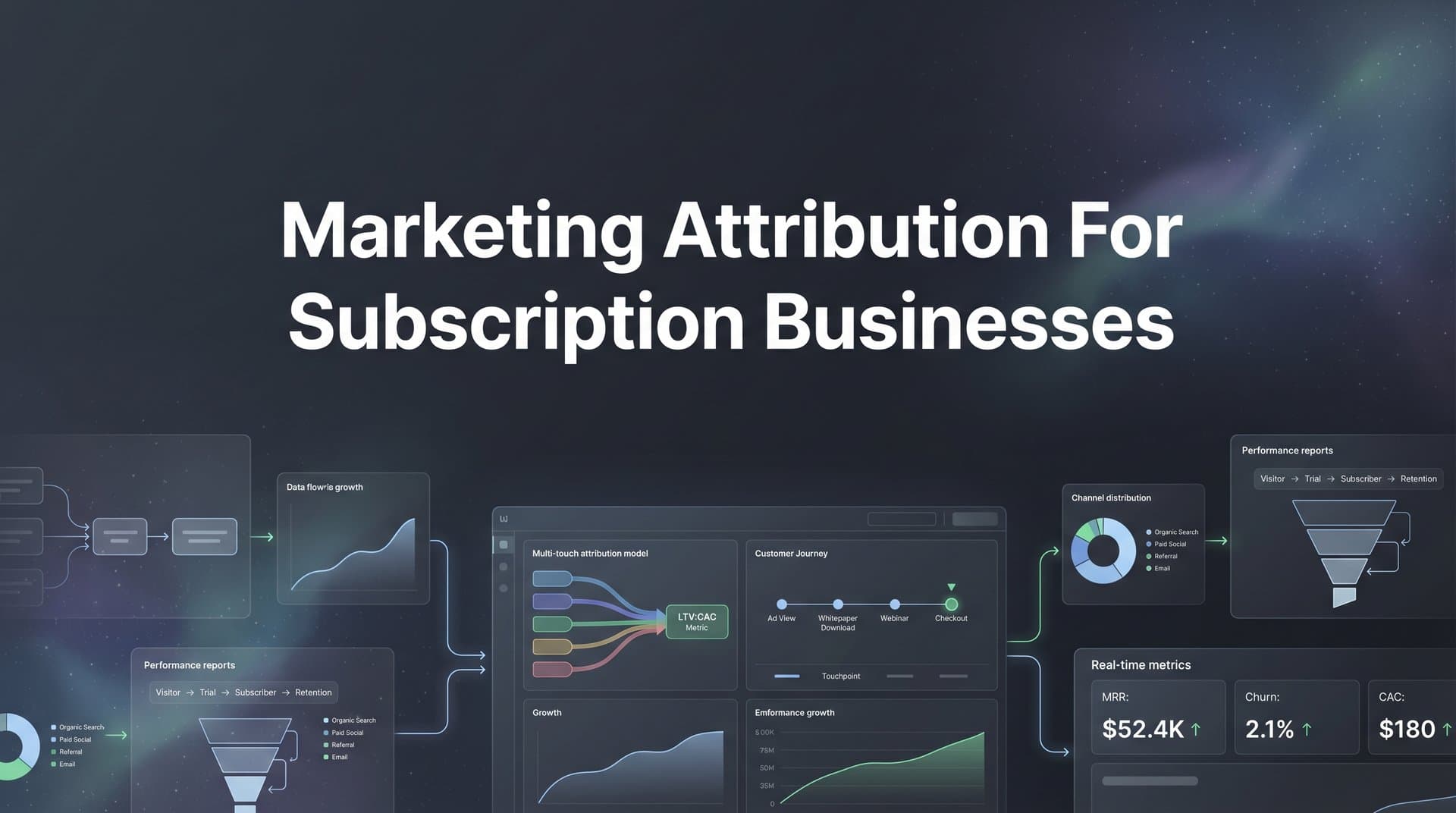
Subscription businesses face a unique attribution challenge: the value of a customer unfolds over months or years, not at a single point of purchase. A subscriber who signs up today might generate revenue for the next three years, making it critical to understand which marketing efforts truly drive long-term value.
Yet most attribution models focus on the initial conversion, missing the bigger picture of lifetime value and retention. They tell you which ad drove the sign-up, but not which ad drove a customer who stayed for 36 months and upgraded twice.
This creates a dangerous blind spot. You might be scaling channels that generate trial sign-ups but terrible retention, while underfunding channels that attract subscribers who stick around and grow their spend over time.
The strategies below are specifically designed for subscription models, helping you connect your marketing spend to recurring revenue and make smarter decisions about where to invest your budget. Each approach addresses a specific gap in traditional attribution, building toward a complete view of what actually drives sustainable growth.
1. Track the Full Subscriber Journey, Not Just Sign-Ups
The Challenge It Solves
Most attribution stops at the conversion event. For subscription businesses, that's like judging a movie by its opening scene. The real story unfolds over time: trial activations, first payments, renewals, upgrades, and eventually either churn or long-term loyalty.
When you only track the initial sign-up, you're measuring marketing effectiveness based on incomplete data. A channel might excel at driving trials but fail to attract subscribers who actually convert to paid plans or stick around past the first billing cycle.
The Strategy Explained
Implement tracking that follows subscribers through every meaningful milestone in their lifecycle. This means connecting your attribution platform to both your ad data and your subscription management system, creating a continuous thread from first touchpoint through renewal cycles.
The key is treating each lifecycle event as an attribution data point. When someone moves from trial to paid, that's valuable signal about which marketing sources drive actual revenue. When they renew after six months, that tells you which channels attract sticky customers. When they upgrade to a higher tier, you learn which sources bring growth-oriented subscribers. Implementing robust attribution tracking for subscription business models is essential for capturing these insights.
This complete journey view reveals patterns invisible in conversion-only tracking. You might discover that Instagram ads drive twice as many trials as LinkedIn, but LinkedIn subscribers convert to paid at three times the rate and stay twice as long.
Implementation Steps
1. Connect your attribution platform to your subscription billing system so lifecycle events flow into your marketing data alongside conversion events.
2. Define the key milestones that matter for your business model: trial start, first payment, first renewal, upgrade events, and churn.
3. Set up tracking for each milestone that captures the original marketing source and all touchpoints in between, creating a complete timeline for every subscriber.
Pro Tips
Focus on events that represent real business value, not vanity metrics. A trial activation matters more than an email open. A renewal matters more than a login. Build your tracking around the moments that actually impact revenue, and you'll get attribution data that drives better decisions.
2. Attribute Revenue to Lifetime Value, Not First Payment
The Challenge It Solves
Traditional attribution assigns revenue value at the point of conversion. For a subscription business, this dramatically undervalues long-term customers and creates misleading ROI calculations. A channel that drives customers worth $2,000 over three years looks identical to one driving customers who churn after the first month if you're only measuring initial conversion value.
This leads to budget allocation based on incomplete economics. You might cut spending on channels that drive your best customers simply because their LTV takes time to materialize.
The Strategy Explained
Shift your attribution focus from conversion value to projected or actual lifetime value. Instead of crediting a marketing touchpoint with the $50 initial subscription fee, credit it with the $600 you expect that customer to generate over their predicted lifetime with your business.
This approach requires calculating LTV either through cohort analysis of existing customers or through predictive modeling based on early engagement signals. The goal is to understand, as early as possible, which marketing sources drive subscribers with the highest long-term value. Platforms focused on marketing attribution platforms revenue tracking can help automate this process.
Many subscription businesses find significant variation in LTV across acquisition channels. Organic search might drive subscribers who stay twice as long as paid social subscribers. Content marketing might attract customers who upgrade at higher rates than display advertising customers.
Implementation Steps
1. Calculate actual LTV for existing customer cohorts segmented by acquisition source, giving you historical benchmarks for different channels.
2. Build a predictive LTV model using early signals like trial engagement, time to first payment, and initial plan selection to estimate lifetime value sooner.
3. Feed LTV data back into your attribution reporting so every marketing touchpoint is credited with projected lifetime value rather than just initial conversion value.
Pro Tips
Start with cohort analysis of customers acquired 12-24 months ago. This gives you real retention and revenue data to inform your LTV calculations. As you build confidence in your models, you can shift toward predictive LTV for newer customers, allowing faster optimization while maintaining accuracy.
3. Use Multi-Touch Attribution to Credit the Full Funnel
The Challenge It Solves
Subscription purchase decisions rarely happen in a single session. A buyer might see your Facebook ad, visit your site, leave, read a comparison article, come back through organic search, watch a demo video, and finally convert through a retargeting ad days or weeks later.
Last-click attribution credits only that final retargeting ad, ignoring the Facebook ad that created awareness and the organic content that built trust. This misrepresents how your marketing actually works and leads to underfunding top-of-funnel activities that play crucial roles in the journey.
The Strategy Explained
Multi-touch attribution distributes credit across all the touchpoints involved in a conversion, recognizing that subscription purchases involve multiple interactions across different channels and timeframes. Different models weight touchpoints differently based on their position in the journey. Our multi-touch marketing attribution platform complete guide breaks down these models in detail.
For subscription businesses, time-decay models often work well because they give more credit to recent touchpoints while still acknowledging earlier awareness-building interactions. Position-based models that emphasize both first and last touch can also be effective, recognizing that initial discovery and final conversion moments both matter.
The key insight is that different channels play different roles. Brand awareness channels like display advertising or social media might rarely be the last click, but they start journeys that eventually convert. Attribution should reflect this reality.
Implementation Steps
1. Ensure your tracking captures all touchpoints across the customer journey, not just the final conversion source, using server-side tracking for accuracy.
2. Test different attribution models with your historical data to see which one best reflects your actual sales process and provides actionable insights.
3. Implement your chosen model and compare results across channels, looking specifically for top-of-funnel activities that contribute to conversions but might be undervalued in last-click reporting.
Pro Tips
Run attribution reports side by side with different models to understand how your channel mix looks under each approach. This comparison often reveals channels that are significantly undervalued in last-click attribution but play important roles in your actual conversion paths.
4. Segment Attribution by Subscription Tier and Plan Type
The Challenge It Solves
Not all subscriptions are created equal. A customer on your enterprise annual plan is worth dramatically more than someone on your basic monthly plan, yet aggregate attribution treats them the same. This masks critical differences in which channels attract your most valuable subscribers.
When you look at attribution without segmentation, a channel might appear to perform well overall while actually driving mostly low-tier subscribers. Meanwhile, a channel that drives fewer conversions but attracts enterprise customers gets undervalued.
The Strategy Explained
Segment your attribution analysis by subscription tier, plan type, and billing frequency. This reveals which marketing channels and campaigns attract different customer segments, allowing you to optimize for the subscribers you actually want.
The analysis often reveals clear patterns. LinkedIn advertising might drive fewer total conversions than Facebook but attract significantly more annual plan subscribers. Content marketing might excel at bringing in customers who start with basic plans but upgrade over time. Paid search might be your best source for enterprise-tier direct sign-ups. Leveraging marketing analytics for subscription businesses helps uncover these valuable patterns.
Understanding these patterns lets you allocate budget based on subscriber quality, not just quantity. You can increase investment in channels that drive high-value tiers and adjust targeting or messaging for channels that underperform with your premium offerings.
Implementation Steps
1. Add subscription tier and plan type as dimensions in your attribution reporting, ensuring every conversion is tagged with the specific plan the customer selected.
2. Analyze conversion rates and average plan value by marketing source, identifying channels that over-index for your most valuable subscription tiers.
3. Create separate campaigns or audience segments optimized specifically for attracting higher-tier subscribers, using insights from your attribution analysis to inform targeting and creative.
Pro Tips
Look beyond initial plan selection to upgrade patterns. Some channels might drive customers who start on basic plans but upgrade frequently, making their long-term value higher than it initially appears. Include upgrade behavior in your segmentation analysis for a complete picture.
5. Feed Enriched Conversion Data Back to Ad Platforms
The Challenge It Solves
Ad platform algorithms optimize toward the conversion signals you send them. If you only send basic conversion events, they optimize for volume. They can't distinguish between a subscriber who will churn in 30 days and one who will stay for three years because they don't have that information.
This creates a fundamental misalignment between what the algorithms optimize for and what you actually want. You need subscribers who stick around and generate recurring revenue, but the platforms are optimizing for anyone who completes a sign-up form.
The Strategy Explained
Send enriched conversion data back to your ad platforms that includes quality signals like trial-to-paid conversion, early engagement metrics, and predicted lifetime value. This gives platform algorithms the information they need to optimize for subscriber quality, not just conversion volume.
Modern ad platforms can accept value-based conversion events where you specify the worth of each conversion. For subscription businesses, this means sending predicted LTV as the conversion value rather than just the initial subscription price. The algorithm then learns to find more people who look like your high-LTV subscribers. A marketing attribution platform with AI capabilities can automate this data enrichment process.
You can also send delayed conversion events when subscribers hit meaningful milestones like their first renewal or an upgrade. This feedback loop helps platforms understand which initial conversions led to valuable long-term customers, improving their targeting over time.
Implementation Steps
1. Set up server-side conversion tracking that can send enriched event data to ad platforms, bypassing browser-based tracking limitations and ensuring accuracy.
2. Configure conversion events to include predicted LTV or actual revenue value rather than fixed conversion values, giving algorithms better optimization signals.
3. Implement delayed conversion events for key milestones like first renewal or upgrade, creating a feedback loop that teaches platforms which conversions lead to retention.
Pro Tips
Platforms like Meta and Google can optimize better when they receive conversion data within seven days of the ad click. For subscription businesses, this means using predicted LTV for initial optimization rather than waiting for actual retention data. As subscribers mature, you can send updated values to refine the platform's understanding.
6. Measure Trial-to-Paid Conversion by Marketing Source
The Challenge It Solves
Many subscription businesses offer free trials to reduce friction and let potential customers experience the product. This creates a critical gap in attribution: the marketing source that drove the trial might not be the same quality as one that drives actual paying subscribers.
A channel might excel at generating trial sign-ups through aggressive messaging or broad targeting, but those trial users never convert to paid subscriptions. Meanwhile, another channel drives fewer trials but much higher trial-to-paid conversion rates. Standard attribution that only tracks trial starts misses this entirely.
The Strategy Explained
Track trial-to-paid conversion rates as a core attribution metric, segmented by marketing source. This reveals which channels drive engaged prospects versus tire-kickers, allowing you to optimize for actual revenue rather than vanity metrics.
The analysis often uncovers significant variation. Channels with highly targeted messaging and qualified audiences typically show higher trial-to-paid conversion. Broader awareness channels might drive more total trials but lower conversion rates. Understanding this lets you set appropriate expectations and budgets for different channel types. SaaS companies in particular benefit from specialized marketing attribution software for SaaS that handles these nuances.
This metric becomes especially powerful when combined with LTV analysis. A channel might have moderate trial-to-paid conversion but the subscribers who do convert become your longest-tenured customers. That's valuable information that trial volume alone would never reveal.
Implementation Steps
1. Set up tracking that connects trial sign-ups to their first payment event, preserving the original marketing source attribution through the conversion.
2. Calculate trial-to-paid conversion rates for each marketing channel, identifying sources that over-perform or under-perform relative to your average.
3. Adjust your channel strategy based on these insights, potentially tightening targeting for channels with low conversion rates or increasing investment in channels that drive high-converting trial users.
Pro Tips
Look at time-to-conversion within the trial period. Some channels might drive users who convert quickly, while others bring prospects who need the full trial period to decide. This timing insight can inform your trial length strategy and follow-up communication for different acquisition sources.
7. Connect Churn Data to Original Acquisition Channels
The Challenge It Solves
Most attribution analysis stops after conversion or perhaps first renewal. But churn patterns reveal the ultimate truth about channel quality. A marketing source might drive subscribers who look great initially but churn at twice your average rate six months in.
Without connecting churn back to acquisition sources, you keep investing in channels that bring temporary subscribers rather than long-term customers. You're optimizing for the wrong outcome because you're not measuring the complete story.
The Strategy Explained
Link subscriber churn events back to the original marketing sources that acquired them, creating a complete view of channel performance from acquisition through the full customer lifecycle. This reveals true channel quality and identifies sources that drive low-retention customers.
The analysis typically shows clear patterns. Some channels consistently drive subscribers with below-average retention, often because their messaging or targeting attracts people who aren't ideal fits for your product. Other channels bring subscribers who stick around significantly longer than average, making them more valuable even if their initial conversion costs are higher. Choosing the right tools from the best marketing attribution platforms available ensures you can track these long-term patterns effectively.
This long-term view fundamentally changes budget allocation decisions. A channel with high acquisition costs but low churn might deliver better ROI than a cheap channel that drives subscribers who leave quickly. You can't know this without connecting churn to acquisition source.
Implementation Steps
1. Ensure your attribution system preserves original acquisition source data throughout the customer lifecycle, not just at conversion, so you can analyze retention by channel months or years later.
2. Create cohort retention reports segmented by acquisition channel, tracking how long subscribers from different sources stay with your business over time.
3. Calculate customer lifetime value by acquisition source using actual retention data, then compare this to your acquisition costs to identify your most profitable channels.
Pro Tips
Pay attention to cohort age when analyzing churn patterns. Recent cohorts haven't had time to show their full retention curves, so focus your analysis on subscribers acquired at least 6-12 months ago for meaningful insights. As newer cohorts mature, watch for changes in retention patterns that might signal shifts in channel quality.
Putting It All Together: Your Subscription Attribution Roadmap
Start by ensuring complete touchpoint tracking across your subscriber journey. This foundation makes everything else possible. Without accurate tracking from first ad click through renewals and churn, the other strategies can't deliver reliable insights.
Next, shift your attribution focus from initial conversions to lifetime value metrics. This reframes how you think about channel performance and reveals which sources drive your most valuable subscribers. Implement multi-touch attribution that reflects your actual sales cycle, recognizing that subscription purchases involve multiple touchpoints across different channels.
Segment your analysis by plan type and subscription tier. This shows you which channels attract different customer segments, allowing you to optimize for the subscribers you actually want rather than just maximizing conversion volume.
Close the loop by feeding enriched data back to your ad platforms. When you send LTV signals and retention data to platform algorithms, they can optimize for subscriber quality instead of just conversion volume. This creates a virtuous cycle where your campaigns get better at finding valuable customers over time.
Finally, connect churn patterns to acquisition sources and measure trial-to-paid conversion by channel. These metrics reveal the complete truth about channel quality, showing you which sources drive subscribers who actually stick around and generate recurring revenue.
These strategies work together to give subscription businesses the clarity needed to scale marketing spend with confidence. You'll know not just which channels drive conversions, but which ones drive the subscribers who power sustainable growth.
Ready to elevate your marketing game with precision and confidence? Discover how Cometly's AI-driven recommendations can transform your ad strategy. Get your free demo today and start capturing every touchpoint to maximize your conversions.


