
You're running campaigns across Google Ads, Meta, LinkedIn, and email. Your monthly ad spend is climbing steadily. But when your CEO asks which channels are actually driving revenue, you freeze. Google Analytics shows one set of numbers. Meta claims credit for conversions that LinkedIn also reports. Your CRM tells yet another story. You're spending serious money without knowing what's working.
This isn't just frustrating—it's expensive. Without clear attribution, you're flying blind, potentially pouring budget into channels that look good on paper but don't actually close deals. Meanwhile, the channels quietly driving your best customers might be starving for investment.
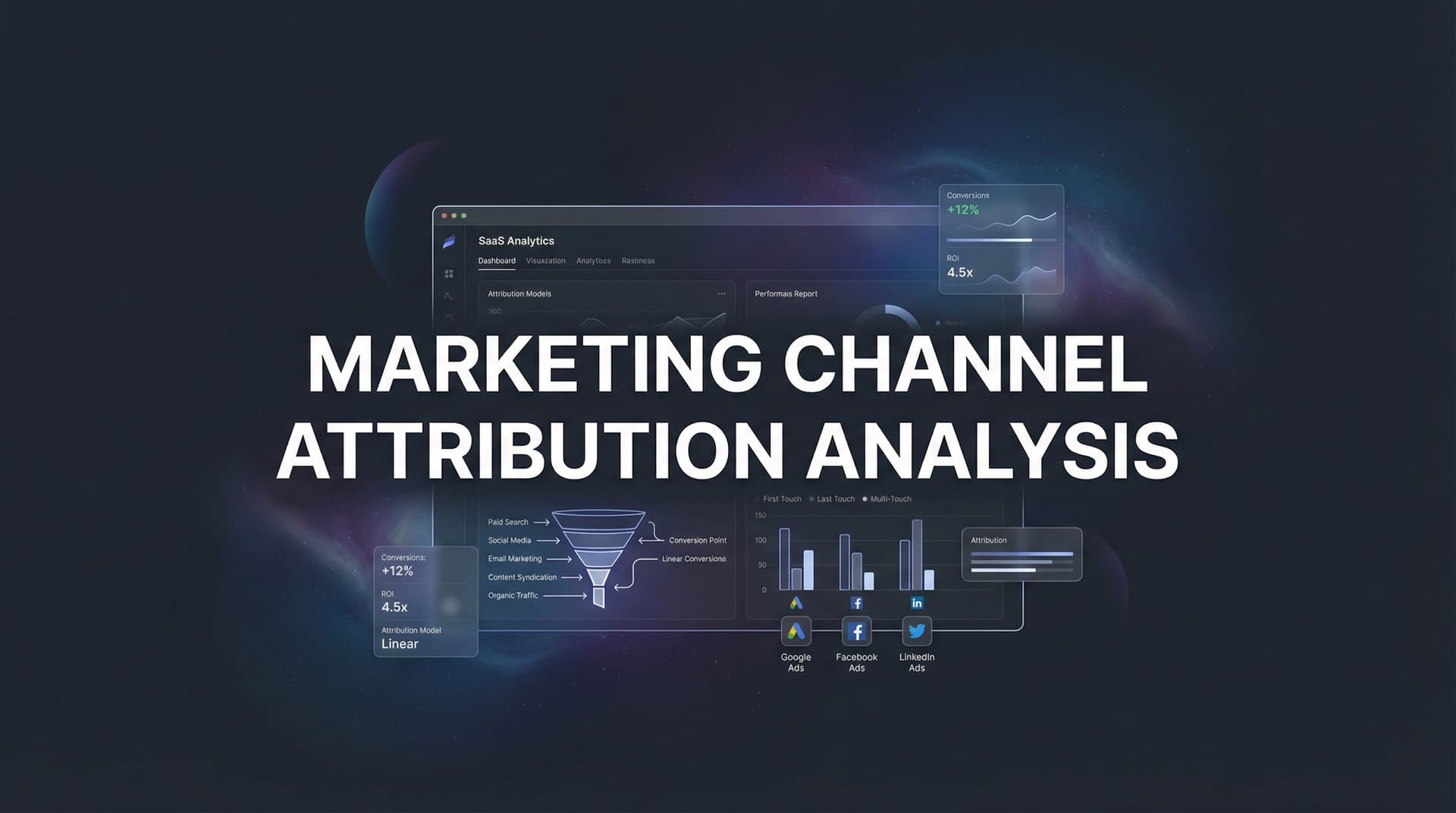
Marketing channel attribution analysis solves this puzzle. It's the systematic process of identifying which marketing channels genuinely contribute to conversions and revenue, revealing the true impact of each touchpoint in your customer journey. This guide will show you how to implement attribution analysis that connects every dollar spent to actual business outcomes, so you can confidently scale what works and cut what doesn't.
The Hidden Revenue Story Your Channels Are Telling
Marketing channel attribution analysis is the process of assigning credit to the various marketing touchpoints that influence a customer's path to conversion. Think of it as detective work for your marketing budget—tracking every interaction a prospect has with your brand and determining which channels deserve credit for the final sale.
Here's why this matters more than you might think. Traditional last-click attribution—where the final touchpoint before conversion gets all the credit—creates a dangerously incomplete picture. A customer might discover your brand through a LinkedIn ad, research your solution via organic search, read comparison content from an email campaign, and finally convert through a branded Google search. Last-click attribution gives Google 100% of the credit, completely ignoring the LinkedIn ad and email that made the conversion possible.
This happens constantly. Modern B2B buyers interact with an average of multiple channels before making a purchase decision. Your SaaS prospect might see your display ad on Monday, click a retargeting ad on Wednesday, receive a nurture email on Friday, and convert the following Tuesday through direct traffic. Without proper attribution, you'd credit that Tuesday direct visit while missing the entire journey that led there.
The gap between vanity metrics and revenue-connected data makes this even more problematic. Impressions look impressive in reports. Click-through rates feel actionable. But neither tells you whether those clicks turned into paying customers. A channel might generate thousands of clicks with zero conversions, while another produces fewer clicks but consistently closes high-value deals.
Consider the difference: Your Facebook campaign shows 50,000 impressions and 2,000 clicks this month. Impressive numbers for a board presentation. But attribution analysis reveals that only 3 of those clicks ever converted, and the average deal value was below your target. Meanwhile, your modest LinkedIn campaign with just 500 clicks drove 12 conversions worth 5x more revenue per customer. Without attribution connecting clicks to revenue, you might double down on Facebook while starving your best-performing channel.
This is where attribution analysis transforms from nice-to-have to business-critical. It reveals which channels are actually driving revenue, not just activity. You stop optimizing for clicks and start optimizing for customers. You discover that your "expensive" LinkedIn ads have a 10x better ROI than your "efficient" display campaigns. You realize your email sequences don't close deals alone, but they're essential assists that make your paid search more effective.
Attribution Models Explained: Choosing Your Lens
Attribution models are the frameworks that determine how credit gets distributed across your marketing touchpoints. Choosing the right model is like choosing the right lens for a camera—it changes what you see and what you miss.
Single-touch attribution models assign 100% of the credit to one touchpoint. First-click attribution credits the initial interaction that brought a prospect into your ecosystem. If someone discovered you through a LinkedIn ad, that ad gets full credit regardless of what happened next. This model works well when you're primarily focused on top-of-funnel performance and lead generation. It answers the question: "Where are our customers coming from?"
Last-click attribution does the opposite—it gives all credit to the final touchpoint before conversion. If a customer converts through branded search, that search gets 100% credit. This model makes sense for direct-response campaigns where the buying decision happens quickly, or when you're specifically measuring bottom-of-funnel conversion efficiency. But it systematically undervalues every channel that builds awareness and consideration.
The limitation of single-touch models becomes obvious with complex buying journeys. Your enterprise software customer doesn't see one ad and buy. They discover you through content, engage with multiple campaigns, attend a webinar, download resources, and finally request a demo. Giving all credit to either the first or last touchpoint ignores the reality of how they actually decided to buy.
Multi-touch attribution models distribute credit across multiple touchpoints, acknowledging that conversions result from accumulated influence. Linear attribution splits credit equally among all interactions. If a customer touched five channels before converting, each gets 20% credit. This model is straightforward and gives every touchpoint recognition, but it treats a brief ad impression the same as a detailed product demo—which rarely reflects reality.
Time-decay attribution gives more credit to touchpoints closer to the conversion. The logic is sound: interactions that happen right before someone buys probably influenced the decision more than something they saw weeks ago. This model works well for sales cycles where momentum builds toward a decision, but it can undervalue early-stage awareness efforts that plant the seed.
Position-based attribution (also called U-shaped) assigns 40% credit to the first touchpoint, 40% to the last, and splits the remaining 20% among middle interactions. This model recognizes that both discovery and closing moments matter most. It's particularly useful for B2B companies where initial awareness and final decision points are clearly valuable, while middle touches provide supporting influence.
Then there's data-driven attribution, which uses machine learning to analyze your actual conversion patterns and dynamically assign credit based on what the data reveals. Instead of applying predetermined rules, AI examines thousands of customer journeys to identify which touchpoint combinations actually lead to conversions. If your data shows that customers who see both LinkedIn ads and email campaigns convert at 3x the rate of those who see just one, the model weights those channels accordingly.
Data-driven models adapt to your specific business reality rather than forcing your data into generic frameworks. They can reveal surprising patterns—maybe your podcast sponsorships don't directly drive conversions, but they dramatically increase conversion rates when combined with retargeting. Or perhaps your webinars are powerful closers but weak awareness drivers. These insights only emerge when you let the data speak instead of imposing predetermined rules. Understanding marketing channel attribution modeling helps you select the approach that best fits your business.
The right model depends on your business context. Short sales cycles with clear conversion paths might work fine with last-click. Complex B2B sales with long consideration periods need multi-touch models. Growing companies with substantial data should explore data-driven attribution to uncover hidden patterns. The key is matching your model to your customer journey, not just picking what sounds sophisticated.
Building Your Attribution Analysis Framework
Effective attribution analysis requires solid infrastructure before you can generate any insights. You're essentially building a data pipeline that connects every marketing touchpoint to eventual revenue outcomes. Without this foundation, you're just collecting disconnected metrics that can't tell you the complete story.
Start with data integration across your core systems. Your ad platforms (Google Ads, Meta, LinkedIn), your CRM (where deals actually close), and your website tracking need to speak the same language. When someone clicks your Facebook ad, that interaction must connect to their eventual form submission, which must link to the opportunity in your CRM, which must tie to the closed deal. Break any link in this chain and you lose attribution visibility.
This is harder than it sounds because each platform operates in its own silo. Google Ads tracks clicks and conversions on its own. Meta has its pixel. LinkedIn has its Insight Tag. Your CRM knows about deals but not which ads drove them. Your analytics platform sees website behavior but can't connect it to ad spend. You need a unified system that stitches these fragments into complete customer journeys.
Server-side tracking has become essential for attribution accuracy, especially with the iOS privacy changes and cookie restrictions reshaping digital marketing. Browser-based pixels and cookies—the traditional tracking methods—are increasingly blocked or limited. iOS users can opt out of tracking. Browsers are restricting third-party cookies. Ad blockers eliminate pixels entirely. The result? Significant gaps in your attribution data if you rely solely on client-side tracking.
Server-side tracking solves this by capturing data on your server before sending it to ad platforms and analytics tools. When someone converts on your website, your server records the event and sends that information directly to Google, Meta, and your analytics platform. This bypasses browser restrictions, captures more complete data, and gives you a reliable source of truth that isn't dependent on what a user's browser allows.
The accuracy difference is substantial. Many companies running only pixel-based tracking are missing 20-40% of their conversions due to iOS restrictions and ad blockers. Server-side tracking recovers most of that lost visibility, giving you a more complete picture of which channels are actually performing. It also feeds better data back to ad platform algorithms, improving their targeting and optimization. Implementing proper attribution marketing tracking ensures you capture every meaningful touchpoint.
Consistent UTM parameter conventions are your attribution taxonomy—the naming system that lets you categorize and analyze traffic sources. Every link in every campaign should include UTM tags that identify the source (which platform), medium (type of traffic), campaign name, and specific creative or placement. Without consistent UTM tagging, traffic shows up as generic referrals that you can't attribute properly.
Create a UTM naming convention and enforce it religiously across your team. Decide whether you'll use underscores or hyphens, how you'll name campaigns, and what level of detail you need. The key is consistency—if one person tags Facebook ads as "facebook" and another uses "meta" and a third uses "fb," you've fragmented your data and made analysis nearly impossible.
Beyond UTM tags, you need event tracking that captures meaningful actions throughout the customer journey. Form submissions, demo requests, content downloads, webinar registrations, trial signups—every conversion event needs to be tracked and connected to the traffic source. These events become the touchpoints in your attribution analysis, the data points that reveal which channels influenced the path to revenue.
Finally, establish a clear definition of what counts as a conversion and how you'll track revenue attribution. Is a demo request a conversion? A trial signup? Only closed deals? Different stages matter for different analyses, but you need clarity on what you're measuring. And for true attribution analysis, you must connect conversions to actual revenue—not just lead volume, but deal value and customer lifetime value.
Reading the Data: Turning Attribution Insights Into Action
Raw attribution data is useless until you extract actionable insights from it. The goal isn't just to know which channels touched your customers—it's to make better budget allocation decisions that improve your marketing ROI. Here's how to read your attribution data and translate it into strategic action.
Start by identifying your high-performing channels that deserve increased investment. Look beyond surface-level metrics to revenue contribution. A channel that generates fewer leads but consistently closes high-value deals is more valuable than one that floods your pipeline with unqualified prospects. Calculate cost per acquisition and customer lifetime value by channel to see true performance.
For example, your attribution analysis might reveal that LinkedIn drives only 15% of your total leads but accounts for 40% of your revenue. The cost per lead is higher than other channels, but the deal values are 3x larger and close rates are double. This is a clear signal to shift budget toward LinkedIn, even though the efficiency metrics look worse at the lead level. Marketing revenue attribution reveals the truth that lead-level metrics hide.
Look for channels with strong assist rates even if they don't get last-click credit. A channel might rarely be the final touchpoint but consistently appear early in high-value customer journeys. Your content marketing might not close deals directly, but attribution analysis shows that 70% of your best customers engaged with your content before converting through other channels. That's valuable insight—content is an essential supporting player that deserves continued investment even without direct conversion credit.
On the flip side, identify underperforming channels and diagnose whether they need optimization or elimination. Low performance might mean the channel is wrong for your audience, or it might mean your messaging and targeting need work. Attribution data helps you distinguish between these scenarios.
If a channel shows lots of clicks but no conversions, that's a messaging or landing page problem—people are interested enough to click but not convinced enough to convert. If a channel shows low engagement across the entire funnel, it might be the wrong audience entirely. Attribution reveals these patterns so you can make informed decisions about whether to fix, pivot, or cut.
Analyze the full funnel to understand which channels drive awareness versus which close deals. Some channels excel at top-of-funnel discovery—they introduce new prospects to your brand and start relationships. Others are bottom-of-funnel closers that convert prospects who are already aware and considering. Both roles are valuable, but they require different optimization strategies and budget approaches. A thorough marketing funnel attribution analysis helps you understand each channel's role in your conversion path.
Your display advertising might be a poor last-click performer but an excellent awareness driver that feeds your retargeting and search campaigns. Attribution analysis reveals this by showing that prospects who see display ads convert at higher rates through other channels later. Without multi-touch attribution, you might cut display for poor direct ROI, not realizing it's an essential first step in your most profitable customer journeys.
Compare your attribution model results to understand how different perspectives change your conclusions. Run the same data through last-click, first-click, and multi-touch models to see how credit shifts. This comparison often reveals biases in your current thinking and highlights channels you've been systematically over-valuing or under-valuing.
If last-click gives your branded search 60% credit but multi-touch attribution drops it to 25%, that's a wake-up call. Your branded search isn't creating demand—it's capturing demand that other channels created. The channels building that demand deserve recognition and budget. This kind of insight only emerges when you compare multiple attribution lenses.
Look for patterns in your highest-value customer journeys. Which channel combinations consistently lead to your best deals? Maybe customers who engage with both your email campaigns and attend webinars convert at 5x the rate of those who only touch one channel. That's actionable insight—you should create campaigns that deliberately move prospects through both touchpoints rather than treating them as separate initiatives.
Common Attribution Pitfalls and How to Avoid Them
Even with solid infrastructure, attribution analysis can lead you astray if you fall into common traps. Understanding these pitfalls helps you interpret your data more accurately and make better decisions.
Cross-device tracking gaps create significant blind spots in attribution. A prospect might see your ad on their phone during their commute, research on their tablet at home, and convert on their work laptop. Without cross-device tracking, these look like three different people, and you lose the connected journey that led to conversion. The mobile ad gets no credit even though it started the entire process.
While perfect cross-device tracking remains challenging, you can minimize blind spots by using login-based tracking where possible and implementing probabilistic matching that uses signals like IP addresses and behavioral patterns to connect likely related sessions. Server-side tracking also helps by capturing more complete data that isn't limited by browser-level restrictions.
Siloed platform reporting leads to systematic over-counting of conversions. Google Ads claims credit for conversions. So does Meta. LinkedIn reports conversions too. When you add up each platform's reported conversions, you get 150% of your actual conversions because they're all claiming credit for the same customers. Each platform uses last-click attribution within its own ecosystem, creating inflated and overlapping claims.
This is why you need a unified attribution system that sits above your individual platforms. Instead of believing each platform's self-reported numbers, you need a single source of truth that tracks actual customer journeys and distributes credit based on real multi-channel attribution in digital marketing. This reveals the true contribution of each channel rather than accepting each platform's biased self-assessment.
Incomplete data windows distort your attribution analysis when you don't account for your full sales cycle. If your average customer takes 45 days to convert but you're analyzing attribution on a 30-day window, you're systematically undercounting the impact of early-stage touchpoints. Channels that drive awareness look ineffective because you're not waiting long enough to see the conversions they influence.
Set your attribution window to match or exceed your average sales cycle. For B2B companies with 60-90 day sales cycles, you need attribution windows of at least that length to capture the full journey. Shorter windows might work for e-commerce with quick purchase decisions, but they'll break attribution analysis for complex sales.
Another common mistake is treating all conversions equally when they have vastly different values. A $500 customer and a $50,000 customer both count as one conversion, but they're not equivalent. Attribution analysis that doesn't weight by revenue value will lead you to optimize for volume instead of value. You might scale a channel that drives lots of small deals while neglecting one that drives fewer but much larger customers.
Always analyze attribution with revenue weighting, not just conversion counting. This reveals which channels drive your most valuable customers, not just the most customers. The insight changes your strategy—suddenly that "expensive" channel with fewer conversions looks brilliant when you see it drives your highest-value deals. Understanding the common attribution challenges in marketing analytics helps you avoid these costly mistakes.
Putting Attribution Analysis Into Practice
Marketing channel attribution analysis transforms how you allocate budget and measure success. Instead of relying on gut feelings or last-click metrics that systematically misrepresent channel value, you gain clear visibility into which marketing investments actually drive revenue.
The implementation path is straightforward: connect your data sources to create unified customer journey tracking, implement server-side tracking for accuracy despite privacy restrictions, establish consistent UTM conventions and event tracking, choose attribution models that match your sales complexity, and analyze the resulting insights to optimize your channel mix.
Start with the basics if you're new to attribution. Get your tracking infrastructure solid first—clean data beats sophisticated models built on incomplete information. Implement server-side tracking to recover the visibility you're losing to iOS restrictions and cookie limitations. Establish UTM conventions that your team actually follows. These foundations enable everything else.
As your attribution capabilities mature, progress toward multi-touch models that reveal the full customer journey. Single-touch attribution is better than nothing, but it will consistently mislead you about channel value. Multi-channel marketing attribution shows you the complete picture—which channels create awareness, which build consideration, and which close deals. This visibility lets you optimize each stage instead of just the final click.
The competitive advantage of proper attribution is substantial. While your competitors guess which channels work, you know. While they over-invest in last-click winners that capture demand created by other channels, you fund the full journey that actually creates customers. While they cut budgets from channels that look ineffective in isolation, you recognize essential assists that make your closers more effective.
Attribution analysis also enables much smarter testing and optimization. Instead of testing changes and measuring only immediate conversion impact, you can see how changes affect the entire funnel. A new top-of-funnel campaign might not show immediate ROI, but attribution reveals it's feeding higher-quality prospects to your bottom-funnel channels and improving their performance. Without attribution, you'd kill the campaign for poor direct returns, not realizing it's improving your overall marketing efficiency.
The marketing landscape will only get more complex. More channels, more touchpoints, longer consideration periods, and increasing privacy restrictions that make tracking harder. Attribution analysis isn't optional anymore—it's how you maintain visibility and control in an increasingly fragmented customer journey. Companies that master attribution will systematically outperform those flying blind on last-click metrics and platform-reported numbers. Selecting the right marketing channel attribution solution is critical to staying competitive.
Moving Forward With Clear Attribution
Marketing channel attribution analysis transforms your marketing from a cost center you hope works into a measurable revenue driver you can optimize with confidence. Every dollar you spend connects to actual business outcomes. Every channel decision is backed by data showing true contribution, not just last-click vanity metrics.
The difference between attribution-driven marketing and guesswork compounds over time. Each budget cycle, you shift more resources toward channels that actually drive revenue and away from those that just look good on surface metrics. Each optimization is informed by complete customer journey data rather than fragmented platform reports. Each strategic decision is grounded in evidence of what actually converts your best customers.
Start with proper tracking infrastructure—server-side implementation, consistent UTM conventions, and unified data that connects ad clicks to closed revenue. Progress toward multi-touch attribution models that reveal the complete journey, not just the final touchpoint. Let data-driven AI models uncover patterns in your specific customer behavior rather than forcing generic rules onto your unique business.
The path forward is clear: stop guessing which channels work and start knowing. Stop accepting each platform's biased self-reporting and start measuring true cross-channel contribution. Stop optimizing for clicks and impressions and start optimizing for revenue. Attribution analysis makes all of this possible.
Ready to elevate your marketing game with precision and confidence? Discover how Cometly's AI-driven recommendations can transform your ad strategy—Get your free demo today and start capturing every touchpoint to maximize your conversions.