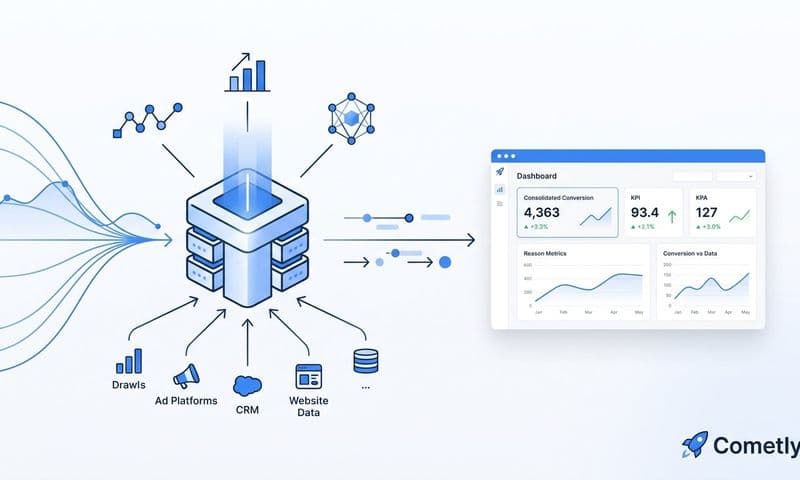

When your ad data lives in Google Ads, your revenue data lives in Stripe, and your pipeline data lives in your CRM, you are not running a marketing operation. You are managing a data fragmentation problem. Every disconnected system creates a gap between what you spend and what you actually know about results.
Marketing data consolidation tools solve this by pulling every source into a single, unified view so your team can make decisions based on complete information rather than partial signals. This guide covers the nine best tools available in 2026, evaluated on their ability to unify ad spend, conversion events, CRM data, and revenue into one place.
Whether you are a B2B SaaS growth team trying to connect pipeline to paid campaigns, or a marketing leader tired of reconciling spreadsheets across platforms, this list will help you find the right fit. Tools are selected based on depth of integrations, attribution capabilities, data accuracy, and how well they serve modern marketing and revenue teams.
1. Cometly
Best for: B2B SaaS teams that need full-funnel attribution from first ad click to closed-won revenue.
Cometly is a marketing attribution and analytics platform built specifically for B2B SaaS companies, connecting ad platforms, CRM data, and revenue into a single source of truth.
 9 Best Attribution Platforms for Agencies in 2026
Where This Tool Shines
Most attribution tools stop at the lead. Cometly keeps going. It connects your paid campaigns directly to pipeline stages and closed revenue, so you can see which ad, which channel, and which audience actually generated deals, not just clicks or form fills.
The Stripe integration is a standout feature for SaaS teams. Instead of manually reconciling subscription revenue with ad spend, Cometly pulls that data together automatically. Pair that with server-side conversion tracking and Conversion API support, and you get attribution that holds up even as browser-side tracking becomes less reliable.
Key Features
Multi-Touch Attribution: Tracks and credits every touchpoint across all paid channels using multiple attribution models, giving you flexibility to analyze the full customer journey.
Server-Side Tracking and Conversion API: Captures conversion events server-side, reducing data loss from ad blockers and browser restrictions while sending enriched signals back to Meta, Google, and other ad platforms.
Stripe Revenue Integration: Connects subscription and payment data from Stripe directly to ad spend, so you can measure true revenue return on your campaigns.
AI Ads Manager: Analyzes cross-channel performance and surfaces recommendations for which campaigns to scale, pause, or adjust based on actual revenue impact.
Customer Journey Analytics: Maps the complete path from first impression to closed deal, including pipeline attribution tied to CRM stages.
70+ Native Integrations: Connects with major ad platforms, CRMs, and analytics tools without requiring custom engineering work.
Best For
Cometly is the strongest fit for B2B SaaS marketing and growth teams running paid campaigns across multiple channels who need to connect ad spend to pipeline and revenue. It is particularly well-suited for teams using Stripe for billing and a CRM like HubSpot or Salesforce for pipeline management.
Pricing
Paid plans are available with pricing based on usage and team size. Visit cometly.com for current pricing details.
2. Funnel.io
Best for: Marketing teams that need clean, normalized data routed to a BI tool or data warehouse.
Funnel.io is a marketing data collection and harmonization platform with over 500 connectors, designed to normalize raw marketing data before pushing it to downstream reporting tools.
 9 Best Marketing Data Consolidation Tools in 2026
Where This Tool Shines
Funnel.io excels at the messy middle of data consolidation: taking inconsistent naming conventions, mismatched schemas, and raw exports from dozens of ad platforms and turning them into clean, structured data. If your team has ever tried to join a Google Ads report with a Meta Ads report and found that campaign naming, date formats, and metric definitions don't match, Funnel.io is designed to solve exactly that problem.
It is less of an attribution platform and more of a data pipeline tool. The value is in getting reliable, normalized data into BigQuery, Snowflake, or Looker Studio so your analysts can build on a solid foundation rather than fighting data quality issues.
Key Features
500+ Data Connectors: Covers ad platforms, CRMs, analytics tools, and more, making it one of the broadest connector libraries available.
Automated Data Normalization: Applies consistent naming and structure across sources so your downstream reports stay coherent.
Flexible Export Destinations: Routes cleaned data to BigQuery, Snowflake, Looker Studio, and other common BI and warehouse destinations.
Custom Data Mappings: Allows teams to define their own business logic rules for how data should be transformed before export.
Best For
Marketing analysts and data teams at mid-to-large companies who need a reliable data pipeline into a warehouse or BI tool. Less suited for teams looking for out-of-the-box attribution or revenue reporting without additional setup.
Pricing
Starts at several hundred dollars per month, scaling with data volume and number of connectors. Visit funnel.io for current plan details.
3. Supermetrics
Best for: Marketing analysts who want to pull ad platform data into spreadsheets or Looker Studio for flexible reporting.
Supermetrics is a widely used data extraction tool that pulls marketing data from ad platforms into Google Sheets, Excel, Looker Studio, and data warehouses.
 9 Best Marketing Data Consolidation Tools in 2026
Where This Tool Shines
Supermetrics is the go-to tool for marketing analysts who live in spreadsheets. It removes the manual export-and-paste workflow by automating data pulls from Google Ads, Meta, LinkedIn, TikTok, and over 100 other sources directly into the tools analysts already use.
The scheduled refresh feature is particularly useful for recurring reports. Set it up once, and your dashboard or spreadsheet updates automatically on whatever cadence you need. It is not an attribution platform, but as a data extraction layer it is reliable and widely trusted.
Key Features
100+ Source Connectors: Covers Google Ads, Meta, LinkedIn, TikTok, and many other ad and analytics platforms.
Spreadsheet and Studio Integration: Connects directly to Google Sheets, Excel, and Looker Studio for flexible, analyst-friendly reporting.
Data Warehouse Destinations: Supports exports to BigQuery and Snowflake for teams that need warehouse-level storage.
Scheduled Automated Refreshes: Keeps reports current without manual intervention, useful for recurring performance dashboards.
Best For
Marketing analysts and performance marketers who need fast, reliable data extraction into familiar reporting environments. Best used as part of a broader data stack rather than as a standalone analytics solution.
Pricing
Plans start at approximately $29 per month for basic connectors, with higher tiers for warehouse destinations and additional sources. Visit supermetrics.com for current pricing.
4. Triple Whale
Best for: Ecommerce and DTC brands running paid campaigns tied to Shopify revenue.
Triple Whale is an ecommerce-focused analytics platform that consolidates ad data with Shopify revenue using a first-party pixel, providing a unified view of ad spend and sales performance.
 9 Best Marketing Data Consolidation Tools in 2026
Where This Tool Shines
For DTC brands, the core challenge is knowing which ad actually drove the purchase. Triple Whale addresses this with a first-party pixel that tracks on-site behavior and connects it to Shopify order data, giving you a cleaner attribution picture than relying on ad platform self-reported numbers alone.
The creative analytics features are a genuine differentiator. Rather than just reporting on campaigns and ad sets, Triple Whale breaks performance down to the individual creative level, which is exactly what performance marketing teams need when making decisions about what to produce next.
Key Features
First-Party Pixel: Tracks visitor behavior on your site and connects it to purchase data for more accurate conversion attribution.
Shopify Revenue Integration: Pulls order and revenue data directly from Shopify and maps it to ad spend across channels.
Creative Analytics: Breaks down performance at the individual ad creative level, helping teams identify what content is actually driving sales.
Cohort Analysis and LTV Reporting: Tracks customer lifetime value and purchase behavior over time to inform acquisition strategy.
Best For
Ecommerce and DTC brands using Shopify with meaningful paid media budgets. Not well-suited for B2B SaaS teams or businesses with longer sales cycles that extend beyond a single transaction.
Pricing
Pricing scales with Shopify store revenue. Visit triplewhale.com for current plan details.
5. Northbeam
Best for: Performance marketing teams managing significant ad budgets across multiple channels who need statistical modeling alongside attribution.
Northbeam is a media mix modeling and attribution platform that blends first-party data with statistical modeling to support cross-channel budget decisions.
 9 Best Attribution Tools for Facebook Advertisers in 2026
Where This Tool Shines
Northbeam sits at the intersection of traditional attribution and media mix modeling. Rather than relying solely on click-based attribution, it uses statistical lift modeling to estimate channel contribution even when direct tracking is incomplete. This matters increasingly as privacy changes make last-click and even multi-touch attribution harder to rely on.
The budget forecasting and scenario planning features give media buyers a way to model the likely impact of shifting spend between channels before making the change. For teams managing large, complex media budgets, this kind of forward-looking analysis adds real value beyond historical reporting.
Key Features
Media Mix Modeling: Applies statistical modeling to estimate channel contribution alongside traditional attribution methods.
First-Party Data Collection: Gathers on-site and conversion data directly to reduce reliance on third-party signals.
Cross-Channel Budget Forecasting: Models the projected impact of budget shifts across channels to support planning decisions.
Custom Attribution Windows: Allows teams to define and compare different attribution windows and models side by side.
Best For
Performance marketing teams at growth-stage or enterprise companies running significant paid media budgets who want both attribution data and statistical modeling in a single platform.
Pricing
Enterprise pricing model. Contact Northbeam directly at northbeam.io for current rates.
6. HubSpot Marketing Hub
Best for: Teams already using HubSpot CRM who want native campaign attribution without adding another integration layer.
HubSpot Marketing Hub is HubSpot's marketing platform that connects campaign activity directly to contacts, deals, and revenue within the HubSpot ecosystem.
 9 Best Campaign Attribution Tracking Solutions for B2B SaaS in 2026
Where This Tool Shines
If your team lives in HubSpot, Marketing Hub removes a significant integration headache. Campaign data, contact records, deal stages, and revenue attribution all exist in the same system, which means you can trace a contact from their first ad click through to a closed deal without stitching together data from separate platforms.
The tradeoff is that Marketing Hub's attribution capabilities are designed for teams already committed to the HubSpot ecosystem. If you are using a different CRM or running complex multi-channel attribution, you will likely hit limitations that a dedicated attribution platform handles more effectively.
Key Features
Native CRM Integration: Campaign data connects directly to HubSpot contacts and deals without requiring additional integrations.
Multi-Touch Attribution Reporting: Provides attribution models within the HubSpot platform, tying marketing activities to pipeline and revenue.
Unified Campaign Dashboard: Email, paid ads, and landing page performance all visible in one interface.
Pipeline Revenue Attribution: Connects marketing activities to HubSpot deal stages and closed revenue.
Best For
B2B teams that are fully committed to HubSpot as their CRM and want attribution without adding a separate tool. Less effective for teams using Salesforce, Pipedrive, or other CRMs as the primary system of record.
Pricing
Marketing Hub Professional starts at $800 per month. Visit hubspot.com for full pricing details.
7. Segment (Twilio)
Best for: Technical SaaS teams that want full control over how user event data is collected and routed across their entire stack.
Segment is a Customer Data Platform that collects user and event data from websites and apps, then routes it in real time to any downstream analytics, marketing, or data warehouse tool.
 9 Best Conversion Tracking Alternatives to Pixels in 2026
Where This Tool Shines
Segment's core value is flexibility. Instead of implementing separate tracking for every tool in your stack, you instrument once with Segment's tracking API and then route that data to any of 300+ downstream destinations. Add a new analytics tool or ad platform? You connect it in Segment rather than re-instrumenting your product.
The identity resolution capability is especially useful for SaaS companies with both anonymous visitors and logged-in users. Segment can stitch those identities together, giving you a more complete picture of how prospects move through your funnel before and after they sign up.
Key Features
Single Tracking API: Instrument your site or app once and route data to 300+ destinations without additional development work per tool.
Real-Time Event Streaming: Sends events to ad platforms, CRMs, and warehouses in real time for up-to-date data across your stack.
Identity Resolution: Unifies anonymous visitor profiles with known user profiles to build complete customer records.
Server-Side Event Tracking: Supports server-side data collection for more reliable first-party event capture.
Best For
Product-led SaaS companies with engineering resources who want precise control over their data collection and routing. Requires meaningful technical setup; less suited for marketing teams without developer support.
Pricing
Free tier available for low-volume use. Team and Business plans scale with monthly tracked users. Visit segment.com for current pricing.
8. Improvado
Best for: Large marketing operations teams and agencies managing complex, multi-client data pipelines at scale.
Improvado is an enterprise marketing data ETL and reporting platform that automates data pipelines from ad platforms and marketing tools, with pre-built dashboards for large-scale reporting needs.
Where This Tool Shines
Improvado is built for scale. Where smaller tools might struggle with the volume and complexity of a large agency or enterprise marketing team, Improvado is designed to handle multi-client deployments, high data volumes, and the kind of custom reporting requirements that come with managing dozens of brands or campaigns simultaneously.
The pre-built dashboard templates are a practical time-saver for teams that need standardized reporting across clients or business units. Rather than building from scratch, teams can start with a working template and customize from there.
Key Features
Automated ETL Pipelines: Builds and maintains data pipelines from ad platforms and marketing tools without manual engineering work for each connection.
Pre-Built Dashboard Templates: Provides ready-to-use reporting templates for common marketing reporting scenarios.
Data Normalization: Standardizes inconsistent schemas across different ad platforms so data is comparable across sources.
Enterprise-Scale Deployments: Supports large multi-client and multi-brand environments with the infrastructure to match.
Best For
Enterprise marketing teams and digital agencies managing large volumes of data across many clients or campaigns. The pricing and complexity make it less practical for smaller teams or single-brand operators.
Pricing
Enterprise pricing with custom quotes. Contact Improvado directly at improvado.io for current rates.
9. Looker Studio
Best for: Teams that need a free, flexible reporting layer on top of already-consolidated marketing data.
Looker Studio is Google's free data visualization and reporting tool that serves as a customizable dashboard layer on top of marketing data sources, with broad connector support.
Where This Tool Shines
Looker Studio is not a consolidation tool in the traditional sense. It does not collect or transform data on its own. What it does is give you a powerful, free interface to visualize data that has already been consolidated elsewhere, whether in a warehouse, a Google Sheet, or directly from Google's own platforms.
For teams already using GA4, Google Ads, and Search Console, the native connectors make it easy to build dashboards without any additional tools or costs. For data coming from other sources, third-party connectors like Supermetrics extend what Looker Studio can display, though those connectors carry their own costs.
Key Features
Free to Use: No per-seat licensing costs, making it accessible for teams of any size.
Native Google Connectors: Direct, no-cost connections to Google Ads, GA4, Search Console, Google Sheets, and BigQuery.
Third-Party Connector Support: Extends to non-Google sources via connectors from Supermetrics and other providers.
Shareable, Customizable Dashboards: Allows teams to build and share interactive reports with stakeholders without additional software.
Best For
Teams that have already solved the data consolidation problem and need a reporting layer on top of it. Also useful for Google-centric marketing operations where the native connectors cover most reporting needs.
Pricing
Free. Third-party connectors that extend Looker Studio to non-Google sources may require paid subscriptions from the connector provider.
Which Tool Is Right for Your Team
The right marketing data consolidation tool depends almost entirely on what you need to connect and what decisions you need to make with the data.
If you are a B2B SaaS team trying to connect paid campaigns to pipeline and closed revenue, Cometly is the most purpose-built option on this list. It handles the full journey from first ad click to closed-won deal, with Stripe integration, server-side tracking, and an AI ads manager that surfaces actionable recommendations rather than just raw data. It is the only tool here specifically designed for the way B2B SaaS marketing and revenue cycles actually work.
For teams that need a clean data pipeline into a warehouse or BI tool, Funnel.io and Supermetrics are strong choices depending on whether you need full normalization or straightforward extraction. Improvado fits teams operating at enterprise scale with complex multi-client requirements.
If you are on Shopify and focused on DTC performance, Triple Whale or Northbeam will serve you better than a B2B-oriented platform. HubSpot Marketing Hub is the natural fit if your entire operation already runs on HubSpot CRM. Segment belongs in the hands of technical teams who want infrastructure-level control over data flows. And Looker Studio is the right answer when you need a reporting layer and want to keep costs low.
The bottom line: consolidation tools are only as valuable as the decisions they enable. Start by identifying the biggest gap in your current data, whether that is connecting ad spend to revenue, normalizing data across sources, or building reliable dashboards, and choose the tool that closes that specific gap most directly.
If connecting every paid touchpoint to actual revenue is the priority, Get your free demo and see how Cometly gives B2B SaaS teams the attribution clarity they need to scale with confidence.