Your marketing team just wrapped their monthly review. The numbers look solid: lead volume is up, cost per lead is down, and the ad platforms are showing strong conversion activity. Then the sales team shares their pipeline report, and it tells a completely different story. Opportunities are thin, revenue is flat, and nobody can explain why the two sets of numbers are so far apart.
This is one of the most common and costly frustrations in B2B SaaS. Marketing and sales are not lying to each other. They are simply looking at different data, measured in different ways, through different systems, with different definitions of what success even means. The result is a persistent gap that erodes trust, distorts budget decisions, and leaves leadership wondering which team to believe.
Here is what most companies get wrong about this problem: they treat it as a communication issue or a process issue. They schedule more alignment meetings, build more shared dashboards, and ask both teams to explain their numbers. But the meetings do not fix anything, because the root cause is not a people problem. It is a data infrastructure problem. The systems are fragmented, the tracking is incomplete, and the attribution models are incompatible. Until those structural issues are addressed, the gap will persist no matter how many alignment calls you run.
This article breaks down exactly why your marketing data is not matching sales, what is causing the disconnect at a technical and structural level, and what you need to do to build a single source of truth that both teams can trust.
The Gap Between Marketing Reports and Sales Reality
Marketing tools and sales tools are built to measure fundamentally different things. Ad platforms like Meta and Google are designed to track activity: impressions, clicks, form fills, and conversion events. They are optimized to show that their platform is working. CRMs like Salesforce and HubSpot are designed to track pipeline: qualified opportunities, deal stages, and closed revenue. These two systems are not built to talk to each other, and they do not share a common definition of what a "conversion" means.
This creates an inherent mismatch. When Meta reports 200 conversions in a month, it is counting every event that matched its attribution criteria within its lookback window. When your CRM shows 40 new opportunities that same month, it is counting contacts that a sales rep has qualified and moved into an active stage. These are not the same thing, and no amount of manual reconciliation will make them equal.
The business impact of this misalignment is significant. Budget decisions get made on flawed data. A channel that looks like a top performer in the ad platform may be generating leads that never convert to pipeline. A channel that looks mediocre in platform reporting may actually be responsible for your best customers, just across a longer time horizon. When marketing and sales are working from different numbers, the wrong channels get funded and the right ones get cut.
Leadership loses trust in both teams. When the CMO presents one set of numbers and the CRO presents another, the executive team is left to decide who to believe. Over time, this erodes confidence in marketing's ability to drive revenue and creates friction between two teams that need to operate in lockstep.
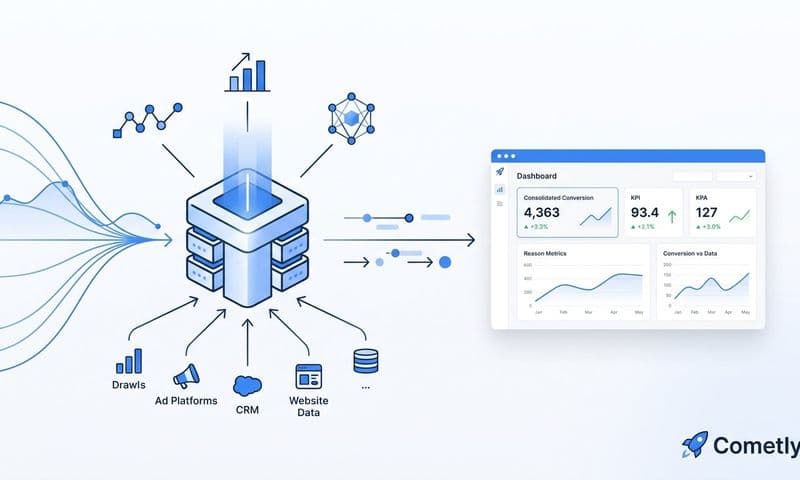
The solution to this problem starts with a concept that is simple in theory and difficult in practice: a single source of truth. A unified data layer that connects ad platforms, website behavior, and CRM outcomes into one consistent view of the customer journey. Without this layer, every team is working from a partial and incomplete picture. Marketing sees the top of the funnel. Sales sees the bottom. Nobody has a clear view of what happens in between, and that is exactly where the disconnect lives.
The Root Causes of Marketing and Sales Data Misalignment
Understanding why the numbers do not match requires looking at three distinct structural problems. Each one contributes to the gap independently, and most B2B SaaS companies are dealing with all three simultaneously.
Attribution model differences: Ad platforms default to their own attribution logic. Meta, for example, uses a combination of click-through and view-through attribution with its own lookback windows. Google Ads has its own model. Neither of these aligns with how a CRM assigns credit. CRMs typically credit the first sales touch, the last marketing touch, or the rep who closed the deal, depending on how the system is configured. When the same conversion gets credited by three different systems using three different rules, the totals will never reconcile.
Tracking gaps and data loss: Pixel-based tracking has become significantly less reliable over the past several years. Browser privacy changes, iOS privacy updates, and increasing use of ad blockers have all reduced the percentage of events that a tracking pixel can capture. When a user converts but the pixel does not fire correctly, that conversion may appear in your CRM but not in your ad platform, or vice versa. These gaps accumulate over time and create systematic discrepancies between what marketing reports and what sales actually sees in the pipeline.
Timing and definition mismatches: This is the most overlooked cause of sales and marketing data gaps. Marketing and sales often measure success at different points in the funnel and at different points in time. Marketing may count a form fill as a conversion the moment it happens. Sales counts a qualified opportunity when a rep has vetted the contact and confirmed genuine interest. These are not the same event, and they do not happen at the same time.
In B2B SaaS, the average sales cycle can run anywhere from a few weeks to several months. A lead generated by a paid ad in one month may not become a closed deal until two or three months later. When marketing reports on the leads generated in a given month and sales reports on the revenue closed in that same month, they are measuring entirely different cohorts of activity. The numbers will look mismatched even when everything is working exactly as it should.
These three causes compound each other. Attribution model differences make it impossible to agree on which channel gets credit. Tracking gaps make the underlying data unreliable. Timing and definition mismatches make it impossible to compare the two teams' reports even when they are looking at the same time period. The result is a data environment where both teams are technically correct within their own systems, but neither set of numbers reflects the full picture of what is actually driving revenue.
How Broken Tracking Silently Distorts Your Marketing Data
Most marketing teams know that tracking is imperfect. What they often underestimate is how significantly those imperfections skew the data they rely on to make decisions.
Pixel-based tracking degrades over time in ways that are not always visible. A user who sees an ad on their phone during their morning commute, then converts on their work laptop three days later, represents a cross-device journey that a standard pixel setup cannot connect. The ad platform sees the click on mobile. The conversion fires on desktop. Without a way to link those two events to the same person, the ad looks like it produced zero results. The conversion looks like it came from direct traffic. Both conclusions are wrong.
Browser privacy restrictions make this worse. Safari's Intelligent Tracking Prevention and Firefox's enhanced privacy settings actively block third-party cookies, which are the mechanism most pixels use to track users across sessions. When a significant portion of your audience uses privacy-focused browsers, your digital marketing data is structurally incomplete before any other issues even enter the picture.
Duplicate and missing conversion events create a different kind of distortion. Without proper deduplication logic, the same lead can be counted multiple times. A user who fills out a form, triggers a pixel event, and is also tracked via a server-side event may appear as two or three conversions in your reporting. This inflates marketing numbers far beyond what the CRM reflects, because the CRM typically deduplicates contacts and counts each person once. The result is marketing reporting three times as many conversions as sales sees in the pipeline, and neither team understands why.
Server-side tracking is the technical fix for these gaps. Instead of relying on a browser-based pixel to capture and transmit conversion data, server-side tracking sends event data directly from your server to the ad platform. This approach bypasses browser restrictions entirely, works regardless of what device the user is on, and produces event data that is far more complete and consistent.
When you combine server-side tracking with proper deduplication logic, the gap between what your ad platforms report and what your CRM shows narrows significantly. The data becomes reliable enough to actually inform decisions, rather than just generating reports that both teams argue about.
Why Attribution Models Create Conflicting Credit for the Same Deals
Attribution is the process of assigning credit to the marketing touchpoints that contributed to a conversion. It sounds straightforward, but the choice of attribution model has a dramatic effect on which channels look like they are working and which ones look like they are not.
First-touch attribution gives all the credit to the first interaction a prospect had with your brand. If someone clicked a LinkedIn ad six months ago and eventually converted via a Google search, LinkedIn gets 100 percent of the credit. Last-click attribution does the opposite: Google gets all the credit for that same deal. Linear attribution splits the credit evenly across every touchpoint in the journey. Each model tells a completely different story about which channels are driving results.
The problem for most B2B SaaS companies is that marketing and sales are not just using different attribution models. They are often using models that are incompatible by design. Ad platforms default to their own native attribution, which is optimized to make their platform look effective. CRMs often default to first-touch or last-touch, depending on how they are configured. When the same deal gets evaluated through two different attribution lenses, it will appear in two different places in two different reports, and neither team can explain why the other team's numbers are so different.
The B2B SaaS buyer journey makes this problem more acute than in simpler sales environments. A typical prospect might encounter your brand through a LinkedIn ad, read a blog post through organic search, attend a webinar, receive a nurture email, and then convert through a Google branded search ad several weeks later. That journey involves five distinct touchpoints across four different channels. Any single-touch model will misrepresent this path by assigning all the credit to one interaction and ignoring the others.
Multi-touch attribution is the most accurate framework for this type of journey. By distributing credit across all the touchpoints that contributed to a conversion, weighted by their position in the funnel and their influence on the outcome, multi-touch attribution produces a picture of channel performance that reflects how B2B buyers actually make decisions. It is not a perfect model, but it is far more accurate than any single-touch approach for companies with complex, multi-channel buyer journeys and longer sales cycles.
When marketing and sales are both working from a multi-touch attribution model built on the same underlying data, they can finally look at the same report and reach the same conclusions. The channel that gets credit in marketing's report is the same channel that gets credit in the pipeline analysis. The numbers align because they are built on a shared foundation.
How to Align Marketing and Sales Around a Unified Data Layer
Closing the gap between marketing data and sales data requires more than a new dashboard. It requires connecting the systems, standardizing the definitions, and building a marketing data integration infrastructure that both teams can trust as their shared source of truth.
Connect your ad platforms, website tracking, and CRM into a single attribution system. This means using a platform that can ingest conversion events from every source, map those events to individual contacts across their entire journey, and report outcomes in a consistent way. When all three systems feed into a single attribution layer, you eliminate the version of reality problem where each team is looking at a different subset of the data.
Implement Conversion API integrations to improve signal quality. Platforms like Meta and Google offer server-side Conversion API connections that allow you to send enriched, first-party event data directly from your server to the ad platform. This does two things. First, it closes the tracking gaps created by browser restrictions, giving you more complete data. Second, it sends higher quality conversion signals to the ad platform's optimization algorithm. When the algorithm has better data about which users actually converted and became customers, it optimizes toward better audiences, which produces results that align more closely with what the CRM shows.
Establish shared conversion definitions between marketing and sales. This is the organizational piece that the technical infrastructure cannot solve on its own. Both teams need to agree on what counts as a lead, what counts as a qualified opportunity, and what counts as a conversion. These definitions need to be documented and enforced in the attribution platform so that every report is built on the same taxonomy. When marketing reports on leads and sales reports on opportunities, and those terms mean the same thing to both teams, the reconciliation process becomes straightforward instead of contentious.
Build a regular reconciliation practice. Even with the right infrastructure in place, discrepancies will occasionally appear. Establish a monthly or bi-weekly review where marketing and sales compare their numbers, identify gaps, and trace them back to their source. This practice keeps the data clean over time and builds the kind of cross-functional trust that makes both teams more effective. A strong marketing analytics strategy ensures this process stays systematic rather than reactive.
Tools like Cometly are built specifically to support this kind of unified data layer. By connecting ad platforms, CRM data, and website events into a single attribution view, Cometly gives marketing and sales teams a shared foundation for reporting, one that tracks every touchpoint from the first ad click through to closed-won revenue. The AI-powered recommendations layer helps teams identify which channels and campaigns are actually driving pipeline, not just generating activity at the top of the funnel.
Putting It All Together: From Data Chaos to Revenue Clarity
The frustration of marketing data not matching sales is real, and it is expensive. But it is also solvable. The gap is almost never the result of bad marketing or bad sales. It is the result of fragmented data infrastructure, incompatible attribution models, and undefined conversion standards. Fix those three things, and the numbers start to align.
The path forward is clear. Start with server-side tracking to close the data gaps that browser restrictions create. Adopt a multi-touch attribution model that reflects how your B2B buyers actually move through the funnel. Establish shared conversion definitions that both teams agree on and document in your attribution platform. And connect all of your data sources into a single layer so that marketing and sales are always looking at the same underlying reality.
Cometly is designed to make this transition straightforward. It connects your ad platforms, CRM, and website tracking into one attribution system, giving you a complete view of every customer journey from the first impression to closed revenue. With 70+ native integrations, Conversion API support for Meta and Google, and AI-powered insights that surface which campaigns are actually moving pipeline, Cometly gives your team the clarity it needs to make confident budget decisions and scale what is actually working.
Marketing and sales do not have to argue about the numbers. When both teams are working from a single, accurate source of truth, those conversations shift from "why don't your numbers match mine" to "here is what the data tells us we should do next." That is the shift that drives real revenue growth.
If your team is ready to stop reconciling conflicting reports and start making decisions from a unified view of your marketing performance, Get your free demo and see how Cometly connects every touchpoint to actual revenue.