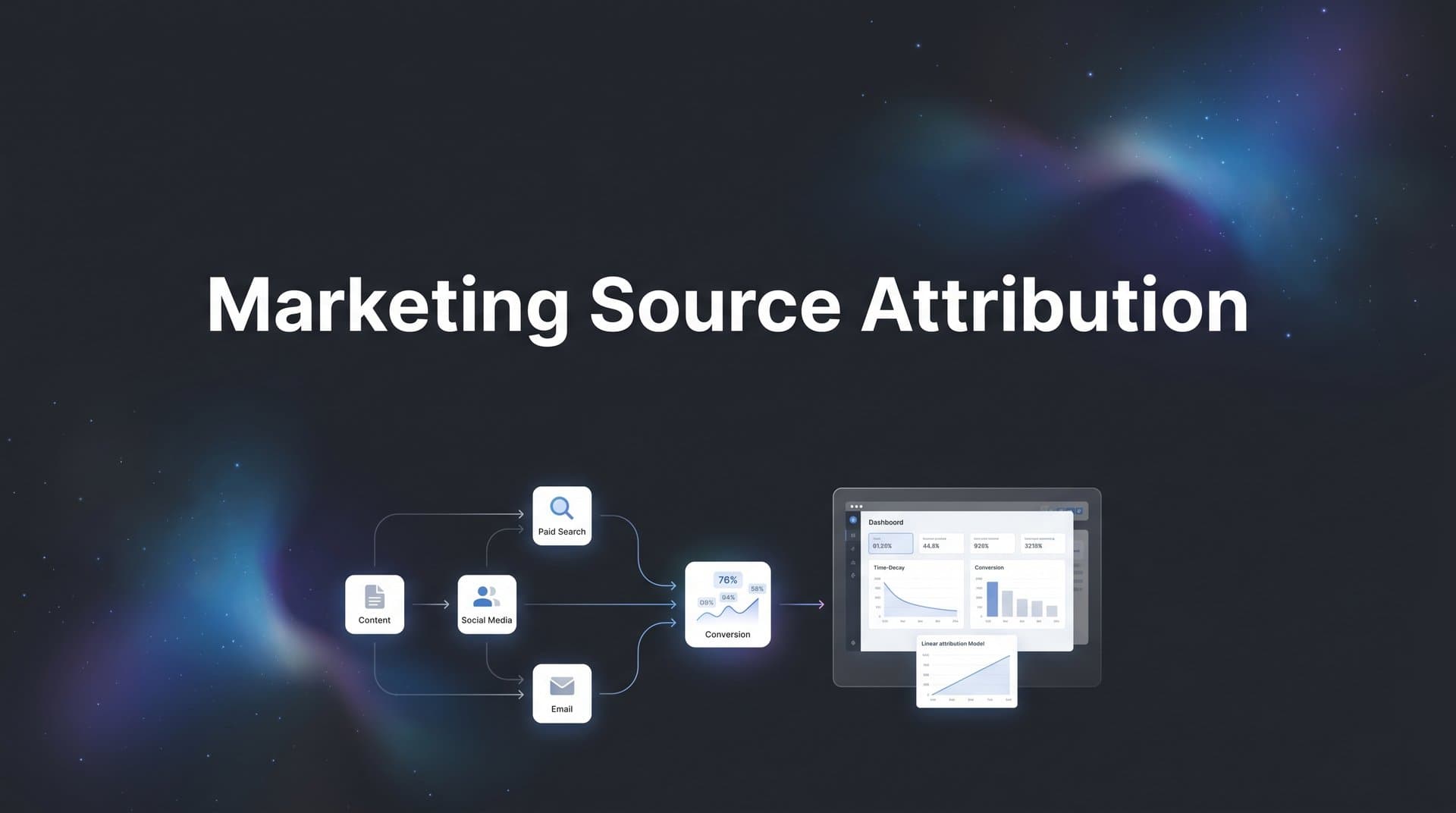
You're running campaigns on Meta, Google, TikTok, and email simultaneously. Your organic content is picking up traction. Sales are coming in. But when your CMO asks which channel actually drove last month's revenue, you find yourself staring at four different dashboards, each claiming full credit for the same conversions. Sound familiar?
This is the core frustration that marketing source attribution is designed to solve. At its heart, source attribution is the practice of connecting every conversion, every sale, every meaningful business outcome back to the specific marketing source that influenced it. Not just the last click. Not just what Meta's dashboard says. The actual path a customer took from first exposure to final purchase.
As marketing budgets face greater scrutiny and campaigns span more channels than ever before, the ability to answer "what's actually working?" has become a competitive advantage. Teams that can confidently trace revenue back to its source can allocate budgets smarter, scale what works, and cut what doesn't. Teams that can't are essentially flying blind with expensive fuel.
This guide will walk you through how marketing source attribution works under the hood, which attribution models tell different parts of the story, why accurate tracking has gotten harder in a privacy-first world, and how to build a system that gives you reliable data you can actually act on. By the end, you'll have a clear framework for turning attribution insights into smarter budget decisions.
The Core Mechanics Behind Source Attribution
Marketing source attribution is not the same as checking your Google Analytics traffic overview or glancing at platform-level metrics. It's a deliberate, structured process of identifying which channels, campaigns, and specific touchpoints contributed to a revenue event. The distinction matters because vanity metrics like impressions, reach, or even clicks tell you very little about what is attribution in marketing actually designed to measure.
The foundation of any source attribution system is data connectivity. Several key data points work together to form a traceable path from a customer's first interaction to their eventual purchase.
UTM Parameters: These are tags appended to your campaign URLs that tell your analytics platform where traffic came from. A properly structured UTM includes the source (such as "google" or "meta"), the medium (such as "cpc" or "email"), the campaign name, and sometimes the specific ad or content variant. When someone clicks a tagged link, that information travels with them into your analytics system.
Click IDs: Ad platforms like Google (GCLID) and Meta (FBCLID) append their own click identifiers to URLs. These IDs allow the platform to match a click to a later conversion event, which is how platform-level attribution works. The challenge is that each platform manages this independently, which creates the duplicate-credit problem many marketers run into.
Referral Sources and First-Party Events: Beyond paid channels, referral data from organic search, direct visits, and social referrals fills in the picture. When this data is connected to CRM events, such as a lead form submission, a demo booking, or a closed deal, you start to see the full customer journey rather than just isolated channel touchpoints.
Here's where source attribution diverges sharply from relying on platform-reported metrics. When you look at Meta Ads Manager and Google Ads side by side, the combined conversion totals often exceed your actual sales. This happens because each platform uses its own attribution window and logic. Meta might credit a conversion if someone saw your ad within seven days of purchasing. Google might credit the same conversion because the person also clicked a search ad. Your CRM records one sale. Your dashboards show two or three.
A proper marketing source attribution system cuts through this noise by establishing a neutral, unified record of what actually happened. It pulls data from your ad platforms, your website, and your CRM, and it applies consistent logic to determine which sources deserve credit. That unified view is what makes confident, data-driven budget decisions possible. Teams looking for the right solution can explore digital marketing attribution software options built to solve this exact problem.
Attribution Models That Shape Your Data Story
Once you have the underlying data infrastructure in place, the next question is how you assign credit across the touchpoints in a customer journey. This is where attribution models come in, and the model you choose has a significant impact on how each marketing source appears to perform.
Think of attribution models as different lenses. Each one shows you the same journey but emphasizes different parts of it. There's no single "correct" model, but there are better and worse choices depending on what question you're trying to answer.
First-Touch Attribution: All credit goes to the very first interaction a customer had with your brand. If someone discovered you through a LinkedIn post and later converted after clicking a Google search ad, LinkedIn gets 100% of the credit. This model is useful for understanding which channels are best at generating awareness and bringing new audiences into your funnel. It tends to overvalue top-of-funnel channels and ignore everything that came after.
Last-Touch Attribution: The opposite approach. All credit goes to the final touchpoint before conversion. In the same example, Google search gets 100% of the credit. This is the default model in many analytics platforms and is useful for understanding what's driving people over the finish line. The problem is it completely ignores the role earlier touchpoints played in building intent. Many teams that rely exclusively on last-touch end up underinvesting in awareness channels that are quietly doing heavy lifting. Understanding the difference between single source and multi-touch attribution is critical for avoiding this trap.
Linear Attribution: Credit is distributed equally across every touchpoint in the journey. If a customer had five interactions before converting, each one receives 20% of the credit. This model acknowledges that the full journey matters, though it treats every touchpoint as equally important regardless of its actual influence.
Time-Decay Attribution: Touchpoints closer to the conversion receive more credit than earlier ones. The logic here is that more recent interactions had a stronger influence on the final decision. This model works well for shorter sales cycles where recency genuinely correlates with influence.
Position-Based Attribution: Also called U-shaped attribution, this model gives the most credit to the first and last touchpoints (typically 40% each) and distributes the remaining 20% across middle interactions. It's a practical compromise that recognizes the importance of both discovery and conversion moments.
The risk of committing to a single model is that you end up making budget decisions based on an incomplete picture. A channel that looks mediocre under last-touch attribution might be one of your strongest awareness drivers when viewed through a first-touch or linear lens. Comparing models side by side is where the real insight lives. For a deeper dive into how each model works, explore this guide on types of marketing attribution models every marketer should know. When a channel performs well across multiple models, you can be genuinely confident it's contributing value. When performance varies dramatically between models, that's a signal worth investigating before you cut or scale that channel.
Why Accurate Source Data Has Become Harder to Get
Even with the right models in place, the quality of your attribution is only as good as the underlying data. And getting accurate source data has become significantly more challenging over the past several years, for reasons largely outside marketers' control.
Apple's introduction of App Tracking Transparency with iOS 14.5 was a turning point for digital advertising. When users are prompted to opt out of tracking, the pixel-based data that Meta and other platforms relied on to match ad exposures to conversions becomes incomplete. For many advertisers, this created a visible gap between what their Facebook Pixel reported and what their CRM or payment system recorded. Campaigns that looked profitable based on platform data turned out to be underperforming when measured against actual revenue. These are exactly the kinds of attribution challenges in marketing analytics that modern teams must navigate.
At the same time, the gradual deprecation of third-party cookies in Chrome has disrupted cross-site tracking more broadly. Browser-based pixels depend on cookies to identify users across different websites and sessions. As those cookies become less reliable, the data flowing into pixel-based attribution systems becomes noisier and less complete.
Cross-device behavior adds another layer of complexity. A customer might first encounter your brand on their phone, research further on a laptop, and convert on a tablet. Without a way to stitch those sessions together, traditional analytics treats them as three separate users, breaking the attribution chain entirely. This is why cross-channel marketing attribution software has become essential for teams running campaigns across multiple platforms.
For B2B companies with longer sales cycles, the challenge compounds further. A prospect might interact with your brand dozens of times over several months before becoming a customer. Tracking that full journey across multiple channels, devices, and time periods requires infrastructure that goes well beyond standard pixel setup.
Server-side tracking has emerged as the most resilient response to these challenges. Instead of relying on a browser-based pixel to fire and send data, server-side tracking captures conversion events directly from your server and sends them to ad platforms through their APIs. Because this process happens server-to-server rather than in the browser, it's not affected by ad blockers, cookie restrictions, or iOS privacy prompts. The data that reaches your ad platform is more complete, more accurate, and more actionable. This approach forms the backbone of a modern, privacy-resilient attribution system.
Building a Source Attribution System That Works
Understanding the theory of attribution is useful. Having a system that actually captures reliable data is what drives results. Building that system requires a few foundational elements working together consistently.
The starting point is UTM discipline. Every paid campaign, every email link, every social post that drives traffic to your site should be tagged with a consistent UTM structure. This sounds basic, but inconsistent naming conventions are one of the most common reasons attribution data becomes unreliable. If your Google campaigns use "google" as the source while someone else on the team uses "Google_Ads" or "goog," your analytics system will treat those as separate sources and your data will be fragmented. Learning how to track marketing campaigns with proper UTM conventions is a prerequisite for everything else.
The next layer is connecting your ad platforms to your CRM. This is what allows you to trace a conversion all the way to revenue rather than stopping at a click or a form fill. When your CRM can receive data about which campaign and source a lead came from, you can follow that lead through the pipeline and eventually tie it to closed revenue. Without this connection, you're measuring activity rather than outcomes.
Server-side tracking, as discussed earlier, is the mechanism that makes this data collection resilient. By implementing a server-side setup, you ensure that conversion events are captured regardless of browser behavior, ad blockers, or privacy settings. First-party data, meaning data collected directly from your own website and customer interactions rather than through third-party cookies, becomes your most reliable asset in this environment.
One of the most powerful but often overlooked components of a modern attribution system is conversion sync. This is the practice of feeding enriched conversion data back to the ad platforms you're running campaigns on. Meta, Google, and other platforms rely heavily on conversion signals to optimize their bidding and targeting algorithms. When you send them richer, more accurate data about which clicks led to real revenue events, their algorithms can do a better job of finding more customers like your best converters. Platforms with robust revenue tracking capabilities make this process seamless. The result is improved targeting efficiency and, over time, lower acquisition costs. Better data in means better optimization out, and that improvement compounds as the platform learns from more accurate signals.
Turning Attribution Insights Into Smarter Budget Decisions
Attribution data becomes genuinely valuable when it changes how you allocate resources. The goal isn't just to know which sources drove revenue historically. It's to use that knowledge to make better decisions about where to invest going forward.
When you have clean, unified source attribution data, budget reallocation becomes a data-driven conversation rather than a gut-feel debate. You can see which channels are generating actual revenue versus which ones are generating clicks, impressions, and engagement that don't convert. Channels that look expensive on a cost-per-click basis might look remarkably efficient when measured on a cost-per-revenue basis. Understanding how to measure marketing attribution accurately is what makes this level of analysis possible. The inverse is also true: channels that appear cheap based on surface metrics might be consuming budget without contributing meaningfully to the bottom line.
This is where AI-powered analysis adds significant leverage. Manually reviewing performance across multiple channels, campaigns, ad sets, and attribution models is time-consuming and prone to cognitive bias. AI can surface patterns across large datasets that manual review would miss, identifying which specific campaigns, audiences, or creative combinations are outperforming expectations and which are quietly draining budget. To understand how this technology works in practice, explore how machine learning can be used in marketing attribution. These insights help teams act faster and with greater confidence.
There's also a compounding feedback loop worth understanding. Better attribution data leads to better optimization decisions. Better optimization leads to stronger campaign performance. Stronger performance generates more conversion events, which feeds more reliable data back into your attribution system. Each cycle reinforces the next. Teams that invest in building accurate attribution infrastructure early tend to see this flywheel accelerate over time, while teams that rely on incomplete or siloed data stay stuck making reactive decisions based on lagging signals.
The practical implication is straightforward: treat your attribution system as a strategic asset, not just a reporting tool. The insights it generates are only as good as the data flowing into it, which is why the infrastructure decisions covered in the previous section directly determine the quality of the budget decisions you can make here.
Your Attribution Action Plan
Marketing source attribution is not a one-time setup. It's an ongoing practice that requires consistent data hygiene, the right infrastructure, and a willingness to interrogate your assumptions by comparing models and sources regularly.
Here are the key takeaways to carry forward. Source attribution is the foundation of understanding true marketing ROI. Without it, you're measuring activity, not outcomes. Multi-touch attribution models provide a more complete view of the customer journey than single-touch models, and comparing them side by side reveals which sources are genuinely driving pipeline. Server-side tracking is the most reliable way to capture conversion data in a privacy-first environment, and it should be a core part of any modern attribution setup. Feeding enriched data back to ad platforms through conversion sync improves their algorithms and compounds your results over time.
To put this into practice, work through this checklist:
1. Audit your current tracking setup and identify gaps where conversion data is being lost or misattributed.
2. Standardize your UTM naming conventions across every channel and enforce them consistently across your team.
3. Connect your ad platforms to your CRM so you can trace conversions all the way to revenue, not just clicks.
4. Implement server-side tracking to capture accurate conversion data regardless of browser restrictions or privacy changes.
5. Compare attribution models regularly and use the differences between them to inform channel strategy rather than defaulting to last-touch by habit.
6. Set up conversion sync to feed enriched data back to your ad platforms and improve their optimization over time.
If you're looking for a platform built to handle all of these needs in one place, Cometly was designed exactly for this. From multi-touch attribution and server-side tracking to AI-powered recommendations and conversion sync across Meta, Google, and beyond, Cometly gives you a unified view of every touchpoint in the customer journey. You get clear, accurate data that shows what's actually driving revenue, and AI-driven insights that tell you where to scale and where to pull back.
You don't need to stitch together five different tools to get accurate source attribution. Get your free demo and see how Cometly makes it possible to track every touchpoint, understand every source, and make every budget decision with confidence.