You're running app install campaigns across TikTok, Google, Meta, and YouTube simultaneously. A user sees your TikTok ad on Monday, searches for your app on Google Wednesday, clicks a Meta ad Thursday, and finally installs from a Google App Campaign on Friday. Now check your dashboards. Every single platform is claiming full credit for that install. Your reported conversions are inflated, your ROAS looks great, and yet you have no idea which channel actually moved the needle.
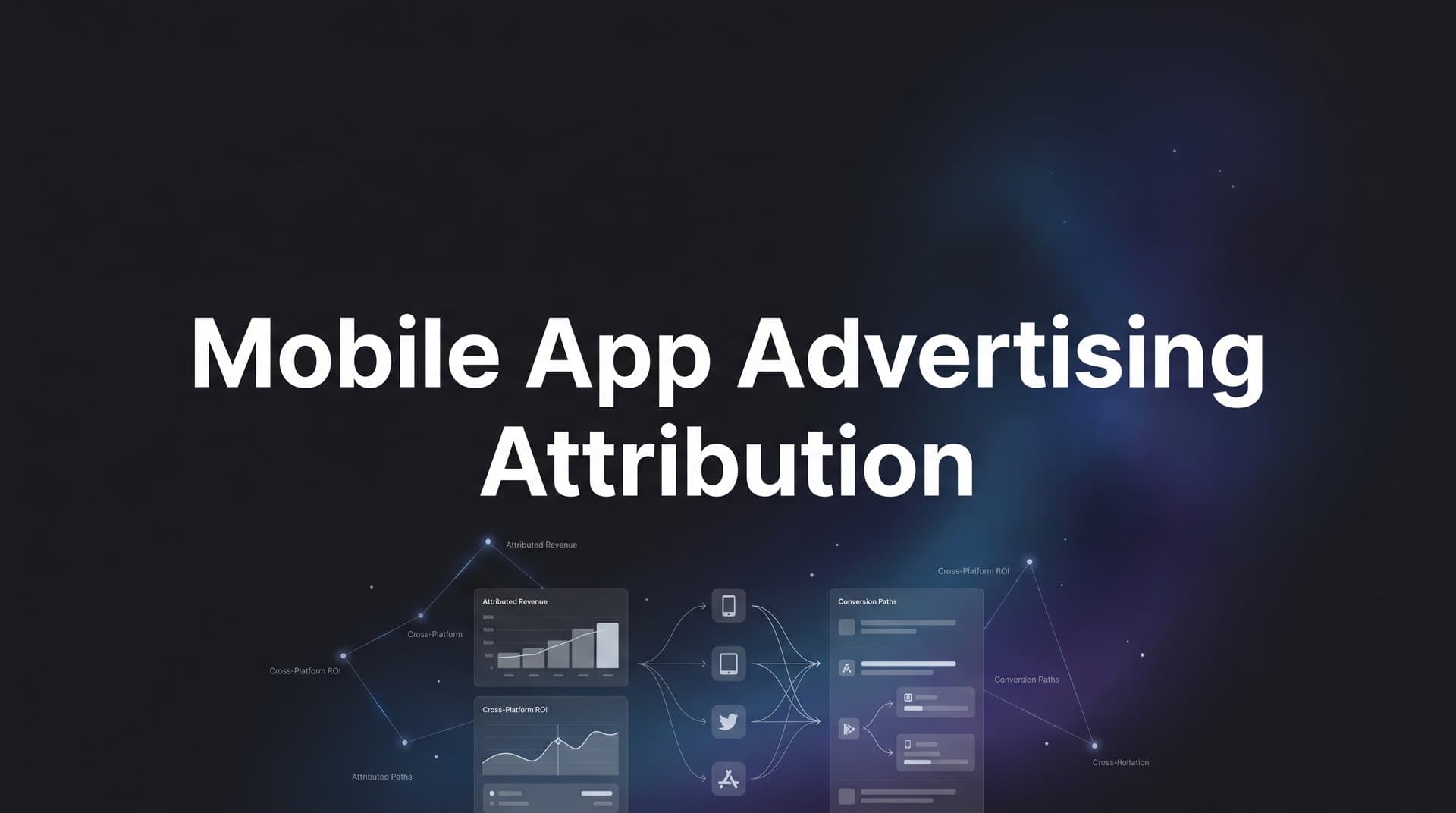
This is the reality of mobile advertising today, and it's why mobile app advertising attribution has become one of the most critical disciplines in a performance marketer's toolkit. Attribution in the mobile ecosystem is the practice of connecting each install, in-app event, and revenue outcome back to the specific ad, creative, or channel that influenced it. Without it, you're flying blind with a budget.
This guide covers everything you need to build a reliable attribution strategy: how the technical mechanics work, which attribution models apply to mobile campaigns, how privacy changes have reshaped measurement, and how to turn attribution data into smarter ad spend. Whether you're managing a single app or a portfolio of products across multiple networks, what follows will give you the clarity to make better decisions with your budget.
Why Tracking Mobile Ad Performance Is Harder Than You Think
On the surface, tracking mobile ad performance sounds straightforward. Someone sees your ad, taps it, installs your app, and you record the conversion. In practice, the mobile ecosystem introduces layers of complexity that break this simple chain almost immediately.
The first challenge is walled gardens. Meta, Google, and TikTok each operate closed ecosystems with their own tracking infrastructure, attribution logic, and reporting standards. When a user interacts with ads across multiple platforms, each platform measures that interaction using its own methodology. There's no shared ledger. Each network reports from its own perspective, which means overlapping attribution and inflated conversion counts are the norm, not the exception.
The second challenge is the gap between ad interaction and install. Unlike web conversions where a click and a purchase can happen in the same browser session, mobile attribution has to bridge two separate environments: the ad network and the app store. A user clicks your ad, gets redirected to the App Store or Google Play, installs the app, opens it, and only then can attribution logic fire. That journey involves multiple handoffs, and traditional tracking methods weren't designed to handle them cleanly.
Then there's the device identifier problem. Mobile attribution has historically relied on device-level identifiers like Apple's IDFA or Google's GAID to deterministically match ad clicks to installs. Privacy changes have significantly limited access to these identifiers, forcing a shift toward probabilistic matching and aggregated measurement. More on that in a later section, but the point is that the technical foundation of mobile attribution has been disrupted at its core. These are among the most significant attribution challenges in marketing analytics that performance teams face today.
Self-reported platform data makes all of this worse. When you pull conversion numbers from Meta Ads Manager, Google Ads, and TikTok Ads separately, you're getting each platform's version of the truth. They each use different attribution windows, different counting methodologies, and different definitions of what counts as a conversion. Add those numbers together and you'll almost certainly exceed your actual install count by a significant margin.
This is where mobile measurement partners (MMPs) and server-side tracking come in. MMPs like AppsFlyer, Adjust, Branch, and Singular act as neutral third parties. They sit outside the walled gardens and apply consistent attribution logic across all your channels, giving you a single source of truth. Rather than asking each platform "did you drive this install?", your MMP answers that question independently using its own data.
Server-side tracking adds another layer of reliability. Instead of depending on client-side pixels that can be blocked by privacy settings or ad blockers, server-side implementations send conversion data directly from your server to ad platforms. This approach is more durable, more accurate, and increasingly essential in a privacy-first world.
How Mobile App Attribution Actually Works
Understanding the mechanics of mobile attribution helps you make smarter decisions about your setup, your measurement windows, and your trust in the data you're seeing. Let's walk through the technical flow.
When a user sees or clicks your ad, the ad network records a unique identifier tied to that interaction. Depending on the platform and the user's privacy settings, this might be a device-level identifier like an IDFA or GAID, a click ID generated by the platform, or a probabilistic fingerprint derived from signals like IP address, device model, and operating system version. This identifier is stored by your attribution provider, typically with a timestamp. For a deeper dive into the fundamentals, our guide on how app marketing attribution works covers the core mechanics in detail.
When the user installs your app and opens it for the first time, your app's SDK fires an install event back to the attribution provider. The provider then attempts to match that install to a recorded ad interaction. If a deterministic match exists (a device ID or click ID that connects the two events), the install is attributed to that specific ad. If no deterministic match is available, the provider may fall back to probabilistic matching, using the available signals to make a best-guess attribution.
Click-Through Attribution (CTA): This is the standard model. A user clicks your ad, and if they install within the defined lookback window (commonly 7 to 30 days depending on the platform and channel), the install is credited to that click. Lookback windows matter because they define how far back you're willing to look when matching an install to an ad interaction. Longer windows capture more installs but can also introduce noise from users who were barely influenced by the ad.
View-Through Attribution (VTA): This model credits an ad impression even if the user never clicked it. If someone sees your video ad, doesn't click, but installs your app within a defined window (often 24 hours for mobile), that install is attributed to the impression. VTA is controversial because it can over-credit upper-funnel channels, but it's valuable for understanding the influence of awareness-stage advertising, particularly video and display formats.
Lookback windows are one of the most important configuration decisions in your attribution setup. Setting them consistently across platforms ensures you're comparing apples to apples. If Meta uses a 7-day click window and Google uses a 30-day click window, your cross-platform comparisons will be distorted.
Deep linking and deferred deep linking add another dimension to mobile attribution. A standard deep link routes a user who already has your app installed directly to a specific piece of in-app content, like a product page or a promotional offer. This improves user experience and makes it easier to measure the effectiveness of re-engagement campaigns.
Deferred deep linking goes further. It works even when the app isn't installed yet. The link remembers the intended destination through the entire install process. So if a user clicks an ad for a specific in-app offer, installs the app, and opens it for the first time, they land directly on that offer rather than a generic home screen. Deferred deep links improve both attribution accuracy and conversion rates by delivering a seamless, contextually relevant first experience.
Attribution Models That Shape Your Mobile Strategy
The attribution model you choose determines how credit is distributed across the touchpoints in a user's journey before they install your app or complete an in-app purchase. Different models tell different stories, and choosing the right one depends on your campaign goals and the complexity of your user acquisition funnel.
Last-Click Attribution: All credit goes to the final ad interaction before the install. This is the default model for most ad platforms and the simplest to understand. It's useful for direct-response campaigns where you want to identify which ad directly triggered the install. The downside is that it ignores every earlier touchpoint that may have built awareness or consideration.
First-Click Attribution: All credit goes to the first ad interaction in the user's journey. This model is useful for understanding which channels introduce your app to new users. It tends to favor top-of-funnel channels like display and video but undervalues the channels that closed the conversion.
Linear Attribution: Credit is distributed equally across all touchpoints. If a user interacted with four ads before installing, each ad gets 25% of the credit. This model acknowledges that multiple touchpoints contributed but treats them all as equally important, which is rarely how influence actually works.
Time-Decay Attribution: Touchpoints closer to the install receive more credit than earlier ones. This model reflects the intuition that a user who clicked your ad yesterday was more influenced by it than by an impression they saw two weeks ago. It's a reasonable middle ground for campaigns with longer consideration cycles.
Data-Driven Attribution: This model uses machine learning to assign credit based on the actual observed impact of each touchpoint across your campaign data. It's the most accurate model when you have sufficient conversion volume, but it requires scale and a robust data infrastructure to produce reliable results. To explore which approach fits your campaigns best, see our breakdown of what attribution model is best for optimizing ad campaigns.
Multi-touch attribution is increasingly important for mobile marketers running cross-platform campaigns. Consider a user who sees a YouTube pre-roll, clicks a Meta ad, and then installs from a Google App Campaign. Last-click gives all credit to Google. First-click gives all credit to YouTube. Only a multi-touch model captures the contribution of each channel in that journey.
For user acquisition campaigns focused on volume and efficiency, last-click is often a practical starting point. It's simple, widely supported, and easy to optimize against. But as your campaigns mature and your user base grows, multi-touch marketing attribution software gives you the nuance to understand which channels are building awareness, which are driving consideration, and which are closing installs.
For retention and re-engagement campaigns, multi-touch models are especially valuable. Users who lapsed and return often interact with multiple re-engagement touchpoints before converting. Crediting only the last interaction misses the cumulative effect of your retention strategy and can lead you to underinvest in channels that are doing important work earlier in the re-engagement journey.
Privacy Changes That Reshaped Mobile Attribution
If you've been running mobile app campaigns for more than a few years, you've felt the impact of privacy changes on your measurement capabilities. The shift has been significant, and understanding it is essential for building an attribution strategy that works in today's environment.
Apple's introduction of App Tracking Transparency (ATT) with iOS 14.5 in 2021 was the most disruptive single event in mobile attribution history. Before ATT, the IDFA was the standard identifier used to match ad clicks to installs across iOS devices. It was reliable, deterministic, and widely supported. ATT required apps to explicitly ask users for permission to track them across other apps and websites. Opt-in rates varied widely, but the result was a substantial reduction in the availability of IDFA for attribution purposes. Deterministic, device-level matching became far less reliable for iOS campaigns overnight.
Apple's response was SKAdNetwork (SKAN), a privacy-preserving attribution framework that provides conversion data to advertisers without revealing user-level information. Instead of telling you "User X installed your app after clicking Ad Y," SKAdNetwork tells you "Campaign Z received N installs during this period." The data is aggregated, delayed by hours or days, and limited in the granularity of conversion values it can report. Apple has continued evolving this framework, introducing AdAttributionKit in newer iOS versions with some improvements to the developer experience, but the fundamental constraints remain: no user-level data, limited conversion signal fidelity, and delayed reporting.
Google's Privacy Sandbox for Android represents a parallel shift on the other side of the mobile ecosystem. While Android's GAID (Google Advertising ID) has historically been more accessible than iOS's IDFA, Google's Privacy Sandbox initiative aims to limit cross-app tracking while preserving some advertising functionality. This rollout is gradual and ongoing, but it signals that Android attribution will face similar constraints to iOS in the coming years. Understanding what is mobile marketing attribution in this evolving landscape is critical for staying ahead of these shifts.
These changes have made probabilistic attribution more important. When deterministic matching isn't possible, attribution providers use available signals (IP address, device type, operating system, language settings, and timing) to make statistically informed guesses about which ad drove an install. Probabilistic matching is less precise than deterministic matching, but it's better than no attribution at all.
Server-side tracking has become one of the most effective responses to these privacy constraints. By sending conversion events directly from your server to ad platforms via APIs (Meta's Conversions API, Google's enhanced conversions, TikTok's Events API), you bypass the client-side limitations that privacy settings create. Server-side data is harder to block, more complete, and more reliable than pixel-based tracking. It also allows you to enrich conversion events with first-party data from your CRM or customer database, improving the quality of signals you're feeding back to ad platform algorithms.
First-party data strategies have become equally essential. Building direct relationships with your users through email, account registration, and in-app behavior gives you attribution signals that don't depend on third-party identifiers. When a user who signed up through a specific campaign makes a purchase six months later, first-party data lets you connect that revenue back to the original acquisition source, something no third-party identifier could reliably do at scale in today's privacy environment.
Building a Mobile Attribution Strategy That Scales
Having the right tools and frameworks in place is only part of the equation. A mobile attribution strategy that actually scales requires deliberate decisions about what you measure, how you measure it, and how you use that data to improve performance over time.
Start by defining your key conversion events beyond installs. Install volume is a vanity metric if those users never engage meaningfully with your app. The events that matter are the ones tied to revenue and retention: in-app purchases, subscription activations, feature completions, session milestones, and whatever actions in your app correlate most strongly with long-term user value. Map these events before you set up your attribution infrastructure so that your measurement captures the full user journey from first touch to meaningful engagement.
Set consistent attribution windows across all platforms. This sounds simple but is frequently overlooked. If you're comparing Meta campaigns with a 7-day click window against Google campaigns with a 30-day click window, you're not making a fair comparison. Align your windows to match your typical consideration cycle and apply them consistently everywhere. Investing in reliable cross-channel marketing attribution software makes this standardization far easier to manage at scale.
Establish naming conventions for your campaigns, ad sets, and ads. Consistent naming is the foundation of clean attribution data. Without it, your reports become impossible to analyze at scale. A naming convention that includes channel, campaign type, audience, creative format, and date gives you the ability to slice and filter your data in ways that surface actionable insights rather than noise.
Feeding accurate conversion data back to ad platforms is one of the highest-leverage actions you can take. When you send enriched, conversion-ready events back to Meta, Google, and TikTok through their respective APIs, you're training their bidding algorithms on the outcomes you actually care about. Platforms optimize for the signals you give them. If you only send install events, they'll optimize for installs. If you send purchase events with revenue values, they'll optimize for buyers. The quality of your conversion signals directly determines the quality of the users your campaigns attract.
Connecting your attribution data to your CRM and broader analytics stack creates a complete view of customer lifetime value. When you can trace a user from their first ad interaction through install, first purchase, and repeat engagement, you can calculate the true return on ad spend for each channel. Platforms focused on marketing attribution platforms revenue tracking make it possible to tie every dollar of ad spend to actual revenue outcomes across your entire funnel.
Platforms like Cometly are built for exactly this kind of connected measurement. By linking your ad platforms, CRM, and website tracking in one place, Cometly gives you a unified view of every touchpoint in the customer journey, with the ability to compare attribution models, analyze channel performance, and make budget decisions based on revenue rather than surface-level metrics.
Turning Attribution Data Into Smarter Ad Spend
Attribution data is only valuable if it changes how you allocate budget and optimize campaigns. The marketers who get the most out of mobile app advertising attribution are the ones who use it to make faster, better-informed decisions rather than just building prettier reports.
The most immediate insight attribution provides is the difference between high-value installs and low-quality ones. Not all installs are equal. A user who installs your app and makes three purchases in the first week is worth far more than a user who installs and never opens the app again. Attribution data lets you trace which creatives, audiences, and placements are driving which type of user. When you can see that a specific TikTok creative is generating installs with high early engagement while a Meta campaign is driving installs that churn within 48 hours, you have a clear signal about where to invest and where to pull back. Learning how to use data analytics in marketing is what transforms raw attribution data into these actionable optimization decisions.
AI-powered recommendations take this analysis further. Manually reviewing attribution data across dozens of campaigns, creatives, and channels is time-consuming and prone to confirmation bias. AI can surface patterns that human analysis would miss: a particular audience segment that consistently converts to paid subscribers, a creative format that outperforms in specific geographic markets, or a budget allocation shift that would improve blended ROAS based on historical performance. Cometly's AI-powered features are designed to do exactly this, identifying high-performing ads and campaigns across every channel and surfacing optimization opportunities in real time.
Real-time attribution reporting enables agile budget management. Traditional end-of-month reporting cycles mean you're always optimizing based on data that's weeks old. When your attribution data updates in real time, you can identify a top-performing campaign on Tuesday and shift budget toward it by Wednesday. You can catch a creative that's fatiguing before it drains your budget. Generating a timely marketing attribution report gives your team the visibility needed to respond to competitive changes without waiting for a monthly review meeting.
The compounding effect of real-time, accurate attribution is significant. Better data feeds better platform algorithms. Better algorithms drive better targeting. Better targeting improves conversion rates. And better conversion rates give you more data to work with. This cycle is what separates mobile marketers who scale efficiently from those who grow spend without growing returns.
Your Next Steps in Mobile Attribution
Mobile app advertising attribution is no longer optional for marketers running campaigns across multiple ad networks. The complexity of the mobile ecosystem, combined with the privacy changes reshaping measurement, means that marketers who rely on self-reported platform data are making budget decisions on fundamentally flawed information.
The key takeaways from this guide are straightforward. Understand the technical mechanics of how attribution works so you can configure your setup correctly. Choose attribution models that match your campaign goals, using multi-touch approaches for cross-platform campaigns and lifecycle analysis. Adapt to privacy-first frameworks by investing in server-side tracking and first-party data strategies. And use accurate attribution data to fuel both your decisions and your ad platform algorithms, because the quality of your conversion signals directly determines the quality of your results.
Getting this right requires a platform that connects all the pieces: your ad channels, your CRM, your website, and your in-app events, with the intelligence to surface what's actually driving revenue. Cometly is built for exactly that. It captures every touchpoint, connects attribution data to real revenue outcomes, and feeds enriched conversion signals back to Meta, Google, TikTok, and more, so your campaigns get smarter over time.
If you're ready to move from guesswork to precision in your mobile app campaigns, Get your free demo today and start capturing every touchpoint to maximize your conversions.