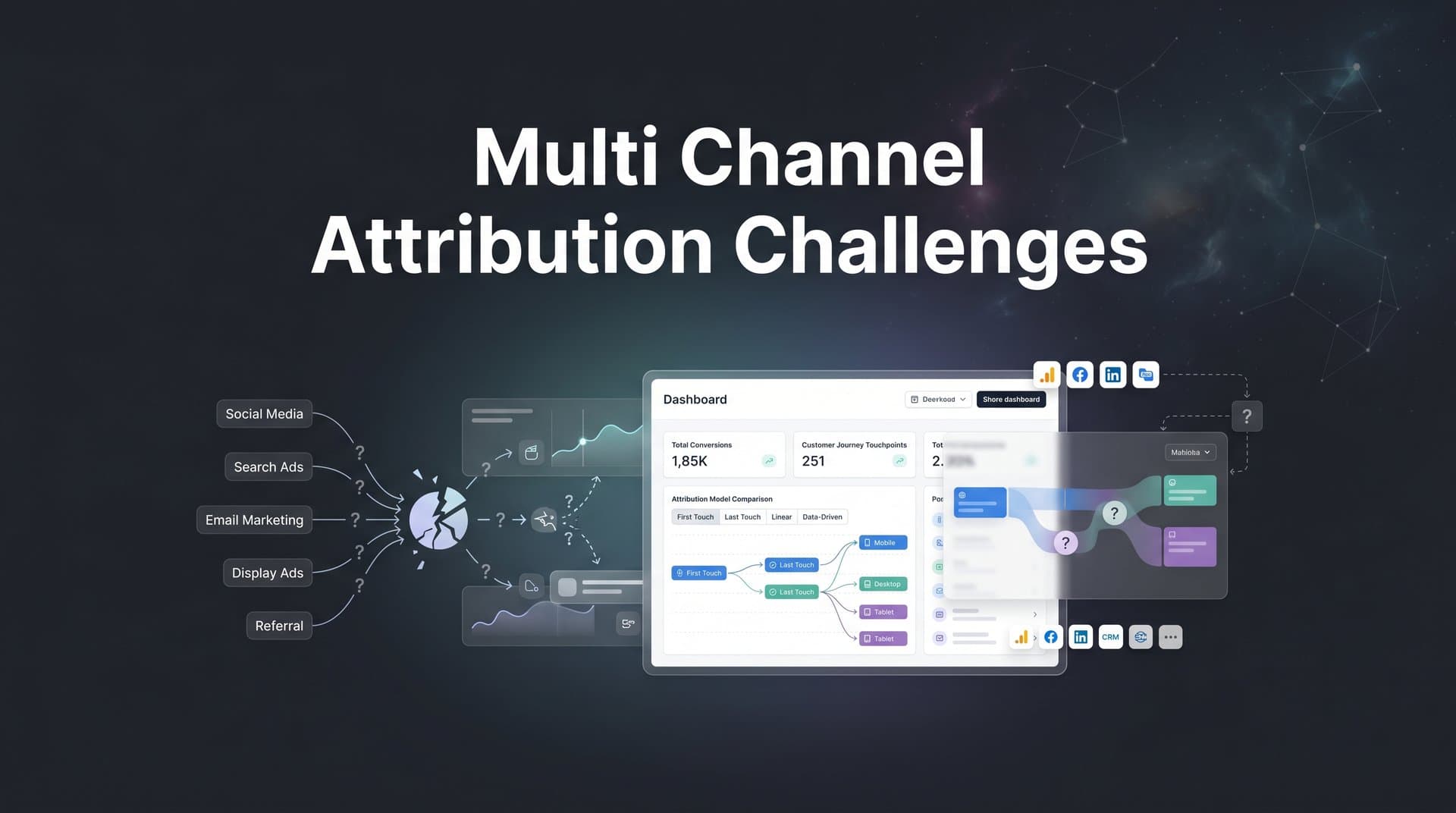
Picture this: you open your weekly reports from Meta, Google, and TikTok. Each dashboard looks impressive. Meta says it drove 80 conversions. Google claims 65. TikTok reports another 40. But when you check your CRM, total actual conversions for the week were 75. Something is very wrong with this picture, and it's a scene that plays out in marketing teams everywhere, every single day.
This is the core problem with multi channel attribution. When you run campaigns across multiple platforms simultaneously, each platform reports results through its own lens, using its own rules, and almost always in its own favor. The numbers rarely reconcile, and the gap between what platforms report and what actually happened can be enormous.
Multi channel attribution challenges are not just a technical headache. They represent a genuine threat to smart budget decisions. If you can't accurately identify which channels and campaigns are driving real revenue, you're essentially flying blind. You might be scaling a channel that looks great on paper but contributes almost nothing to actual sales. You might be cutting campaigns that play a critical role in the customer journey but never get credit for it. The stakes are high, and the problem is getting harder to solve, not easier.
This article breaks down the biggest obstacles marketers face when trying to track the full customer journey across multiple channels, and more importantly, what you can actually do about them.
Why Every Ad Platform Tells a Different Story
Here's the thing: Meta, Google, and TikTok are not trying to deceive you. They are each reporting accurately from their own perspective. The problem is that their perspectives are fundamentally limited, and their methodologies are designed in ways that almost guarantee conflicting data.
Each platform uses its own attribution window, which is the time period during which a conversion gets credited to an ad interaction. Meta, for example, defaults to a 7-day click and 1-day view window. This means if someone clicks a Meta ad on Monday and converts the following Sunday, Meta claims that conversion. Google Ads uses different default windows, and TikTok has its own settings. When a customer interacts with ads across all three platforms in a single week before converting, all three platforms can legitimately claim that conversion under their own rules.
The result is double or even triple counting. Your combined platform reports might show 185 conversions when your actual business recorded 75. This inflation isn't a bug in any one platform's reporting. It's an inevitable consequence of siloed, self-reported metrics. Understanding how to fix attribution discrepancies is essential for getting an accurate picture of performance.
The deeper issue is that each platform can only see the touchpoints it owns. Meta knows about Meta ad clicks. Google knows about Google ad clicks. Neither has visibility into what happened on the other platform, or in your email campaigns, or through organic search. So when they report a conversion, they're not lying, they're just working with incomplete information and attributing credit based on their own interactions with the customer.
This is why relying solely on individual platform dashboards to measure performance is so dangerous. You need an independent attribution layer that sits above all your channels and applies consistent rules across every touchpoint. Without that neutral third-party view, you're making budget decisions based on data that is structurally biased toward making each platform look as good as possible.
Think of it like asking three different salespeople which one closed the deal. Each will have a reasonable argument for why they deserve the credit. The only way to get an accurate answer is to look at the full sales process from the outside.
The Privacy Shift That Broke Traditional Tracking
Even if you solved the platform discrepancy problem, you'd still be dealing with a second major challenge: a significant portion of customer behavior is simply no longer trackable through traditional methods.
When Apple introduced its App Tracking Transparency framework with iOS 14.5, it required apps to ask users for explicit permission before tracking their behavior across other apps and websites. The majority of users declined. This immediately reduced the volume of conversion data flowing back to ad platforms like Meta, creating massive gaps in their ability to understand which ads led to purchases. The impact on reported performance metrics was significant and well-documented across the industry.
Browser-level privacy restrictions have added further complexity. Safari has long blocked third-party cookies by default. Firefox followed. Chrome has been evolving its approach to third-party cookie support as well. The result is that client-side pixel tracking, which has been the backbone of digital advertising measurement for years, has become increasingly unreliable. These are among the most pressing attribution challenges in marketing analytics today.
Client-side tracking works by placing a small piece of code (a pixel) in the user's browser that fires when a conversion event occurs. But if the browser blocks the cookie, if the user has an ad blocker installed, or if they're on a device where tracking permissions have been denied, that pixel never fires. The conversion happens, but it's invisible to your tracking system.
This creates real blind spots in the customer journey. You might be seeing only a fraction of your actual conversions in your platform dashboards, which makes optimization decisions unreliable. You're optimizing toward the conversions you can see, not toward all the conversions that are actually happening.
Server-side tracking has emerged as the most resilient response to these challenges. Instead of relying on a browser-based pixel to send conversion data, server-side tracking sends that data directly from your server to the ad platform. It bypasses browser restrictions, ad blockers, and cookie limitations entirely. Platforms like Meta (via the Conversions API) and Google (via server-side tagging) have built infrastructure to receive this data.
The challenge is that implementing server-side tracking requires technical resources and setup. Many teams have not yet made the transition, which means they're still operating with tracking gaps that grow larger as privacy restrictions tighten. Closing those gaps is no longer optional. It's a prerequisite for accurate attribution.
Cross-Device and Cross-Channel Blind Spots
Modern customers don't follow a straight line from ad to purchase. They meander. They see a TikTok ad on their phone during lunch, search for reviews on their laptop that evening, click a retargeting ad on their tablet the next morning, and finally convert after receiving an email with a discount code. That's four devices, four touchpoints, and potentially four different sessions that look like four completely separate users to most tracking systems.
This is the cross-device problem, and it's one of the most stubborn multi channel attribution challenges marketers face. Without identity resolution, meaning a way to connect all those interactions to a single person, each device-session combination appears as a unique visitor. You end up with fragmented journey data that makes it nearly impossible to understand the true path to conversion. Implementing a robust cross-channel attribution strategy is critical for connecting these fragmented touchpoints.
The cross-channel dimension adds another layer of complexity. Paid ads are only part of the story. Customers also interact with organic search results, social media posts, YouTube videos, email newsletters, and even offline touchpoints like events or word-of-mouth referrals. Most attribution systems are built around paid ad clicks and do a poor job of capturing or crediting these other interactions.
Consider what happens to email in most attribution setups. A customer clicks a nurture email, visits your site, and converts. If your email platform and your ad attribution system aren't connected, that email touchpoint either gets missed entirely or gets lumped into "direct" traffic, which is often a catch-all for sessions where the source is unknown. The email campaign that actually pushed the customer over the line gets no credit.
The practical consequence of these blind spots is a systematic bias in how budget gets allocated. Bottom-funnel channels like branded search and retargeting tend to be the last touchpoint before conversion, so they capture credit in most attribution models. Awareness channels like display ads, social prospecting campaigns, and content marketing often touch the customer earlier in the journey and rarely get credited even though they initiated the relationship.
Over time, if you're only rewarding what you can measure, you'll keep cutting awareness spend and doubling down on retargeting. But retargeting only works if there's a healthy pipeline of new prospects coming in at the top of the funnel. Underinvesting in awareness to over-invest in retargeting is a common mistake that multi channel attribution blind spots make very easy to make.
Choosing the Right Attribution Model (and Why It Matters More Than You Think)
Even when you have solid tracking in place and a unified view of your customer journey, you still face a fundamental question: how do you divide credit for a conversion among all the touchpoints that contributed to it?
This is the attribution model question, and the answer you choose has a direct, material impact on where your budget goes.
Last-click attribution, still the default in many platforms and tools, gives 100% of the credit to the final touchpoint before conversion. It's simple and easy to understand, but it systematically undervalues everything that happened earlier in the journey. Branded search and retargeting ads, which typically appear at the end of the funnel, tend to look like superstars under last-click. Prospecting campaigns and content that introduced the customer to your brand in the first place get nothing. Understanding the difference between single source and multi-touch attribution is key to moving beyond these limitations.
First-click attribution does the opposite. It credits the first interaction entirely, which can make awareness campaigns look great but ignores all the nurturing and conversion-focused activity that followed. Linear attribution spreads credit equally across all touchpoints, which sounds fair but doesn't account for the fact that some interactions are genuinely more influential than others.
Time-decay models give more credit to touchpoints that occurred closer to the conversion, which has some intuitive logic but still tends to favor bottom-funnel activity. Position-based models, sometimes called U-shaped, give heavy credit to the first and last touchpoints while distributing the remainder across the middle. Each of these models tells a different story, and each one will produce a different set of "best performing" channels when applied to the same data. For a deeper comparison, explore the various multi-touch attribution models available.
Here's where it gets consequential: the model you use shapes your budget allocation decisions. If last-click attribution makes your retargeting campaigns look like your top performers, you'll invest more there. If a data-driven multi-touch model reveals that your prospecting campaigns on Meta are actually initiating a large percentage of your highest-value customer journeys, you might make a completely different investment decision.
Multi-touch attribution models, which distribute credit across the entire journey based on actual contribution, are generally more accurate and more useful for budget decisions. But they require complete, accurate data to function properly. If your tracking has gaps, if cross-device journeys are broken, or if organic touchpoints are missing, even the most sophisticated model will produce misleading results. The model is only as good as the data feeding it.
Data Silos and the Integration Problem
Here's a scenario that's painfully familiar to most marketing teams: your ad performance data lives in Meta Ads Manager and Google Ads. Your website analytics are in a separate tool. Your leads and customer records are in your CRM. Your revenue data is in your billing system or your sales team's spreadsheets. None of these systems talk to each other automatically.
This is the data silo problem, and it's one of the most underrated multi channel attribution challenges because it's not about tracking technology at all. It's about data architecture.
When your ad data and your CRM data are disconnected, you can measure clicks and even leads, but you can't trace those leads through to actual closed revenue. You know that a campaign generated 200 form fills, but you don't know how many of those became paying customers, what they were worth, or which ad creative they first interacted with. You're measuring marketing activity rather than marketing impact. Platforms focused on marketing attribution and revenue tracking are designed to bridge exactly this gap.
This gap is especially acute in B2B environments where sales cycles are long and complex. A prospect might click an ad, download a whitepaper, attend a webinar, speak with a sales rep, and convert three months later. If your ad platform and your CRM aren't connected, the ad team sees a lead and claims success. The revenue that eventually comes in is invisible to the marketing attribution system entirely.
Even in shorter-cycle B2C contexts, the disconnect between ad spend and actual revenue makes it very difficult to calculate true return on ad spend. You might be optimizing toward cost per lead when what you actually care about is cost per acquired customer or revenue generated per dollar spent. Learning how to analyze multi-channel ad performance holistically can help you move beyond these siloed metrics.
Connecting your ad platforms, your website analytics, and your CRM into a single attribution system closes this gap. It enables you to trace the full customer journey from the first ad impression through to closed revenue, and it gives you the ability to optimize toward business outcomes rather than proxy metrics. This is what true revenue attribution looks like, and it's only possible when your data sources are integrated rather than isolated.
Practical Ways to Overcome Multi Channel Attribution Challenges
Understanding the problems is one thing. Solving them requires a deliberate, infrastructure-level approach. Here are the most impactful steps you can take to build more accurate, actionable attribution.
Implement server-side tracking as your foundation. Transitioning from client-side pixels to server-side tracking is the single most important step you can take to close tracking gaps created by privacy changes and browser restrictions. Server-side tracking captures conversions that browser-based pixels miss, giving you a more complete and accurate picture of what's actually happening. Once you're capturing better data, you can sync those enriched conversion events back to ad platforms like Meta and Google. This matters because ad platforms use conversion data to train their optimization algorithms. When the data you feed them is incomplete, their targeting and bidding decisions suffer. Better conversion data means better algorithmic performance across your campaigns.
Adopt a centralized attribution platform that connects all your data sources. No amount of platform-level optimization will solve attribution if your data remains siloed. You need a single system that connects your ad channels, your website, and your CRM, and applies consistent attribution logic across all of them. Investing in the right cross-channel marketing attribution software gives you a neutral, independent view of the customer journey that isn't biased toward any single platform's reporting. When you can see every touchpoint in one place and trace each customer from first interaction to revenue, you can make budget decisions based on actual contribution rather than self-reported platform metrics. This is the difference between knowing which channels look good and knowing which channels actually drive growth.
Use AI-powered analysis to surface insights and guide scaling decisions. Even with unified data and solid tracking, the volume of information across multiple channels and campaigns can be overwhelming to analyze manually. AI-powered attribution tools can process that data continuously, identify patterns that humans would miss, and surface specific recommendations about which ads and campaigns are performing best across channels. Instead of spending hours reconciling data from different dashboards, you can get clear, actionable guidance on where to increase budget, where to pull back, and which creative approaches are resonating with your highest-value customers.
Platforms like Cometly are built specifically to address these challenges. Cometly captures every touchpoint from ad clicks to CRM events, connects your ad platforms to your revenue data, and uses AI to analyze performance across all your channels simultaneously. It also syncs enriched conversion data back to Meta, Google, and other platforms to improve their optimization algorithms, which means better results from the same ad spend.
The goal is not perfect attribution. Perfect attribution doesn't exist. The goal is attribution that is accurate enough to make consistently better decisions, and that requires the right infrastructure rather than better manual analysis of flawed data.
Building the Attribution Foundation You Actually Need
Multi channel attribution challenges are real, complex, and growing. Privacy changes have made tracking harder. Customer journeys have become more fragmented. Platform discrepancies make self-reported data unreliable. And data silos prevent most teams from connecting ad spend to actual revenue.
But these challenges are solvable. The path forward requires moving beyond individual platform dashboards and building a unified attribution infrastructure: server-side tracking to capture what pixels miss, connected data sources to link ad activity to revenue, consistent attribution models to distribute credit fairly, and AI-powered analysis to turn that data into clear decisions.
Marketers who invest in this infrastructure stop guessing and start knowing. They can confidently scale what works, cut what doesn't, and defend their budget decisions with data that actually holds up.
Cometly is designed to be that infrastructure. It captures every touchpoint across the full customer journey, connects your ad platforms to your CRM and revenue data, and uses AI to surface the recommendations you need to scale with confidence. Whether you're dealing with platform discrepancies, tracking gaps, or disconnected data sources, Cometly brings it all into one clear, actionable view.
If you're ready to stop reconciling conflicting reports and start making attribution work for your business, Get your free demo today and see how Cometly can bring real clarity to your marketing data.