You're running ads across Google, Meta, LinkedIn, and maybe TikTok. A lead converts. Your Google Ads dashboard claims credit. So does Meta. LinkedIn says it played a role too. Who's actually telling the truth?
The reality is they all are—and none of them are. Modern customers interact with 6-8 touchpoints before converting. They see your Facebook ad, search your brand name, read a blog post, click a LinkedIn ad, and finally convert through a Google search. But if you're still using single-touch attribution—crediting only the first or last click—you're making budget decisions based on a fraction of the story.
Without understanding the full customer journey, you're flying blind. You might cut a profitable discovery channel because it doesn't show last-click conversions. Or you might pour money into bottom-funnel tactics while starving the awareness channels that actually start the journey. Multi-touch attribution solves this by revealing which channels actually drive revenue across the entire path to conversion. This guide breaks down the core attribution methods, shows you how to choose the right one for your business, and walks through what it takes to implement it correctly.
Why Single-Touch Models Leave Money on the Table
Single-touch attribution models operate on a fundamentally flawed premise: that one touchpoint deserves all the credit for a conversion. First-touch attribution gives 100% credit to the initial interaction—the first ad click, the first website visit, the moment someone enters your ecosystem. Last-touch attribution does the opposite, crediting only the final interaction before conversion.
Here's the problem with first-touch: it completely ignores everything that happened after that initial awareness moment. A customer might discover your brand through a Facebook ad, but then engage with your email campaign, watch your YouTube video, read three blog posts, and finally convert through a retargeting ad. First-touch attribution says Facebook deserves all the credit, while the nurturing channels that actually moved them toward conversion get nothing.
Last-touch attribution has the inverse problem. It gives all credit to the final touchpoint—often a branded search or direct visit—while ignoring the discovery channels that introduced your brand in the first place. This creates a dangerous feedback loop where you keep investing in bottom-funnel tactics because they show strong attribution, while the top-funnel channels that feed your pipeline get starved of budget.
The real-world impact shows up in misallocated budgets. You might cut a display campaign because it doesn't show last-click conversions, not realizing it's driving 40% of your initial brand awareness. Or you might double down on branded search because it shows great last-touch attribution, missing that you're just capturing demand created by other channels.
Think of it like crediting only the closer on a sales team while ignoring the SDRs who qualified leads and the account executives who nurtured relationships. Every team member plays a role. The shift to multi-touch attribution means recognizing that conversions are team efforts across multiple touchpoints—and allocating credit accordingly. For a deeper dive into these differences, explore our guide on single source attribution and multi-touch attribution models.
Breaking Down the Core Multi-Touch Attribution Methods
Multi-touch attribution distributes conversion credit across multiple touchpoints in the customer journey. The question isn't whether to use multi-touch attribution—it's which method matches your marketing reality. Let's break down the core models and when each one makes sense.
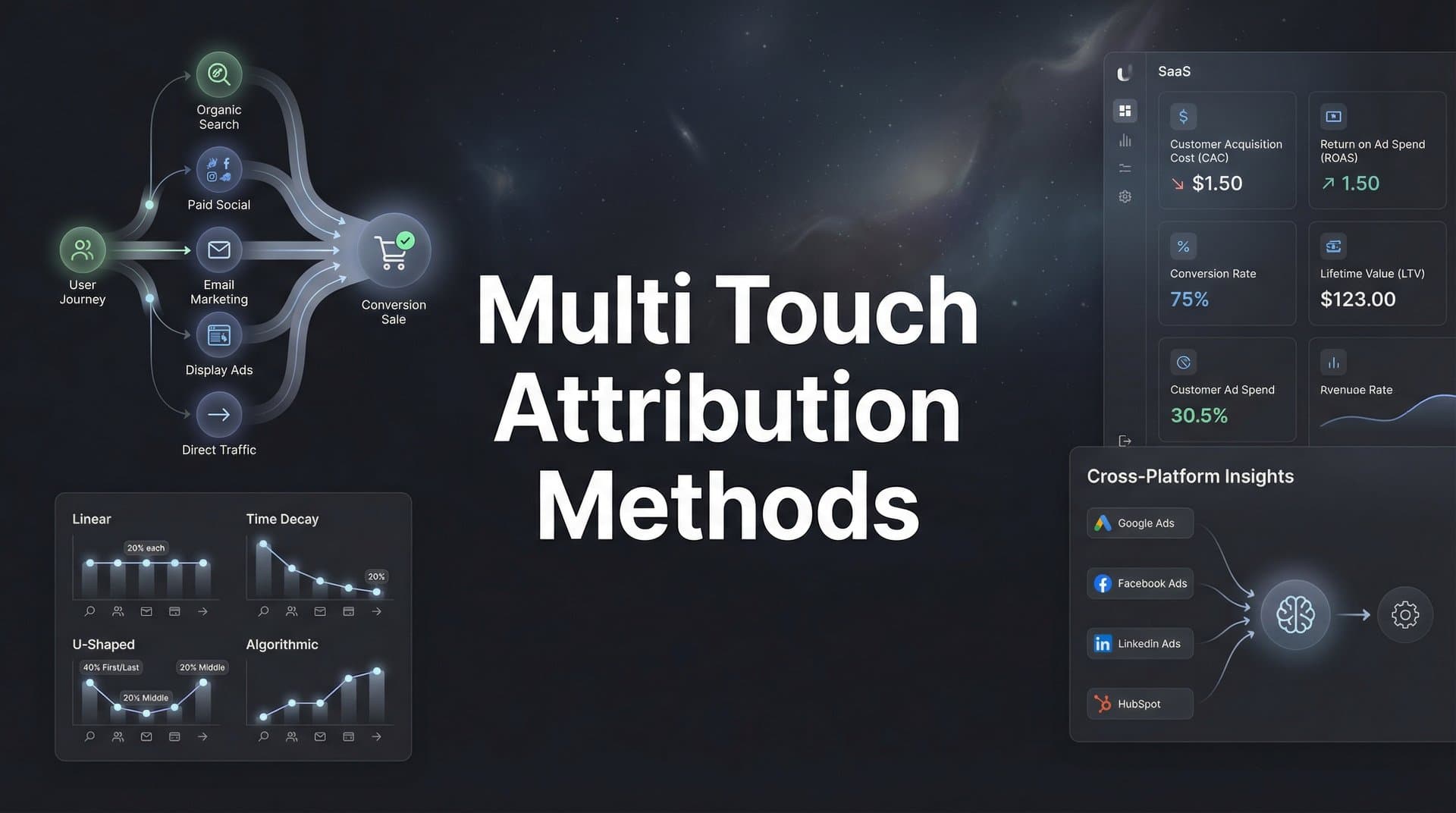
Linear Attribution: This is the most straightforward multi-touch model. Linear attribution gives equal credit to every touchpoint in the customer journey. If someone interacts with five touchpoints before converting, each gets 20% credit. The logic is simple: every interaction contributed equally to the final decision.
Linear attribution makes sense when you have a balanced funnel where discovery, consideration, and conversion tactics all play roughly equal roles. It's particularly useful for businesses with shorter sales cycles where each touchpoint carries similar weight. The downside? It doesn't account for the reality that some touchpoints—like the first impression or the final push—often matter more than middle-journey interactions.
Time-Decay Attribution: This model acknowledges that touchpoints closer to conversion typically have more influence on the decision. Time-decay attribution assigns progressively more credit to interactions as they get closer to the conversion moment. A touchpoint from last week gets more credit than one from last month.
Time-decay works well for sales-focused teams running aggressive conversion campaigns. If you're running retargeting ads, email sequences, and bottom-funnel search campaigns designed to close deals quickly, time-decay reflects that reality. It's especially valuable for e-commerce and lead generation where the final touchpoints often provide the critical push toward conversion.
Position-Based (U-Shaped) Attribution: This model recognizes that the first and last touchpoints often carry special significance. Position-based attribution typically assigns 40% credit to the first interaction, 40% to the last interaction, and distributes the remaining 20% across middle-journey touchpoints.
The logic makes sense: the first touchpoint introduces your brand and creates awareness, while the last touchpoint closes the deal. Everything in between nurtures and qualifies, but those bookend moments deserve extra weight. Position-based attribution is popular with B2B marketers who recognize that both discovery and closing touchpoints are critical in longer sales cycles. Understanding first touch vs last touch attribution helps clarify why this balanced approach works.
W-Shaped Attribution: This model adds a third critical moment to position-based attribution: the opportunity-creation touchpoint. W-shaped attribution typically assigns 30% credit to the first interaction, 30% to the lead creation moment (like a form fill or demo request), 30% to the final conversion touchpoint, and distributes the remaining 10% across other interactions.
W-shaped attribution is built for B2B and longer sales cycles where there's a clear moment when a prospect becomes a qualified lead. That middle moment—when someone raises their hand and says they're interested—deserves recognition alongside the discovery and closing touchpoints. For businesses with complex funnels involving multiple stages of qualification, W-shaped attribution captures the full picture.
Choosing Between Rule-Based Models
Each of these models uses predetermined rules to distribute credit. Linear says "equal credit everywhere." Time-decay says "recent matters more." Position-based says "first and last matter most." W-shaped says "first, middle qualification, and last matter most."
The right choice depends on your sales cycle, funnel complexity, and which touchpoints you believe carry the most weight. But all rule-based models share a limitation: they apply the same logic to every conversion, regardless of how individual customer journeys actually unfold. That's where data-driven attribution comes in. Our multi-touch attribution models guide provides additional context for making this decision.
Algorithmic and Data-Driven Attribution Explained
Data-driven attribution flips the script. Instead of applying predetermined rules, it uses machine learning to analyze actual conversion patterns and assign credit dynamically based on what's really driving results. The model looks at customers who converted versus those who didn't, identifies which touchpoints made the biggest difference, and distributes credit accordingly.
Here's how it works: the algorithm analyzes thousands of customer journeys, comparing the paths of converters to non-converters. It asks questions like: "How much more likely is someone to convert if they interact with this channel?" and "Which touchpoint sequences show the strongest correlation with conversion?" Based on those patterns, it assigns credit to the touchpoints that actually move the needle.
The advantage over rule-based models is adaptability. Customer behavior changes. New channels emerge. Campaign performance shifts. A rule-based model keeps applying the same logic regardless of these changes. Data-driven attribution adjusts automatically, recalculating credit distribution as patterns evolve. If retargeting ads suddenly become more influential, the model recognizes that and shifts credit accordingly.
But data-driven attribution comes with requirements. You need volume—enough conversions and touchpoint data for the algorithm to identify meaningful patterns. Most platforms require hundreds of conversions per month at minimum to generate reliable insights. You also need comprehensive tracking infrastructure that captures every touchpoint across devices and platforms.
The tracking challenge is real. iOS privacy changes have made pixel-based tracking less reliable. Third-party cookies are disappearing. Cross-device journeys create gaps in the data. Without complete visibility into the customer journey, even the most sophisticated algorithm will miss critical touchpoints and skew attribution results.
That's why data-driven attribution increasingly relies on server-side tracking and first-party data. Server-side tracking captures events directly from your server rather than relying on browser pixels, maintaining accuracy even as privacy restrictions tighten. First-party data from your CRM and customer database fills in gaps that ad platform pixels miss.
When implemented correctly, data-driven attribution provides insights that rule-based models can't match. It reveals which specific touchpoint combinations drive conversions. It identifies undervalued channels that play supporting roles in high-converting journeys. It adapts to seasonal shifts and campaign changes without manual reconfiguration. But it's only as good as the data you feed it—which brings us to matching attribution methods to your specific marketing reality. Learn more about how multi-touch attribution works at a technical level.
Matching Attribution Methods to Your Marketing Reality
The "best" attribution method doesn't exist. The right method matches your sales cycle, data maturity, and marketing complexity. Here's how to choose based on your business reality.
Short Sales Cycles (E-commerce and Direct Response): If customers typically convert within days or weeks of first interaction, linear or time-decay attribution provides the clearest insights. E-commerce brands running discovery ads, retargeting campaigns, and email sequences benefit from time-decay models that recognize the importance of closing touchpoints while still crediting awareness channels.
Linear attribution works well when you're running balanced campaigns across discovery and conversion tactics with similar influence. If your Facebook ads, Google Shopping campaigns, and email marketing all play roughly equal roles in driving sales, linear attribution reflects that reality without overweighting any single touchpoint.
The key advantage with shorter cycles: you get faster feedback loops. You can test attribution findings, adjust budgets, and see results within weeks rather than months. This makes it easier to validate whether your chosen attribution method actually reflects customer behavior.
Long B2B Sales Cycles: When customers take months to convert and move through multiple qualification stages, position-based or W-shaped attribution captures the full journey. B2B marketers need to credit both the discovery touchpoints that create awareness and the closing touchpoints that drive decisions, while recognizing the middle moments when prospects become qualified leads.
W-shaped attribution is particularly valuable when you have a clear lead creation moment—a demo request, a consultation booking, a trial signup. That middle touchpoint deserves recognition alongside the discovery and closing interactions. It tells you which channels are good at creating awareness, which are good at driving qualification, and which are good at closing deals.
For complex B2B funnels involving multiple decision-makers and long consideration periods, these position-based models provide structure that linear and time-decay models miss. They acknowledge that not all touchpoints play the same role in the journey.
High Ad Spend Across Multiple Platforms: If you're spending heavily across Google, Meta, LinkedIn, TikTok, and other platforms, data-driven attribution becomes increasingly valuable. The more channels you run, the more complex the attribution challenge—and the more benefit you get from algorithmic models that can identify patterns across that complexity.
Data-driven attribution excels at revealing cross-channel synergies. It might show that LinkedIn ads don't drive many last-click conversions but significantly increase conversion rates when combined with Google search. Or that TikTok ads create awareness that makes retargeting campaigns far more effective. Rule-based models miss these interaction effects. For teams managing this complexity, understanding multi-channel attribution best practices is essential.
The requirement is data infrastructure. You need tracking that captures touchpoints across all platforms, connects them to the same customer journey, and feeds that complete picture into your attribution model. Without comprehensive data, algorithmic attribution just produces garbage insights based on incomplete information.
Data Maturity Matters
Your attribution method should match your data capabilities. If you're just starting to move beyond last-click attribution and your tracking infrastructure has gaps, start with simpler rule-based models like linear or position-based. Get comfortable with multi-touch thinking, fix your tracking gaps, and then graduate to more sophisticated methods.
If you have comprehensive tracking, high conversion volume, and clean data connecting all touchpoints, data-driven attribution delivers insights that rule-based models can't match. But don't jump to algorithmic attribution before you have the foundation in place. Bad data plus sophisticated algorithms equals expensive mistakes.
Implementation Essentials: Getting Multi-Touch Attribution Right
Choosing an attribution method is the easy part. Implementing it correctly requires solving the tracking, data connection, and infrastructure challenges that make or break attribution accuracy. Here's what it takes to get multi-touch attribution right.
Building Your Tracking Foundation: Multi-touch attribution requires complete visibility into the customer journey. That means connecting data from your ad platforms, CRM, website analytics, and any other system that captures customer interactions. Each platform tracks different touchpoints, and you need all of them flowing into a unified view.
Start with your ad platforms. Google Ads, Meta, LinkedIn, and other channels need tracking pixels or conversions API implementations that capture clicks and impressions. But here's the critical piece: those touchpoints need to connect to the same customer ID across platforms. Without identity resolution that ties together cross-platform interactions, you're just collecting disconnected data points.
Your CRM captures crucial conversion events—form fills, demo requests, opportunity creation, closed deals. These need to flow back into your attribution system so you can connect ad touchpoints to actual revenue outcomes. For B2B marketers, CRM integration is non-negotiable. You can't do meaningful attribution without connecting ad interactions to sales results.
Website analytics fills in the gaps. Google Analytics or similar tools track organic search visits, direct traffic, referrals, and on-site behavior. These touchpoints belong in your attribution model alongside paid interactions. The customer who discovers you through organic search, clicks a Facebook ad, and converts through a Google Ad deserves attribution credit for all three touchpoints.
Avoiding Common Attribution Pitfalls: The biggest attribution killer is data gaps. iOS privacy restrictions, ad blockers, cross-device journeys, and cookie limitations create blind spots in your tracking. If you're missing 30% of touchpoints because of tracking gaps, your attribution insights are fundamentally flawed.
Server-side tracking addresses many of these challenges. Instead of relying on browser pixels that get blocked or restricted, server-side tracking captures events directly from your server and sends them to ad platforms via API. This maintains tracking accuracy even as browser-based tracking becomes less reliable.
Cross-device tracking remains challenging. A customer might see your ad on mobile, research on desktop, and convert on tablet. Without device-graph technology or logged-in user data that connects these interactions, you're treating them as separate journeys. The more cross-device behavior your customers exhibit, the more critical identity resolution becomes.
Attribution windows matter too. If you set a 7-day attribution window but your sales cycle takes 30 days, you're missing touchpoints. Conversely, if you use a 90-day window for a product with a 5-day consideration period, you're crediting touchpoints that had no real influence. Match your attribution window to your actual sales cycle.
Feeding Better Data Back to Ad Platforms: Multi-touch attribution isn't just about analyzing past performance. The best implementations feed enriched conversion data back to ad platforms to improve targeting and optimization. This creates a virtuous cycle where better attribution leads to better ad performance.
When you send conversion data back to Meta or Google, include the full attribution picture. Instead of just telling Meta "this person converted," tell them "this person converted, here's the revenue value, here's which touchpoints contributed, and here's the customer quality score." This enriched data helps ad platform algorithms optimize for high-value conversions, not just conversion volume. For Meta-specific strategies, explore Facebook multi-touch attribution implementation.
Server-side conversion tracking enables this data enrichment. You can send first-party data from your CRM, include customer lifetime value predictions, and provide context that browser pixels can't capture. The ad platforms use this richer data to find more customers like your best converters.
Turning Attribution Insights Into Budget Decisions
Multi-touch attribution data is worthless if you don't act on it. The goal isn't just to understand which channels contributed to conversions—it's to make smarter budget allocation decisions that improve ROI. Here's how to turn attribution insights into action.
Reading Attribution Reports: Start by identifying undervalued channels. Look for touchpoints that show low last-click attribution but high multi-touch contribution. These are your hidden performers—channels that play crucial supporting roles but get overlooked in last-click analysis. A LinkedIn campaign might show weak last-click numbers but appear in 60% of converting journeys. That's a signal to maintain or increase investment, not cut it.
Next, find your budget waste. Look for channels with high spend but low multi-touch contribution. These might be channels that capture existing demand (like branded search) but don't actually create new opportunities. Or they might be awareness channels that generate clicks but don't lead to conversions. Either way, they're candidates for budget reallocation.
Pay attention to touchpoint sequences. Which combination of channels drives the highest conversion rates? You might discover that customers who see a Facebook ad, then search your brand, then click a retargeting ad convert at 3x the rate of other paths. That insight suggests doubling down on that sequence. For teams running complex campaigns, attribution tracking for multiple campaigns provides a framework for this analysis.
Testing Attribution Findings: Don't make major budget shifts based purely on attribution data. Test your insights first. If attribution suggests a channel is undervalued, increase its budget by 20-30% and watch what happens to conversions and revenue. If attribution suggests cutting a channel, reduce spend gradually while monitoring impact.
The goal is validation. Attribution models make assumptions about how credit should be distributed. Testing confirms whether those assumptions match reality. If you cut a channel that attribution says is overvalued and conversions drop, you've learned the model missed something important.
Run holdout tests when possible. Pause a channel completely in one market while maintaining it in another, then compare results. This gives you clean data about true incremental impact, which you can compare to what your attribution model predicted.
Building a Continuous Optimization Loop: Attribution isn't a one-time analysis. Customer behavior changes. New channels emerge. Campaign performance shifts. Build a continuous optimization loop where you review attribution data weekly or monthly, identify opportunities, test changes, and refine your model based on results.
Use real-time attribution data to make in-flight optimizations. If you notice a channel's contribution increasing, shift budget toward it immediately rather than waiting for the next planning cycle. If a previously strong channel shows declining influence, investigate why and adjust accordingly.
The most sophisticated marketers use attribution insights to inform creative strategy, not just budget allocation. If attribution shows that video ads play a crucial awareness role in high-converting journeys, invest in better video creative. If blog content consistently appears in converting paths, double down on content production. Understanding multi-channel attribution for ROI helps connect these insights to bottom-line results.
Putting It All Together
Choosing the right multi-touch attribution method isn't about finding the "best" model—it's about matching the method to your sales cycle, data maturity, and marketing complexity. E-commerce brands with short cycles often benefit from time-decay models that emphasize closing touchpoints. B2B companies with long sales cycles need position-based or W-shaped models that credit discovery, qualification, and closing moments. High-spend marketers with comprehensive data can leverage algorithmic attribution that adapts to changing patterns.
But the attribution method is only half the equation. Accurate attribution requires complete touchpoint tracking and clean data infrastructure. You need tracking that captures interactions across ad platforms, CRM systems, and website analytics. You need identity resolution that connects cross-platform and cross-device journeys. You need server-side tracking that maintains accuracy as browser-based tracking becomes less reliable.
The payoff is worth the investment. Multi-touch attribution reveals which channels actually drive revenue, not just which ones get credit in oversimplified models. It shows you where to increase spend, where to cut waste, and which channel combinations create the highest-converting journeys. It transforms budget decisions from guesswork into data-driven strategy.
AI-powered attribution is making these insights more accessible. Machine learning models can now analyze complex customer journeys, identify patterns that humans miss, and provide optimization recommendations in real time. The technology that once required data science teams is becoming available to any marketer willing to invest in proper tracking infrastructure.
Ready to elevate your marketing game with precision and confidence? Discover how Cometly's AI-driven recommendations can transform your ad strategy—Get your free demo today and start capturing every touchpoint to maximize your conversions.