

Your buyers don't convert after seeing one ad. They click a LinkedIn post, read a blog, search your brand name, open an email, attend a webinar, and then, weeks later, finally book a demo. By the time they become a customer, they've touched your brand across five, six, maybe ten different channels. But here's the problem: most marketing teams are still analyzing each of those channels in complete isolation.
Paid social lives in one dashboard. Google Ads in another. Email metrics sit in your ESP. CRM data is somewhere else entirely. When every channel tells its own story, no one is telling the full story. And that gap between fragmented reporting and reality is where budget decisions go wrong.
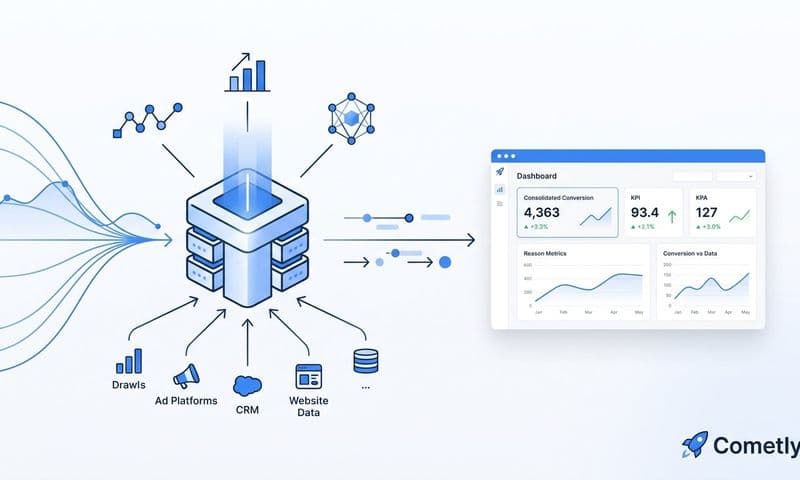
Omnichannel marketing analytics is the framework that fixes this. It unifies data from every channel, every touchpoint, and every stage of the buyer journey into a single, coherent picture of what is actually driving revenue. This article breaks down what omnichannel analytics really means, why siloed reporting consistently misleads even experienced teams, how attribution connects channel activity to pipeline and revenue, and what it takes to build this capability in practice.
Why Siloed Channel Data Is Costing You Revenue
Picture a typical B2B SaaS marketing team. They're running paid campaigns on LinkedIn and Google, nurturing leads through email sequences, publishing organic content, and retargeting warm audiences on Meta. Each of those channels has its own reporting interface, its own conversion tracking, and its own version of the truth.
The result is a reporting environment where every channel looks like it deserves more credit than it actually earned. Last-click attribution in Google Ads shows search driving conversions. LinkedIn's native analytics claims its ads influenced those same deals. Email reports show opens and clicks from prospects who later converted. When you add up the attributed revenue across every platform, it often exceeds your actual revenue by a wide margin. This is the double-counting problem, and it's endemic to siloed reporting.
But the deeper issue isn't just inflated numbers. It's the decisions those numbers drive. When a channel appears to underperform in isolation, teams pull budget from it. What they don't see is that the channel was playing a critical role earlier in the journey: generating awareness, driving the first click, or keeping a prospect engaged during a long evaluation period. Remove it, and pipeline quietly starts to shrink weeks later, with no clear cause visible in any single dashboard.
The B2B SaaS buyer journey is inherently multi-touch. Buying decisions in this space typically involve multiple stakeholders, extended evaluation timelines, and a mix of self-directed research and sales interaction. A prospect might discover your product through a paid ad, spend weeks reading your content, get retargeted on social, receive a nurture email, and then search your brand name directly before booking a demo. That final branded search click gets the credit in last-click reporting. Every channel that built the relationship before it gets nothing.
This distortion compounds over time. Teams optimize toward the channels that look good in siloed reports, not the channels that are actually moving buyers through the funnel. Budget flows toward bottom-funnel tactics while awareness and consideration channels are starved. The pipeline holds for a while, then gradually weakens as the top of the funnel dries up.
Fixing this requires a fundamentally different approach to measurement, one that treats the buyer journey as a single connected path rather than a series of independent channel interactions.
Defining Omnichannel Marketing Analytics
Omnichannel marketing analytics is the practice of collecting, unifying, and analyzing performance data across every marketing channel to understand how those channels work together to drive conversions and revenue. The key word is "together." This is what separates it from multichannel analytics.
Multichannel analytics measures channels independently. You have a paid search report, a social report, an email report. Each one tells you how that channel performed on its own terms. Omnichannel analytics, by contrast, treats the customer journey as a single continuous path and measures the contribution of each touchpoint within that path. The question shifts from "how did LinkedIn perform?" to "how did LinkedIn contribute to the deals we closed this quarter, and how did it interact with the other channels that also touched those buyers?"
That reframing changes everything about how you interpret data and make decisions.
To make this work, an omnichannel analytics system needs to pull from several core data sources simultaneously. Ad platform data from Google, Meta, LinkedIn, and others provides spend and click-level performance. Website behavior data captures what visitors do after they arrive. CRM data connects leads to pipeline stages and deal values. Server-side conversion events ensure that key actions are captured accurately regardless of browser-level tracking limitations. And revenue data from billing systems connects the entire chain to actual closed business.
When these sources are unified in a single platform, patterns emerge that are invisible in siloed reporting. You can see which channel combinations produce the highest conversion rates. You can identify which awareness touchpoints are most likely to appear in the journeys of your highest-value customers. You can understand how long the average journey takes and which channels are most active at each stage. Understanding the definition of marketing analytics at this level is what separates teams that report on activity from teams that drive revenue decisions.
This is not just a reporting upgrade. It's a strategic capability that allows marketing teams to make resource allocation decisions based on the actual contribution of each channel to revenue, rather than on whichever platform's native reporting makes the strongest case for itself.
Attribution Models: The Engine Behind Omnichannel Measurement
Collecting unified data across channels is the first step. But raw data from multiple sources doesn't automatically tell you which channels deserve credit for a conversion. That's where attribution models come in. An attribution model is the set of rules that determines how credit for a conversion is distributed across the touchpoints in a customer journey. Without a clear model, omnichannel data is just a list of events with no interpretive framework.
Understanding the major model types is essential for any team building an omnichannel analytics practice.
First-touch attribution assigns all credit for a conversion to the very first channel a buyer interacted with. This model is useful for understanding what is generating awareness and driving initial discovery. For B2B SaaS teams trying to evaluate top-of-funnel investments, it provides a clear signal. The limitation is that it ignores everything that happened after that first interaction, including the nurturing, retargeting, and consideration-stage content that moved the buyer toward a decision.
Last-click attribution does the opposite: it gives all credit to the final touchpoint before a conversion. This is the default model in many ad platforms and analytics tools, which is part of why it's so widely used and so consistently misleading for B2B SaaS. In a long sales cycle, the last click is often a branded search or a direct visit, a low-effort action that reflects an already-made decision rather than the influence that drove it. Last-click attribution systematically over-credits bottom-funnel channels and under-credits the awareness and consideration touchpoints that built the relationship.
Linear attribution distributes credit equally across every touchpoint in the journey. This is more balanced than single-touch models and acknowledges that multiple channels contribute to a conversion. The limitation is that it treats all touchpoints as equally important, which is rarely true. A display ad impression and a product demo are not equivalent contributions to a closed deal.
Data-driven attribution uses algorithmic weighting based on actual conversion patterns in your data. Rather than applying arbitrary rules, it analyzes which touchpoints and channel combinations are most strongly correlated with conversions and assigns credit accordingly. For B2B SaaS teams with sufficient conversion volume, this is the most accurate approach because it reflects the reality of your specific buyer journeys rather than a generic assumption about how credit should be distributed.
The right model for your team depends on your data volume, sales cycle length, and what decisions you're trying to inform. Many sophisticated teams use multiple models in parallel, comparing results to understand how different parts of the funnel are performing. Teams that want to go deeper should explore the most common attribution challenges in marketing analytics before committing to a single framework. The goal is not to find the one "correct" model but to use attribution as a lens that reveals the true contribution of each channel within the context of the full customer journey.
Server-Side Tracking and First-Party Data: The Infrastructure Layer
Even the most sophisticated attribution model is only as accurate as the data feeding it. And for many teams, that data has a significant problem: a meaningful share of conversion events are never captured at all.
Browser-based pixel tracking, the traditional method for recording conversions and sending signals back to ad platforms, has become increasingly unreliable. Ad blockers prevent pixels from firing. Safari's Intelligent Tracking Prevention limits cookie lifespans and restricts cross-site data collection. Broader cookie deprecation trends across the industry mean that browser-level tracking will continue to degrade over time. The result is a growing gap between the conversions that actually happen and the conversions that get recorded.
When conversion data is incomplete, attribution is distorted. Channels that drove real conversions appear to underperform because those events weren't captured. Ad platforms receive weak signals and optimize toward the wrong audiences. Budget decisions get made on data that doesn't reflect reality.
Server-side tracking addresses this directly. Instead of relying on a browser pixel to fire and transmit data, server-side tracking sends conversion events directly from your server to the ad platform. This transmission bypasses browser-level restrictions entirely. Conversion APIs, including Meta's Conversion API and Google's Enhanced Conversions, are the primary mechanisms for this. They allow teams to send first-party event data directly to ad platforms with higher accuracy and reliability than pixel-based tracking alone.
For omnichannel analytics, this matters enormously. Accurate cross-channel measurement depends on complete data. If events from even one channel are systematically under-reported, the entire attribution picture is skewed. A channel that appears to be a poor performer may simply be one whose conversions aren't being captured correctly.
First-party data enrichment adds another layer of value here. When the events sent back to ad platforms are enriched with accurate customer data, deduplicated to prevent double-counting, and matched to real conversion outcomes rather than proxy metrics, the ad platforms' machine learning models receive higher-quality signals. This improves audience targeting, lookalike modeling, and bid optimization over time. The platform starts optimizing toward the audiences most likely to become actual customers, not just clicks or form fills.
Server-side tracking and Conversion API integration are not optional add-ons for teams serious about omnichannel analytics. They are foundational infrastructure. Without them, the data layer that powers your marketing attribution analytics will always have gaps that undermine the accuracy of your insights.
From Channel Metrics to Pipeline and Revenue Attribution
Most marketing teams are comfortable measuring channel metrics: impressions, clicks, cost-per-click, MQLs, cost-per-lead. These numbers are easy to pull and easy to report. But for B2B SaaS teams, they are ultimately proxy metrics. They tell you what happened at the top of the funnel. They don't tell you whether any of it translated into pipeline, closed deals, or revenue.
This is where omnichannel analytics delivers its highest strategic value: connecting marketing activity all the way to closed-won revenue.
Revenue attribution works by linking ad spend and channel touchpoints to CRM pipeline stages and ultimately to closed deals. When a prospect who clicked a LinkedIn ad three weeks ago, read two blog posts, received a nurture email, and then booked a demo eventually signs a contract, every touchpoint in that journey should receive appropriate credit based on your attribution model. The result is a view of marketing performance that is grounded in actual business outcomes rather than activity metrics. Teams building this capability should study B2B marketing analytics in depth to understand how pipeline-level measurement differs from standard channel reporting.
This requires integrating your revenue data directly into the analytics layer. Connecting billing data from tools like Stripe to your ad performance data allows you to calculate true ROI by channel. Instead of asking "how many leads did this campaign generate?", you can ask "how much revenue did this campaign contribute to, and what did it cost to generate that revenue?" That is a fundamentally different and more valuable question.
CRM integration is equally important. Pipeline stage data allows you to understand not just which channels drive leads, but which channels drive leads that actually progress through the funnel. A channel that generates a high volume of leads that rarely convert to opportunities is very different from a channel that generates fewer leads with a high close rate. Without revenue attribution, you can't see this distinction.
For growth-stage B2B SaaS teams, this capability changes how marketing is positioned within the organization. When marketing can demonstrate its direct contribution to pipeline and revenue, rather than just reporting on impressions and MQLs, it earns a seat at the table for strategic resource allocation decisions. Budget conversations shift from "how much should we spend on marketing?" to "where should we invest to generate the highest revenue return?"
Building an Omnichannel Analytics Practice: What It Takes
Understanding the concepts behind omnichannel analytics is one thing. Building the capability in practice requires getting several foundational elements right.
Unified data collection is the starting point. Every channel that touches your buyers needs to feed data into a single system. This means connecting your ad platforms, website tracking, CRM, and revenue data through a platform that can ingest and normalize all of it. Fragmented data collection is the root cause of the siloed reporting problem. Solving it requires a deliberate infrastructure decision, not just a new dashboard.
A consistent event taxonomy ensures that conversion events are defined and tracked the same way across every channel. If "lead" means something different in your CRM than it does in your ad platform, your attribution data will be inconsistent. Establishing clear definitions for key events, from first touch to demo request to closed-won, and applying them consistently across your entire data stack is foundational work that pays dividends in reporting accuracy. A well-structured marketing analytics strategy should define these event standards before any platform integrations are built.
A single attribution platform that connects ad platforms to CRM and revenue data is the operational core of an omnichannel analytics practice. This is where the data from all your channels comes together, where attribution models are applied, and where the insights that drive decisions are surfaced. Trying to stitch this together manually across multiple tools is time-consuming and error-prone. A purpose-built platform that handles the integrations and attribution logic removes that burden. Teams evaluating their options should review the leading criteria for choosing a marketing analytics platform before making a commitment.
The AI layer is increasingly central to what makes modern omnichannel analytics platforms valuable. AI can surface patterns across large, multi-channel datasets that would be difficult or impossible to identify manually. It can identify which channel combinations produce the highest conversion rates, flag underperforming campaigns before significant budget is wasted, and recommend budget reallocation based on revenue contribution rather than lead volume. This moves teams from reactive reporting to proactive optimization.
Feeding enriched first-party data back to ad platforms closes the loop. When ad platforms receive high-quality conversion signals via Conversion APIs, their algorithms optimize toward the audiences most likely to convert into actual revenue. Over time, this creates a compounding improvement in ad performance: better signals lead to better targeting, which leads to better conversion rates, which generates even better signals.
The teams that build this capability gain a durable competitive advantage. They spend less on channels that don't contribute to revenue, invest more in the ones that do, and continuously improve their targeting through better data feedback loops. Omnichannel analytics isn't a project you complete. It's a practice you build and refine over time.
The Bottom Line: Attribution as a Revenue Strategy
Omnichannel marketing analytics is not a reporting upgrade. It's a strategic capability that allows B2B SaaS teams to understand the true contribution of every channel, allocate budget with confidence, and connect marketing activity directly to revenue. The teams that build it stop optimizing for proxy metrics and start optimizing for what actually matters: pipeline and closed-won deals.
The foundation is complete, accurate data across every touchpoint. That means server-side tracking to capture events that browser pixels miss, Conversion API integration to send enriched signals back to ad platforms, unified attribution that connects ad spend to CRM and revenue data, and an AI layer that surfaces actionable insights across the full dataset.
Cometly is built to deliver exactly this. It connects your ad platforms, CRM, and revenue data into a single source of truth, applies multi-touch attribution across the full customer journey, and uses AI to identify which campaigns and channels are actually driving revenue. With 70-plus native integrations and end-to-end attribution from first ad click to closed-won revenue, it gives B2B SaaS marketing teams the clarity they need to make smarter budget decisions and scale what works.
If you're ready to move beyond siloed dashboards and start measuring what actually drives revenue, Get your free demo and see how Cometly can transform the way your team tracks, analyzes, and optimizes every channel.