You're spending thousands of dollars every month across Meta, Google, TikTok, and maybe a handful of other platforms. The dashboards are full of numbers. Campaigns are running. Conversions are being reported. And yet, when someone asks you which channels are actually driving revenue, you hesitate.
That hesitation is more common than most marketers admit. The problem is not a lack of data. It is a lack of the right data. Platform-reported metrics tell you what each platform wants you to believe, but they rarely tell you the full story of how a customer actually found you, engaged with your brand, and decided to buy.
This is exactly where attribution data changes everything. When you can see every touchpoint a customer interacted with before converting, you stop guessing about where to put your budget and start making decisions grounded in evidence. You identify what is working, cut what is not, and scale with a level of confidence that platform dashboards alone can never give you.
In 2025 and 2026, this capability has become even more critical. Privacy changes, iOS restrictions, and the ongoing degradation of third-party cookie tracking have created significant gaps in platform-reported data. Marketers who rely solely on what Meta or Google tells them are increasingly operating on incomplete information. This guide walks you through how to use attribution data to optimize ad spend, make smarter budget decisions, and build a system that gets more accurate over time.
Why Most Marketers Are Flying Blind with Their Budgets
Here is a scenario that plays out in marketing teams constantly. You look at your Meta Ads dashboard and it shows 50 conversions. You check Google Ads and it reports 45 conversions. Add up the numbers from every platform you are running, and you might be counting 120 total conversions for a month where your CRM only shows 80 actual customers. Something does not add up.
The reason is straightforward: ad platforms are not neutral observers. They are both the media buyer and the scorekeeper, and they have a financial incentive to take credit for as many conversions as possible. When a customer clicks a Google ad on Monday, then sees a Meta retargeting ad on Thursday, and finally converts on Friday, both platforms claim that conversion. This overlap is not a bug in the system. It is simply how each platform measures its own impact within its own attribution window.
The result is inflated, overlapping numbers that make it nearly impossible to allocate budget reliably. You might be doubling down on a channel that is collecting credit for conversions it barely influenced, while underinvesting in the channel that actually started the customer journey.
Privacy changes have made this problem significantly worse. Since Apple's App Tracking Transparency rolled out with iOS 14.5, mobile tracking has become far less reliable for advertisers. Users who opt out of tracking create gaps in conversion data that platforms attempt to fill with statistical modeling. That modeling is imperfect, and the estimates can vary widely from what actually happened.
Third-party cookie restrictions across major browsers have compounded the issue. Browsers like Safari and Firefox have blocked third-party cookies for years, and Chrome has been moving in the same direction. This means browser-based pixel tracking, which most platforms rely on, misses a growing portion of conversions. What gets reported is a fraction of the full picture.
The real cost of this blind spot shows up in your results. Wasted spend flows toward campaigns that look strong in-platform but contribute little to actual revenue. Channels that genuinely drive conversions get starved of budget because their contribution is harder to see without proper attribution. Learning how to fix attribution discrepancies is essential for reclaiming that lost visibility.
This is not a problem that resolves itself. Without an independent attribution layer that sits above all your platforms and connects data across them, the blind spot only grows as your campaigns become more complex.
Attribution Data Explained: What It Actually Tells You
Attribution data, in practical terms, is the record of every touchpoint a customer interacted with before they converted. It connects the dots between a first ad impression, a website visit, an email click, a retargeting ad, a CRM entry, and a final purchase, giving you a complete picture of the path from stranger to customer.
Think of it like a trail of breadcrumbs. Every time someone engages with your brand across any channel, that interaction gets recorded. A robust customer attribution tracking system assembles those breadcrumbs into a coherent path and then assigns credit to each touchpoint based on the model you choose. That last part, the credit assignment, is where the nuance lives.
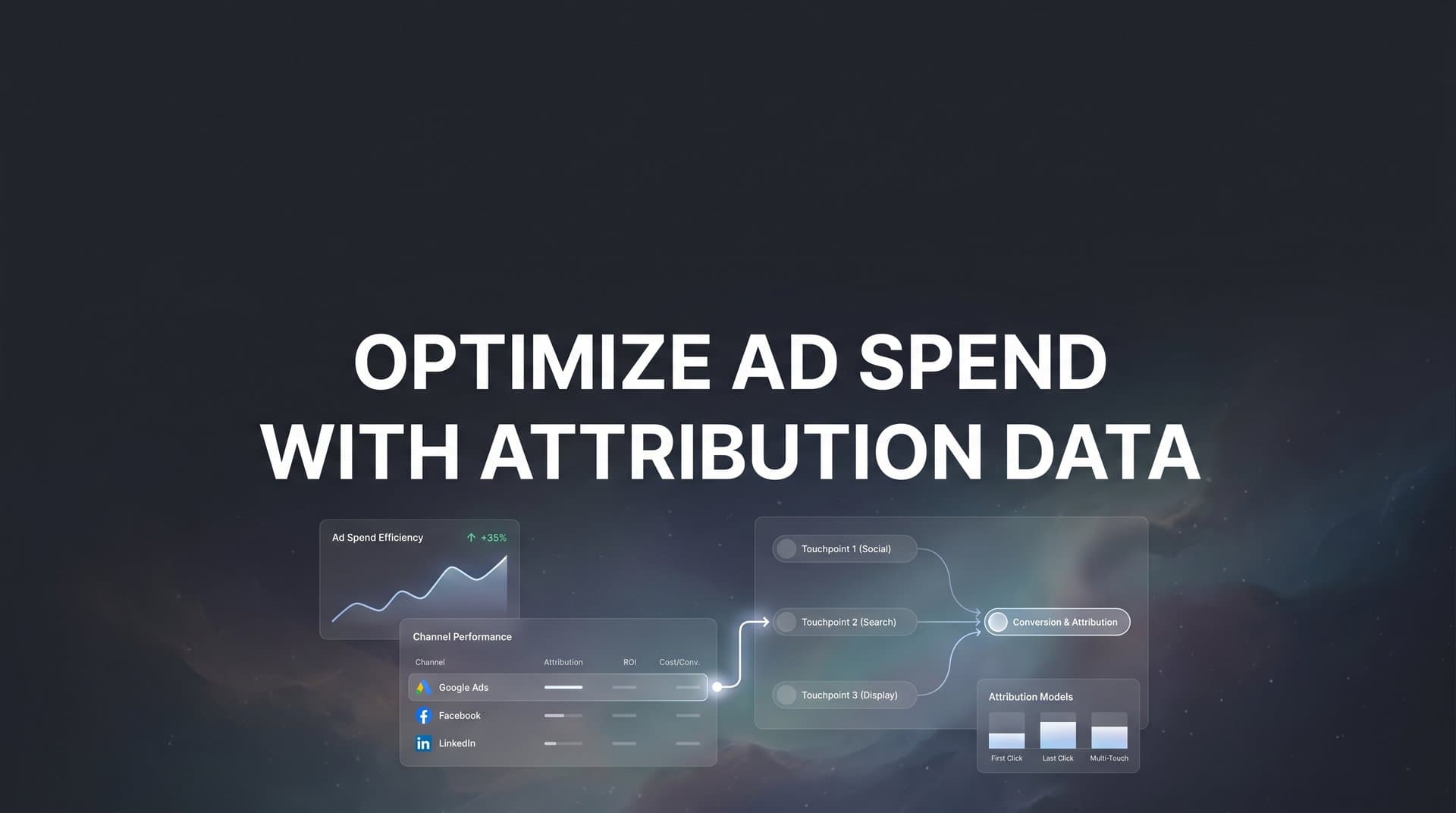
Single-touch attribution models are the simplest. First-click attribution gives all the credit to the very first touchpoint in the journey, which is useful if your primary goal is understanding what drives awareness and initial interest. Last-click attribution, still the default in many platforms, gives all the credit to the final touchpoint before conversion. It is easy to understand but tends to over-reward bottom-funnel channels like branded search while ignoring everything that built interest earlier in the journey.
Multi-touch attribution models distribute credit across multiple touchpoints, and they reveal far more about how your funnel actually works. Linear attribution splits credit equally across every touchpoint. Time-decay attribution gives more credit to touchpoints that occurred closer to the conversion, which makes sense for shorter sales cycles where recency matters. Position-based attribution, sometimes called U-shaped, gives the most credit to the first and last touchpoints while distributing the remainder across the middle, recognizing both the role of initial discovery and the final conversion driver.
Each model tells a different story, and the right one depends on your goals and your sales cycle. For ecommerce with short buying cycles, time-decay or last-click might be appropriate. For B2B with multi-week or multi-month sales cycles, linear or position-based models often reveal more about how awareness and nurturing channels contribute to pipeline.
The critical distinction is between platform-reported attribution and independent, cross-platform attribution. Platform-reported data only shows you what happened within that platform's ecosystem. It cannot see what happened on other platforms, in your CRM, or across devices unless you are using a unified attribution system.
Independent attribution data connects all of these sources into one view. It captures the full customer journey regardless of which platform or channel was involved, eliminates the double-counting problem, and gives you a single source of truth for making budget decisions. That unified view is what transforms attribution from an interesting metric into a genuine optimization tool.
Five Practical Ways to Use Attribution Data for Smarter Budget Decisions
Understanding attribution data is one thing. Using it to actually move budget and improve results is another. Here are five concrete ways to put attribution insights to work.
Reallocate spend based on funnel role, not just conversion credit. Multi-touch attribution reveals that different channels play different roles in the customer journey. Some channels consistently appear as the first touchpoint that introduces customers to your brand. Others show up repeatedly in the middle of the journey, nurturing interest. And some are strong closers that appear just before conversion. Rather than cutting any channel that does not show high last-click conversions, use attribution data to understand each channel's actual role and budget accordingly. A channel that drives strong top-of-funnel entry points deserves investment even if it rarely gets last-click credit.
Identify campaigns that look good in-platform but contribute little in reality. This is one of the most valuable exercises attribution data enables. Pull your cross-channel attribution report and compare it against what each platform is reporting independently. You will often find campaigns or ad sets that show impressive in-platform conversion numbers but appear minimally in multi-touch attribution paths. These are candidates for budget reduction or restructuring. The discrepancy is not a mystery; it is the double-counting effect made visible.
Set channel-specific KPIs that reflect actual funnel position. Once you know which channels drive awareness versus consideration versus conversion, you can stop evaluating them all on the same metric. Holding a top-of-funnel awareness campaign to a direct ROAS standard is a category error. Attribution data lets you define the right success metric for each channel: cost per new user introduction for awareness channels, engagement and return visit rates for consideration channels, and conversion efficiency for bottom-funnel channels. This prevents you from cutting campaigns that are doing exactly what they should be doing.
Use attribution data to inform budget testing cycles. Rather than shifting budget based on gut feeling or platform recommendations, use attribution insights to form a hypothesis and then test it. If attribution data shows that a particular audience segment consistently appears in multi-touch paths but is not being targeted heavily, increase spend there and measure whether it improves overall conversion volume. Attribution data then becomes your feedback loop for validating the test.
Spot diminishing returns before they show up in your ROAS. When you track attribution data over time, patterns emerge. You might notice that as you increase spend on a particular channel, the incremental contribution to multi-touch conversion paths starts to plateau or decline. Choosing the right attribution model for optimizing ad campaigns helps you catch these early signals of diminishing returns that in-platform data often masks until it becomes obvious in your overall numbers.
Building a Reliable Attribution Foundation: Tracking and Data Quality
Attribution data is only as good as the tracking infrastructure underneath it. And in 2025 and 2026, browser-based pixel tracking alone is no longer sufficient to capture a complete picture of your customer journeys.
Server-side tracking has become essential for accurate attribution. Traditional pixel tracking sends conversion data from the user's browser to the ad platform. But ad blockers, cookie restrictions, and iOS privacy settings intercept a significant portion of those signals before they ever reach the platform. The result is systematic under-reporting of conversions, which skews your attribution data and makes optimization harder.
Server-side tracking solves this by sending conversion data directly from your server to the ad platform, bypassing the browser entirely. Because the data travels server-to-server rather than through the user's browser, it is not affected by ad blockers or cookie restrictions. Using the right ad tracking tools recovers conversion signals that would otherwise be lost, giving your attribution model a more complete dataset to work with.
Beyond tracking technology, the quality of your attribution foundation depends on connecting the right data sources. Your ad platforms capture click and impression data. Your website captures behavioral signals. Your CRM captures lead and revenue data. When these systems operate in silos, you can only see fragments of the customer journey. When they are connected into a unified attribution system, you can trace the path from a first ad click all the way through to closed revenue, which is especially important for B2B marketers where the gap between lead and close can span weeks or months.
Connecting your CRM to your attribution data is particularly powerful for understanding true return on ad spend. A well-implemented marketing attribution CRM integration goes beyond surface-level conversion volume, allowing you to evaluate campaigns on lifetime value by tracking what those leads are actually worth in terms of closed revenue.
There is also a compounding benefit to improving your tracking infrastructure: better data fed back to the ad platforms improves their own optimization. When you sync enriched conversion data back to Meta, Google, and other platforms through server-side integrations, their algorithms have more complete information to work with. This improves targeting, lookalike audience quality, and bid optimization. The platforms perform better because they are learning from better data. It is a feedback loop that rewards investment in tracking quality over time.
Platforms like Cometly are built around this principle. By combining server-side tracking with cross-platform attribution and conversion sync capabilities, the entire system gets more accurate and more effective as you use it.
From Data to Action: A Step-by-Step Optimization Workflow
Having attribution data available is not the same as acting on it. The marketers who get the most out of attribution are those who build a repeatable workflow around it, reviewing it consistently and using it to drive specific budget decisions.
Here is a practical weekly or biweekly workflow you can build into your process.
1. Pull your cross-platform attribution report. Start by looking at your unified attribution data for the period, not the individual platform dashboards. You want a view that shows every channel's contribution to conversions based on your chosen attribution model. Look at both assisted conversions and direct conversions for each channel.
2. Compare against in-platform data. Pull the conversion numbers each platform is reporting for the same period. Place them side by side with your attribution data. Look for channels where the in-platform numbers are significantly higher than what your attribution model shows. These discrepancies indicate double-counting or over-attribution by the platform, and they are your most important signal for where spend may be misallocated.
3. Identify your highest-contributing and lowest-contributing channels. Based on your attribution data, rank your channels by their contribution to conversions across the full funnel. Separate top-of-funnel contribution from bottom-of-funnel contribution. This gives you a clear picture of where value is being created and where spend is producing minimal impact.
4. Make specific, measured budget adjustments. Based on your findings, shift budget toward high-contributing channels and reduce spend on low-contributing ones. Avoid drastic changes in a single cycle. Incremental adjustments allow your attribution data to reflect the impact of changes without introducing too many variables at once.
5. Use AI-powered recommendations to surface insights at scale. As your campaign volume grows, manually reviewing every ad set and channel becomes time-consuming. Marketing data analytics software can automatically surface which ads and campaigns are performing strongly across channels and flag underperformers that need attention. This accelerates the workflow significantly and ensures you are not missing optimization opportunities buried in large datasets. Cometly's AI capabilities are designed specifically for this, surfacing recommendations across every channel so you can act quickly.
6. Validate changes in the next cycle. After making budget adjustments, use your next attribution report as the feedback loop. Did the channels you increased spend on show improved contribution? Did reducing spend on low-performers affect overall conversion volume? This iterative process, driven by data-driven attribution rather than platform metrics, is how you build compounding improvements in ROAS and cost per acquisition over time.
Common Mistakes That Undermine Attribution-Based Optimization
Even marketers who invest in attribution tools can undermine their own results by making a few predictable mistakes. Knowing what to avoid is just as important as knowing what to do.
Locking into a single attribution model without comparing models. Every attribution model tells a partial story. If you only look at last-click, you will consistently undervalue your awareness and consideration channels. If you only look at first-click, you will undervalue your closers. The most informed budget decisions come from comparing multiple models and understanding how each one shifts the credit picture. Understanding the difference between single-source and multi-touch attribution is a diagnostic tool rather than picking one model and treating it as absolute truth.
Making drastic budget cuts based on short data windows. Attribution data needs time to capture complete conversion cycles, especially in B2B contexts where a prospect might take six to eight weeks from first touch to close. If you pull a two-week attribution report and cut a channel because it shows low contribution, you may be cutting a channel that plays a strong role in deals that have not yet closed. Give attribution data enough time to reflect your actual sales cycle before making significant budget decisions. For ecommerce, shorter windows may be appropriate. For B2B, longer windows are essential.
Ignoring the feedback loop back to ad platforms. One of the most overlooked aspects of attribution-based optimization is what happens after you collect better data. If you are not syncing enriched conversion data back to your ad platforms, their algorithms continue to optimize on incomplete information. They cannot learn from the full picture of what actually converted. This means that even as your own attribution understanding improves, the platforms are still making suboptimal decisions about who to show your ads to. Closing this loop, by feeding better data back to Meta, Google, and other platforms through server-side integrations, is what allows the entire system to improve together.
Treating attribution as a one-time setup rather than an ongoing practice. Attribution infrastructure needs maintenance. Tracking setups drift over time as websites change, new campaigns launch, and platforms update their APIs. Regular audits of your tracking quality ensure that the data feeding your attribution model remains accurate. If the inputs degrade, the insights will too.
Putting It All Together
Optimizing ad spend is not about spending less. It is about spending smarter. And spending smarter requires knowing what is actually working, which is exactly what attribution data provides.
When you can see every touchpoint in the customer journey, compare it across channels without the distortion of platform self-reporting, and use that information to make specific budget decisions, every dollar you allocate becomes more intentional. You stop rewarding platforms for conversions they did not truly drive, and you start investing in the channels and campaigns that genuinely move customers from awareness to revenue.
The key takeaways from this guide are straightforward. Build a tracking foundation that captures complete data through server-side tracking. Connect your ad platforms, website, and CRM into a unified attribution view. Use multi-touch attribution to understand each channel's true role in the funnel. Build a repeatable workflow around your attribution data rather than relying on platform dashboards. Avoid the common mistakes of short data windows, single-model thinking, and ignoring the feedback loop back to your platforms.
The marketers who build this system are the ones who can scale with confidence rather than anxiety, because they know what is working and why.
If you are ready to move from guesswork to precision, Get your free demo of Cometly today. Cometly gives you the unified attribution view, AI-powered recommendations across every channel, server-side tracking for complete data capture, and conversion sync to feed better information back to your ad platforms. Every tool you need to optimize ad spend with attribution data, all in one place.