
You're running ads on Google, LinkedIn, and Meta. Leads are coming in. Deals are closing. But when someone asks which channel is actually driving revenue, the honest answer is: you're not entirely sure. That's not a strategy problem. It's an attribution problem.
Paid advertising attribution is the mechanism that connects your ad spend to real business outcomes. It answers the question every B2B SaaS marketer should be asking: which campaigns, channels, and touchpoints actually contributed to the deals in your pipeline? Without a reliable answer, budget decisions become guesswork, and guesswork is expensive.
This article breaks down how paid advertising attribution works, why the technical foundation matters more than most teams realize, and how connecting your full funnel from first ad click to closed revenue transforms attribution from a reporting exercise into a genuine growth lever. Whether you're evaluating your current setup or building one from scratch, this is the framework you need.
The Multi-Touch Reality Most Teams Are Ignoring
B2B buying is not a single moment. A prospect might see a LinkedIn ad on a Tuesday, ignore it, then click a Google retargeting ad two weeks later, download a resource, go quiet for a month, and finally book a demo after seeing a Meta ad during a product launch campaign. By the time they become a customer, they've touched your brand across multiple channels, multiple times, over an extended period.
This is the multi-touch reality of B2B SaaS. Buying decisions involve multiple stakeholders, long sales cycles, and a sequence of interactions that unfolds across weeks or months before a deal closes. No single ad deserves all the credit. And yet, without proper attribution, that's exactly what happens.
The most common default is last-click attribution, where the final touchpoint before conversion gets 100% of the credit. It's simple, but it's deeply misleading. It tells you which channel closed the loop, not which channels built the relationship, created awareness, or moved the prospect through the funnel. Channels that do the heavy lifting early in the journey get starved of budget because they never show up as the "converting" source.
The result is predictable: high-performing channels get defunded, underperformers get rewarded, and growth teams make budget decisions based on incomplete data. Campaigns that look like losers in a last-click view might be the primary drivers of pipeline when you look at the full journey. Campaigns that look like winners might just be capturing demand that other channels created.
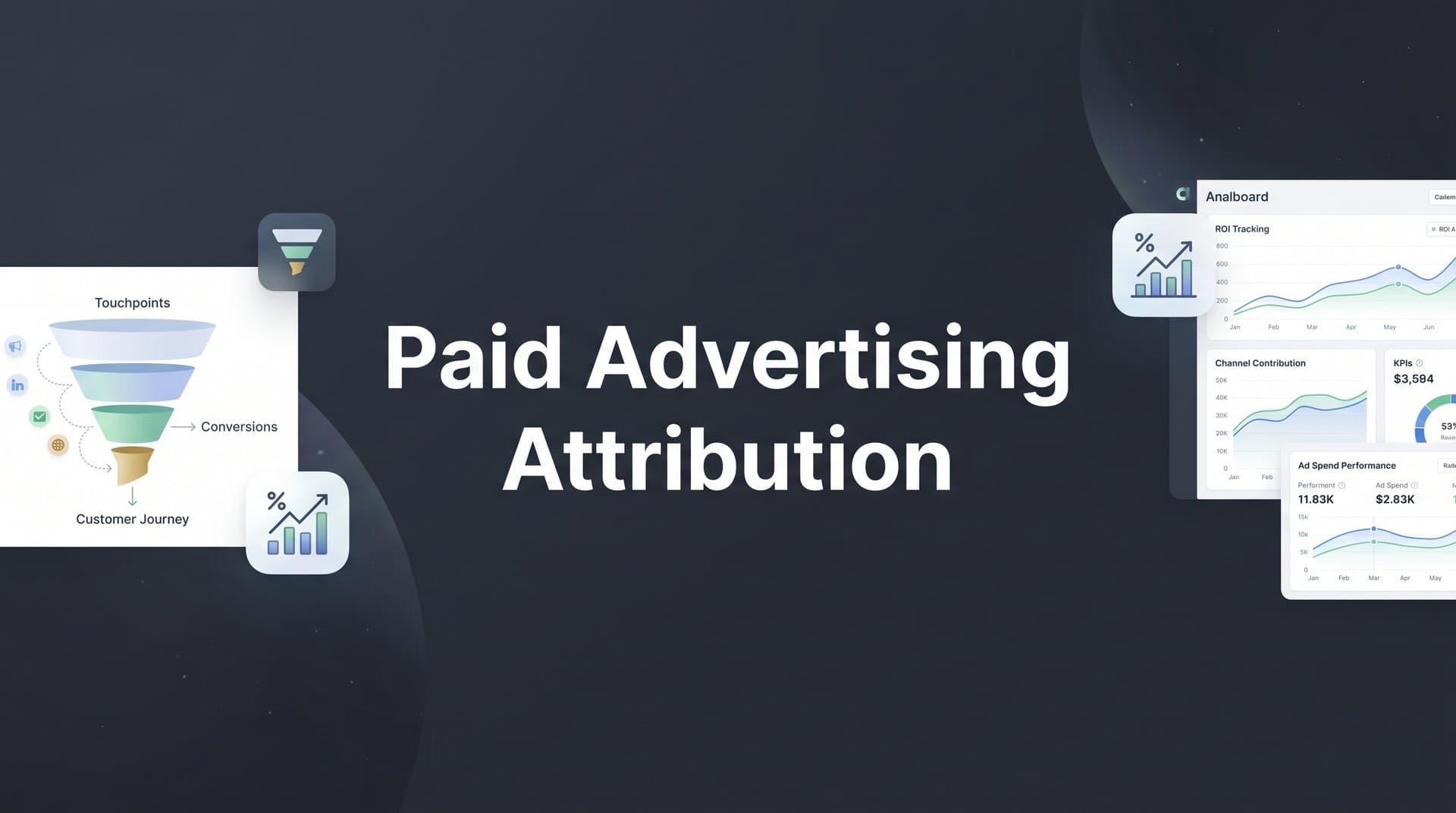
This is the problem attribution is actually solving. It reconstructs the customer journey as a sequence of trackable touchpoints and assigns credit across that journey in a way that reflects how buying decisions actually happen. The goal is not just to know which channel got the final click. It's to understand which combination of channels, campaigns, and messages moves prospects from unaware to closed-won.
When you have that visibility, every budget decision becomes more defensible. You stop funding channels because they feel right and start funding them because the data shows they work. Understanding single source versus multi-touch attribution models is the first step toward making that shift.
How Paid Advertising Attribution Works
At its core, paid advertising attribution works by capturing data at every touchpoint in the customer journey and then connecting those touchpoints to downstream outcomes. The mechanics involve three main components: tracking technology, attribution windows, and funnel-level data integration.
Tracking technology is what captures touchpoint data in the first place. UTM parameters appended to ad URLs tell your analytics platform where a visitor came from, which campaign they clicked, and which ad creative they engaged with. Tracking pixels placed on your website fire when specific events occur, such as a page view, a form submission, or a demo booking. These signals feed your attribution system with the raw data it needs to reconstruct the customer journey.
Server-side event tracking takes this further by sending conversion data directly from your server to ad platforms, bypassing the browser entirely. This matters more than ever given the limitations of client-side tracking, which we'll address in detail shortly. The key point here is that the quality of your attribution is directly tied to the completeness of your tracking. If touchpoints go uncaptured, the journey has gaps, and attribution becomes inaccurate.
Attribution windows define which touchpoints are eligible for credit. A 7-day click window means that if a prospect clicked an ad and converted within 7 days, that ad gets credit. A 30-day window expands the eligible period. The window length you choose has a significant effect on what your data shows. Shorter windows can make certain channels look less effective than they are, particularly for B2B SaaS where the path from first touch to conversion often spans weeks. Choosing the right window for your sales cycle is not a minor detail. It shapes the conclusions you draw from your attribution data.
The third component is funnel-level integration: connecting ad platform data to the outcomes that actually matter for your business. Most ad platforms report on clicks, impressions, and platform-reported conversions. But those metrics stop at the surface. True paid advertising attribution connects ad data to leads, pipeline stages, and closed revenue. It answers not just "did someone click?" but "did that click eventually turn into a deal?"
This connection requires integrating your ad platforms with your CRM and, ideally, your billing or revenue data. When those systems talk to each other, attribution can follow a prospect all the way through the funnel, from the first ad interaction to the moment a deal closes. That's where attribution stops being a vanity metric and starts being a revenue intelligence tool. The best marketing attribution platforms for revenue tracking are built specifically to make this connection seamless.
Attribution Models Compared: Choosing the Right Credit Framework
Once you have touchpoint data, you need a model to decide how credit gets distributed across those touchpoints. Different attribution models answer different questions, and choosing the wrong one can lead you to systematically misunderstand your channel performance.
First-Touch Attribution: All credit goes to the first interaction a prospect had with your brand. This model is useful for understanding which channels are best at generating awareness and bringing new prospects into the funnel. Its weakness is that it ignores everything that happened after that initial touchpoint, including the nurturing, retargeting, and bottom-of-funnel pushes that moved the prospect toward a decision.
Last-Touch Attribution: All credit goes to the final touchpoint before conversion. It's simple and easy to implement, which is why it's the default in many platforms. But as discussed earlier, it systematically undervalues upper-funnel channels and overstates the importance of conversion-stage interactions. For B2B SaaS with long sales cycles, this model produces a distorted picture of channel contribution.
Linear Attribution: Credit is distributed equally across all touchpoints in the journey. This model acknowledges the multi-touch reality of B2B buying, but it treats every touchpoint as equally important, which is rarely accurate. A brand awareness impression and a high-intent demo request ad are not equivalent contributions to a closed deal.
Time Decay Attribution: More credit is assigned to touchpoints that occurred closer to the conversion event. The logic is that recency indicates relevance. This model works reasonably well for shorter sales cycles but can undervalue the early-stage touchpoints that first introduced a prospect to your brand, particularly in complex B2B sales where awareness takes time to build.
Data-Driven Attribution: Rather than applying a fixed rule, data-driven models use machine learning to analyze which touchpoint combinations actually correlate with conversions. This is the most sophisticated approach, but it requires sufficient conversion volume to produce reliable results. For teams with lower conversion numbers, the model may not have enough data to generate meaningful insights.
The most important practice is not picking one model and treating it as gospel. Comparing models side by side reveals more than any single model can show on its own. When first-touch and last-touch tell very different stories about a channel's performance, that tension is informative. It tells you that the channel plays a different role depending on where you look in the funnel, which is exactly the kind of nuance that drives smarter budget decisions.
The right model depends on your sales cycle length, your funnel complexity, and the specific question you're trying to answer. Use first-touch to evaluate awareness campaigns. Use time decay for shorter cycles. Use data-driven when you have the volume to support it. A detailed comparison of attribution models for marketers can help you determine which framework fits your specific funnel. And always compare.
Server-Side Tracking and First-Party Data: The Modern Attribution Foundation
Here's a problem that's quietly undermining attribution for many B2B SaaS teams: a significant portion of your ad touchpoints are never being recorded. Not because the tracking wasn't set up, but because the browser-based tracking that most teams rely on has become increasingly unreliable.
Apple's App Tracking Transparency framework, introduced with iOS 14.5, required apps to request user permission before tracking activity across other apps and websites. The opt-in rate for tracking turned out to be low, which meant that a large share of iOS user behavior stopped flowing into ad platform reporting. Meta's pixel-based attribution was hit particularly hard, with reported conversions dropping substantially for many advertisers.
At the same time, ad blockers have become widespread, and many of them block tracking pixels by default. Third-party cookies, which have long been a backbone of cross-site attribution, are being phased out across major browsers. The cumulative effect is a growing gap between what actually happens in your funnel and what your tracking technology is able to capture.
When touchpoints go unrecorded, attribution breaks down. Campaigns that are driving real results look underperforming in your data. Budget gets pulled from channels that are actually working. The decisions you make based on that incomplete data are systematically biased toward the wrong conclusions. These are among the most damaging common attribution challenges in marketing that teams face today.
Server-side tracking addresses this directly. Instead of relying on a browser-based pixel to fire and report a conversion, server-side tracking sends event data directly from your server to ad platforms using Conversion APIs, such as Meta's Conversion API (CAPI) or Google's Enhanced Conversions. Because this happens at the server level, it bypasses ad blockers, cookie restrictions, and browser privacy settings entirely.
The result is higher match rates between your conversion events and the ad interactions that drove them. Ad platforms receive richer, more complete data, which improves their ability to optimize campaigns and attribute conversions accurately. First-party data, collected directly from your own systems rather than through third-party cookies, is not subject to the same browser-level restrictions and gives you a durable foundation for attribution that won't erode as privacy changes continue.
For B2B SaaS teams serious about accurate paid advertising attribution, server-side tracking is no longer optional. It's the infrastructure layer that makes everything else reliable. Without it, you're building attribution on a foundation that has already started to crack. Understanding how Facebook Ads attribution works in a post-iOS world illustrates exactly why this infrastructure shift is so critical.
From Ad Click to Closed Revenue: Connecting the Full Funnel
Most attribution setups stop at the lead. An ad gets credit when someone fills out a form or books a demo. That's a starting point, but for B2B SaaS, it's not the finish line. A lead is not revenue. And in B2B, lead quality varies dramatically by channel, campaign type, and audience segment.
A channel that generates a high volume of leads might look excellent in a lead-level attribution view. But if those leads have low close rates, long sales cycles, or small deal sizes, the actual revenue contribution of that channel is far lower than it appears. Meanwhile, a channel generating fewer but higher-quality leads might look like an underperformer when measured by volume alone.
This is why true paid advertising attribution for B2B SaaS requires connecting ad platform data all the way to CRM data and revenue data. When you can see not just which campaigns generated leads, but which campaigns generated pipeline, which generated opportunities, and which generated closed-won revenue, you're working with a fundamentally different and more accurate picture of channel performance. The best marketing attribution tools for B2B SaaS companies are purpose-built to surface exactly this kind of full-funnel visibility.
Integrating CRM data with your attribution platform allows you to track how leads from each campaign progress through the sales funnel. Integrating revenue data, such as from Stripe or your billing system, allows you to assign actual deal value back to the campaigns that sourced those customers. At that point, you can calculate true return on ad spend at the campaign level, not just cost per lead.
This is the concept of a single source of truth for marketing data. Rather than switching between your ad platform dashboards, your CRM, and your revenue reporting to piece together a picture of performance, everything is visible in one place. Ad spend, pipeline stage, deal value, and closed revenue are connected and queryable together.
For growth teams making budget decisions, this visibility changes the conversation. Instead of debating which channel "feels" like it's working, you can show exactly which campaigns generated the revenue in your pipeline and make allocation decisions accordingly.
Putting Paid Attribution to Work: Decisions It Should Drive
Attribution is only valuable if it changes how you act. The goal is not a more detailed report. The goal is better decisions, made faster, with more confidence. Here's what accurate paid advertising attribution should actually enable.
Confident Budget Reallocation: When attribution connects ad spend to pipeline and revenue, budget decisions stop being political and start being data-driven. You can see which channels are generating deals at an acceptable cost and shift spend accordingly. Channels that look expensive on a cost-per-click basis might look excellent on a cost-per-revenue basis. Attribution gives you the lens to see the difference.
AI-Powered Pattern Recognition: Human analysts can review campaign performance and draw conclusions, but they can only process so much data at once. AI-powered attribution analysis can surface patterns across thousands of ad variations, audience segments, and channel combinations simultaneously. It can identify which creative formats are driving pipeline, which audience segments have the shortest time-to-close, and which campaign structures are generating the highest revenue per dollar spent. These are insights that manual analysis would miss or take too long to surface. Mastering analytics for paid campaigns is what separates teams that react to data from teams that act on it proactively.
Better Signals for Ad Platform Algorithms: When you send enriched, conversion-ready event data back to Meta, Google, and other ad platforms, their optimization algorithms get better inputs to work with. Instead of optimizing toward surface-level signals like clicks or form fills, the platforms can optimize toward the conversion events that actually matter to your business, such as qualified leads, opportunities, or closed revenue. This creates a compounding effect: better data leads to better optimization, which leads to better campaign performance, which generates more data to feed back into the system.
Attribution as a Decision Engine: The teams getting the most value from attribution are not using it as a reporting exercise. They're using it as an active decision-making engine. Every budget cycle, every campaign launch, and every creative test is informed by attribution data. Over time, this creates a compounding advantage. Each decision is slightly better than the last because it's built on a more complete picture of what actually drives revenue.
This is the operational posture that separates teams that scale efficiently from teams that spend more to grow more. Attribution is the mechanism that makes scaling intelligent rather than just expensive.
The Bottom Line on Paid Advertising Attribution
Paid advertising attribution is not a nice-to-have for B2B SaaS teams. It's the foundation that makes every other marketing decision more reliable. Without it, you're allocating budget based on incomplete data, undervaluing channels that build pipeline, and making growth bets you can't actually justify.
The progression matters: start by understanding the multi-touch reality of your customer journey. Build tracking infrastructure that captures every touchpoint reliably, including server-side events that bypass the browser-level gaps that are silently corrupting your data. Choose attribution models that match your sales cycle and the questions you're actually trying to answer. Then connect your ad data all the way to closed revenue so that every budget decision is grounded in what's actually driving your business forward.
That full-funnel visibility, from first ad click to closed-won deal, is exactly what Cometly is built to deliver. It connects your ad platforms, CRM, and revenue data into a single source of truth, tracks every touchpoint with server-side precision, and uses AI to surface the patterns and recommendations that drive smarter scaling decisions.
If you're ready to stop guessing and start making attribution work as an active growth engine, Get your free demo today and see how Cometly connects every touchpoint to the revenue outcomes that matter.