Digital advertising did not get harder because marketers lost their edge. It got harder because the underlying data infrastructure that powered a decade of performance marketing was quietly dismantled, piece by piece, by browser vendors, mobile operating systems, and ad platforms responding to a global shift in privacy expectations.
If your conversion numbers look lower than they should, your cost-per-acquisition keeps climbing, or your attribution reports feel increasingly disconnected from what your CRM is telling you, you are not imagining it. The tracking environment that most ad platforms were built on has fundamentally changed. And unlike a platform algorithm update or a seasonal performance dip, this one does not reverse itself.
This article is a practical guide for B2B SaaS marketers who want to understand what changed, why it matters more for their business model than for most, and what a durable response actually looks like. We will cover the major privacy updates that triggered this shift, how signal loss distorts your reporting, and the technical and strategic moves that separate teams who are adapting from those who are flying blind.
The Privacy Shift That Rewired Digital Advertising
The disruption did not happen all at once. It arrived in waves, each one eroding a different layer of the tracking infrastructure that digital advertisers had come to depend on.
The most significant single event was Apple's introduction of App Tracking Transparency (ATT) with iOS 14.5 in 2021. ATT required apps to ask users for explicit permission before tracking them across other apps and websites. Opt-in rates across most markets came in well below what ad platforms had historically assumed, which meant that a substantial portion of mobile ad activity suddenly became invisible to platforms like Meta. The volume of mobile signals available for attribution dropped sharply, and it has not recovered.
Browser-level changes compounded the problem. Safari and Firefox had already been blocking third-party cookies by default for years before Apple's mobile move. Google's Chrome, which holds the largest share of global browser usage, has been working through a longer and more complex deprecation timeline, but the direction is not in question. Cross-site tracking through third-party cookies is being phased out across the industry. The only real variable is timing.
What made these changes so disruptive was not any single update in isolation. It was that they collectively dismantled the default tracking infrastructure most ad platforms relied on: pixel-based, cookie-dependent attribution that assumed unrestricted access to browser and device identifiers. That assumption no longer holds.
B2B SaaS companies feel this differently than e-commerce businesses, and it is worth being specific about why. An e-commerce conversion often happens in a single session: a user clicks an ad, lands on a product page, and completes a purchase. The attribution chain is short. Even with some signal loss, there is a reasonable chance the pixel captures the event.
In B2B SaaS, the journey looks nothing like that. A prospect might see a LinkedIn ad, read a blog post, attend a webinar, click a retargeting ad two weeks later, and then finally book a demo after a colleague forwards them a case study. That journey spans multiple sessions, multiple devices, and potentially multiple months. Signal loss at any point in that chain breaks the attribution entirely. And because high-value B2B conversions like demo requests, trial activations, and closed-won deals often happen in environments where browser pixels are unreliable or absent, the data gaps compound at exactly the moments that matter most.
This is not a temporary disruption waiting to resolve itself. It is a structural change in how digital advertising data flows, and understanding it clearly is the first step toward building something more durable in response. Teams navigating this shift can benefit from exploring privacy-compliant tracking alternatives that are designed to work within the new constraints rather than against them.
How Signal Loss Distorts What You See in Your Ad Accounts
Signal loss does not just mean missing data. It means distorted data, and that distinction matters enormously when you are making budget decisions.
When browser-based pixels cannot fire reliably, ad platforms do not simply report fewer conversions and leave it at that. They fill the gaps. Meta has publicly documented that a portion of the conversions reported in Ads Manager are statistically modeled rather than directly observed. The platform uses pattern recognition across available signals to estimate what likely happened when direct measurement was not possible. The result is a reporting environment where real and modeled conversions are blended together, often without a clear way for marketers to distinguish between the two.
This creates a specific and underappreciated problem: your cost-per-acquisition figures may look more favorable than they actually are. If modeled conversions are being attributed to campaigns that are not actually generating those outcomes, you are measuring performance against an inflated baseline. Scaling spend based on those numbers means you are optimizing toward a signal that does not fully reflect reality.
The view-through attribution problem makes this worse. As click-based pixel data degrades, platforms lean more heavily on view-through attribution, crediting ads that a user saw but did not click. View-through attribution has legitimate uses, but when it becomes the dominant signal because click-based tracking has been compromised, it can dramatically inflate the apparent performance of upper-funnel campaigns. A display campaign that contributed nothing to revenue can appear to be a top performer if enough users who later converted happened to have been served an impression.
Last-click attribution compounds the distortion further. When mid-funnel touchpoints go untracked because pixels failed to fire across sessions, the final interaction before conversion gets all the credit by default. In B2B SaaS, that final touchpoint is often a branded search or a direct visit, not the paid campaign that actually initiated the relationship. Teams relying on last-click data in a signal-degraded environment will systematically undervalue the channels doing the early work and overinvest in the ones that simply happened to be present at the end.
The real decision-making risk here is not just wasted budget. It is misallocated budget at scale. A team that believes a particular channel is performing strongly based on in-platform reporting may double down on that channel, pulling resources from campaigns that are actually driving pipeline but are not being credited for it. Over time, this kind of optimization based on incomplete data erodes overall marketing performance improvement in ways that are difficult to diagnose without better measurement infrastructure in place.
The core issue is that privacy updates affecting ad performance do not just reduce what you can see. They change what the data you can see actually means. That is the challenge that requires a structural response, not just a reporting workaround.
Why First-Party Data Has Become the New Foundation
If third-party tracking is the thing that broke, first-party data is the thing that replaces it. But it is worth being precise about what that means in a B2B SaaS context, because the term gets used loosely.
First-party data is data you collect directly from your own customers and prospects, with their knowledge and consent, through your own channels. In B2B SaaS, that includes CRM events like demo requests and opportunity stage changes, form submissions on your website, product signups and activation milestones, and revenue events like subscription starts or expansions. These are signals your business owns and controls, independent of what any browser, device, or ad platform decides to restrict.
The critical difference between first-party data and browser-based tracking is where the data lives and how it travels. Browser pixels depend on the client side: they fire based on what happens in a user's browser, which means they are subject to cookie restrictions, ad blockers, browser privacy settings, and the tracking limitations Apple introduced at the OS level. First-party data collected through your CRM or server-side infrastructure is not subject to any of those restrictions. It exists because your customer took an action in your system, not because a script successfully executed in their browser.
This is why first-party data bypasses the limitations of browser-based tracking in a meaningful way. When you connect a closed-won deal in your CRM back to the ad campaign that sourced the opportunity, you are working with a signal that no browser update can degrade. The connection between the ad exposure and the revenue outcome is established through your own data infrastructure, not through a third-party cookie that may or may not have survived the session. Understanding the full B2B customer journey is essential for identifying which first-party signals carry the most attribution weight.
There is also a compounding strategic advantage for companies that invest in first-party data collection early. Ad platforms like Meta and Google use conversion signals to train their machine learning models for targeting and optimization. Richer, more accurate conversion signals produce better model performance. When you send high-quality first-party conversion data back to these platforms through server-side integrations, you are not just improving your own attribution. You are improving the platform's ability to find and target the users most likely to convert for your specific business. Companies that build this infrastructure earlier accumulate a targeting advantage that grows over time, while competitors relying on degraded pixel data are training platform AI on increasingly noisy signals.
The shift from third-party tracking to first-party data collection is not just a technical adjustment. It is a strategic repositioning that determines how well your advertising actually works in the environment that now exists, not the one that existed five years ago.
Server-Side Tracking and Conversion APIs: The Technical Fix Explained
Understanding the problem is useful. Understanding the technical solution is what actually moves the needle. Server-side tracking and Conversion APIs are the infrastructure layer that makes first-party data actionable in your ad accounts.
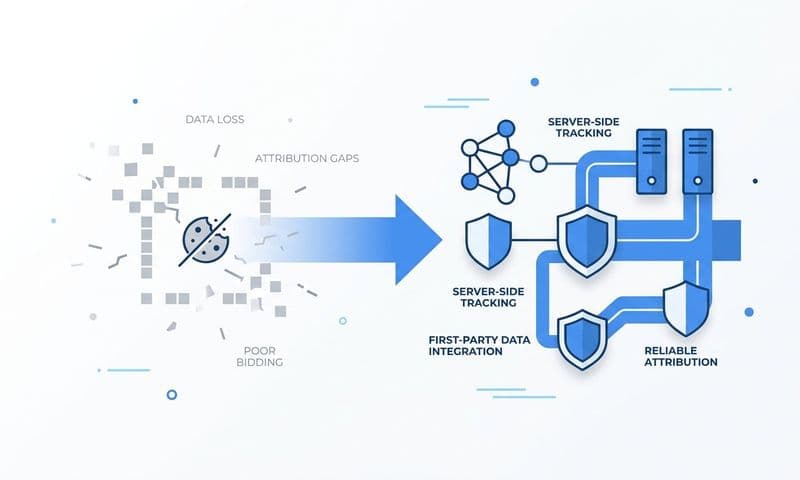
Here is the plain-language version of how server-side tracking works. Traditional pixel-based tracking relies on the browser: when a user completes an action on your website, a JavaScript pixel fires from their browser and sends that event to the ad platform. The problem is that this process can be blocked by browser privacy settings, ad blockers, iOS restrictions, or cookie limitations at any point in the chain. The pixel depends entirely on what the browser allows it to do.
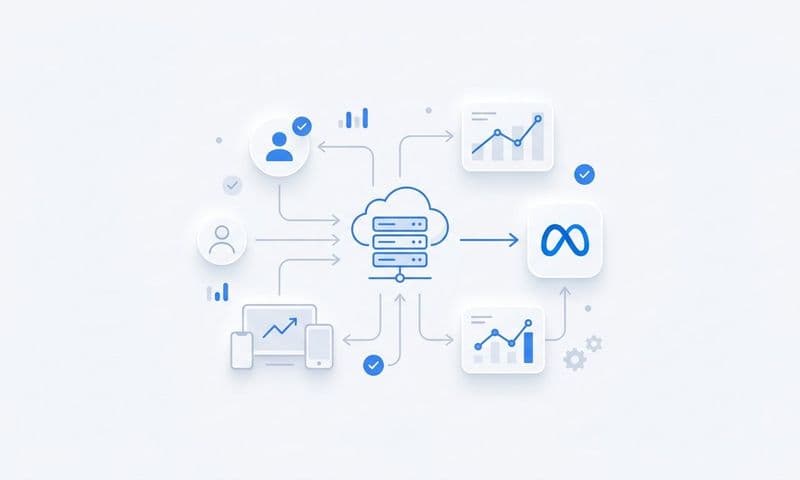
Server-side tracking removes the browser from the equation. Instead of a pixel firing from the user's device, your server sends the conversion event directly to the ad platform's API. The data travels from your infrastructure to the platform's infrastructure, bypassing browser restrictions entirely. Ad blockers cannot intercept it. iOS settings cannot limit it. Cookie deprecation does not affect it. The conversion is recorded based on what happened in your system, not what a browser script was permitted to execute.
Meta's Conversions API (CAPI) and Google's Enhanced Conversions are the two most important implementations of this approach for most B2B SaaS marketers. Meta CAPI allows you to send web events, app events, and CRM events directly from your server to Meta's platform, supplementing or replacing browser pixel data. Google Enhanced Conversions works similarly, using hashed first-party data to match conversions more accurately and fill gaps left by cookie limitations. Both platforms have moved from treating these tools as advanced configurations to treating them as baseline requirements for accurate measurement. Choosing the right performance marketing tracking software is what makes this server-side infrastructure practical to deploy and maintain.
One important technical consideration when implementing server-side tracking alongside existing browser pixels is event deduplication. If both your browser pixel and your server-side event fire for the same conversion, you risk double-counting that conversion in your reporting. Ad platforms handle this through deduplication logic: you pass a unique event ID with both the browser event and the server event, and the platform uses that ID to recognize that both signals refer to the same action and count it only once. Getting deduplication right is essential for preserving data accuracy without inflating your reported conversion numbers.
For B2B SaaS companies specifically, server-side tracking opens up something that browser pixels fundamentally cannot do: it allows you to send CRM-based conversion events back to ad platforms. When a demo request converts to a qualified opportunity, or a trial user becomes a paying customer, those events happen in your CRM, not on a web page where a pixel could fire. Server-side infrastructure is the mechanism that connects those downstream revenue events back to the original ad exposure, completing the attribution chain that browser-based tracking leaves broken.
Attribution Models Under Pressure: Choosing the Right Framework Post-Privacy
Privacy updates have not just reduced the volume of tracking data available. They have exposed something that was always true but easy to ignore: single-touch attribution models are structurally fragile, and signal loss makes that fragility impossible to hide.
Last-click attribution was always a simplification. It assigned all conversion credit to the final touchpoint before a user converted, ignoring everything that happened before it. In an environment where every touchpoint was being tracked reliably, this was at least a consistent simplification. You knew you were undervaluing upper-funnel activity, but the data was at least stable. In a signal-degraded environment, last-click attribution becomes actively misleading. When early and mid-funnel touchpoints go untracked because pixels failed across sessions or devices, last-click does not just undervalue those touchpoints. It erases them from the record entirely. The final interaction gets full credit not because it was the most important, but because it was the only one the tracking system managed to capture.
First-touch attribution has the inverse problem. It over-credits the channel that first introduced a prospect to your brand, which can make awareness campaigns look disproportionately valuable while obscuring the role of mid-funnel nurture and conversion-focused activity.
Multi-touch attribution addresses this by distributing credit across the full set of observed interactions in a customer journey. This makes it inherently more resilient to signal loss. Because it draws on a broader set of touchpoints rather than depending on a single pixel-dependent event, the model can still produce meaningful credit assignments even when some signals are missing. A journey with five observed touchpoints can still be attributed meaningfully if one of them goes untracked. A last-click model with the same missing signal produces a completely wrong answer. For a deeper look at how these frameworks compare, the guide on performance marketing attribution covers the full spectrum of models and their practical trade-offs.
Data-driven attribution takes this adaptability further. Rather than applying a fixed formula for distributing credit, data-driven models use pattern recognition across your available conversion data to assign credit dynamically based on which touchpoints are actually associated with higher conversion rates. This approach is the most adaptive in a privacy-first environment because it does not rely on any single tracking mechanism. It works with the signals that are available and adjusts as the data environment changes.
For B2B SaaS marketers navigating the current landscape, the practical implication is this: if you are still relying on last-click attribution as your primary measurement framework, you are making budget decisions based on a model that was designed for a tracking environment that no longer exists. Moving toward multi-touch or data-driven attribution is not just a measurement upgrade. It is a necessary adjustment to the reality of how digital advertising data actually flows today.
Building a Privacy-Resilient Measurement Stack for B2B SaaS
Understanding the problem and the theory is one thing. Building the infrastructure that actually solves it is another. A privacy-resilient measurement stack for B2B SaaS has a few essential components, and they need to work together as a connected system rather than as isolated tools.
Server-side event tracking: This is the foundation. Browser pixels alone are no longer sufficient for accurate attribution. You need server-side infrastructure that captures conversion events from your web properties and sends them directly to ad platform APIs, bypassing browser restrictions. This applies to web events, but more importantly for B2B SaaS, it applies to CRM events that happen entirely outside the browser environment.
CRM integration: The most valuable conversions in B2B SaaS happen downstream from the initial web interaction. A demo request is a signal. A qualified opportunity is a stronger one. A closed-won deal is the signal that actually matters for revenue attribution. Connecting your CRM to your attribution infrastructure closes the loop between ad clicks and real business outcomes, giving you visibility into which campaigns are actually generating pipeline and revenue, not just form fills. Tracking the right SaaS marketing metrics at each stage of this funnel ensures that your attribution model reflects genuine business impact.
Consistent UTM and naming conventions: Even with server-side tracking in place, campaign-level visibility depends on clean, consistent tagging across every ad platform and channel. A rigorous UTM tracking strategy ensures that when conversion data flows through your attribution system, it can be accurately mapped back to the specific campaign, ad set, and creative that generated it. This sounds operational, but it is the layer that makes everything else interpretable.
A centralized attribution layer: Individual ad platforms report in ways that serve their own interests. Meta Ads Manager, Google Ads, and LinkedIn Campaign Manager each use their own attribution windows, models, and conversion definitions. When you rely on each platform's native reporting, you get a fragmented, often contradictory picture. A centralized attribution platform sits above all of these, pulling data from ad platforms, your CRM, and your revenue systems into a single source of truth that is not dependent on any one platform's increasingly modeled reporting.
This is where Cometly fits into the stack. Cometly is built specifically for B2B SaaS teams who need to connect ad spend to pipeline and revenue without relying on browser pixels or platform-native reporting. It captures every touchpoint from the first ad click to closed-won revenue, integrating with your ad platforms, CRM, and revenue data to give you a complete view of the customer journey. It sends enriched, conversion-ready events back to Meta and Google, improving the quality of the signals those platforms use for targeting and optimization. And it surfaces AI-driven recommendations that help you identify which campaigns and channels are actually driving results, so you can scale with confidence rather than guesswork.
The goal of this stack is not to recreate the tracking environment that existed before privacy updates changed everything. It is to build something more durable: a measurement infrastructure that is grounded in first-party data, connected across your entire revenue funnel, and resilient to whatever the next round of privacy changes brings.
Putting It All Together: Your Path Forward
Privacy updates affecting ad performance are not a temporary obstacle that will resolve itself when platforms find a workaround. They reflect a durable shift in how digital advertising data flows, driven by changes at the OS level, the browser level, and the regulatory level that are not going to reverse. The tracking environment that most ad platforms were built on is not coming back.
The marketers who adapt by investing in first-party data infrastructure, server-side tracking, and multi-touch attribution will have a measurable advantage over those still relying on browser pixels and platform-native reporting. Not because they found a clever hack, but because they built their measurement on signals that are actually durable: data they own, collected through infrastructure they control, connected to revenue outcomes they can verify.
Looking forward, the companies with the strongest first-party data foundations will be best positioned to scale ad spend with confidence. As privacy standards continue to evolve, the gap between teams with robust attribution infrastructure and those without it will widen. The time to build that foundation is now, before the next wave of signal loss makes the gaps even harder to close.
Ready to connect every ad dollar to real revenue? Get your free demo and see how Cometly helps B2B SaaS teams capture every touchpoint, eliminate attribution blind spots, and scale what actually works.