Here is a tension that plays out inside nearly every B2B SaaS company at some point: marketing is celebrating a record month for leads while sales is complaining that none of them are closing. Both teams are working hard. Both teams have dashboards full of green numbers. Yet revenue is not growing the way the board expected. Sound familiar?
This is the misalignment problem, and it is one of the most common reasons B2B SaaS companies struggle to scale efficiently. When sales and marketing optimize for their own metrics in isolation, the business pays the price in wasted budget, bloated sales cycles, and forecasts that never quite materialize.
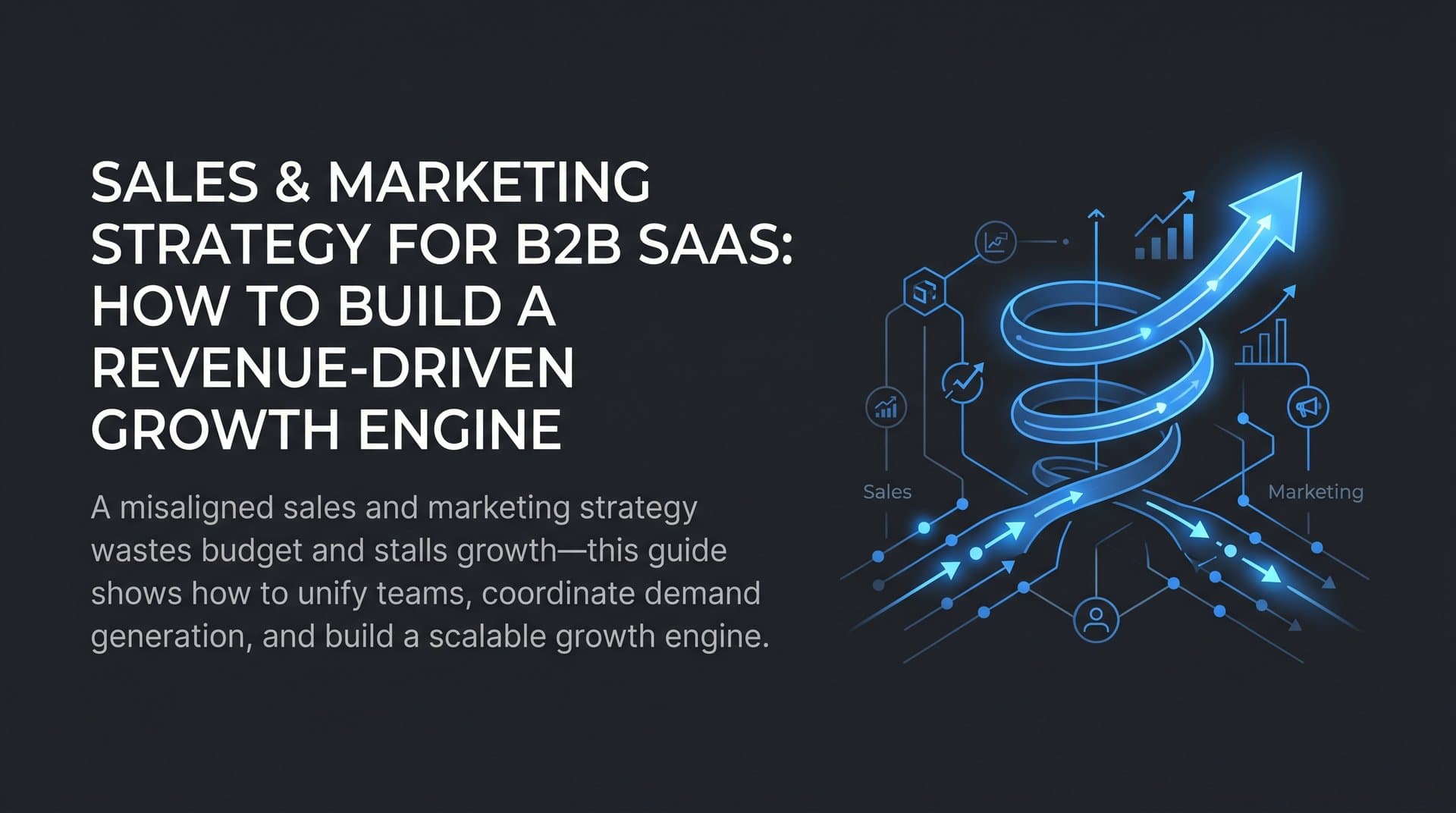
Building a sales and marketing strategy for B2B SaaS that actually works requires treating revenue as a shared goal, not a handoff. It means coordinating demand generation, pipeline development, attribution, and measurement into a single operating system where both teams can see the same data and make decisions from the same playbook.
This article breaks down exactly how to build that system. We will cover why B2B SaaS requires a fundamentally different approach than other business models, how to construct the strategic foundation, which demand generation channels deliver results, how to align the sales motion to pipeline quality, and how to use attribution to connect every dollar of ad spend to actual revenue outcomes.
Why B2B SaaS Demands a Different Playbook
Most traditional sales and marketing frameworks were built for transactional businesses where a single buyer makes a quick decision. B2B SaaS does not work that way. Buying cycles often span weeks or months, involve multiple stakeholders across different functions, and require building consensus before anyone signs a contract.
Think about what that means for your strategy. Marketing cannot hand off a single contact and call it a qualified lead. Sales cannot expect a two-call close on a mid-market deal. The entire motion needs to be designed around multi-touch journeys where multiple personas are being nurtured simultaneously, each with different concerns and different information needs.
The subscription model adds another layer of complexity. Unlike a one-time purchase business, a SaaS company does not fully capture the value of a customer at the point of sale. Revenue is realized over time through renewals, expansions, and upsells. This changes the acquisition cost math entirely. A higher customer acquisition cost can be justified if lifetime value is strong and net revenue retention is healthy. But it also means that acquiring the wrong customers, those who churn early or never expand, destroys unit economics even if the initial sale looked good on paper.
This is why metrics like LTV to CAC ratio, net revenue retention, and expansion MRR are as strategically important as new logo acquisition. Marketing programs that generate high volumes of poor-fit leads can actually damage the business by feeding sales a pipeline that looks full but converts at low rates and churns quickly.
Sales and marketing alignment is not a soft, cultural concept in this context. It is a hard operational requirement. When both teams share a common definition of a qualified lead, agree on which accounts to prioritize, and look at the same funnel data, the downstream effects are measurable: shorter sales cycles, higher win rates, and more accurate forecasting. When they do not, you get the scenario described at the top of this article: lots of activity, not enough revenue.
Building the Foundation: ICP, Positioning, and Funnel Architecture
Before you spend a dollar on ads or send a single outbound sequence, you need three things locked in: a precise ideal customer profile, clear positioning, and a funnel architecture that maps the buyer journey from first awareness to closed revenue.
The ideal customer profile is the strategic starting point for both sales and marketing. Without it, marketing generates volume without quality and sales wastes time on prospects who will never convert. A strong ICP goes beyond basic firmographics like company size and industry. It incorporates technographic signals (what tools the company already uses), behavioral patterns (how they engage with content or product trials), and revenue potential (whether the deal size and expansion opportunity justify the acquisition investment).
The practical value of a well-defined ICP is that it creates a shared filter. Marketing uses it to target campaigns. Sales uses it to qualify inbound and prioritize outbound. When both teams are working from the same ICP definition, the leads that marketing generates are the leads that sales wants to work.
Positioning determines how your product is framed against every alternative a buyer is considering, including doing nothing. In a crowded SaaS market, generic messaging fails. Buyers are sophisticated. They have seen dozens of tools that claim to solve their problem. Strong positioning articulates a specific outcome for a specific type of buyer in language that resonates with their actual situation. This makes ad creative more compelling and sales conversations more focused, because both are anchored to the same differentiated value proposition.
Funnel architecture maps the stages a prospect moves through on the way to becoming a customer. For B2B SaaS, this typically means awareness, consideration, evaluation, and decision. Each stage requires different content, different messaging, and different sales motions. A prospect in the awareness stage needs content that helps them understand the problem category. A prospect in the evaluation stage needs comparison content, proof points, and access to a trial or demo. Treating all prospects the same regardless of where they are in the journey is one of the most common reasons conversion rates underperform.
Getting these three elements right before scaling any channel is the difference between building on a solid foundation and pouring budget into a leaky funnel.
Demand Generation Channels That Actually Work for B2B SaaS
Paid media for targeted reach: LinkedIn Ads, Google Ads, and increasingly other platforms play a central role in scalable demand generation for B2B SaaS. LinkedIn's targeting capabilities, including job title, seniority, company size, and industry, make it particularly effective for reaching enterprise and mid-market buyers. It works well for top-of-funnel brand and category awareness campaigns where you are trying to get in front of specific personas before they are actively searching. Google Ads captures demand that already exists, reaching buyers who are actively searching for solutions in your category. The key is matching channel selection to where your ICP actually spends time and what stage of the buying journey they are in.
Content marketing and SEO for compounding organic demand: Content is how B2B SaaS companies build sustainable, long-term demand without full dependence on paid acquisition. The most effective approach maps content to buying stages. Top-of-funnel content addresses the broad pain points your ICP is experiencing. Middle-of-funnel content helps them evaluate solutions. Bottom-of-funnel content, including comparison pages, ROI frameworks, and detailed product use cases, supports the final decision. SEO-driven content compounds over time, generating qualified traffic months and years after publication.
Account-based marketing for high-value accounts: ABM flips the traditional funnel by starting with a defined list of target accounts rather than casting a wide net and filtering down. Marketing and sales agree on which accounts represent the highest potential, then coordinate personalized, multi-channel outreach to those specific companies. ABM is especially effective for enterprise B2B SaaS where deal sizes justify the investment in highly tailored campaigns. It also naturally forces the sales and marketing alignment that the broader strategy requires, because both teams are working the same account list with shared visibility into engagement.
The most effective demand generation programs combine all three of these approaches in a coordinated way. Paid media generates immediate pipeline. Content builds long-term organic reach and nurtures prospects through the funnel. ABM concentrates resources on the highest-value opportunities. The common thread across all three is that they work best when anchored to a precise ICP and measured against pipeline and revenue outcomes, not just lead volume.
The Sales Motion: From Pipeline to Closed-Won
Demand generation gets prospects into the funnel. The sales motion is what converts them into customers. In B2B SaaS, there is no single right sales motion. The approach that works depends on your product, your market, and your deal size.
Product-led growth has become a well-established motion where the product itself drives adoption and creates qualified signals for sales. A prospect signs up for a free trial, engages deeply with a specific feature, invites teammates, and starts hitting usage limits. These behavioral signals indicate genuine buying intent. Sales teams that monitor PLG signals and prioritize outreach to high-engagement accounts convert at significantly higher rates than those working cold outbound lists. For companies with a self-serve product, PLG can also generate revenue without direct sales involvement at the lower end of the market, freeing sales resources for larger opportunities.
Sales-led growth relies on SDRs and BDRs to qualify inbound leads and drive outbound prospecting. This motion is more resource-intensive but is often necessary for enterprise deals where the buying process is complex and the product requires more hands-on evaluation. Many mature SaaS companies run a hybrid model, using PLG signals to prioritize sales outreach and inform where reps should focus their time.
Pipeline velocity is the metric that connects marketing's demand generation work to actual sales outcomes. It measures how quickly deals move through stages and at what deal value. When marketing teams understand pipeline velocity, they can optimize their programs for deal quality rather than just lead volume. A campaign that generates fewer leads but higher-velocity opportunities is more valuable than one that floods the funnel with poor-fit prospects that stall at the evaluation stage.
Sales enablement is the operational bridge between marketing-generated interest and sales-driven conversion. This includes competitive battlecards, objection handling guides, demo frameworks, and ROI calculators. The most effective enablement materials are built from real buyer conversations. When sales surfaces the objections they hear most often and marketing builds assets that address those objections directly, close rates improve. This feedback loop between sales and marketing is one of the highest-leverage activities in the entire go-to-market system.
Attribution: Connecting Ad Spend to Revenue Outcomes
Here is the question that most B2B SaaS marketing leaders cannot answer with confidence: which campaigns and channels actually drove closed revenue last quarter? Not leads. Not pipeline. Closed revenue.
The reason this question is so hard to answer is attribution. Most companies default to last-click attribution because it is the easiest to implement. Last-click gives all the credit to the final touchpoint before a conversion, which is often a branded search or a direct visit. This systematically undervalues every channel that initiated and nurtured the buying journey, including the LinkedIn campaign that created the first impression, the blog post that brought the prospect back two weeks later, and the webinar that moved them from consideration to evaluation.
Multi-touch attribution distributes credit across all the touchpoints in a buyer's journey, giving a more accurate picture of what is actually working. Different attribution models, including linear, time-decay, and position-based, distribute credit in different ways. The right model depends on your business, but any multi-touch approach is more informative than last-click for understanding the true contribution of each channel and campaign.
Server-side tracking has become increasingly important for accurate attribution. Browser-based tracking through pixels is degraded by ad blockers, iOS privacy changes, and cookie deprecation. When tracking breaks down, ad platforms receive incomplete conversion signals and their optimization algorithms perform worse. Server-side tracking via Conversion APIs, such as Meta CAPI and Google Enhanced Conversions, sends enriched, first-party event data directly from your server to the ad platform. This improves signal quality, which improves ad platform targeting and bidding performance. It is no longer optional infrastructure. It is a competitive requirement.
Revenue attribution closes the loop entirely. Rather than stopping at the lead or opportunity stage, revenue attribution connects CRM data with ad platform data to show which campaigns influenced pipeline creation and which drove closed-won deals. This is the data that makes budget allocation decisions defensible. When you can show that a specific LinkedIn campaign influenced a set of closed deals with a combined contract value that exceeds the campaign spend by a meaningful multiple, you have the evidence to scale that investment. Without revenue attribution, marketing budgets are allocated based on assumptions and gut feel, which is how companies end up over-investing in channels that generate activity but not revenue.
For B2B SaaS companies with long sales cycles, revenue attribution also requires patience. A campaign running today may not show up in closed revenue for three to six months. Building attribution infrastructure that can track touchpoints across that full timeline is what separates companies that make genuinely data-driven decisions from those that only think they do.
Measuring What Matters: Metrics That Drive Smarter Decisions
Not all metrics are created equal. Many of the numbers that marketing teams report regularly, including impressions, clicks, and raw lead volume, tell you what happened but not whether it mattered. The metrics that actually drive smarter decisions in B2B SaaS are further down the funnel.
Pipeline generated by channel: Which channels and campaigns are creating qualified pipeline? This metric connects marketing activity to sales outcomes and is a much stronger signal than lead volume alone.
Cost per qualified opportunity: How much does it cost to generate an opportunity that sales actually wants to work? This filters out the noise of unqualified leads and focuses attention on efficiency at the point where marketing hands off to sales.
Sales cycle length by source: Do leads from certain channels close faster than others? Shorter sales cycles from a particular source suggest better ICP fit and more effective pre-sales education, both of which are signals worth amplifying.
Revenue attributed to marketing programs: The ultimate measure. Which marketing investments are driving closed revenue? This is the number that justifies budget and informs strategic allocation decisions.
Customer acquisition cost and CAC payback period are the financial metrics that determine whether your growth is sustainable. A long payback period signals that either acquisition costs are too high or conversion rates through the funnel are too low. Both point back to strategic gaps that need to be addressed before scaling spend.
A unified marketing dashboard that consolidates data from ad platforms, your CRM, and your website into a single view is the operational tool that makes all of this possible. Without it, marketing and sales leaders are making decisions based on incomplete, siloed data. The result is the kind of misalignment described at the start of this article: two teams looking at different numbers and drawing different conclusions about what is working.
From Strategy to Scalable Growth
The framework described throughout this article follows a logical sequence. Start with ICP and positioning to ensure that every downstream activity is aimed at the right buyers with the right message. Build coordinated demand generation across paid, organic, and account-based channels. Align the sales motion to pipeline quality so that the handoff from marketing to sales is clean and conversion rates reflect genuine buyer fit. Then close the loop with attribution that connects ad spend to pipeline and closed revenue.
The difference between B2B SaaS companies that scale efficiently and those that plateau is rarely budget. It is the quality of their data and the degree of alignment between sales and marketing around shared revenue goals. Companies that invest in the infrastructure to measure what is actually driving results can make compounding improvements over time. Those that operate on assumptions and siloed metrics keep repeating the same mistakes.
This is where Cometly comes in. Cometly is the attribution and analytics layer that makes this entire strategy measurable. It captures every touchpoint across the customer journey, from the first ad click to the closed-won deal in your CRM. It connects ad platform data with revenue data so you can see exactly which campaigns are driving pipeline and which are driving revenue. It feeds enriched, first-party conversion data back to Meta, Google, and other ad platforms through server-side integrations, improving signal quality and ad optimization performance. And it surfaces AI-driven recommendations that help you identify what is working and scale it with confidence.
If you are building or refining a sales and marketing strategy for B2B SaaS and want to move from assumptions to evidence, the first step is getting full visibility into your revenue engine. Get your free demo and see how Cometly connects your ad spend to pipeline and revenue in real time.