B2B SaaS companies pour significant budget into paid ads, content campaigns, and demand generation programs. Yet when the quarter closes, marketing teams often struggle to answer the most fundamental question their CFO or VP of Sales is asking: which of those investments actually drove closed-won revenue?
The problem isn't a lack of data. It's a lack of connected data. Salesforce holds the pipeline story. Ad platforms hold the acquisition story. And most teams are trying to run their business with only half the picture.
This is where the Salesforce journey becomes critical. The Salesforce journey is the structured path a prospect takes from the moment they enter your CRM as a lead through every pipeline stage until they become a paying customer, or don't. Understanding this journey isn't just a CRM hygiene exercise. It's the foundation for proving marketing ROI, optimizing spend, and building the kind of alignment between marketing and sales that actually moves revenue.
In this article, we'll break down what the Salesforce journey is, why it leaves most marketing teams with blind spots, how to map your marketing touchpoints to CRM stages, and how to build the full-funnel visibility that turns attribution data into smarter budget decisions.
The Path From First Touch to Closed-Won: Understanding the Salesforce Journey
At its core, the Salesforce journey is the sequence of tracked stages a prospect moves through inside Salesforce CRM. It begins at lead creation, progresses through qualification and opportunity stages, and ends at either closed-won or closed-lost. Every stage in that sequence represents a distinct signal of buyer intent, and each transition tells you something meaningful about how your pipeline is maturing.
Salesforce structures this journey using a set of core objects. Leads represent unqualified contacts who have shown initial interest but haven't been vetted by sales. Once a lead meets qualification criteria, they're typically converted into a Contact associated with an Account, and an Opportunity is created to track the active deal. Activities, including calls, emails, and meetings, are logged against these records to capture the sales interaction history.
Each of these objects plays a distinct role. The Lead object captures early-stage signals. The Opportunity object tracks deal progression, deal value, expected close date, and stage. The Account object represents the company-level relationship. Together, they give sales teams a structured view of where every prospect stands in the buying process.
Here's where B2B SaaS marketing teams need to pay close attention. The Salesforce journey and the broader B2B customer journey are not the same thing, and confusing the two leads to serious blind spots.
The Salesforce journey is CRM-side data. It tells you what happened after a prospect entered your system: which stages they moved through, how long they stayed in each stage, and whether they ultimately converted. What it doesn't capture by default is everything that happened before that lead was created. Which ad did they click? Which campaign brought them to your site? Which piece of content influenced their decision to fill out your form?
The broader customer journey includes all of those upstream touchpoints: paid search clicks, LinkedIn ad impressions, retargeting sequences, organic content, and direct website visits. This is the marketing story that lives outside Salesforce, spread across ad platforms, analytics tools, and your website.
Smart B2B SaaS teams need both views simultaneously. The Salesforce journey tells you what's converting. The broader customer journey tells you why. When you can connect the two, you stop making decisions based on lead volume and start making decisions based on what actually drives revenue.
Why Salesforce Data Alone Leaves Marketing Teams Without Answers
Salesforce is a powerful tool for managing pipeline and forecasting revenue. But it was designed primarily as a sales tool, not a marketing attribution platform. That distinction matters enormously when marketing teams are trying to justify budget and optimize campaigns.
The core limitation is straightforward: Salesforce captures what happens after a lead enters the CRM, but it rarely captures the full pre-CRM story. Which ad drove the original click? Which keyword triggered the search? Which campaign sequence warmed up the prospect before they converted? Unless your team has explicitly built the infrastructure to capture and pass that data into Salesforce, those questions go unanswered.
This creates a predictable and costly problem. Without upstream marketing data connected to Salesforce stages, marketers default to optimizing for whatever they can measure. And what's easiest to measure is lead volume. So teams scale campaigns that generate a high number of form submissions, even when those leads rarely progress beyond the MQL stage and almost never close.
The result is a familiar tension between marketing and sales. Marketing reports strong lead numbers. Sales complains about lead quality. Both teams are looking at real data, but they're looking at different parts of the same story and drawing incompatible conclusions.
This is the attribution gap. When marketing data and sales data live in separate systems without a bridge between them, budget decisions get made on incomplete information. A paid LinkedIn campaign might generate fewer leads than a broad display campaign, but if those LinkedIn leads convert to closed-won at a dramatically higher rate, the display campaign is wasting budget that should be redirected. You can only see that if you can trace Salesforce outcomes back to specific ad investments.
The attribution gap also affects how teams interact with their ad platforms. Meta and Google optimize their algorithms based on the conversion signals you send them. If you're only sending form submission events, those platforms optimize toward people who fill out forms, not necessarily toward people who become paying customers. The feedback loop is broken at the most important point: closed revenue.
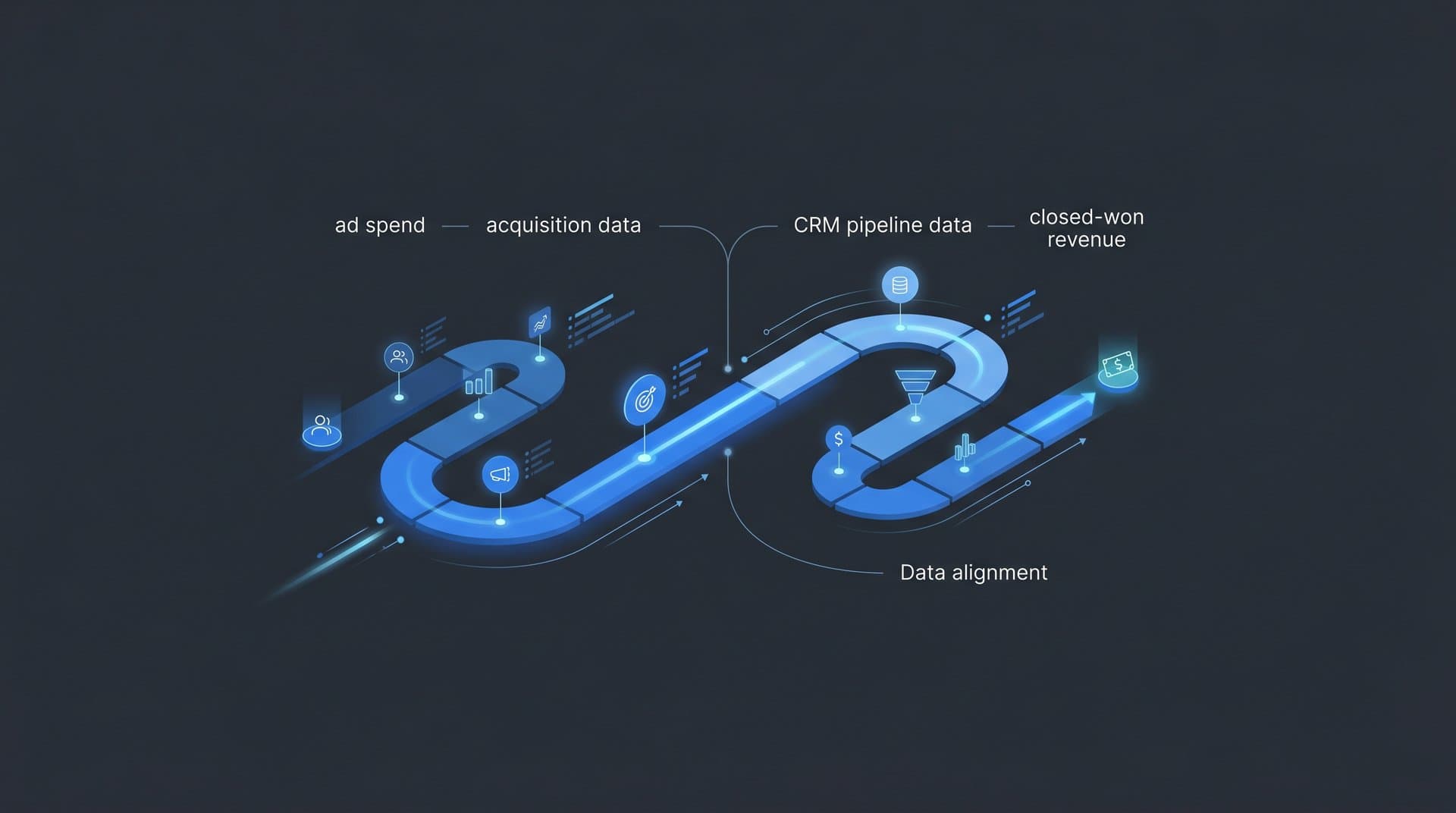
Closing the attribution gap requires connecting the upstream marketing story to the downstream Salesforce story. That connection is what transforms CRM data from a sales reporting tool into a full-funnel marketing intelligence asset.
Mapping Marketing Touchpoints to Salesforce Stages
Once you understand the gap between marketing data and CRM data, the next step is building the bridge. That means mapping specific marketing touchpoints to specific Salesforce stages, so you can understand which marketing activities are driving progression through your pipeline, not just generating initial interest.
Think about how each stage in your Salesforce journey corresponds to a marketing action. A prospect moving from anonymous visitor to Lead is typically triggered by a paid ad click, an organic search visit, or a social media interaction that leads to a form submission. That first touch is often a paid channel: Google Search, LinkedIn Ads, or Meta. The MQL stage, where a lead meets your qualification criteria, often reflects the influence of nurture sequences, retargeting campaigns, or high-intent content like a demo request page.
The SQL stage, where sales accepts the lead as sales-qualified, often correlates with prospects who engaged with multiple touchpoints before converting. They may have clicked a paid ad, returned via organic search, engaged with an email sequence, and then requested a demo. The Opportunity stage reflects active sales engagement, but marketing still plays a role here through sales enablement content, case studies, and retargeting ads that keep your brand visible during the evaluation period. Closed-Won is the outcome every marketing dollar is ultimately working toward.
Multi-touch attribution is the framework that makes this mapping actionable. Rather than giving all credit to the first ad click or the last touchpoint before conversion, multi-touch attribution distributes credit across all the interactions that contributed to a prospect moving through Salesforce stages. This gives you a much more accurate picture of which channels and campaigns are genuinely influencing pipeline progression.
To connect marketing touchpoints to Salesforce records in practice, you need three foundational elements. First, UTM parameters on every ad and campaign link so that traffic sources are tagged and trackable from the moment someone clicks. Second, form tracking that captures those UTM values at the point of submission and passes them into your CRM as lead fields. Third, CRM field mapping that preserves the original source data as a lead converts to a contact and opportunity, so you don't lose the marketing context when Salesforce converts a lead record.
When these three elements are in place, every Opportunity in Salesforce carries a record of the marketing touchpoints that contributed to its creation. You can then analyze which campaigns are producing high-value opportunities, which channels are driving the fastest stage progression, and where in the funnel specific ad investments are having the most impact.
Key Metrics That Reveal How Your Salesforce Journey Is Performing
Understanding the Salesforce journey conceptually is one thing. Diagnosing its performance requires a specific set of metrics that reveal where the journey is flowing smoothly and where it's breaking down.
Stage conversion rates are the foundational diagnostic. These measure the percentage of prospects that move from one Salesforce stage to the next: lead to MQL, MQL to SQL, SQL to Opportunity, and Opportunity to Closed-Won. When you look at these rates together, you can pinpoint exactly where your funnel has a leak. A high lead-to-MQL rate paired with a low MQL-to-SQL rate, for example, suggests that marketing is generating interest but not from the right audience. A high SQL-to-Opportunity rate with a low Opportunity-to-Closed-Won rate points to a sales execution or product-fit issue rather than a marketing problem.
Pipeline velocity is a metric that adds a time dimension to stage conversion analysis. It measures how fast deals move through your Salesforce pipeline, and it's calculated by combining the number of active deals, average deal value, win rate, and average sales cycle length. A declining pipeline velocity often signals a misalignment between the prospects marketing is attracting and the buyers sales is equipped to close. When marketing campaigns pull in leads from audiences that don't match your ideal customer profile, those deals tend to stall in the pipeline rather than progress efficiently.
Revenue attribution metrics connect Salesforce outcomes back to specific marketing investments. Three metrics are particularly valuable here. Cost per pipeline dollar measures how much ad spend it takes to generate one dollar of pipeline value in Salesforce. Marketing-sourced revenue percentage tracks what portion of closed-won revenue originated from a marketing-generated lead, helping you quantify marketing's contribution to the business. Channel-level ROI breaks down the return on investment by specific ad channel, so you can compare the revenue efficiency of LinkedIn versus Google versus Meta rather than evaluating marketing as a single undifferentiated budget line.
These metrics only become available when your CRM data and your ad spend data are connected. Without that connection, you can calculate stage conversion rates inside Salesforce, but you can't tie those outcomes back to specific campaigns or channels. The metrics exist in isolation rather than forming a coherent picture of SaaS marketing performance.
Together, these three layers of measurement give you a complete diagnostic framework: stage conversion rates tell you where the journey breaks down, pipeline velocity tells you how efficiently it's moving, and revenue attribution metrics tell you which marketing investments are driving the outcomes that actually matter.
How to Connect Ad Data to Your Salesforce Journey for Full-Funnel Visibility
Knowing that you need to connect ad data to Salesforce is one thing. Understanding the technical architecture that makes it possible is what separates teams that achieve full-funnel visibility from those that stay stuck in the attribution gap.
The starting point is server-side tracking. Traditional browser-based tracking, which relies on cookies and JavaScript pixels, has become increasingly unreliable. Privacy changes, browser restrictions, and ad blockers mean that a meaningful portion of conversion events never get recorded by ad platform pixels. Server-side tracking bypasses these limitations by sending conversion data directly from your server to ad platforms, rather than relying on the browser to do it.
Conversion API integrations, such as Meta's Conversion API and Google's Enhanced Conversions, are the practical implementation of server-side tracking for your most important ad platforms. When you configure these integrations correctly, you can send Salesforce stage progression events, such as Opportunity Created or Closed-Won, directly back to Meta and Google. This means your ad platforms are no longer optimizing toward form submissions. They're optimizing toward the downstream outcomes that actually matter to your business.
This is a significant shift in how ad platform algorithms work on your behalf. When Meta's algorithm receives Closed-Won signals from Salesforce, it can identify the characteristics of prospects who became paying customers and find more people like them. The targeting improves over time because the feedback loop is closed at the revenue level, not the lead level.
The second component is integrating your CRM with a dedicated attribution platform. This creates a single source of truth where every Salesforce stage event is tied back to the originating ad, campaign, and channel. Instead of toggling between Salesforce reports and ad platform dashboards and trying to manually reconcile the numbers, you have one unified view that connects every touchpoint to every CRM outcome.
Data enrichment is the third element that elevates this architecture from functional to powerful. Enrichment means combining your Salesforce CRM data with ad platform interaction data and website behavior data to create a complete, layered view of each prospect's journey. A CRM record enriched with ad interaction history, page visit sequences, and campaign engagement data gives your marketing team dramatically more signal to work with when evaluating campaign performance and making budget decisions.
Platforms like Cometly are built specifically to create this connected infrastructure for B2B SaaS companies. By linking ad platforms, CRM data, and website behavior in real time, Cometly gives marketing teams the full-funnel visibility they need to move from optimizing for leads to optimizing for revenue. You can learn more about how this works in our guide to Salesforce attribution integration.
Turning Salesforce Journey Insights Into Smarter Marketing Decisions
Full-funnel visibility is only valuable if it changes how you make decisions. The real payoff of connecting your Salesforce journey to your marketing data is the ability to reallocate budget, refine targeting, and optimize campaigns based on what's actually driving closed revenue rather than what looks good in a lead volume report.
The most immediate application is budget reallocation. When you can see which channels and campaigns are producing Opportunities and Closed-Won deals, not just leads, you can make confident decisions about where to increase investment and where to pull back. A campaign that generates high lead volume but low pipeline contribution is consuming budget that could be redirected to a campaign that's consistently producing high-quality opportunities. This kind of reallocation is impossible without the CRM-to-ad-data connection, and it's one of the highest-leverage decisions a B2B SaaS marketing team can make.
AI-driven recommendations add another layer of intelligence to this process. When your attribution platform has access to enriched data that combines Salesforce outcomes with ad interaction history and campaign performance, AI can surface patterns that would be difficult to identify manually. It can flag which campaign segments are trending toward high close rates, identify audience characteristics that correlate with fast pipeline velocity, and recommend budget shifts before underperforming segments drain significant spend. This moves your team from reactive reporting to proactive optimization.
The feedback loop back to ad platforms is where this entire system compounds over time. When Salesforce closed-won events are sent back to Meta and Google via Conversion API, those platforms update their optimization models with your highest-value conversion signals. Over time, their algorithms become better at finding prospects who resemble your actual paying customers rather than just people who fill out forms. The quality of your ad-generated pipeline improves, your cost per closed-won deal decreases, and the entire marketing engine becomes more efficient.
This is the compounding advantage that separates B2B SaaS companies with mature attribution infrastructure from those still relying on last-click attribution and manual reporting. Each closed-won deal fed back into the system makes the next campaign smarter. Each budget reallocation based on real revenue data improves overall marketing efficiency. The Salesforce journey stops being a sales reporting artifact and becomes the engine that drives continuous marketing improvement.
The teams that build this infrastructure early gain a durable competitive advantage. They scale what works faster, cut what doesn't sooner, and align marketing and sales around the metrics that actually reflect business performance.
Putting It All Together: From CRM Stages to Revenue Confidence
The Salesforce journey is only as valuable as the data connected to it. A well-structured CRM with clean pipeline stages is a strong foundation, but it's not a complete picture. The full picture requires connecting every Salesforce outcome back to the marketing touchpoints, ad investments, and campaign sequences that drove it.
When marketing teams can trace every closed-won deal back to the original ad click, they stop guessing about what's working. They stop scaling channels based on lead volume and start scaling based on revenue contribution. They stop defending their budget in quarterly reviews and start bringing the data that proves their impact.
That's the transformation that full-funnel attribution enables: a shift from marketing as a cost center to marketing as a measurable revenue driver.
Cometly is built to close the gap between ad spend and Salesforce revenue. By connecting every touchpoint to every CRM stage in real time, Cometly gives B2B SaaS marketing teams a single source of truth for their pipeline performance. From server-side Conversion API integrations that feed closed-won signals back to Meta and Google, to AI-driven recommendations that surface your highest-performing campaigns, Cometly brings the entire Salesforce journey into focus.
If you're ready to stop optimizing for leads and start optimizing for revenue, it starts with connecting your ad data to your Salesforce pipeline. Get your free demo today and see how Cometly turns your Salesforce journey into your most powerful marketing asset.