Your Meta campaigns are burning through budget. Google Ads shows conversions you can't verify in your CRM. TikTok's dashboard claims success, but revenue tells a different story. You know the problem: browser privacy restrictions have gutted traditional tracking accuracy. iOS updates alone have caused marketers to lose visibility into 30-40% of their conversion data. The solution everyone's talking about? Server-side tracking. But before you dive in, you need to answer the question keeping you up at night: what will this actually cost?
The confusion is real. Ask three vendors about server-side tracking costs, and you'll get three wildly different answers. One quotes $50/month for cloud hosting. Another presents a $15,000 implementation proposal. A third offers a monthly subscription that scales with your ad spend. Meanwhile, you're left wondering which hidden fees will surface later, how much developer time you'll need, and whether this investment will actually solve your attribution problems.
Here's what you need to know: server-side tracking costs aren't one-size-fits-all. Your actual investment depends on your traffic volume, technical resources, and how many ad platforms you're running. This guide breaks down the real numbers—from DIY infrastructure costs to managed solution pricing—so you can budget accurately and choose the approach that makes sense for your team.
Breaking Down the True Price Tag of Server-Side Tracking
Infrastructure costs cover the servers that actually process your tracking data. If you're building your own solution, this means cloud hosting fees from providers like Google Cloud Platform, AWS, or Azure. These platforms charge based on compute resources—how much processing power your server uses—and the number of requests it handles. For a site processing 100,000 monthly sessions, expect baseline hosting costs between $50-200 monthly. But here's the catch: traffic spikes during promotions or seasonal peaks can multiply those costs unexpectedly. Managed solutions bundle infrastructure into their subscription pricing, eliminating the guesswork.
Implementation costs represent the upfront investment to get everything working. This includes configuring your server, connecting it to each ad platform's API (Meta CAPI, Google Enhanced Conversions, TikTok Events API), mapping your conversion events correctly, and testing everything thoroughly. DIY implementation typically requires 40-80 hours of developer time. At standard agency rates of $100-200 per hour, that's $4,000-16,000 in labor costs. Managed platforms handle this setup as part of onboarding, often including it in the first month's subscription or charging a one-time setup fee of $500-2,000. For teams needing hands-on help, an attribution tracking setup service can streamline the entire process.
Ongoing maintenance costs are where many teams underestimate the real investment. Ad platforms update their APIs regularly. Meta changes CAPI requirements. Google modifies Enhanced Conversions specifications. TikTok adds new event parameters. Each change requires updates to your server-side configuration. DIY solutions need ongoing developer time—budget 5-10 hours monthly minimum for maintenance, updates, and troubleshooting. That's another $500-2,000 monthly in developer costs. Managed solutions include these updates automatically, keeping your tracking current without additional technical work.
The hidden costs hit hardest when you're unprepared for them. Platform-specific debugging can consume entire days when conversion events aren't firing correctly. SSL certificate renewals, domain configuration changes, and compliance updates (like GDPR consent handling) all require technical attention. And if you're tracking events across multiple domains or subdomains, complexity multiplies quickly.
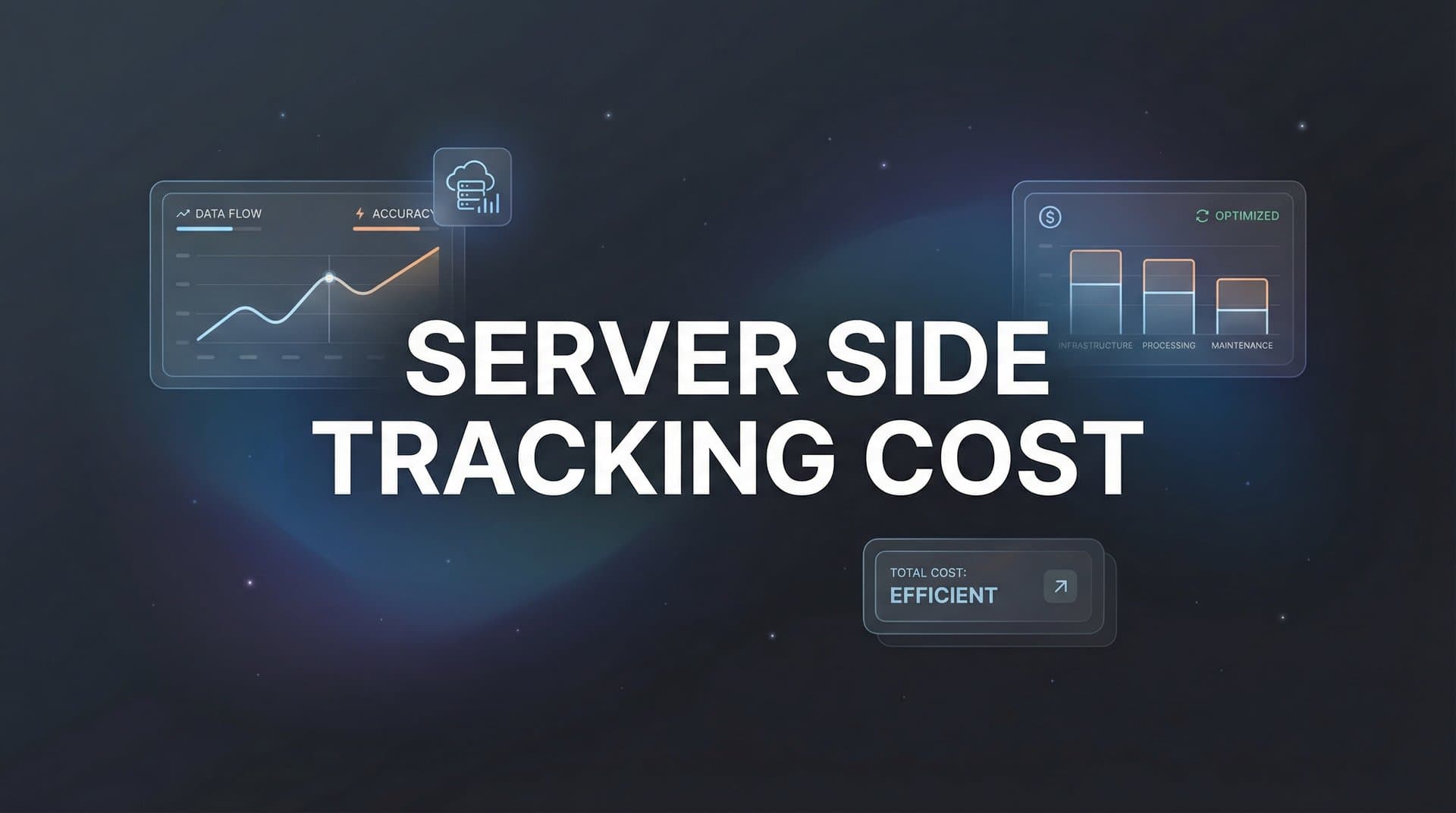
Total cost of ownership for DIY server-side tracking typically ranges from $8,000-25,000 in the first year when you factor in implementation, hosting, and maintenance. Managed solutions generally run $200-2,000 monthly depending on your traffic volume and feature requirements—translating to $2,400-24,000 annually with significantly less technical overhead.
DIY Infrastructure: When Building Your Own Makes Sense
Building your own server-side tracking infrastructure gives you maximum control and customization. But it's not the budget-friendly option many teams assume it will be.
Google Cloud Platform is the most common choice for DIY server-side tracking, primarily because it integrates directly with Google Tag Manager Server-Side. GCP charges based on your server's compute resources and the number of requests it processes. For a marketing site with moderate traffic (50,000-100,000 monthly sessions), you'll typically run a small instance that costs $50-100 monthly. Medium-traffic sites (100,000-500,000 sessions) often need $150-400 monthly in hosting. High-traffic properties processing millions of sessions can see hosting costs reach $1,000+ monthly during peak periods.
AWS and Azure offer similar pricing structures with slightly different cost optimization opportunities. AWS Lambda can reduce costs for variable traffic patterns by charging only for actual compute time used. Azure provides competitive pricing for teams already using Microsoft's ecosystem. But regardless of provider, you'll face the same fundamental challenge: predicting costs accurately requires understanding your traffic patterns, event volume, and processing requirements.
The technical requirements extend well beyond just spinning up a server. You need a custom domain or subdomain for your tracking server—this maintains first-party context that's crucial for tracking accuracy. SSL certificates are mandatory for secure data transmission. Your server needs proper configuration to handle POST requests from your website, process that data, and forward it to multiple ad platform APIs simultaneously. Each ad platform requires platform-specific setup: Meta CAPI needs access tokens and pixel IDs, Google Enhanced Conversions requires customer data hashing, TikTok Events API demands specific event formatting. Understanding server side vs client side tracking helps clarify why this architecture matters.
Developer expertise is the make-or-break factor for DIY implementations. Your team needs working knowledge of server administration, API integrations, JavaScript for client-side tagging, and debugging tools for troubleshooting data flow issues. When something breaks—and it will—you need someone who can quickly identify whether the problem is in your client-side code, server configuration, or platform API connection.
DIY server-side tracking makes sense for large enterprises with dedicated development teams who need highly customized tracking implementations. If you're processing unique data points that standard platforms don't support, or if you're integrating with proprietary internal systems, building your own infrastructure gives you that flexibility. Companies with strict data governance requirements may also prefer DIY solutions to maintain complete control over where data is processed and stored.
But for most marketing teams and agencies, the DIY approach creates more problems than it solves. The initial cost savings disappear quickly once you factor in ongoing maintenance, troubleshooting time, and the opportunity cost of pulling developers away from product work to fix tracking issues. A comprehensive server-side tracking implementation guide can help teams understand the full scope of work involved.
Managed Solutions: Predictable Pricing for Marketing Teams
Managed server-side tracking platforms flip the cost equation entirely. Instead of paying for infrastructure and developer time separately, you pay a predictable monthly subscription that includes everything.
SaaS attribution platforms like Cometly bundle server-side tracking into their core offering. Pricing typically follows one of two models: event-based tiers or ad spend-based tiers. Event-based pricing charges based on how many conversion events you're tracking monthly—common tiers might be 50,000 events for $299/month, 250,000 events for $599/month, or custom pricing for higher volumes. Ad spend-based pricing scales with your monthly advertising budget, typically charging 0.5-2% of ad spend with minimum monthly fees.
What's included in that subscription makes the value proposition clear. Automatic platform updates mean your tracking stays current when Meta, Google, or TikTok change their API requirements—no developer time needed. Pre-built integrations connect to all major ad platforms out of the box, eliminating weeks of custom development work. Built-in compliance handling manages GDPR consent, data processing agreements, and privacy regulations automatically. And dedicated support teams help troubleshoot issues without requiring your developers to become tracking experts.
Managed platforms also handle the infrastructure scaling automatically. Traffic spike during a product launch? The platform absorbs it without additional charges or performance degradation. Running a Black Friday campaign that triples your normal traffic? No need to upgrade server instances or worry about capacity planning. The platform's infrastructure scales dynamically to handle your needs. When comparing options, reviewing server-side tracking tools compared helps identify which features matter most for your use case.
The real advantage for marketing teams is removing technical barriers between you and accurate data. Instead of submitting tickets to your dev team and waiting days for tracking fixes, you can adjust event configurations through a dashboard interface. When you launch a new campaign and need to track a specific conversion action, you can set it up immediately rather than waiting for a developer sprint.
Managed solutions work best for marketing teams and agencies who want tracking accuracy without managing infrastructure. If your team's core competency is running effective ad campaigns—not server administration—paying for a managed platform lets you focus on what you do best. Agencies managing multiple client accounts particularly benefit from managed platforms, since they can implement consistent tracking across all clients without multiplying their infrastructure management workload. The best ad tracking software for agencies typically includes these managed infrastructure capabilities.
The cost predictability matters more than many teams initially realize. With DIY solutions, you're constantly estimating developer hours, monitoring hosting costs, and hoping nothing breaks during critical campaign periods. Managed platforms give you a fixed monthly cost that you can budget for confidently. For most marketing teams, that predictability alone justifies the investment.
Calculating Your ROI: When Server-Side Tracking Pays for Itself
The real cost of server-side tracking isn't the subscription or hosting fees. It's the opportunity cost of making decisions based on incomplete data.
Consider what bad tracking data actually costs your business. You're running Meta campaigns that show strong ROAS in Ads Manager, so you increase budget. But your CRM data tells a different story—those "conversions" aren't turning into actual customers. You've just scaled a campaign that doesn't work, wasting thousands in ad spend. Or you're seeing Google Ads conversions that you can't match to real leads, so you're optimizing toward phantom results while genuinely effective campaigns get underfunded.
Accurate attribution changes this equation fundamentally. When you can see which specific ads, audiences, and campaigns drive actual revenue—not just clicks or reported conversions—you optimize budget allocation with confidence. That Facebook ad set that looks mediocre in platform reporting but consistently generates high-value customers? You scale it. That Google campaign with impressive conversion numbers but terrible revenue attribution? You cut it. Understanding why server-side tracking is more accurate reveals the technical reasons behind these data quality improvements.
The math becomes clear quickly. If you're spending $50,000 monthly on paid advertising and server-side tracking helps you identify and eliminate just 10% in wasted spend, you've saved $5,000 monthly. A managed attribution platform costing $500-1,000 monthly pays for itself immediately. Even if the improvement is more modest—say 5% better budget allocation—you're still generating positive ROI within the first month.
But the benefits extend beyond eliminating waste. Server-side tracking feeds better conversion data back to ad platform algorithms. When Meta's algorithm receives accurate, complete conversion signals through CAPI instead of degraded pixel data, it optimizes more effectively. Your campaigns find better audiences. Your cost per acquisition improves. Your ROAS increases even on campaigns you were already running. Following best practices for tracking conversions accurately ensures you capture every signal that matters.
Here's a framework for evaluating whether server-side tracking makes financial sense for your business. Calculate your current monthly ad spend across all platforms. Estimate your current data loss—if you're running iOS-heavy campaigns, you might be missing 30-40% of conversions. Consider what better optimization could achieve—even a conservative 10% improvement in campaign efficiency. Compare that potential savings against the cost of implementing and maintaining server-side tracking.
For most businesses spending $10,000+ monthly on paid advertising, the ROI calculation strongly favors implementing server-side tracking. The investment pays for itself through better optimization, reduced waste, and improved algorithm performance. For smaller advertisers spending under $5,000 monthly, the ROI timeline extends longer, but the data accuracy benefits still compound over time.
The teams that see the fastest ROI are those running multi-platform campaigns where attribution complexity is highest. If you're coordinating Meta, Google, TikTok, and LinkedIn campaigns simultaneously, server-side tracking becomes essential for understanding which platforms and campaigns actually drive results. Implementing attribution tracking for multiple campaigns provides the cross-platform visibility needed to optimize effectively.
Choosing the Right Approach for Your Budget and Team
The decision between DIY and managed server-side tracking comes down to three factors: your traffic volume, available technical resources, and accuracy requirements.
Traffic volume determines infrastructure costs and complexity. Sites processing under 100,000 monthly sessions can often start with smaller hosting instances or lower-tier managed plans. Medium-traffic properties (100,000-500,000 sessions) need more robust infrastructure or mid-tier managed solutions. High-traffic sites processing millions of sessions require either significant cloud infrastructure investment or enterprise managed platform plans. If your traffic is highly variable—think e-commerce sites with seasonal peaks—managed solutions handle scaling more gracefully than DIY infrastructure.
Technical resources are the make-or-break factor for DIY implementations. Do you have a developer who can dedicate 40-80 hours to initial setup, then 5-10 hours monthly for ongoing maintenance? Can that person troubleshoot API issues when Meta changes their CAPI requirements at 2am before your product launch? If the answer is no, or if pulling developer time from product work creates opportunity costs, managed solutions eliminate this bottleneck entirely.
Accuracy requirements influence which features you need. Basic server-side tracking captures conversion events and sends them to ad platforms—this solves the iOS tracking problem and improves data completeness. Advanced attribution platforms add multi-touch attribution modeling, cross-device tracking, and AI-powered optimization recommendations. If you need to understand the entire customer journey across multiple touchpoints, managed attribution tracking tools deliver insights that DIY solutions require significant additional development to replicate.
When evaluating vendors, ask these specific questions: What's included in the base subscription versus what costs extra? How does pricing scale as traffic or event volume increases? What implementation support do you provide, and is it included or an additional fee? How do you handle platform API updates—automatically or do clients need to manually update configurations? What's your average response time for support requests during critical campaign periods? Reviewing the top server-side tracking platforms helps establish benchmarks for these criteria.
Watch for red flags in pricing structures. Per-event fees that scale linearly can become expensive quickly as your business grows—a pricing model that works at 50,000 monthly events might become prohibitive at 500,000 events. Hidden implementation costs are another warning sign—if the quoted monthly price seems low but setup requires a $10,000 professional services engagement, factor that into your total cost comparison. And be wary of platforms that charge separately for each ad platform integration—you shouldn't pay extra to connect Meta, then pay again to add Google, then pay a third time for TikTok.
For most marketing teams and agencies, managed solutions deliver better ROI by eliminating technical overhead and providing immediate access to accurate attribution data. The predictable monthly cost, automatic updates, and dedicated support let you focus on optimizing campaigns rather than maintaining infrastructure. DIY solutions make sense primarily for large enterprises with specific customization needs and dedicated technical teams who can maintain the infrastructure long-term.
Making the Investment That Transforms Your Marketing Data
Server-side tracking isn't an expense—it's an investment in making better marketing decisions with complete, accurate data. The question isn't whether you can afford to implement it. It's whether you can afford to keep running campaigns blind while browser privacy restrictions continue degrading your tracking accuracy.
The right approach depends on your team's capabilities and growth trajectory. Large enterprises with in-house development teams might benefit from DIY infrastructure's customization potential. But for most marketing teams running multi-platform campaigns, managed solutions deliver faster ROI by eliminating technical complexity while providing the accurate attribution data that directly improves ad performance.
Consider where your team's expertise actually lies. Are you experts at running high-performing ad campaigns, or at managing server infrastructure? The teams seeing the strongest results are those who choose solutions that let them focus on their core competency—optimizing marketing performance—rather than becoming tracking infrastructure specialists. Understanding the full range of server-side tracking benefits helps justify the investment to stakeholders.
The cost of inaction compounds daily. Every campaign you run with incomplete tracking data is a campaign you're optimizing based on partial information. Every budget allocation decision made without accurate attribution is a decision that could be directing spend toward underperforming channels. The longer you wait to implement server-side tracking, the more ad spend you're potentially wasting on campaigns that appear successful but don't actually drive revenue.
For marketing teams serious about scaling profitably, server-side tracking has moved from "nice to have" to "essential infrastructure." The investment pays for itself through better optimization, reduced waste, and improved algorithm performance. And with managed solutions handling the technical complexity, there's no reason to delay implementation while your tracking accuracy continues degrading.
Ready to elevate your marketing game with precision and confidence? Discover how Cometly's AI-driven recommendations can transform your ad strategy—Get your free demo today and start capturing every touchpoint to maximize your conversions.