You're spending real budget across Meta, Google, TikTok, and half a dozen other channels. The clicks are coming in, leads are filling your CRM, and your dashboards are full of numbers. But when someone asks you which campaigns are actually driving revenue, you hesitate. Sound familiar?
This is the gap that marketing funnel analytics is designed to close. At its core, funnel analytics is the practice of measuring performance at every stage of the buyer journey, from the first time someone sees your ad all the way through to a closed deal or repeat purchase. It's not just about collecting data. It's about understanding how prospects move through your funnel, where they drop off, and what that means for your budget decisions.
The frustrating reality is that most marketing teams are data-rich but insight-poor. They have access to platform dashboards, Google Analytics, CRM reports, and email metrics, but each tool tells a different story. Without a funnel-level view that connects all of these data points, you're essentially flying blind, optimizing for metrics that may have nothing to do with revenue.
This guide will walk you through what marketing funnel analytics actually involves, which metrics matter at each stage of the buyer journey, where tracking typically breaks down, and how to build a setup that connects your ad spend directly to revenue outcomes. Whether you're running campaigns for a growing brand or managing accounts for multiple clients, understanding your funnel data is the foundation for scaling with confidence.
The Anatomy of a Marketing Funnel and Why Each Stage Demands Different Metrics
Before you can analyze your funnel, you need a clear picture of what you're actually measuring. The marketing funnel, at its most practical level, breaks down into four stages: awareness, consideration, conversion, and retention. Each stage represents a fundamentally different mindset in your prospect, and that difference has direct implications for which metrics should guide your decisions.
At the awareness stage, your goal is to get in front of the right audience. Prospects here don't know you well, and they're not ready to buy. The metrics that matter are about reach and relevance: impressions, reach, frequency, and click-through rate. These tell you whether your message is landing in front of enough people and whether it's compelling enough to earn a click.
At the consideration stage, prospects are evaluating their options. They've clicked your ad, visited your site, maybe downloaded a resource or joined your email list. Here, you're tracking engagement depth. Landing page conversion rates, email open and click rates, time on site, and lead quality indicators become your compass. The question shifts from "are people seeing us?" to "are the right people taking meaningful next steps?"
At the conversion stage, you're measuring what actually matters to the business: cost per acquisition, return on ad spend, revenue per channel, and pipeline contribution. This is where most analytics setups fall short, because connecting ad-level data to actual revenue requires more than a platform dashboard can provide. Understanding the marketing analytics metrics that matter at this stage is critical for accurate performance evaluation.
The retention stage is often overlooked entirely in paid media analytics, but it's where the economics of your funnel either hold up or fall apart. Customer lifetime value, repeat purchase rate, and churn metrics belong here. Understanding retention helps you evaluate whether your acquisition efforts are bringing in customers worth keeping.
One of the most common mistakes marketers make is treating all metrics as equally important regardless of where in the funnel they live. Optimizing a top-of-funnel campaign based on cost per acquisition doesn't make sense. Neither does measuring a retargeting campaign by impressions alone. Each stage needs its own KPI framework, and those frameworks need to connect to each other.
This is the deeper purpose of funnel analytics: not just tracking individual metrics in isolation, but understanding how prospects move between stages and where the biggest drop-offs occur. A high click-through rate at the top of your funnel means very little if 90% of those clicks bounce before converting. Exploring the different types of marketing analytics can help you build a more complete picture of performance across every stage.
The Metrics That Actually Move the Needle at Each Stage
Now let's get specific. Understanding which metrics to track at each funnel stage is one of the most practical skills a marketer can develop, because it separates signal from noise in a world where dashboards can display hundreds of data points simultaneously.
Top of Funnel: Visibility and First Engagement
At the top of the funnel, you're playing a volume and relevance game. The core metrics are impressions, reach, click-through rate (CTR), and cost per click (CPC). These tell you how efficiently you're generating initial interest from your target audience.
A healthy CTR signals that your creative and messaging resonate with the audience you're targeting. A low CTR despite strong impressions usually points to a creative or targeting problem. CPC helps you understand the efficiency of that traffic generation, though it's worth noting that cheap clicks from the wrong audience are not a win.
The important caveat here: top-of-funnel metrics are leading indicators, not success metrics. They tell you about potential, not outcomes. Many marketers make the mistake of celebrating a high-impression campaign without asking what happened to those people afterward. Top-of-funnel data only becomes meaningful when you can trace those early interactions forward through the funnel.
Middle of Funnel: Lead Quality and Progression
The middle of the funnel is where many analytics setups go quiet, which is exactly why it's where so much budget gets wasted. The metrics that matter here include landing page conversion rate, lead form completion rate, email open and click rates, content engagement depth, and lead scoring signals from your CRM.
For a plain-English breakdown, read our explainer on what is cost per lead form completion.
Volume is not the goal at this stage. Lead quality is. A campaign that generates a large number of leads at a low cost per lead can look great in a platform dashboard while actually delivering poor-fit prospects who never convert. Tracking lead progression, meaning how many leads move from initial capture to a sales-qualified stage, gives you a much clearer picture of middle-funnel health.
Email engagement metrics become particularly important here if you're running nurture sequences. Open rates and click rates tell you whether your follow-up content is relevant enough to keep prospects engaged between their initial interest and their purchase decision. Learning how to use data analytics in marketing effectively can help you identify which nurture touchpoints are actually moving prospects forward.
Bottom of Funnel: Revenue Attribution and Efficiency
This is where understanding marketing funnel analytics pays off most directly. Bottom-of-funnel metrics include cost per acquisition (CPA), return on ad spend (ROAS), revenue per channel, pipeline contribution, and customer lifetime value (CLV).
CPA and ROAS are the metrics that connect your ad spend to business outcomes. They answer the question every stakeholder eventually asks: are we making money from this? But calculating these numbers accurately requires more than platform-reported data. It requires a direct connection between your ad campaigns and your actual revenue records, whether that lives in a CRM, an e-commerce platform, or a billing system.
Customer lifetime value adds another dimension. A channel that drives customers with high CLV is more valuable than its CPA alone suggests, and vice versa. When you factor CLV into your funnel analytics, your budget allocation decisions become significantly sharper. This is one reason why boosting sales with marketing analytics requires looking beyond surface-level platform metrics.
Where Most Tracking Breaks Down and How to Fix It
Here's the uncomfortable truth: even marketers who understand funnel metrics often can't measure them accurately. The tracking infrastructure that most teams rely on has significant gaps, and those gaps get wider every year as privacy regulations and platform changes reshape the data landscape.
Cross-platform attribution gaps are the most common problem. When a prospect sees your ad on TikTok, clicks a Google search ad two days later, and then converts through a retargeting campaign on Meta, which platform gets credit? Without a unified attribution system, each platform claims the conversion for itself. Your Meta dashboard says one thing, your Google dashboard says another, and your actual revenue numbers don't match either. These are among the most persistent attribution challenges in marketing analytics that teams face today.
iOS privacy changes have made pixel-based tracking significantly less reliable. Apple's App Tracking Transparency framework, introduced in iOS 14 and further reinforced in subsequent updates, limits the ability of ad platforms to track user behavior across apps and websites. The result is that platform-reported conversion data has become less accurate for many advertisers, particularly those running campaigns aimed at mobile audiences.
Data silos between ad platforms and CRMs create another layer of disconnection. Your ad platforms know about clicks and platform-reported conversions. Your CRM knows about leads, sales cycles, and closed deals. But if these systems don't talk to each other, you're left manually trying to reconcile data that was never designed to connect.
Last-click bias is a subtler problem but equally damaging. Many default attribution setups credit the last touchpoint before a conversion, which systematically undervalues upper-funnel channels like display advertising, social awareness campaigns, and content. This leads teams to cut budget from channels that are actually doing important work earlier in the journey.
The solutions to these problems point in the same direction: server-side tracking and first-party data strategies. Server-side tracking moves the data collection from the browser (where it's vulnerable to ad blockers, browser restrictions, and iOS limitations) to your own server, which communicates directly with ad platforms. This approach is more reliable, more accurate, and more resilient to the privacy changes reshaping digital advertising.
Multi-touch attribution is the other essential fix. Rather than crediting a single touchpoint, multi-touch attribution distributes credit across all the interactions in a customer's journey, giving you a more accurate picture of which channels and campaigns are actually contributing to revenue.
Connecting Ad Spend to Revenue Through Attribution
Attribution is the mechanism that makes funnel analytics actionable. Without it, you have a collection of stage-level metrics that don't connect to each other or to business outcomes. With it, you can trace a customer from their first ad impression all the way to a closed deal and understand exactly which touchpoints contributed along the way.
Different attribution models distribute credit differently, and understanding those differences matters for how you interpret your data and allocate your budget.
First-touch attribution gives all credit to the first interaction a prospect had with your brand. This is useful for understanding which channels are best at generating awareness and driving initial interest, but it ignores everything that happened between that first touch and the conversion.
Last-touch attribution does the opposite, crediting only the final interaction before conversion. It's simple to implement but systematically undervalues the channels that warmed up the prospect earlier in the journey.
Linear attribution distributes credit equally across all touchpoints in the customer journey. It's more balanced than first or last touch but doesn't account for the fact that some interactions are more influential than others.
Time-decay attribution weights recent touchpoints more heavily, reflecting the logic that interactions closer to the conversion decision are more influential. This works well for shorter sales cycles.
Data-driven attribution uses machine learning to assign credit based on actual patterns in your conversion data, making it the most sophisticated option for teams with sufficient data volume. Exploring the best marketing attribution analytics options can help you determine which model fits your business.
The model you choose shapes the budget decisions you make. A team using last-touch attribution will systematically over-invest in bottom-funnel retargeting and under-invest in awareness channels that are generating the prospects being retargeted in the first place.
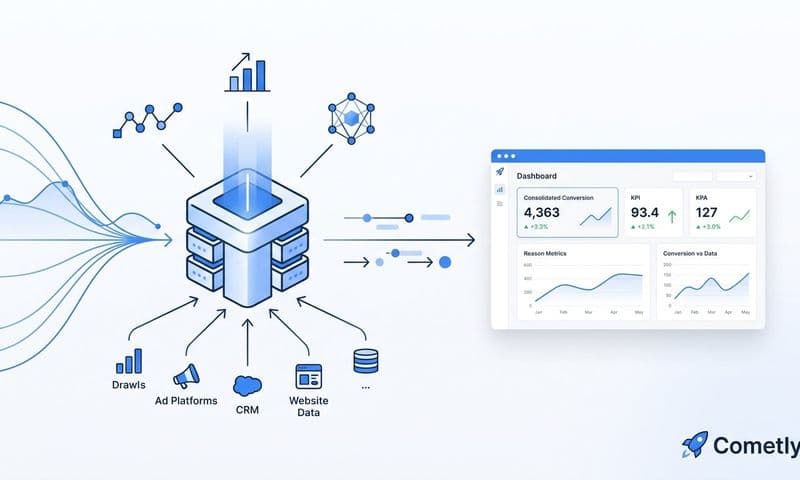
This is where connecting your ad platforms, website analytics, and CRM into a unified view becomes essential. Cometly is built specifically for this purpose. It captures every touchpoint across the customer journey, connects those touchpoints to actual revenue outcomes, and feeds enriched conversion data back to ad platforms like Meta and Google. That feedback loop helps ad platform algorithms optimize more effectively, improving targeting and reducing acquisition costs over time. Instead of each platform operating in its own data bubble, your entire marketing stack works from a single, accurate view of what's actually driving results.
Turning Funnel Data Into Decisions That Actually Improve Performance
Data without action is just overhead. The real value of understanding marketing funnel analytics comes from using that data to make better decisions faster. Here's a practical framework for doing exactly that.
Step one is identifying the weakest stage of your funnel. Pull your stage-level metrics and look for the biggest drop-off points. Is your top-of-funnel traffic strong but your landing page conversion rate low? That points to a middle-funnel problem. Is your lead volume healthy but your close rate poor? That suggests either a lead quality issue at the top or a nurture gap in the middle. Start where the data shows the most significant leakage.
Step two is diagnosing the root cause. A weak stage can have multiple causes, and treating the wrong one wastes time and budget. Common culprits include creative fatigue (your ads have been running long enough that your audience is tuning them out), targeting mismatch (you're reaching people who aren't a fit for your offer), landing page friction (slow load times, unclear value propositions, or forms that ask for too much), and lead nurture gaps (prospects are interested but not getting enough relevant follow-up to move forward). A solid marketing analytics strategy helps you systematically work through these diagnoses rather than guessing.
Step three is prioritizing fixes based on revenue impact. Not every funnel problem is worth solving immediately. Focus on the fixes that will have the greatest downstream effect on revenue. A small improvement in your middle-funnel conversion rate often has a larger revenue impact than a significant improvement in top-of-funnel CTR, because it affects every prospect who's already shown intent.
AI-powered analytics tools are changing how quickly marketers can move through this process. Rather than manually pulling reports and cross-referencing spreadsheets, platforms with AI-driven insights can surface optimization recommendations automatically, flagging underperforming campaigns, identifying high-performing ad variations, and highlighting budget inefficiencies across channels. The growing power of AI marketing analytics is making this level of insight accessible to teams of all sizes.
The feedback loop matters here too. When you send accurate, enriched conversion data back to your ad platforms, their algorithms get smarter. Meta's and Google's optimization systems perform better when they receive high-quality conversion signals rather than incomplete or delayed data. This is one of the most underappreciated benefits of a strong funnel analytics setup: it doesn't just help you make better decisions, it helps your ad platforms make better decisions on your behalf.
Building a Funnel Analytics Stack That Grows With Your Campaigns
Understanding the concepts behind funnel analytics is one thing. Having the infrastructure to execute on them is another. A modern funnel analytics stack needs four core components working together.
Server-side tracking is the foundation. As browser-based tracking becomes less reliable due to privacy changes and ad blockers, server-side tracking ensures that your conversion data is captured accurately and sent directly to your ad platforms without depending on client-side scripts that can be blocked or restricted.
A multi-touch attribution platform is the layer that makes sense of your cross-channel data. This is what allows you to see the full customer journey rather than the fragmented, platform-specific view that each individual ad dashboard provides. Without this, you're making budget decisions based on incomplete information. Reviewing a comprehensive marketing analytics solution can help you understand what capabilities to look for when evaluating platforms.
CRM integration closes the loop between marketing activity and revenue outcomes. When your attribution platform can pull in data from your CRM, you can trace a customer from their first ad interaction through to a closed deal, and understand the true revenue contribution of every channel and campaign.
A centralized analytics dashboard brings everything together in a single view. Marketers running campaigns across multiple platforms need one place to see performance across all channels, compare attribution models, and identify optimization opportunities without toggling between five different dashboards that each tell a different story.
When evaluating tools to build this stack, prioritize platforms that offer real-time data rather than delayed reporting, support conversion syncing back to ad platforms, and provide AI-driven insights rather than just raw data exports. Comparing the best marketing analytics tools available will help you find the right fit for your team's needs and budget. The goal is not more data. The goal is faster, more confident decisions based on accurate data.
The Bottom Line on Funnel Analytics
Understanding marketing funnel analytics is not about tracking more. It's about tracking the right things at the right stages and connecting all of it to revenue. When you have that visibility, every budget decision becomes clearer, every optimization becomes more targeted, and every conversation with stakeholders becomes more grounded in evidence.
Start by auditing your current tracking setup. Are you measuring performance at each stage of the funnel, or just at the top and bottom? Are there gaps between your ad platforms and your CRM? Are you relying on platform-reported data that may be inflated or conflicting? Identifying those gaps is the first step toward closing them.
From there, consider how a unified attribution platform can give you the single source of truth your team needs to scale campaigns with confidence. Cometly connects your ad platforms, website, and CRM into one real-time view, captures every touchpoint in the customer journey, and feeds enriched conversion data back to ad platforms to improve their optimization. It's built for marketers who are done guessing and ready to make decisions based on what's actually working.
If you're ready to move from data overload to real clarity, Get your free demo and see how Cometly can give you the funnel visibility you need to grow with confidence.