

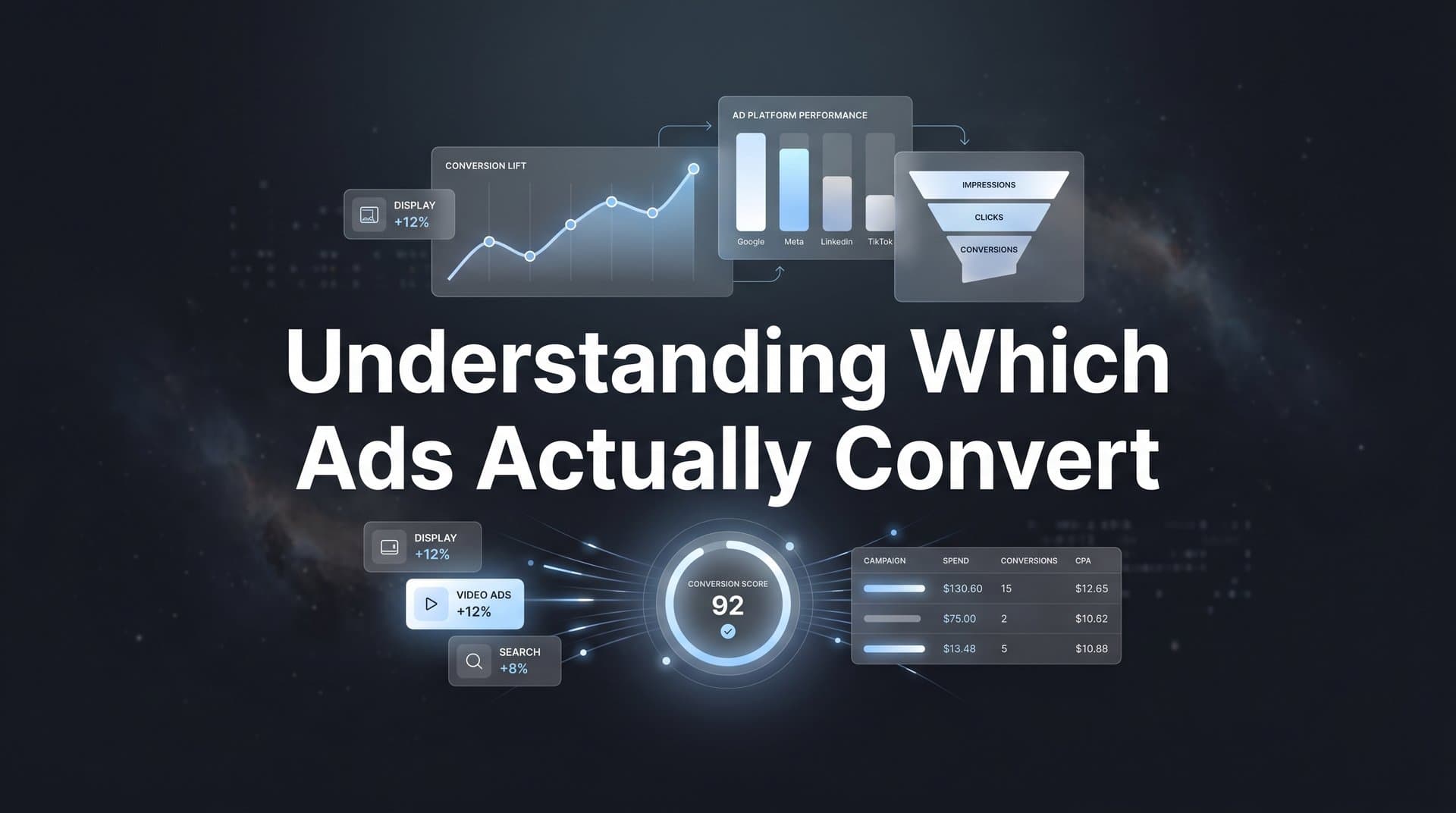
You're spending $10,000 a month on Facebook ads, another $8,000 on Google, and maybe $5,000 across LinkedIn and TikTok. Your dashboards show thousands of clicks, hundreds of leads, and your sales team is closing deals. But here's the question that keeps you up at night: which ads are actually driving those sales?
Most marketers can't answer that question with confidence. They see engagement metrics that look impressive—click-through rates, impressions, platform-reported conversions—but when they try to connect those numbers to actual revenue, the picture gets murky fast. One platform claims credit for a conversion, another platform claims the same conversion, and your CRM shows a customer journey that touched six different ads before purchasing.
This isn't just a measurement problem. It's a decision-making crisis. Without knowing which ads actually convert, you're essentially flying blind with your budget. You might be cutting ads that drive awareness for your best customers while scaling ads that attract tire-kickers who never buy. The gap between what your ad platforms tell you and what's really happening in your business can cost you thousands in wasted spend and missed opportunities.
The Vanity Metrics Trap: When Good Numbers Mean Nothing
Let's get brutally honest about something most marketers don't want to admit: the metrics you're celebrating in your weekly reports might be completely disconnected from business outcomes.
Platform dashboards are designed to make you feel good. They highlight clicks, impressions, engagement rates, and platform-attributed conversions. These numbers go up, you feel productive, and the platforms keep getting paid. But here's the thing—clicks are not customers. A thousand people clicking your ad means absolutely nothing if none of them end up buying from you.
The Engagement Illusion: An ad with a 5% click-through rate looks like a winner in your Facebook Ads Manager. People are clearly interested, right? But when you trace those clicks to actual revenue, you might discover that audience converts at half the rate of an ad with a 2% CTR that targets a different segment. The "losing" ad is actually your revenue driver, but you'd never know it from looking at engagement metrics alone. This is why proving which ads actually drive revenue requires looking beyond surface-level metrics.
The Double-Counting Disaster: Here's where things get messy. A customer clicks your Facebook ad on Monday, sees your Google retargeting ad on Wednesday, and converts on Friday after clicking an email link. Facebook claims the conversion. Google claims the conversion. Your email platform claims the conversion. Suddenly one sale is being counted three times across your reporting, and your total "conversions" add up to more than your actual customer count.
Each platform operates in its own silo, using its own tracking pixel, applying its own attribution window, and fighting for credit. They're not lying—they're just showing you their perspective of a multi-touchpoint journey. The problem is that their perspective is designed to make their platform look as valuable as possible. Understanding the Google Ads and Facebook Ads attribution conflict is essential for accurate reporting.
The Privacy Reality Check: Even if platform metrics were perfectly accurate in 2020, they're not anymore. iOS privacy changes have fundamentally broken pixel-based tracking. When Apple introduced App Tracking Transparency, they didn't just make tracking a little harder—they created blind spots that most marketers still don't fully understand.
Your Facebook pixel might only be capturing 60-70% of actual conversions from iOS users. Google Analytics is missing mobile app conversions entirely unless you've implemented proper app-to-web bridging. And with third-party cookies disappearing across browsers, the traditional tracking infrastructure that marketers relied on for a decade is crumbling.
The result? You're making budget decisions based on incomplete data, crediting the wrong ads, and potentially killing campaigns that are actually working while scaling ones that aren't.
The Multi-Touchpoint Reality: Why Last-Click Attribution Fails
Think about the last significant purchase you made—not an impulse buy, but something you actually researched. Maybe it was a software tool for work, a high-ticket service, or even a new car. How many times did you interact with that brand before buying?
For most B2B purchases and considered consumer decisions, the answer is somewhere between five and eight touchpoints. A prospect sees your LinkedIn ad, visits your website, downloads a guide, gets retargeted on Facebook, receives nurture emails, watches a webinar, and finally books a demo. That's seven touchpoints before they even talk to sales.
Now here's the critical question: which ad "converted" them? If you're using last-click attribution—which most platforms default to—you'd give 100% of the credit to whatever they clicked right before converting. Probably that retargeting ad or the email link. Meanwhile, the LinkedIn ad that introduced them to your brand gets zero credit, even though without it, the entire journey never would have started.
The Awareness Ad Dilemma: Top-of-funnel ads that introduce your brand to new audiences rarely get credit in last-click models, even when they're essential to your growth. You run a cold audience campaign on Facebook targeting your ideal customer profile. It performs "poorly" according to platform metrics—high cost per click, low immediate conversion rate. So you cut it.
Three months later, your retargeting campaigns start underperforming because you've stopped feeding new prospects into the funnel. Your "efficient" retargeting ads were only efficient because awareness campaigns were doing the heavy lifting earlier in the journey. But last-click attribution made the awareness ads look like failures. Many marketers find themselves losing money on ads because they can't find winning campaigns when using flawed attribution models.
The Conversion Ad Paradox: On the flip side, bottom-of-funnel ads often get too much credit. A retargeting ad that shows up when someone is already 90% convinced to buy looks like a superstar in last-click attribution. It gets credit for the conversion, even though five other touchpoints did most of the persuasion work.
This creates a dangerous feedback loop. You see retargeting "working," so you increase retargeting budget. But you're not actually creating more demand—you're just fighting harder for the same pool of people who were going to convert anyway. Meanwhile, you're underinvesting in the awareness and consideration ads that actually grow your addressable market.
The Cross-Device Challenge: Modern customer journeys don't happen on a single device. Someone discovers your brand on their phone during a commute, researches on their laptop at work, and converts on a tablet at home. Traditional cookie-based tracking can't connect these dots—it sees three different "users" instead of one journey.
This fragmentation means you're not just misattributing credit between ads—you're missing entire chunks of the journey. That "direct" conversion in your analytics? It probably wasn't direct at all. The customer likely clicked an ad on a different device, but your tracking couldn't connect it.
The bottom line: if you're relying on last-click attribution or platform-native reporting, you're making decisions based on a fundamentally incomplete picture of how your marketing actually works.
Attribution Models Decoded: Finding Your Truth
Attribution models aren't just academic concepts—they're different lenses for understanding which marketing activities deserve credit for your conversions. Think of them like different camera angles filming the same scene. Each angle reveals something the others miss.
First-Touch Attribution: This model gives 100% credit to the first ad or channel that introduced someone to your brand. It's the opposite of last-click, and it's particularly useful if you're trying to understand which channels are best at generating new demand versus just capturing existing demand.
When it makes sense: If you're in growth mode and want to identify which top-of-funnel campaigns are bringing in genuinely new prospects, first-touch helps you see that. It prevents you from accidentally killing awareness campaigns that aren't getting credit in last-click models.
The limitation: It completely ignores everything that happened after the first touch. That nurture sequence that convinced someone to buy? The retargeting ad that brought them back? First-touch gives them zero credit, which can make mid and bottom-funnel activities look worthless.
Last-Touch Attribution: We've already discussed why this is problematic, but it's not useless. Last-touch shows you which final touchpoint pushed people over the conversion line. For businesses with very short sales cycles—think impulse purchases or low-consideration products—last-touch might actually be fairly accurate because the journey is simple enough that the last touch really is the most important.
When it makes sense: If you're running e-commerce with products people buy quickly, or if you're optimizing a specific conversion point in a longer journey, last-touch can help you understand what's working at that specific stage. Understanding the differences in Facebook Ads attribution vs Google Ads attribution helps you interpret each platform's reporting correctly.
The limitation: For anything with a considered purchase process, last-touch systematically undervalues awareness and consideration activities while overvaluing conversion activities.
Linear Attribution: This model splits credit evenly across all touchpoints in the journey. If someone interacted with six ads before converting, each ad gets 16.7% of the credit. It's democratic, but not necessarily accurate.
When it makes sense: Linear attribution is useful when you genuinely believe every touchpoint contributes equally, or when you're just starting to move beyond last-click and want a simple way to acknowledge that multiple touchpoints matter.
The limitation: In reality, not all touchpoints are equally valuable. The ad that introduced someone to your brand probably had more impact than the fifth retargeting impression they barely noticed. Linear attribution treats them the same.
Time-Decay Attribution: This model gives more credit to touchpoints closer to the conversion and less credit to earlier touchpoints. It acknowledges that the journey matters, but assumes recent interactions were more influential than older ones.
When it makes sense: For businesses where recency matters—where the final decision-making phase is genuinely more important than early awareness—time-decay can provide a more nuanced view than last-click while still recognizing that later touchpoints had more influence.
The limitation: It can still undervalue the critical awareness phase that started the entire journey, just not as severely as last-click.
Data-Driven Attribution: Instead of applying a predetermined rule, data-driven models analyze your actual conversion data to determine which touchpoints statistically have the most impact. They compare journeys that converted versus journeys that didn't to identify which touchpoints made the difference.
When it makes sense: If you have enough conversion volume for statistical significance (generally hundreds of conversions per month minimum), data-driven attribution can reveal patterns that rule-based models miss. It might show that a specific touchpoint combination is particularly powerful, or that certain channels are more valuable at specific stages.
The limitation: You need significant data volume, and the model is only as good as the data you're feeding it. If your tracking has gaps, the model will draw conclusions from incomplete information.
The Multi-Model Approach: Here's the truth that most attribution guides won't tell you—you shouldn't pick one model and call it done. The smartest marketers compare multiple models side-by-side to understand the full story. When you see how credit shifts between first-touch, last-touch, and data-driven models, you start to understand which channels are doing what in your funnel.
Bridging the Gap: Connecting Ads to Actual Revenue
Platform metrics tell you what happened on the platform. Your CRM tells you what happened in your business. The problem is, these two systems rarely talk to each other in a meaningful way, and that disconnect is costing you money.
A lead converts in your CRM three weeks after clicking an ad. Your ad platform has no idea that conversion happened because its attribution window expired after seven days. Or a high-value customer makes a $50,000 purchase, but your ad platform thinks all conversions are equal because you never told it the difference between a $500 customer and a $50,000 customer.
Why CRM Integration Changes Everything: When you connect your ad platforms to your CRM, you move from tracking "conversions" to tracking actual business outcomes. You can see which ads drove leads that became customers, which ads attracted high-value buyers versus low-value ones, and which campaigns have the best customer lifetime value—not just the best cost per lead.
This visibility transforms decision-making. Instead of optimizing for cheap leads, you can optimize for profitable customers. You might discover that a campaign with a $200 cost per lead actually delivers better ROI than a campaign with a $50 cost per lead because the $200 leads convert to customers at 3x the rate and spend 2x as much. Learning how to prove which ads drive sales starts with this revenue-focused approach.
The Server-Side Tracking Solution: Browser-based tracking is broken. Between iOS privacy restrictions, cookie blockers, and browser limitations, pixel-based tracking is missing 30-40% of conversions for many businesses. Server-side tracking fixes this by capturing conversion events directly from your server rather than relying on browser cookies.
When someone converts on your website, your server sends that conversion data directly to your ad platforms—no browser required, no cookie needed, no iOS restriction blocking it. This means you see conversions that pixel-based tracking misses, you can track conversions that happen offline or in mobile apps, and you maintain accuracy even as privacy regulations tighten. If you've struggled with tracking paid ads after the iOS update, server-side implementation is the solution.
Feeding Better Data to Ad Algorithms: Here's something most marketers don't realize—when you send enriched conversion data back to your ad platforms, you're not just improving your reporting. You're actually improving your ad performance.
Ad platforms use machine learning to optimize delivery. Facebook's algorithm learns which users are most likely to convert based on the conversion data you send it. If you're only sending basic "purchase" events, the algorithm treats all purchases the same. But if you send enriched events that include purchase value, customer type, or lifetime value predictions, the algorithm can optimize for high-value conversions specifically.
The platform's AI gets smarter about who to show your ads to. Instead of just finding people likely to convert, it finds people likely to become valuable customers. This feedback loop between accurate attribution data and platform optimization is where serious performance improvements happen.
The businesses seeing the best results from paid advertising aren't just tracking better—they're creating a closed loop where attribution insights inform optimization, which improves results, which provides better data, which enables even smarter optimization. It's a compounding advantage that starts with connecting your ad data to your revenue data.
Building Your Attribution Infrastructure: A Practical Roadmap
Understanding attribution theory is one thing. Actually implementing it in your business is another. Let's break down the practical steps to move from guesswork to clarity about which ads actually convert.
Step 1: Implement Consistent UTM Tracking: Before you can attribute conversions accurately, you need to know where traffic is coming from. UTM parameters are the foundation—those tags you add to URLs that tell analytics tools which campaign, source, and creative drove each visit.
Create a naming convention and stick to it religiously. Every ad, every email, every social post should have properly tagged links. Use utm_source for the platform, utm_medium for the channel type, utm_campaign for the campaign name, and utm_content to identify specific ads or variations. Consistency here is critical because inconsistent tagging creates data chaos that makes attribution impossible. A well-organized marketing campaign tracking spreadsheet can help maintain this consistency across your team.
Step 2: Set Up Server-Side Conversion Tracking: If you're still relying exclusively on browser pixels, you're working with incomplete data. Implement server-side tracking for your key conversion events—purchases, lead submissions, demo bookings, whatever matters for your business.
This requires some technical setup, but the payoff is dramatic. You'll capture conversions that browser-based tracking misses, maintain accuracy as privacy restrictions increase, and gain the ability to send enriched conversion data back to ad platforms. This isn't optional anymore—it's essential infrastructure for modern marketing.
Step 3: Connect Your CRM to Your Ad Platforms: Your CRM knows which leads became customers and how much revenue they generated. Your ad platforms know which ads drove those leads. Connecting these systems lets you see the complete picture—not just which ads drove leads, but which ads drove revenue.
Set up integrations that flow data both ways. Send lead and customer data from your CRM back to your ad platforms so they can optimize for actual business outcomes. Pull ad interaction data into your CRM so you can see the full customer journey in one place.
Step 4: Build Revenue-Focused Dashboards: Stop staring at platform-native dashboards that show you what the platform wants you to see. Build custom dashboards that connect ad spend to actual revenue outcomes.
Your dashboard should answer questions like: Which campaigns drove the most revenue this month? What's the customer acquisition cost by channel when you factor in actual sales, not just leads? Which ad creative variations attract customers with the highest lifetime value? These questions require combining data from multiple sources—ad platforms, analytics, CRM, and revenue data.
Step 5: Deploy AI-Powered Analysis: Once you have clean data flowing from multiple sources, the volume of information becomes overwhelming for manual analysis. This is where AI-powered ads optimization recommendations become essential.
AI can analyze thousands of customer journeys simultaneously to identify patterns you'd never spot manually. It can surface insights like "customers who interact with both LinkedIn and Facebook ads convert at 2.3x the rate of single-touchpoint customers" or "this specific ad creative combination drives 40% higher customer lifetime value." These insights inform optimization decisions that would be impossible to make based on gut feel or simple reporting.
The goal isn't to implement every possible tracking technology—it's to build a system that gives you confidence in your attribution data so you can make smart budget decisions. Start with the fundamentals, then layer in sophistication as your needs and capabilities grow.
From Insights to Action: Optimizing Based on True Performance
Attribution data is worthless if it just sits in a dashboard. The entire point is to use that clarity to make better decisions about where to spend your budget and how to scale your campaigns.
Reallocating Budget with Confidence: Once you understand which ads actually drive revenue, budget decisions become straightforward. You're not guessing which campaigns to scale—you're following the data to profitable outcomes.
Look at your attribution data and identify campaigns that are driving high-value customers at acceptable acquisition costs. Those campaigns get more budget. Find campaigns that look good on engagement metrics but don't actually drive revenue. Those campaigns get cut or restructured. It sounds simple, but most marketers can't do this confidently because they don't have accurate attribution data. Understanding how ad tracking tools can help you scale ads using accurate data is the foundation of confident budget allocation.
The key is moving from cost-per-click or cost-per-lead optimization to customer acquisition cost and return on ad spend optimization. A campaign might have a higher cost per lead but deliver better ROI because those leads convert to customers at higher rates or generate more revenue. Without attribution connecting ads to revenue, you'd kill that campaign for being "expensive."
Scaling Winners Without Fear: One of the biggest challenges in paid advertising is knowing when to scale. You have a campaign that's working at $5,000 per month—should you increase it to $15,000? Traditional metrics don't give you confidence because you're not sure if the conversions you're seeing are actually driving revenue or just creating vanity metrics.
With proper attribution, scaling decisions become data-driven. You can see that a campaign is consistently driving customers with strong lifetime value at a profitable acquisition cost. You know it's not just getting credit for conversions it didn't actually drive. So you scale it aggressively, monitor the data, and adjust if efficiency changes at higher spend levels.
Creating a Continuous Optimization Loop: The best marketing teams don't just optimize once—they build systems for continuous improvement. Attribution data feeds into weekly optimization decisions, which improve results, which provides better data, which enables smarter optimization.
Set up a regular cadence for reviewing attribution data and making adjustments. Weekly reviews might focus on tactical optimizations—pausing underperforming ads, increasing bids on high-performers. Monthly reviews might look at channel mix and budget allocation. Quarterly reviews might examine attribution model comparisons and strategic shifts in channel strategy.
This continuous loop is where compounding improvements happen. Each optimization cycle makes your campaigns slightly more efficient. Over months and years, those incremental improvements add up to dramatically better performance than competitors who are still making decisions based on incomplete data.
Moving Forward: Making Attribution Your Competitive Advantage
Understanding which ads actually convert isn't just about better reporting—it's about making confident decisions that drive real business growth. When you can see the complete customer journey, connect ad spend to revenue outcomes, and identify which campaigns truly drive profitable customers, you stop wasting budget on activities that don't work and start scaling the ones that do.
The marketers winning in 2026 aren't the ones with the biggest budgets. They're the ones with the clearest data. They know which channels drive awareness, which touchpoints move prospects through consideration, and which final interactions convert browsers into buyers. They've moved beyond platform-reported metrics to unified attribution that shows the full picture.
This clarity compounds over time. Better attribution leads to smarter budget allocation, which improves results, which provides richer data, which enables even more precise optimization. Meanwhile, competitors still flying blind with last-click attribution and platform-native reporting are stuck in a cycle of guesswork and wasted spend.
The infrastructure you need—server-side tracking, CRM integration, multi-touch attribution, AI-powered analysis—might seem complex, but it's not optional anymore. Privacy changes and tracking limitations have made traditional pixel-based measurement unreliable. The businesses that adapt to this new reality will have a massive advantage over those that don't.
Ready to elevate your marketing game with precision and confidence? Discover how Cometly's AI-driven recommendations can transform your ad strategy—Get your free demo today and start capturing every touchpoint to maximize your conversions.


