Picture this: a prospect clicks your LinkedIn ad on a Tuesday, finds your blog through Google two weeks later, opens three of your nurture emails, watches a product demo video, and finally books a call after seeing a retargeting ad on Friday. That's five touchpoints across four platforms. Yet when you pull your reports, your CRM credits the demo request to "direct," your LinkedIn dashboard claims the conversion, and Google Analytics shows organic search as the source. Three tools, three different stories, zero consensus.
This is the daily reality for B2B SaaS marketing teams running multi-channel campaigns. The data exists, but it's scattered across disconnected platforms that each apply their own attribution logic. Budget decisions get made on incomplete information, high-performing channels get underfunded, and the actual story of how customers find and choose your product stays buried.
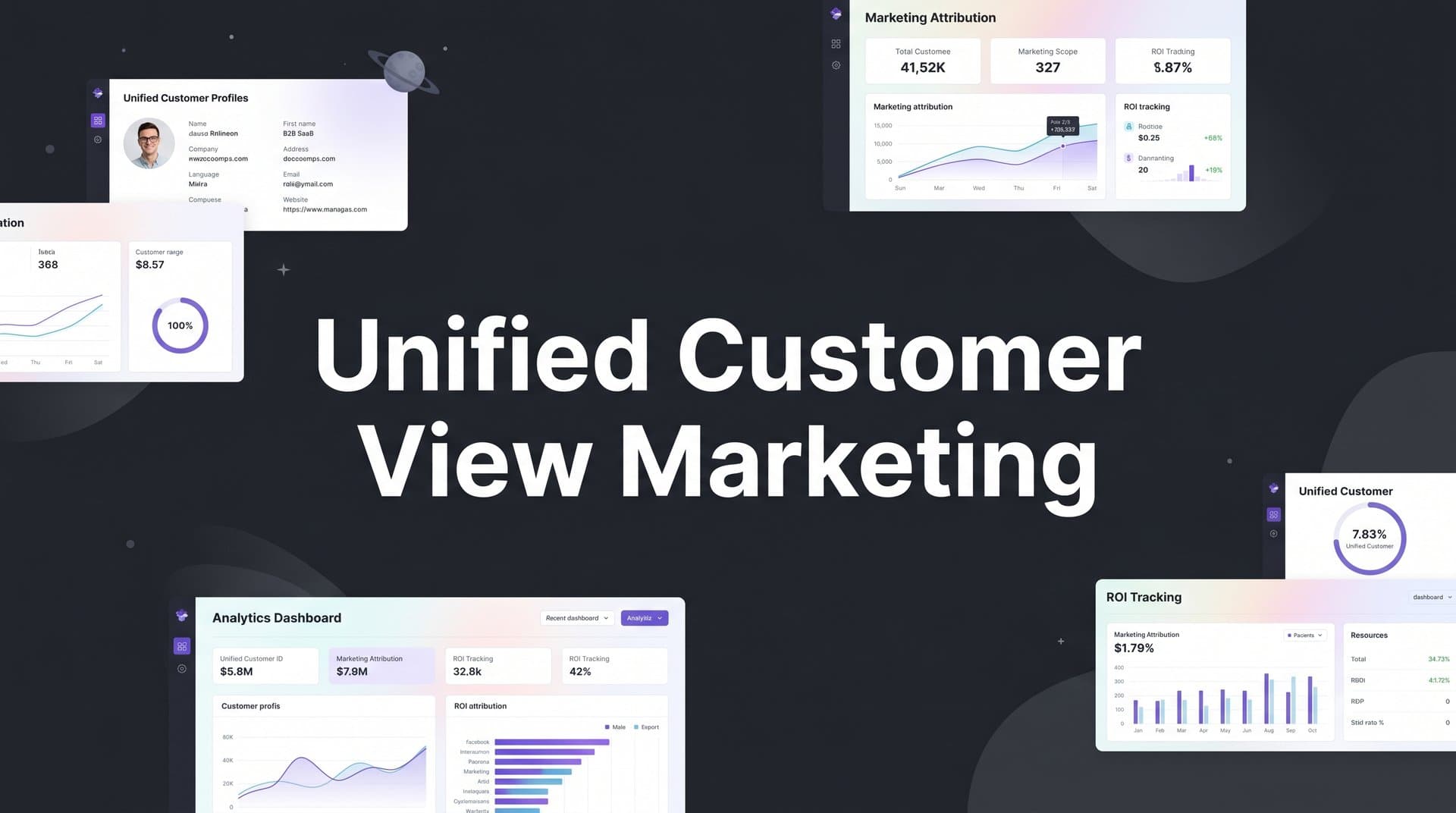
Unified customer view marketing is the framework that fixes this. At its core, it's the practice of consolidating every interaction a prospect has with your brand — paid clicks, organic visits, email opens, CRM stage changes, and revenue events — into a single, coherent record. For B2B SaaS companies where sales cycles stretch across weeks or months and involve multiple stakeholders, this isn't a nice-to-have. It's the foundation of every smart budget decision you'll make.
This article walks through why fragmented data actively costs you revenue, what a genuine unified customer view looks like, how multi-touch attribution makes it actionable, what technical infrastructure you need to build it, and what becomes possible for your team once it's in place.
Why Marketing Data Silos Are Costing You Revenue
Every tool in your marketing stack was built to do one thing well. Meta Ads tracks clicks and conversions within its ecosystem. HubSpot manages contacts and pipeline stages. Google Analytics measures website behavior. Stripe records revenue. Each platform is excellent at its job — and completely blind to what the others are seeing.
By default, these tools don't talk to each other. Meta attributes a conversion to the last ad a user clicked within its platform. Google Ads does the same within its network. Your CRM may record the source based on a UTM parameter from the first session it captured. The result is that the same closed deal gets claimed by multiple platforms simultaneously, and the total attributed revenue across your stack often exceeds your actual revenue by a wide margin.
For B2B SaaS teams specifically, this fragmentation creates a particularly damaging problem: budget misallocation. When you're relying on last-click or platform-native attribution, channels that appear at the end of the journey get all the credit. Retargeting campaigns look like revenue engines. Top-of-funnel channels like LinkedIn or content marketing look like they're barely contributing. The natural response is to cut investment in awareness and double down on retargeting — which eventually starves the top of your funnel and slows pipeline growth.
This is what's often called the attribution gap: the distance between what your data tells you is working and what is actually driving revenue. In a simple, short sales cycle, this gap might be manageable. In B2B SaaS, where a prospect might take 60 to 90 days from first touch to closed-won, and where multiple people from the same company might each interact with your marketing before a deal closes, the gap becomes enormous.
The attribution gap widens as your marketing stack grows. Every new tool you add is another silo with its own tracking logic, its own attribution model, and its own version of the truth. Without a unified layer that sits above all of these tools and applies a consistent methodology, you're not getting clearer data as your stack scales — you're getting more noise.
The downstream consequences are real. Teams invest in channels that look good in platform dashboards but contribute little to pipeline. They cut campaigns that appear underperforming but are actually initiating the majority of their highest-value customer journeys. They optimize toward form fills and demo requests without understanding which of those leads actually close. The gap between marketing activity and revenue outcomes stays wide, and the ability to confidently measure marketing campaign effectiveness stays out of reach.
What a Unified Customer View Actually Means
The term gets used loosely, so it's worth being precise. A unified customer view in a marketing attribution context is a single, consolidated profile of each prospect or customer that aggregates every interaction they've had with your brand — across every channel, platform, and device — into one coherent record.
That means a unified view includes the LinkedIn ad click from day one, the organic blog visit from week two, the email open from week three, the webinar attendance from week five, the retargeting click from week six, the demo booking, the CRM stage progressions, and the eventual closed-won event. All of it, connected to the same person, in one place.
It's important to distinguish a unified customer view from simple data aggregation. Pulling all your platform data into a spreadsheet or a basic dashboard is aggregation. It gives you more data in one place, but it doesn't solve the fundamental problem: you still have disconnected data points that don't know they belong to the same person.
A true unified view requires identity resolution — the process of linking anonymous interactions (a website visit before a form fill, an ad impression on a device you don't recognize) to known CRM contacts. This is technically challenging and is one of the main reasons unified views are harder to build than they appear. A prospect might visit your site from a work laptop, click an ad on their phone, and fill out a form on a tablet. Without identity resolution, those look like three different people.
Think of a unified customer view as having three distinct layers, each building on the one before it.
Data Collection: Capturing events from every channel without gaps or duplication. This means tracking ad clicks, website behavior, email interactions, CRM stage changes, and revenue events consistently and completely.
Identity Resolution: Connecting those events to a single user profile. This involves matching anonymous pre-conversion sessions to known post-conversion contacts, resolving cross-device journeys, and handling the complexity of account-level attribution in B2B contexts where multiple contacts from one company each have their own journey.
Attribution: Once you have a complete, identity-resolved record of the customer journey, attribution is the layer that assigns credit to each touchpoint based on its contribution to the outcome. This is where you move from "here's everything that happened" to "here's what actually drove the result."
Each layer depends on the one before it. Attribution without complete data collection produces misleading results. Identity resolution without clean data collection creates messy, unreliable profiles. The framework only works when all three layers are functioning together — which is why building a unified customer view is a systems problem, not just an analytics problem.
The Role of Multi-Touch Attribution in Unifying Customer Data
Attribution is the engine that transforms a unified customer view from an interesting data asset into an actionable decision-making tool. But not all attribution models are created equal, and the model you choose has a direct impact on which channels appear valuable and which ones get overlooked.
Single-touch attribution models — first-click and last-click — are the default for most ad platforms and many CRMs. They're simple to implement and easy to understand. They're also fundamentally incompatible with a unified customer view. By design, they reduce a complex, multi-channel journey to a single data point and ignore every other touchpoint that contributed to the outcome.
Last-click attribution tells you which channel was present at the moment of conversion. It doesn't tell you which channels created the awareness that made conversion possible, which ones nurtured the prospect through a long consideration phase, or which combinations of touchpoints are most commonly present in the journeys of your highest-value customers. For a B2B SaaS company with a 60-day sales cycle and five or six meaningful touchpoints per customer journey, last-click attribution is essentially discarding most of your data.
Multi-touch attribution models distribute credit across all touchpoints in a customer journey. The specific distribution logic varies by model. Linear attribution gives equal credit to every touchpoint. Time-decay models give more credit to touchpoints closer to conversion. Position-based models give heavier weight to the first and last touches while distributing the remainder across the middle. Data-driven attribution uses statistical modeling to assign credit based on each touchpoint's actual influence on conversion outcomes.
For B2B SaaS teams, data-driven or custom models that reflect the full length of the sales cycle tend to produce the most actionable insights. They reveal which channels are effective at initiating awareness (often LinkedIn or content), which ones support consideration (webinars, case study pages, email sequences), and which ones drive the final conversion push (retargeting, direct outreach). This is intelligence that single-touch models simply cannot provide.
The connection between model selection and business outcomes is direct. If your attribution model tells you that LinkedIn is underperforming because it rarely appears as the last touch before a demo booking, you'll reduce your LinkedIn investment. If a data-driven model reveals that LinkedIn is present in the first touch of a large portion of your highest-value closed deals, you'll invest more. Same underlying data, completely different strategic conclusion depending on the model.
This is why multi-touch attribution isn't just a technical choice — it's a strategic one. The model you apply to your unified customer data shapes the decisions your team makes about where to invest, what to scale, and what to cut. Getting it right requires understanding your sales cycle, your channel mix, and the typical journey patterns of your best customers. Reviewing a marketing attribution report built on the right model is what separates confident budget decisions from guesswork.
Building the Technical Foundation: Tracking, Data Enrichment, and Integration
Understanding what a unified customer view is and why it matters is one thing. Building the technical infrastructure to make it real is another. There are three core components: reliable event collection, data enrichment, and integration across your full marketing and revenue stack.
Server-Side Tracking and Conversion APIs: Browser-based pixel tracking has become significantly less reliable over the past few years. Ad blockers prevent pixels from firing. iOS privacy changes limit cross-site tracking. Cookie deprecation is reducing the accuracy of session-based attribution. The result is that a meaningful portion of your conversion events never reach the ad platforms that need them for optimization.
Server-side tracking and Conversion APIs — Meta's Conversion API (CAPI) and Google's Enhanced Conversions are the primary examples — address this by sending event data directly from your server to the ad platform, bypassing the browser entirely. This approach captures events that browser pixels miss, improves match rates between your customer data and ad platform audiences, and produces a more complete and accurate picture of which ads are driving results. For any B2B SaaS team serious about unified customer view marketing, server-side event collection is foundational infrastructure, not an optional upgrade.
Data Enrichment: Raw event data tells you that something happened: a page was visited, a form was submitted, a button was clicked. Enriched event data tells you who it happened to and in what context. Enrichment is the process of appending additional attributes to raw events — company size, industry, lead score, CRM stage, deal value, account tier — so that your attribution platform can distinguish between a form fill from a qualified enterprise prospect and one from a student doing research.
Enriched events produce dramatically more accurate attribution signals. When you send a conversion event to Meta or Google that includes CRM stage and deal value alongside the standard event data, the platform's algorithm can optimize toward the characteristics of your best leads rather than simply maximizing form fills. This is the difference between feeding ad platform AI useful signal and feeding it noise.
The Integration Layer: The final component is connecting all of your data sources into a single attribution platform. This means integrating your ad platforms (Meta, Google, LinkedIn, TikTok), your CRM (HubSpot, Salesforce), your website analytics, your email platform, and your revenue data (Stripe or your billing system) so that every event in the customer journey is visible in one place.
When this integration is complete, you can trace a customer's journey from the first ad impression they ever saw to the invoice they paid, with every touchpoint in between mapped to a single profile. That's the technical foundation of a unified customer view — and it's what makes everything downstream possible. Choosing the right marketing analytics platform to serve as that integration layer is one of the most consequential decisions a B2B SaaS team will make.
From Unified Data to Smarter Marketing Decisions
Once your unified customer view is in place, the nature of your marketing conversations changes. Instead of debating which platform's attribution report to trust, you're asking more valuable questions: which campaigns are contributing to pipeline velocity, which audience segments convert fastest, and which channel sequences are most common in the journeys of your highest-LTV customers.
Pipeline contribution becomes measurable in a way it simply isn't with siloed data. You can look at a specific campaign and see not just how many form fills it generated, but how many of those leads progressed to qualified opportunity, how long they took to get there, and how many ultimately closed. This is the difference between measuring marketing activity and measuring marketing impact.
Understanding journey patterns across segments also becomes possible. You might find that enterprise prospects typically need eight or more touchpoints before booking a demo, while SMB prospects convert in four or five. Or that prospects who engage with a specific piece of content in the middle of their journey close at a higher rate. These patterns are invisible when your data is fragmented. With a unified view, they become strategic assets.
Here's where it gets particularly interesting for teams willing to go further: AI-driven analysis on top of unified data can surface patterns that manual reporting misses entirely. When an AI system has access to complete, enriched customer journey data, it can identify which ad creative combinations correlate with shorter sales cycles, which channel sequences produce the highest LTV customers, and which audience characteristics are most predictive of conversion. These are the kinds of insights that move the needle on growth, and they require data completeness as a prerequisite. AI is only as smart as the data it learns from.
The loop closes when you send enriched, conversion-ready events back to Meta and Google. Ad platform algorithms are powerful, but they optimize toward the signals they receive. If those signals are incomplete — if Meta only sees form fills and never learns which of those leads became paying customers — it optimizes toward filling forms, not toward generating revenue. When you send back enriched events that include CRM stage progressions and revenue data, the algorithm learns what your actual best customers look like and finds more of them. This feedback loop between your unified attribution data and your ad platforms is one of the highest-leverage optimizations available to a B2B SaaS marketing team.
Putting It All Together: Making the Unified View Work for Your B2B SaaS Team
Moving from fragmented data to a unified customer view is a process, not a single implementation. The practical path forward involves a few clear steps that build on each other.
Start with an audit of your current tracking setup. Identify where your data collection has gaps: are your server-side events configured correctly, are your UTM parameters consistent across campaigns, are CRM stage changes being captured as conversion events? Most teams discover significant gaps at this stage — events that aren't firing, attribution windows that don't match their sales cycle, or CRM data that isn't connected to their ad platforms at all.
Next, implement server-side event collection and connect your Conversion APIs. This step alone typically improves the completeness of your conversion data and gives ad platform algorithms better signal to work with. From there, connect your CRM and revenue data to your attribution platform so that the full journey from first touch to closed-won is visible in one place.
Align your team on a consistent attribution model. This is as much a strategic conversation as a technical one. The model you choose should reflect your sales cycle length, your channel mix, and the business outcomes you're optimizing toward. Once you've chosen a model, apply it consistently across all channels so that you're comparing performance on an apples-to-apples basis.
Two challenges are worth addressing directly. Identity resolution across long B2B sales cycles is genuinely difficult. Prospects often interact with your marketing over months, across multiple devices, before converting. Robust identity resolution requires matching anonymous sessions to known contacts using a combination of deterministic signals (email addresses, form fills) and probabilistic matching. This is an area where the quality of your attribution platform matters significantly.
Account-level attribution adds another layer of complexity. In B2B, multiple contacts from the same company may each have their own journey with your marketing before a deal closes. A complete unified view needs to handle both individual contact journeys and account-level attribution — recognizing that the conversion event is the closed deal, not just the individual demo booking.
This is precisely the problem Cometly is built to solve. Cometly captures every touchpoint from ad click to CRM event, connects ad spend directly to pipeline and closed-won revenue, and gives growth teams a real-time single source of truth for marketing performance. With 70+ native integrations, server-side tracking, Conversion API support, and AI-driven recommendations, Cometly brings together the data collection, identity resolution, and attribution layers that a unified customer view requires — so your team can stop reconciling conflicting reports and start making decisions with confidence.