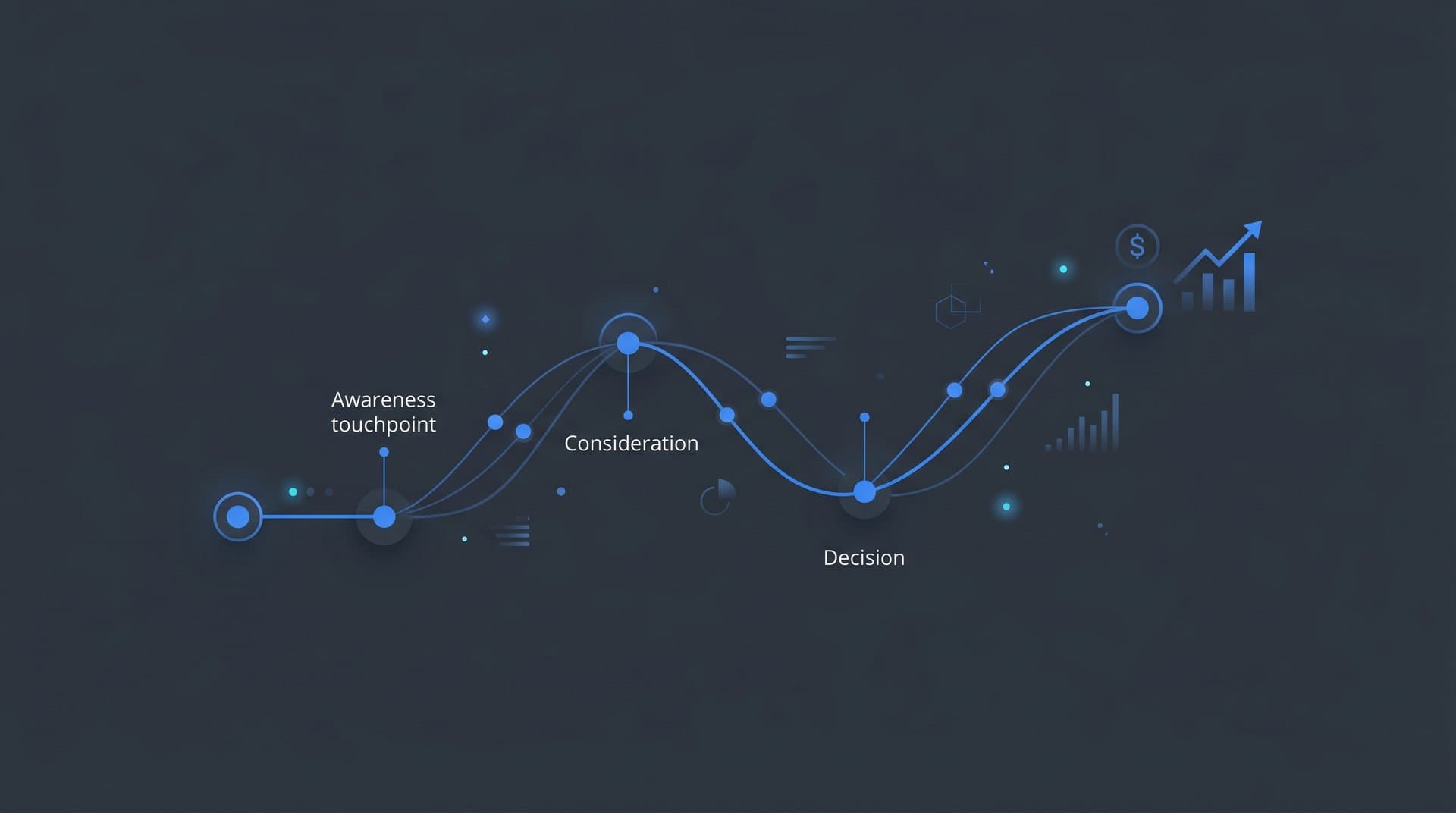
Most marketing teams can sketch the consumer journey stages on a whiteboard in under two minutes. Awareness, Consideration, Decision, and beyond. The framework is familiar, almost intuitive. But here is the problem: knowing the stages and being able to measure what happens at each one are two completely different things.
The gap between theory and data is where marketing budgets go to waste. A campaign drives thousands of impressions in the Awareness stage, but no one can tell whether those impressions ever became demos. A retargeting ad nudges a prospect toward the Decision stage, but the credit goes to the last click before signup. The buyer's actual journey, with all its loops and pauses and re-entries, stays invisible.
This is the core tension that most B2B SaaS marketing teams live with. The consumer journey framework is genuinely useful. It helps teams think about messaging, channel strategy, and content. But without attribution data that maps each stage to real touchpoints, the framework becomes a planning tool rather than an optimization engine.
What changes everything is connecting stage-level behavior to measurable outcomes. When you can see which ad drove the first click, which content moved a prospect from Consideration to Decision, and which campaign ultimately contributed to closed-won revenue, the consumer journey stops being a diagram and starts being a decision-making system.
This article covers the five core consumer journey stages with a B2B SaaS lens, what buyers actually do at each stage and where they drop off, how attribution models shape what you can and cannot see, how to preserve data integrity across a long and complex journey, and how to connect all of it to pipeline and revenue. By the end, you will have a clear picture of how to turn journey stage knowledge into smarter spend decisions.
The Five Stages That Define Every Buying Decision
The consumer journey has been mapped and remapped for decades, from AIDA models to modern lifecycle frameworks. For B2B SaaS, five stages capture the full arc: Awareness, Consideration, Decision, Retention, and Advocacy. Each one represents a distinct mental state, a different set of questions the buyer is asking, and a different set of behaviors you can track.
Awareness: The buyer has recognized a problem or a gap, but may not yet know your product exists. They are searching broadly, consuming educational content, and starting to understand the landscape. In B2B SaaS, this often means reading blog posts, watching explainer videos, or encountering a paid ad while researching a category-level question.
Consideration: The buyer now knows solutions exist and is actively evaluating options. They are visiting comparison sites, reading reviews, downloading guides, and shortlisting vendors. The questions shift from "what is this?" to "which one is right for us?" This stage often involves multiple stakeholders, especially in larger organizations.
Decision: The buyer is ready to choose. They are requesting demos, visiting pricing pages, talking to sales, and negotiating terms. The intent signals here are high-value and time-sensitive. Missing a prospect at this stage, or delivering the wrong message, can lose a deal that took months to develop.
Retention: The contract is signed, but the journey is not over. In SaaS, where revenue is recurring, the post-purchase experience directly affects renewal rates and expansion. Buyers in this stage are evaluating whether the product delivers on its promise and whether it fits into their workflow.
Advocacy: Satisfied customers become a growth channel. They refer colleagues, write reviews, and share their experience in communities. Advocacy is often undertracked and underinvested, despite being one of the most cost-efficient drivers of new pipeline.
Here is the critical nuance for B2B SaaS: these stages are rarely linear. A prospect might enter at the Consideration stage through a targeted LinkedIn ad, stall for three months, re-engage at Awareness when a colleague shares a piece of content, and then accelerate through Decision in two weeks. Buyers loop back, go dark, and re-enter at unexpected points.
This non-linear reality is precisely why single-touch attribution fails. If you only credit the first click or the last click, you miss the entire middle of the journey. The touchpoints that keep a prospect warm during a three-month stall, or that re-ignite interest after a long pause, never receive credit for the role they played.
Stage-level intent signals give you a behavioral map to work from. An ad click on a category-level keyword signals Awareness. A visit to your comparison page or a G2 review check signals Consideration. A pricing page visit or a demo request signals Decision. When you can tie these behaviors to specific campaigns and channels, you stop guessing about what is working and start seeing the actual path buyers take through your funnel. Understanding the full B2B customer journey is essential for building campaigns that reach buyers at every stage.
What Buyers Actually Do at Each Stage (And Where They Disappear)
Understanding the stages conceptually is one thing. Knowing the specific behaviors that define each stage, and the moments where buyers most often drop off, is what separates teams that optimize their funnels from teams that keep running the same campaigns and hoping for better results.
In the Awareness stage, buyers engage with top-of-funnel content: blog posts, social ads, YouTube videos, podcasts, and search results for broad, problem-oriented queries. They are not ready to be sold to, and pushing them toward a demo request at this stage typically drives low-quality conversions or high drop-off rates. The goal here is to build familiarity and trust, not to close.
In the Consideration stage, behavior shifts meaningfully. Buyers start visiting your website directly, spending time on feature pages, comparing you to alternatives, and reading customer reviews. They may download a detailed guide or sign up for a webinar. In B2B SaaS, this stage often involves multiple team members, each researching different aspects of the decision.
In the Decision stage, intent is unmistakable. Pricing page visits, demo requests, free trial signups, and direct outreach to sales all signal that a buyer is close to committing. This is also the stage where speed matters most. Prospects who request a demo and do not hear back quickly often move on to a competitor or lose momentum entirely.
The drop-off points between stages are predictable once you know where to look. Between Awareness and Consideration, the most common failure is misaligned messaging: top-of-funnel ads that generate clicks but lead to landing pages that immediately push for a demo, creating friction before trust is established. Between Consideration and Decision, slow follow-up and lack of retargeting are frequent culprits. A prospect who visited your pricing page three times last week is signaling strong intent, but if your team does not know that because the data is not connected, that signal goes unanswered.
This is the attribution gap in practice. When marketers cannot see which channel or ad influenced a stage transition, they cannot make informed decisions about where to invest. They may cut a top-of-funnel campaign that was consistently driving Consideration-stage engagement, simply because it did not show direct conversions in the platform's native reporting.
Conversion tracking and customer journey analytics are what close this gap. When every touchpoint is captured and connected to downstream behavior, you can see not just where buyers enter the funnel but where they accelerate, where they stall, and what finally moves them to act. That visibility is the foundation of a funnel you can actually optimize.
How Attribution Models Shape What You See Across the Journey
Attribution models are not neutral. The model you choose determines which touchpoints receive credit, which campaigns look successful, and ultimately where your budget goes. For B2B SaaS companies with complex, multi-stage buyer journeys, choosing the wrong model can lead to decisions that actively undermine growth.
First-touch attribution gives all credit to the first interaction a buyer had with your brand. This model is useful for understanding which channels are best at initiating journeys, but it severely overvalues Awareness-stage touchpoints. A podcast ad that introduced a buyer to your category gets full credit, even if it took eight more touchpoints over four months to close the deal.
Last-click attribution does the opposite. It assigns all credit to the final touchpoint before conversion, typically a branded search click or a direct visit to the pricing page. This model overvalues Decision-stage activity and makes it appear as though top-of-funnel campaigns contribute nothing. Teams using last-click attribution often end up cutting the campaigns that were actually building the pipeline they are now converting.
Linear attribution distributes credit equally across all touchpoints. It is more balanced than single-touch models but treats a brand awareness impression the same as a demo request, which does not reflect the actual weight different interactions carry in the buying process.
Data-driven attribution, when available, uses statistical modeling to assign credit based on the actual contribution each touchpoint made to the conversion. It is the most sophisticated option, but it requires sufficient conversion volume and clean data to produce reliable results.
Multi-touch attribution is the practical standard for most B2B SaaS teams. It acknowledges that multiple campaigns, channels, and touchpoints contribute to a single conversion over an extended period, and it distributes credit accordingly. This approach is far better suited to journeys where a buyer might interact with a LinkedIn ad, read three blog posts, attend a webinar, and then convert on a retargeting campaign, all before ever talking to sales.
The practical consequence of model selection is significant. Many B2B SaaS marketing teams have discovered, after switching from last-click to multi-touch attribution, that campaigns they were considering cutting were actually initiating a large share of their closed-won deals. The campaigns looked unproductive under last-click because they operated at the top of the funnel, where conversions are not immediate. Under multi-touch attribution, their true contribution becomes visible.
Choosing the right attribution model is not just a reporting preference. It directly shapes how you allocate budget across the consumer journey stages, and whether you invest in the full funnel or inadvertently starve the stages that matter most. Teams that understand what attributed revenue actually measures are far better positioned to defend their top-of-funnel spend.
Tracking Consumer Journey Stages Without Losing Data
Even with the right attribution model in place, your data is only as good as your ability to capture it. And in B2B SaaS, where the path from first click to closed revenue can span months and involve dozens of touchpoints, data loss is a persistent and serious problem.
Browser-based tracking has become increasingly unreliable. Privacy changes across major browsers have shortened cookie lifespans, reduced cross-site tracking capabilities, and made it harder to stitch together a buyer's journey across multiple sessions and devices. Ad platforms have responded by introducing their own attribution windows, often defaulting to settings that favor their own inventory and undercount the contribution of other channels.
The result is a fragmented picture. A buyer clicks a LinkedIn ad, visits your website, returns three weeks later via organic search, requests a demo after seeing a retargeting ad, and closes six weeks after that. Without a system designed to connect these events, each platform reports only the slice it can see, and no one has the full story. Teams that find themselves unable to track the customer journey across sessions often discover that browser limitations are the root cause.
Server-side tracking addresses this directly. By moving event tracking from the browser to the server, you eliminate the dependency on cookies and browser-based scripts that are increasingly blocked or limited. Server-side tracking captures events more reliably and passes them to your analytics and ad platforms with greater accuracy and completeness.
Conversion API integration takes this further by creating a direct, server-to-server connection between your website events and ad platforms like Meta and Google. Instead of relying on pixel-based tracking that can be blocked or degraded, Conversion API sends event data directly, preserving the signal quality that ad platform algorithms depend on for targeting and optimization. Understanding the difference between Meta browser events vs Meta server events is critical for choosing the right implementation approach.
First-party data enrichment is the third piece of the puzzle. This means capturing and syncing CRM events, form submissions, demo completions, and closed-won revenue data back to your attribution system and ad platforms. When a deal closes in your CRM, that event should flow back to the campaigns and touchpoints that contributed to it. This is what transforms your attribution from a traffic measurement tool into a revenue measurement tool.
For B2B SaaS, where offline conversions like sales calls, demos, and contract signings are central to the buying process, this kind of data enrichment is not optional. It is the only way to close the loop between the ad spend that initiated a journey and the revenue that resulted from it months later. Without it, you are measuring clicks and leads while the actual business outcomes remain invisible.
Connecting Stage Data to Pipeline and Revenue Metrics
Tracking consumer journey stages is valuable. Connecting that tracking to pipeline and revenue is where it becomes transformative. This is the shift from marketing analytics to marketing accountability, and it changes how teams think about every campaign decision.
Pipeline attribution maps which ads, channels, and campaigns contributed to deals at each stage of the sales cycle. It answers questions like: which campaigns are most effective at generating qualified leads? Which channels are best at moving prospects from Consideration to Decision? Which touchpoints appear most frequently in the journeys of deals that close?
This kind of analysis requires connecting your ad platform data to your CRM. When a lead is created, that event should be tied to the campaign that drove it. As that lead progresses through the pipeline, each stage transition becomes another data point. When the deal closes, the full journey is visible: which campaigns touched this buyer, at which stages, and how long each stage took.
Revenue attribution takes this one step further. Instead of measuring success by leads or conversions, it measures success by actual revenue generated. This means connecting ad spend directly to closed-won deals, and calculating true ROI at the campaign and channel level. A campaign that generates many leads but few closed deals looks very different under revenue attribution than it does under lead-volume reporting. Reviewing your marketing dashboard KPIs through a revenue lens rather than a volume lens is one of the most impactful shifts a team can make.
For SaaS companies with subscription revenue, connecting billing or payment data to attribution adds another layer of value. When you can tie a campaign not just to a closed deal but to the monthly recurring revenue that deal represents, you can calculate lifetime value at the channel level and make budget allocation decisions based on the quality of revenue, not just the quantity of conversions.
A marketing attribution platform designed for this purpose unifies all of these data sources: ad platform data, CRM events, and billing or revenue data. Instead of stitching together reports from three different tools, every consumer journey stage is visible in a single view. You can see which campaigns are driving pipeline, which are driving revenue, and where the gaps are between the two. This is the infrastructure that makes stage-level optimization possible at scale.
Using Journey Stage Data to Make Smarter Ad Decisions
Data is only useful when it changes behavior. Stage-level journey data, when properly collected and attributed, should directly inform how you allocate budget, build creative, and configure your ad campaigns. Here is how that works in practice.
Budget allocation becomes more precise when you understand which channels perform best at each stage. Some channels are highly efficient at generating Awareness: they reach large audiences at low cost per impression and consistently initiate new journeys. Others excel at Decision-stage conversion: they reach buyers who are already in-market and ready to act. Knowing which channels play which role allows you to fund each appropriately rather than applying a uniform budget across the board.
Without stage-level data, teams often over-invest in Decision-stage channels because those conversions are visible and attributable, while Awareness-stage channels get cut because their contribution is harder to see. The result is a funnel that converts well at the bottom but starves at the top, eventually leading to pipeline decline. Building a system to track the full customer journey online is what prevents this kind of structural underinvestment.
AI-powered recommendations add another layer of intelligence. By analyzing patterns across campaigns, channels, and touchpoints, AI can surface which specific ads are accelerating movement between stages and which ones are generating engagement without contributing to pipeline. This kind of insight is difficult to derive manually from large datasets, but it becomes actionable when an attribution platform applies machine learning to the patterns in your own conversion data.
The feedback loop to ad platforms is equally important. When you send enriched, stage-level conversion data back to Meta, Google, and other platforms, you improve the quality of the signals their algorithms use for targeting and optimization. Instead of optimizing toward surface-level events like page views or form fills, the algorithms can optimize toward the behaviors that actually predict revenue: demo completions, qualified lead submissions, and closed deals.
This creates a compounding effect. Better data in means better targeting, which means better-quality traffic entering the funnel, which means more stage progressions to learn from, which means even better optimization over time. The consumer journey stages become not just a measurement framework but a continuous improvement engine for your entire ad strategy.
Putting It All Together: From Framework to Revenue Engine
The consumer journey stages are not just a way to understand buyers. They are a measurement system for optimizing spend. When every stage is tracked, attributed, and connected to revenue, the guesswork disappears. You know which channels initiate journeys, which campaigns accelerate them, and which touchpoints close deals. You can invest with confidence because the data supports every decision.
The path to that clarity runs through a few key capabilities: multi-touch attribution that reflects the full complexity of B2B buying journeys, server-side tracking and Conversion API integration that preserve data integrity across a long sales cycle, first-party data enrichment that connects CRM and revenue events back to ad campaigns, and a unified view that brings all of it together in one place.
This is exactly what Cometly is built to do. Cometly connects your ad platforms, CRM, and revenue data to give you a complete, real-time view of every consumer journey stage. From the first ad click to closed-won revenue, every touchpoint is captured, attributed, and connected to the outcomes that matter. You get AI-driven recommendations that surface what is working, enriched conversion data that feeds back to Meta and Google for better targeting, and pipeline and revenue attribution that shows true ROI at the campaign and channel level.
If your team is ready to move beyond surface-level metrics and start making decisions based on the full picture, Cometly gives you the infrastructure to do it. Get your free demo and see how Cometly's attribution and customer journey analytics can connect every stage of your buyer's journey to the revenue it generates.