Most marketing teams can tell you how many clicks a campaign generated. Fewer can tell you what happened after. And almost none can trace a single prospect's path from the first time they saw an ad to the moment they became a paying customer. That gap is not a reporting inconvenience. It is a strategic blind spot that quietly shapes every budget decision you make.
The user journey experience is the full sequence of interactions a prospect has with your brand, across every channel, device, and moment in time, from the first impression to closed revenue and beyond. For B2B SaaS companies, understanding this sequence is no longer a nice-to-have. It is the foundation of every smart growth decision.
This article breaks down what the user journey experience actually looks like in B2B SaaS, why gaps in journey data cost you real pipeline, how attribution models shape what you see, and what technical infrastructure you need to track it end to end. By the end, you will have a clear framework for turning journey data into smarter ad decisions and measurable revenue impact.
The Path Your Buyers Actually Take (It Is Not a Straight Line)
Picture the classic marketing funnel: awareness at the top, consideration in the middle, decision at the bottom. It is clean, logical, and almost entirely divorced from how B2B buyers actually behave.
The user journey experience, as it plays out in reality, looks more like a web than a funnel. A prospect might discover your product through a paid search ad, read a blog post two weeks later, ignore a retargeting ad, attend a webinar, get a cold email from your sales team, visit your pricing page three times, and then finally request a demo after a colleague mentions your product in a Slack message. That is one journey. Every deal in your pipeline has a version of it.
In B2B SaaS, this complexity is amplified by several factors that simply do not exist in consumer buying contexts. Sales cycles are longer, often stretching across weeks or months. Multiple stakeholders are involved, each researching independently and influencing the final decision from different angles. And the touchpoints themselves are spread across a wide range of channels: paid search, paid social, organic content, email nurture sequences, product trials, and direct sales conversations.
Each of those touchpoints represents a data signal. Each one contributes something to the prospect's eventual decision. But most marketing teams are only capturing a fraction of them, and the ones they do capture are rarely stitched together into a coherent sequence.
The linear funnel model persists in most organizations because it is easy to report on. You can pull a last-click conversion report in minutes. But that report tells you almost nothing about the journey that led to the conversion. It tells you which channel got the final credit, not which channels actually did the work.
This distinction matters enormously. When you optimize based on last-click data, you systematically defund the channels that generate awareness and nurture consideration, the channels that make the final click possible in the first place. You are essentially rewarding the closer and firing the entire team that set up the deal.
Understanding the user journey experience means accepting that the path is non-linear, multi-session, and often invisible to standard reporting tools. The first step toward fixing your attribution is acknowledging that the funnel model is a simplification, not a map.
Why Gaps in Journey Data Cost You Real Revenue
When you cannot see the full journey, you cannot accurately attribute conversions. And when attribution is inaccurate, budget flows to the wrong places. This is not a theoretical risk. It is a systematic problem that compounds over time.
Here is how it typically unfolds. A prospect first discovers your product through a LinkedIn ad. They visit your site, read a few pages, and leave. Two weeks later, they find you again through organic search. They download a guide, enter your email nurture sequence, and eventually click a branded search ad before requesting a demo. In a last-click model, Google Ads gets full credit. LinkedIn gets nothing. Your organic content gets nothing. Your email program gets nothing.
Based on that data, you shift budget away from LinkedIn and content, and into branded search. The pipeline looks stable for a quarter. Then it starts to decline. You have cut the channels that were generating new awareness and feeding the top of the funnel, and you are only seeing the impact months later when the pipeline dries up. By then, the connection between the budget decision and the outcome is nearly impossible to trace.
This is the compounding effect of bad journey data. Each misattributed conversion reinforces a flawed model of what is working. Budget decisions built on that model create downstream consequences that are difficult to diagnose because the feedback loop is so slow.
There is a second layer of damage that is less obvious but equally significant. Ad platforms like Meta and Google use conversion signals to train their bidding algorithms. When those signals are incomplete because browser-based pixels miss conversions due to ad blockers, cookie restrictions, or cross-device behavior, the algorithms optimize toward a distorted picture of your customer. They find more people who look like the conversions you reported, not the customers who actually drive revenue.
The result is ad spend that looks efficient on paper but underperforms in pipeline. You are paying for optimization toward an incomplete signal, and the gap between marketing-reported conversions and CRM-recorded revenue widens.
Full journey visibility closes this gap. When you can connect every touchpoint to a pipeline outcome, you can see which channels actually influence revenue, not just which ones generate activity. That clarity is what separates growth teams that scale efficiently from those that spin their wheels.
The Core Stages of a B2B User Journey
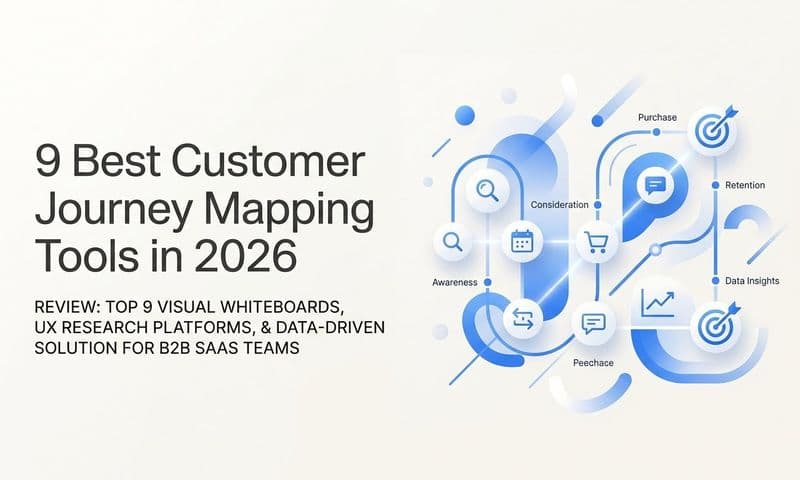
To track the user journey experience accurately, you need a clear model of what stages exist and what data signals define each one. In B2B SaaS, the journey broadly moves through four stages: Awareness, Consideration, Decision, and Retention.
Awareness: This is the first moment a prospect encounters your brand. It might be a paid search ad, a social post, a mention in a newsletter, or an organic search result. The data signal here is typically a first-touch event: an ad impression, a click, or a first website visit. This stage is often the hardest to attribute accurately because it happens before any form of identification exists. The prospect is anonymous, and the interaction may not be captured at all if your tracking infrastructure relies solely on cookies.
Consideration: This is where the prospect begins actively evaluating your product. They are consuming content, comparing alternatives, and starting to form a preference. Touchpoints at this stage include retargeting ad clicks, blog and resource page visits, webinar registrations, demo page views, and email engagement. This is also where multi-session behavior becomes critical to track. A prospect might visit your site five times over three weeks before taking any action that your CRM would recognize as a lead event.
Decision: This stage covers the final interactions that lead to conversion. It includes demo requests, trial starts, pricing page visits, and direct sales touchpoints. This is where most attribution models focus their attention because it is the closest to the conversion event. But optimizing only for this stage ignores everything that made the decision possible.
Retention: Post-conversion events matter too. Expansion revenue, upsells, and referrals all have journeys of their own. Tracking what happens after a customer converts gives you insight into which acquisition channels produce the highest-value customers over time, not just the most conversions in the short term.
Each stage requires different data signals, and each signal needs to be captured and connected to a persistent identifier that allows you to stitch the journey together across sessions and devices. This is where touchpoint weighting becomes relevant. Different attribution models assign credit differently across these stages, which means the model you choose will determine which parts of the journey appear most valuable in your reporting.
A well-constructed journey map captures signals at every stage and preserves the sequence, so you can see not just which touchpoints occurred, but in what order and with what time gaps between them. That sequence is where the real insight lives.
How Attribution Models Shape What You See in the Journey
Attribution models are not neutral lenses. Each one tells a fundamentally different story about the same user journey, and the story you choose to believe determines where your budget goes.
Take a prospect who interacts with your brand through a LinkedIn ad, two organic blog posts, a retargeting ad, and a branded search ad before converting. Here is what each major attribution model would tell you about that journey.
First-touch attribution gives all credit to the LinkedIn ad. It treats the first interaction as the cause of the conversion and ignores everything that came after. This model is useful for understanding which channels generate initial awareness, but it dramatically undervalues the nurture touchpoints that kept the prospect engaged over time.
Last-click attribution gives all credit to the branded search ad. It treats the final interaction as the decisive one and ignores everything that came before. This is the default model in most ad platforms and the most commonly used in practice. It is also the most misleading for B2B SaaS, where the journey to conversion is rarely driven by a single touchpoint.
Linear attribution distributes credit equally across all four touchpoints. It acknowledges that multiple interactions contributed to the conversion, which is more accurate than first-touch or last-click. But equal weighting is still an approximation. It does not reflect the reality that some touchpoints are more influential than others.
Data-driven attribution uses algorithmic weighting based on actual conversion patterns in your data. It assigns credit based on which touchpoints statistically correlate with conversion outcomes. This model requires sufficient data volume to produce reliable weights, but it is the most accurate representation of how your specific audience moves through the journey.
The practical implication of model selection is significant. If you run your budget decisions on last-click data, you will consistently underinvest in top-of-funnel and mid-funnel channels. Those channels will show low conversion numbers not because they are underperforming, but because they are being measured with a tool that cannot see their contribution.
Multi-touch attribution is the most complete lens for understanding the full user journey experience in B2B SaaS. It acknowledges the reality of complex, multi-session buying behavior and distributes credit in a way that reflects actual influence rather than proximity to the conversion event. For teams making budget decisions that affect pipeline, the attribution model is not a reporting preference. It is a strategic choice with real revenue consequences.
Tracking the Journey End to End: What You Need in Place
Understanding the user journey experience conceptually is one thing. Actually capturing it in your data is another. The technical infrastructure required for full journey tracking has evolved significantly, and the old approach of relying on browser-based pixels is no longer sufficient.
The foundation of reliable journey tracking today is server-side conversion tracking. Traditional pixel-based tracking fires JavaScript from the user's browser, which means it is subject to ad blockers, browser privacy restrictions, and the ongoing deprecation of third-party cookies. Server-side tracking sends event data directly from your server to the ad platform, bypassing client-side limitations entirely. This dramatically improves data completeness, particularly for the conversion events that matter most to attribution.
Conversion API integrations extend this capability to specific ad platforms. Meta's Conversion API and Google's Enhanced Conversions allow you to send first-party event data directly from your server to the platform, supplementing or replacing pixel-based signals. When these integrations are configured correctly, the ad platform receives a more complete and accurate picture of your conversion events, which improves both attribution reporting and algorithm optimization.
First-party data collection is the second critical component. As third-party cookies continue to be restricted across browsers, the only reliable foundation for journey tracking is data you collect directly from your own users. This means capturing identifiers like email addresses and user IDs at key interaction points and using them to stitch together cross-session and cross-device behavior into a unified journey record.
The third component is connecting your data sources into a single layer. Ad platform data tells you what happened in the paid channel. CRM data tells you what happened in the sales process. Website event data tells you what happened between those two points. When these sources are siloed, you can see each piece of the journey in isolation but not the sequence that connects them. Integrating ad platforms, CRM, and website behavior into a unified data layer is what closes the gaps that fragment journey visibility.
Two additional technical considerations matter for data quality. Event deduplication ensures that the same conversion is not counted multiple times when both pixel and server-side events fire for the same action. Data enrichment involves appending CRM signals, such as lead status, deal stage, and revenue amount, to the event data, so that your journey records reflect not just marketing activity but actual business outcomes. Together, these practices ensure that the journey data you collect is clean, complete, and connected to revenue.
Turning Journey Insights Into Smarter Ad Decisions
Complete journey data is only valuable if you can act on it. The goal is not to build a more detailed report. The goal is to make better decisions about where to invest your ad budget and how to optimize your campaigns.
When you have full journey visibility, the first thing you can do is identify which channels and campaigns actually influence pipeline, not just generate clicks or impressions. This distinction is critical. A channel that drives a high volume of first-touch visits might look unimpressive in a last-click report but appear as a consistent contributor to pipeline when you look at its role across multi-touch journeys. Conversely, a channel that appears to drive many conversions in last-click reporting might be capturing credit for conversions that were already in motion, adding little incremental value.
Journey data also reveals which touchpoint sequences have the highest conversion rates. This is the kind of pattern that manual reporting cannot surface at scale. You might discover that prospects who engage with a specific piece of content before seeing a retargeting ad convert at a significantly higher rate than those who see the retargeting ad first. That insight changes how you sequence your campaigns, which audiences you retarget, and which content you invest in producing.
AI-driven analysis accelerates this process considerably. Rather than manually cross-referencing channel data with CRM outcomes, AI can scan the full journey dataset and surface the patterns that correlate with conversion and revenue. It can identify which audience segments respond to specific channel combinations, which campaigns are generating pipeline influence that does not show up in standard conversion reporting, and where budget reallocation would have the greatest impact on revenue outcomes.
The final piece connects journey analytics back to the ad platforms themselves. When you feed enriched, conversion-ready events back to Meta and Google, including downstream CRM signals like qualified lead status or closed-won revenue, you are giving the platform's algorithm a more accurate target to optimize toward. Instead of optimizing for form fills, you are optimizing for the behaviors that actually predict revenue. This improves targeting quality, reduces wasted spend on low-intent audiences, and compounds over time as the algorithm accumulates better signal.
This is where platforms like Cometly create a meaningful advantage. By connecting ad platforms, CRM data, and website events into a single attribution layer, Cometly gives marketing teams the complete journey picture they need to make these decisions with confidence, from identifying which channels drive pipeline to feeding enriched signals back to ad platforms for smarter optimization.
Putting It All Together
The user journey experience is the most important data asset a B2B SaaS marketing team has. It is the only thing that connects your ad spend to your revenue outcomes in a way that is both accurate and actionable. And most teams are only seeing a fraction of it.
The path forward requires four concrete actions. First, map the real stages of your buyer journey, including the non-linear, multi-session behavior that standard funnel models ignore. Second, choose an attribution model that reflects the complexity of B2B buying behavior, which means moving beyond last-click toward multi-touch or data-driven approaches. Third, implement server-side tracking and Conversion API integrations to capture the conversion signals that browser-based pixels miss. Fourth, use AI-driven analysis to surface the journey patterns that manual reporting cannot detect at scale.
None of these steps are optional if your goal is to grow efficiently. The teams that understand their full user journey experience will consistently outperform those that optimize based on incomplete data, because they are making decisions based on what is actually driving revenue, not just what is easiest to measure.
If you are ready to stop guessing and start seeing the complete picture from first ad click to closed-won revenue, Cometly is built exactly for this. It gives B2B SaaS marketing teams a single source of truth for the entire customer journey, with multi-touch attribution, server-side tracking, CRM integration, and AI-driven insights all in one platform. Get your free demo today and start capturing every touchpoint to maximize your conversions.