

You are watching your ad spend climb every month. Leads are coming in. The pipeline looks active. But when leadership asks which campaigns are actually driving revenue, the room goes quiet. Nobody has a confident answer.
This is one of the most common and costly problems in B2B SaaS marketing today. Not because teams are not working hard, but because the data they are working from is incomplete. When traffic sources are untagged, untracked, or misattributed, every budget decision becomes a guess dressed up as strategy.
The frustrating part is that this is not a spending problem. You could double your ad budget tomorrow and still have the same issue. This is a visibility problem. When your analytics show "unknown source" or "direct" across a significant portion of your traffic, you are not looking at real data. You are looking at gaps.
This article breaks down exactly why unknown ad sources drain budgets, where the gaps come from, and what a reliable fix actually looks like. If you manage paid media for a B2B SaaS company and you are tired of making decisions on incomplete data, this is the guide you need.
The Hidden Cost of "Unknown Source" in Your Ad Data
When a session shows up in your analytics as "unknown source" or gets lumped into direct traffic, it does not mean someone typed your URL directly into their browser. More often, it means the tracking broke somewhere along the way.
Unknown source traffic typically comes from a few specific places. Untagged links shared in emails, Slack messages, or documents. Broken UTM parameters that were either never added or got stripped during redirects. Missing attribution parameters on paid ads that were built without a consistent tagging convention. And direct visits from users who clicked a link in an environment that does not pass referral data, like certain mobile apps or secure HTTPS-to-HTTP redirects.
Each of these scenarios produces the same result in your reporting: a visit that cannot be traced back to the campaign that generated it.
Here is where it gets expensive. When paid traffic gets misclassified as direct or organic, your organic numbers look stronger than they actually are. Leadership sees healthy organic growth and assumes the channel is working well. Meanwhile, the paid campaigns generating that traffic are not getting credit. Budget decisions get made on this distorted picture.
The compounding effect is what makes this particularly damaging over time. If a paid LinkedIn campaign is consistently driving qualified leads but those sessions are being attributed to direct, you have no data to justify scaling that campaign. It looks like it is underperforming because the results it is generating are invisible to your paid ads analytics reporting stack.
At the same time, a campaign that genuinely is not working might appear functional because a few conversions from other sources got assigned to it by default. You keep funding it. You keep hoping it improves. The budget keeps draining.
This is not a hypothetical scenario. It is the operational reality for many B2B SaaS marketing teams running multi-channel paid programs without airtight tracking infrastructure. The unknown source problem is not a minor data quality issue. It is a direct cause of misallocated budget at scale.
The first step to fixing it is understanding that every session in your analytics represents a real person who clicked a real ad or visited a real page. When that session shows up as unknown, it is not neutral. It is a signal that your tracking has a gap, and that gap is costing you money.
Why Attribution Gaps Are More Common Than Most Teams Realize
Most marketing teams know that attribution is imperfect. What they underestimate is how frequently and silently it breaks down in practice.
The most preventable cause is missing or inconsistent UTM parameters. UTMs are the query string tags appended to URLs that tell your analytics tool where a visitor came from, which campaign sent them, and what ad they clicked. When these tags are missing, malformed, or applied inconsistently across campaigns, your analytics cannot categorize the traffic correctly. It defaults to direct or unknown.
This happens more often than teams want to admit. A new campaign gets built in a rush. The UTM template gets skipped. A landing page URL gets shared in a sales email without the tracking parameters. A third-party tool strips query strings during a redirect. Each instance creates another hole in your data. Using a marketing campaign tracking spreadsheet with enforced UTM conventions can prevent many of these gaps before they compound.
Cross-device journeys create a different kind of gap that is harder to fix with tagging alone. A B2B buyer might click your Google ad on their phone during a commute, come back to your website on their work laptop the next day through organic search, and then convert after a sales rep sends a follow-up email. Without a tracking system that can stitch those sessions together under a single user identity, the original paid touchpoint is completely lost. The conversion gets attributed to organic or direct, and the Google campaign that started the journey gets no credit.
This is not a rare edge case in B2B SaaS. It is the norm. Enterprise buyers research solutions across multiple devices and sessions over weeks or months. Linear, session-based attribution simply cannot handle that complexity.
Platform-level attribution discrepancies add another layer of confusion. Meta, Google, and LinkedIn each use their own attribution windows, counting methodologies, and conversion definitions. Meta might count a view-through conversion from someone who saw your ad but never clicked. Google might count the same conversion as a last-click from a branded search. LinkedIn might claim it too based on a prior impression.
When you pull reporting from each platform separately, the numbers do not add up. Total conversions reported across platforms often exceed actual conversions by a wide margin. Teams either trust one platform and ignore the others, or they average the numbers and hope for the best. Neither approach gives you an accurate picture of what is actually working. These Facebook ads reporting discrepancies are a well-documented symptom of this exact problem.
The B2B SaaS buying cycle amplifies all of these problems. Long evaluation periods, multiple stakeholders, and touchpoints spread across weeks or months mean there are simply more opportunities for tracking to break down. The more complex the journey, the more attribution gaps you accumulate.
What You Are Actually Losing When Sources Go Untracked
The most immediate loss is budget. When you cannot see which campaigns are driving qualified pipeline, you end up funding campaigns based on surface-level metrics like click-through rate, cost per click, or raw lead volume. These metrics feel like performance. They are not the same as revenue.
A campaign can generate hundreds of leads at a low cost per lead while producing almost no closed revenue. Without attribution that connects those leads to actual deals, the campaign looks like a success. Budget keeps flowing to it. Meanwhile, a campaign driving fewer but higher-quality leads that actually convert to customers might look expensive on a cost-per-lead basis and get cut. Understanding how leads connect to revenue is what separates efficient teams from those constantly chasing vanity metrics.
This pattern plays out constantly in teams that lack full-funnel attribution. They optimize for the metrics they can see and remain blind to the outcomes that actually matter. The result is a paid media program that is busy but not efficient.
The second loss is optimization leverage. When you do not know which touchpoints drive pipeline, you cannot improve your targeting, your creative, or your bidding strategy in any meaningful way. You are essentially flying blind and making creative decisions based on instinct rather than evidence.
Think about what you could do with accurate touchpoint data. You could identify which ad formats and messages move prospects from awareness to consideration. You could see which channels tend to assist conversions even if they rarely close them. You could adjust your bidding to favor placements that correlate with high-value customers rather than just high conversion volume. None of that is possible when sources are unknown.
The third loss is strategic. Leadership teams that cannot get a clear answer to "what is marketing actually driving?" will eventually lose confidence in the marketing function. Budget approval cycles slow down. Growth investments get delayed. The marketing team gets positioned as a cost center rather than a revenue driver.
This is not about optics. It is about the real organizational cost of operating without reliable marketing data. When attribution is broken, the entire growth function suffers, not just the paid media team.
Building a Tracking Foundation That Eliminates Unknown Sources
Fixing the unknown source problem starts with getting disciplined about UTM tagging across every paid channel. This sounds basic, but most teams do not have a truly enforced convention. They have guidelines that get followed inconsistently.
A reliable UTM strategy means defining a standard naming convention before any campaign goes live and treating it as non-negotiable. Every paid link, every ad, every email campaign should have parameters for source, medium, campaign, content, and term applied consistently. The naming convention should be documented, version-controlled, and used as a checklist during campaign setup, not an afterthought.
It also means auditing existing campaigns regularly. UTM parameters get broken during platform migrations, landing page rebuilds, and redirect chain updates. A monthly audit of your top traffic sources to check for unknown or direct misclassification is a simple habit that catches problems before they compound.
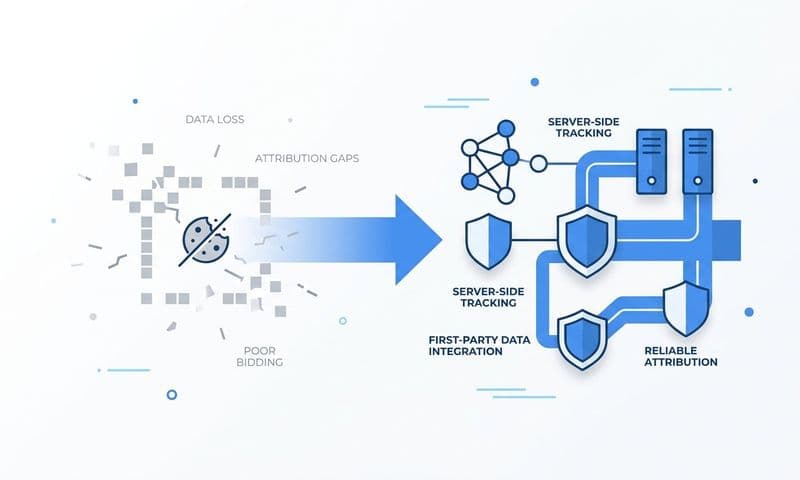
The more significant infrastructure upgrade is moving from browser-based pixel tracking to server-side tracking via Conversion APIs. Pixel-based tracking relies on JavaScript running in the user's browser, which means it is vulnerable to ad blockers, iOS privacy restrictions, and browser cookie limitations. As privacy standards have tightened, pixel data has become increasingly unreliable.
Server-side tracking works differently. Instead of relying on the browser to fire a pixel, your server sends conversion data directly to the ad platform's API. Meta's Conversion API, Google's Enhanced Conversions, and LinkedIn's Conversion API all support this approach. Because the data travels server-to-server rather than through the browser, it is not affected by ad blockers or device-level privacy settings. The signal is cleaner and more complete.
First-party data collection closes the loop further. When you capture lead and customer data directly from your forms, CRM, and product, you have a reliable identifier that can be matched back to ad platform data. This is especially powerful for B2B SaaS teams that want to connect an ad click from six months ago to a deal that just closed in their CRM.
Syncing this first-party data back to your ad platforms means their algorithms can optimize toward actual revenue outcomes rather than just form fills. When Meta or Google knows which of your leads actually became customers, they can find more people who look like your best customers. That is a meaningful performance improvement that starts with better data infrastructure at the source.
How Multi-Touch Attribution Connects Every Dollar to a Result
Even with clean UTM tagging and server-side tracking in place, you still need the right attribution model to make sense of the data. And for most B2B SaaS teams, the default model they are using is actively misleading them.
Last-click attribution assigns all conversion credit to the final touchpoint before a lead converts. It is simple, easy to implement, and deeply flawed for complex B2B buying journeys. When last-click is your default, every channel that touches a prospect earlier in their journey gets zero credit. Display campaigns, social awareness ads, content downloads, and webinar registrations all appear to contribute nothing, even when they are the reason the prospect entered your funnel in the first place.
This is why upper-funnel channels consistently appear wasteful under last-click reporting. They are not wasteful. They are invisible. And because they appear to produce no results, they get cut. The funnel gets narrower. Acquisition costs rise because you are only investing in the bottom of the funnel and wondering why top-of-funnel volume is declining.
Multi-touch attribution solves this by distributing credit across every touchpoint in the customer journey. Depending on the model you use, credit might be weighted toward the first touch, the last touch, and key middle touchpoints. Understanding the difference between single-source and multi-touch attribution models is essential before choosing the right approach for your team.
The specific model matters less than the principle: every channel that influenced the buyer's journey gets visibility into its contribution. That means you can see which channels tend to start journeys, which ones nurture prospects through the middle, and which ones close deals. That is actionable intelligence that last-click attribution simply cannot provide.
The most powerful version of this connects ad spend not just to leads but to pipeline and closed revenue. When you can see that a specific LinkedIn campaign contributed to ten deals worth a combined value in your CRM, you have a real return on investment number. Not a cost per lead. Not a click-through rate. An actual revenue outcome tied to a specific ad investment.
That is the level of clarity that changes how marketing teams operate and how leadership perceives the marketing function.
Turning Attribution Clarity Into Smarter Ad Spend Decisions
Attribution data is only valuable if it changes how you allocate budget. The goal is not just to know where your conversions came from. It is to use that knowledge to put more money behind what is working and pull back from what is not.
With full-funnel attribution in place, budget reallocation becomes a data-driven process rather than a debate. You can identify which channels are generating qualified pipeline, not just lead volume, and shift budget toward those channels with confidence. You can also identify campaigns that generate high click volume and low revenue contribution and cut them without second-guessing the decision.
This kind of reallocation is difficult when your data is incomplete. When sources are unknown and attribution is broken, every budget conversation becomes political rather than analytical. Someone defends their channel because they believe in it. Someone else questions a channel because the numbers look bad in isolation. Without a shared source of truth, these conversations do not resolve cleanly.
AI-driven attribution recommendations add another layer of insight that human analysis often misses. When an attribution platform is processing data across every touchpoint, campaign, and channel in real time, it can surface patterns that would take a human analyst weeks to find. AI ads optimization can reveal a specific ad creative that consistently appears in the journeys of your highest-value customers, or a channel that looks expensive on a cost-per-lead basis but drives deals that close faster and at higher contract values.
The final piece is feeding enriched conversion data back to your ad platforms. When Meta, Google, or LinkedIn receives detailed conversion signals that include revenue data and customer quality indicators, their optimization algorithms can do more with it. Instead of optimizing toward any form fill, they optimize toward the form fills that actually become revenue. Over time, this improves targeting efficiency and reduces wasted spend at the platform level.
This is the full loop: accurate tracking generates clean data, clean data enables multi-touch attribution, attribution insights drive smarter budget decisions, and enriched conversion signals improve platform-level optimization. Each piece reinforces the others. And it all starts with eliminating unknown sources from your reporting.
The Bottom Line: Stop Guessing, Start Scaling
Wasting money on ads from unknown sources is not an inevitable cost of running paid media. It is a solvable problem, and the solution is not complicated. It requires consistent tracking infrastructure, the right attribution model, and a platform that connects your ad spend to real revenue outcomes.
The teams that fix this problem do not just get better data. They get a competitive advantage. They can scale what works, cut what does not, and justify growth investment with evidence instead of intuition. They stop having uncomfortable conversations in leadership meetings and start driving those conversations with confidence.
Cometly is built specifically for this. It connects your ad platforms, CRM, and website data to give B2B SaaS marketing teams a single source of truth for every dollar spent and every deal closed. With multi-touch attribution, server-side conversion tracking, AI-driven recommendations, and real-time pipeline visibility, Cometly gives you the clarity to stop guessing and start scaling.
If you are ready to see exactly which ads are driving revenue and stop funding campaigns that only look good on paper, Get your free demo and see what accurate attribution actually looks like in practice.