

For B2B SaaS marketing teams, ad reporting is only as valuable as it is accurate. When your data is off, every decision downstream suffers. You might cut a campaign that was quietly driving pipeline, or double down on a channel that looks good on the surface but never converts to revenue.
The challenge is that accurate ad reporting is harder to achieve than most teams realize. Browser privacy changes, cross-device journeys, disconnected tools, and platform-native attribution biases all create gaps between what your dashboards show and what is actually happening.
This article breaks down seven practical strategies to close those gaps and build a reporting foundation you can trust. Whether you are managing paid search, social, or a full multi-channel mix, these approaches will help you connect ad spend to real business outcomes and make smarter budget decisions with confidence.
1. Implement Server-Side Tracking to Replace Unreliable Pixel Data
The Challenge It Solves
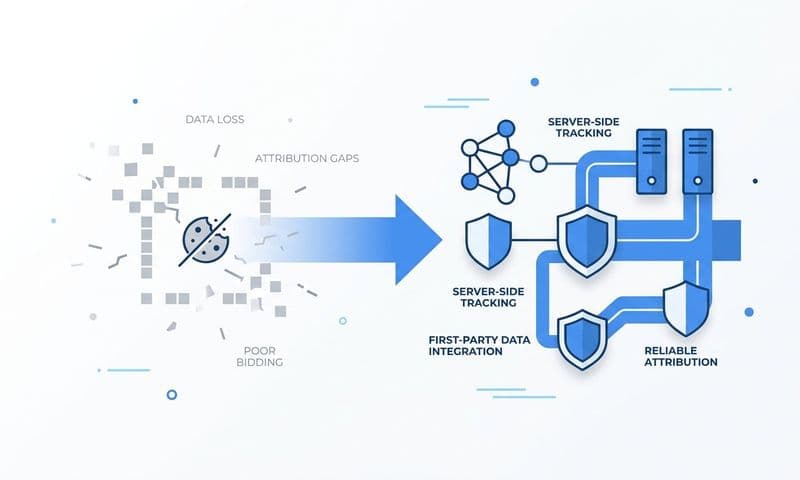
Browser-based pixels have become increasingly unreliable. Safari's Intelligent Tracking Prevention, tightening cookie restrictions in Chrome, and the widespread use of ad blockers all intercept or block the signals your pixel tries to send. The result is a growing gap between conversions that actually happen and conversions your ad platforms can see and optimize against.
The Strategy Explained
Server-side tracking sends conversion events directly from your server to ad platforms like Meta and Google, completely bypassing browser limitations. Instead of relying on a JavaScript pixel firing in the user's browser, your server captures the event and forwards it through Meta's Conversion API (CAPI) or Google's Enhanced Conversions. Understanding why server-side tracking is more accurate helps teams prioritize this infrastructure upgrade before other optimizations.
Because this data travels server-to-server, it is not subject to browser privacy restrictions or ad blockers. First-party data collected this way typically achieves higher match rates, which means your ad platforms receive stronger optimization signals. Better signals lead to smarter bidding, more accurate audience targeting, and more reliable reported performance.
Implementation Steps
1. Audit your current pixel coverage to identify what percentage of conversions your browser pixel is capturing versus what your CRM or backend records show.
2. Set up Meta CAPI or Google Enhanced Conversions through your server or a tag management solution that supports server-side containers.
3. Pass first-party data signals such as hashed email addresses and phone numbers to improve event match quality on the platform side.
4. Run both pixel and server-side tracking simultaneously during the transition, using event deduplication to prevent double-counting.
Pro Tips
Do not treat server-side tracking as a set-and-forget installation. Verify match quality scores inside Meta Events Manager and Google's diagnostics regularly. A high event match quality score confirms your server-side setup is sending clean, usable signals that actually improve ad platform optimization.
2. Standardize UTM Tagging Across Every Campaign and Channel
The Challenge It Solves
Inconsistent UTM parameters are one of the most common and quietly damaging causes of fragmented attribution data. When different team members or agencies use different naming conventions across campaigns, channels, or time periods, aggregating performance data becomes unreliable. You end up with dozens of variations of the same source in your analytics tool, and cross-channel comparison becomes impossible.
The Strategy Explained
A consistent UTM taxonomy gives every campaign, ad set, and creative a structured identity that flows cleanly through your entire reporting stack. Your taxonomy should define standard values for five parameters: utm_source for the platform, utm_medium for the channel type, utm_campaign for the campaign name, utm_content for the specific ad creative, and utm_term for the keyword or audience segment. Learning how to use naming conventions for ad creative insights gives teams a practical framework for building this structure consistently.
The key is that this structure should mirror your CRM field naming conventions. When UTM data flows into your CRM as clean, predictable values, you can map leads to their originating campaigns with confidence and build accurate pipeline attribution without manual cleanup.
Implementation Steps
1. Define a master UTM taxonomy document that specifies approved values for each parameter and makes it the single reference for all teams and agencies.
2. Build a UTM builder tool or spreadsheet that auto-generates compliant URLs, reducing the risk of manual errors or inconsistent capitalization.
3. Audit existing campaigns to identify and correct broken or non-standard UTM parameters that are currently fragmenting your attribution data.
4. Set up automated alerts or validation rules in your analytics platform to flag any new traffic sources that do not match your approved taxonomy.
Pro Tips
Enforce lowercase-only UTM values across the board. Analytics tools treat "LinkedIn" and "linkedin" as two different sources, which silently splits your data. A single capitalization rule in your taxonomy document prevents this common reporting error before it starts.
3. Use Multi-Touch Attribution Instead of Last-Click Models
The Challenge It Solves
Last-click attribution credits 100% of a conversion to the final touchpoint before the conversion event. In B2B SaaS, where sales cycles often span weeks or months and involve multiple interactions across different channels, this systematically undervalues every touchpoint except the last one. Top-of-funnel awareness campaigns, mid-funnel retargeting, and nurture sequences that do the heavy lifting of building intent get zero credit.
The Strategy Explained
Multi-touch attribution distributes conversion credit across the full customer journey, giving a more accurate picture of which channels and touchpoints are genuinely contributing to pipeline and revenue. Common models include linear attribution, which spreads credit equally across all touches, time-decay attribution, which weights recent touches more heavily, and position-based attribution, which emphasizes the first and last touch. Reviewing the five most common ad attribution models helps teams choose the right starting point for their sales cycle.
Data-driven attribution goes further by using algorithmic weighting based on actual conversion path data, making it the most accurate option when you have sufficient volume. The right model for your team depends on your average sales cycle length and the number of touchpoints in a typical buyer journey. Platforms like Cometly allow you to compare multiple attribution models side by side so you can understand how credit distribution shifts depending on the model you apply.
Implementation Steps
1. Map your typical buyer journey to understand how many touchpoints occur before a conversion and across which channels.
2. Select a starting attribution model that fits your sales cycle, beginning with position-based or linear if you are moving away from last-click for the first time.
3. Compare model outputs side by side to see which channels gain or lose credit when you move away from last-click.
4. Align your budget allocation and campaign optimization decisions to the multi-touch model rather than defaulting back to last-click metrics.
Pro Tips
Do not switch attribution models mid-quarter without documenting the change. Model switches create apparent performance swings that can be misread as actual campaign changes. Always annotate model changes in your reporting so future analysis accounts for the methodology shift.
4. Connect Ad Data Directly to Pipeline and Revenue
The Challenge It Solves
Many B2B SaaS marketing teams optimize ad campaigns based on lead volume or MQL counts. This creates a dangerous disconnect because not all leads convert to revenue at the same rate across different channels. A channel that generates high lead volume at low cost per lead may produce opportunities that rarely close, while a more expensive channel may consistently drive high-value customers. Without revenue data connected to ad spend, you are optimizing for the wrong signal.
The Strategy Explained
Connecting your CRM to your ad platforms allows you to track performance beyond the lead stage, mapping ad spend all the way to MQLs, sales-qualified opportunities, and closed-won revenue. This creates true ROI visibility at the campaign and channel level. Understanding how SaaS growth teams attribute revenue to marketing efforts reveals the specific data connections that make this possible.
This connection requires a bidirectional data sync between your ad platforms and CRM. When a deal closes in your CRM, that revenue event should flow back to the originating campaign, giving you an accurate cost-per-acquisition and return on ad spend based on actual revenue rather than proxy metrics. Cometly integrates directly with Stripe and CRM systems to connect ad data to revenue, giving B2B SaaS teams end-to-end attribution from first ad click to closed-won deals.
Implementation Steps
1. Ensure your CRM captures lead source data from UTM parameters at the point of form submission or sign-up, creating a clean link between ad activity and contact records.
2. Map CRM pipeline stages to your attribution reporting so you can see how leads from each channel progress through the funnel over time.
3. Set up a revenue sync so that closed-won deal values flow back to your attribution platform and are associated with the originating campaign.
4. Build a reporting view that shows cost per opportunity and cost per closed-won customer by channel, not just cost per lead.
Pro Tips
Account for sales cycle lag when evaluating channel performance. A campaign that ran last month may not show closed-won revenue for another 60 to 90 days depending on your average deal cycle. Build a time-lag analysis into your reporting to avoid prematurely cutting channels that are still generating pipeline.
5. Deduplicate Conversion Events to Avoid Inflated Reporting
The Challenge It Solves
When you run both a browser pixel and a server-side CAPI integration simultaneously, which is the recommended setup for maximum coverage, both can fire for the same conversion event. Without deduplication, ad platforms count that conversion twice. Inflated conversion counts distort your cost per acquisition and return on ad spend metrics, leading to budget decisions based on performance that looks better than it actually is.
The Strategy Explained
Deduplication works by assigning a unique event ID to every conversion event and passing that ID through both the browser pixel and the server-side integration. When the ad platform receives two signals with the same event ID, it recognizes them as duplicates and counts only one. Match keys such as hashed email addresses or phone numbers provide an additional layer of deduplication, helping platforms identify the same user across signals even when event IDs differ. Teams dealing with this issue should also review common patterns of inaccurate conversion tracking to identify other sources of data distortion.
This is not just a technical nicety. Accurate conversion counts are the foundation of accurate CPA and ROAS calculations. If your reported conversions are inflated by 20 or 30 percent, your optimization decisions are built on a distorted baseline.
Implementation Steps
1. Generate a unique event ID for every conversion event at the point it fires, using a consistent format such as a UUID or a combination of user ID and timestamp.
2. Pass the same event ID through both your browser pixel parameters and your server-side API payload so the platform can match and deduplicate them.
3. Include hashed first-party identifiers such as email addresses in your server-side events to improve match quality and support deduplication even when event IDs are missing.
4. Validate your deduplication setup by checking the event match quality and duplicate event rates inside Meta Events Manager or Google's conversion diagnostics.
Pro Tips
Monitor your deduplication rate over time. A sudden increase in duplicate events can indicate a tracking configuration change or a new pixel firing that was added without coordination. Treat deduplication rate as a data quality metric and include it in your regular tracking audits.
6. Build a Single Source of Truth With a Centralized Attribution Dashboard
The Challenge It Solves
Platform-native reporting tools each use their own attribution windows and models. Meta Ads Manager defaults to a seven-day click and one-day view window. Google Ads uses data-driven attribution by default. LinkedIn uses its own model. When you pull performance reports from each platform separately, you are comparing numbers that were calculated using different rules, which makes cross-channel comparison misleading and budget allocation decisions unreliable.
The Strategy Explained
A centralized attribution dashboard consolidates data from all ad platforms and your CRM into a single view that normalizes attribution windows and models across every source. Instead of toggling between platform dashboards and reconciling conflicting numbers, you work from one consistent dataset where every channel is measured by the same rules. Evaluating the right attribution reporting software is the critical first step in building this unified view.
This normalization is what makes accurate cross-channel comparison possible. You can see which channels are genuinely driving the most pipeline and revenue, rather than which channels have the most favorable native reporting defaults. Cometly is built specifically for this workflow, pulling data from 70-plus native integrations into a unified view where you can apply consistent attribution models and compare channel performance on equal terms.
Implementation Steps
1. Audit your current reporting stack to identify all the data sources that need to feed into your centralized dashboard, including ad platforms, CRM, and analytics tools.
2. Select an attribution platform that supports native integrations with your ad platforms and CRM and allows you to configure consistent attribution windows across all sources.
3. Define your standard attribution model and reporting window at the organization level so every team member is working from the same methodology.
4. Retire or deprioritize platform-native reports for cross-channel decisions, reserving them only for platform-specific optimization tasks like creative testing within a single channel.
Pro Tips
Document your chosen attribution window and model in a shared reporting standards guide. When stakeholders ask why your numbers differ from what Meta or Google shows natively, you need a clear, consistent answer. Transparency about methodology builds trust in your centralized data over time.
7. Audit Your Tracking Setup Regularly to Catch Data Drift
The Challenge It Solves
Tracking accuracy degrades over time. Website updates break pixels. CMS changes remove tracking scripts. New campaign structures launch without proper UTM parameters. Ad platform APIs update and require configuration changes. CRM sync jobs fail silently. Each of these issues creates a small gap in your data, and small gaps compound into significant reporting errors if left unaddressed for weeks or months.
The Strategy Explained
A recurring tracking audit process catches these issues before they corrupt your reporting at scale. The goal is to systematically verify that every component of your tracking infrastructure is functioning correctly: pixels, server-side integrations, UTM parameters, CRM syncs, and attribution platform connections. Following established best practices for tracking conversions accurately gives teams a reliable checklist to work from during each audit cycle.
Think of it like a regular maintenance check on a complex system. You would not run a car for a year without checking whether everything still works. Your tracking infrastructure deserves the same discipline. Building this into a monthly or quarterly process ensures data quality stays high and that any degradation is caught quickly rather than discovered after a major budget decision has already been made.
Implementation Steps
1. Check pixel firing on key conversion pages using browser developer tools or a tag auditing tool to confirm events are firing correctly and passing the right parameters.
2. Verify server-side CAPI event match quality scores inside Meta Events Manager and confirm that Enhanced Conversions diagnostics in Google show healthy data.
3. Pull a sample of recent campaigns and check that all UTM parameters are present, correctly formatted, and consistent with your taxonomy standards.
4. Test your CRM sync by tracing a recent lead from the original ad click through to the CRM record, confirming that source data, campaign data, and pipeline stage updates are all flowing correctly.
Pro Tips
Create a tracking audit checklist and assign it as a recurring calendar task. The checklist format removes ambiguity about what needs to be checked and makes it easy to delegate the audit to any team member. Logging audit results over time also helps you identify patterns, such as a particular integration that breaks frequently, so you can address the root cause rather than repeatedly fixing the same symptom.
Putting It All Together
Building accurate ad reporting is not a one-time setup task. It is an ongoing discipline that requires the right infrastructure, consistent processes, and a clear framework for connecting ad activity to business outcomes.
Start by auditing your current tracking setup to identify where data is leaking. Then prioritize server-side tracking and UTM standardization as your foundation. From there, layer in multi-touch attribution and CRM-connected revenue data to move beyond vanity metrics. Add deduplication to keep your conversion counts clean, consolidate everything into a centralized dashboard, and build a regular audit cadence to maintain data quality over time.
Each strategy reinforces the others. Server-side tracking feeds cleaner signals into your attribution models. Standardized UTMs make CRM revenue attribution reliable. Deduplication keeps your centralized dashboard accurate. Together, they create a reporting stack where the numbers you see actually reflect what is happening in your business.
Cometly is built specifically for this workflow. It captures every touchpoint from first ad click to closed-won revenue, connects your ad platforms and CRM into a single source of truth, and uses AI to surface which campaigns are actually driving growth. When your reporting is accurate, your decisions are faster, your budget allocation improves, and your team builds real confidence in the data.
That is the foundation every B2B SaaS marketing team needs to scale paid acquisition effectively. Get your free demo today and start capturing every touchpoint to maximize your conversions.