

Most B2B SaaS marketing teams can tell you their click-through rate. They can pull up cost per lead, scroll through campaign dashboards, and point to hundreds of form fills as proof their ads are working. But ask them which specific campaigns drove closed-won revenue last quarter, and the room goes quiet.
That silence is the gap between ad activity and ad ROI. And it is more common than most teams want to admit.
The problem is not a lack of data. It is a lack of connected data. Your ad platforms track clicks. Your CRM tracks deals. Your billing system tracks revenue. But without the infrastructure to link these systems together, you are left making budget decisions based on whichever number is easiest to pull, not the one that actually reflects business impact.
Accurate ROI tracking for ads in B2B SaaS requires more than installing a pixel and calling it done. It requires a deliberate framework that starts with defining what a real conversion looks like, builds a reliable data foundation, connects your ad data to pipeline and revenue, and feeds enriched signals back into your ad platforms to improve performance over time.
This guide walks you through that framework step by step. Whether you are running paid search, paid social, or a mix of channels, you will come away with a practical system for knowing exactly which ads are driving growth and which ones are quietly burning budget.
Here is what we will cover: defining your conversion events, building first-party tracking infrastructure, connecting ad data to CRM and revenue, choosing the right attribution model, building an ROI dashboard, and closing the feedback loop with your ad platforms. Each step builds on the last, so by the end you will have a complete, repeatable process your team can actually use.
Step 1: Define Your Conversion Events and Revenue Goals
Before you touch a single tracking tag or platform setting, you need to get clear on what you are actually trying to measure. This sounds obvious, but it is the step most teams skip, and it is the root cause of most inaccurate ROI reporting.
In B2B SaaS, the conversion journey looks very different from e-commerce. A single deal might involve a content download, a webinar registration, a demo request, an SQL handoff, a proposal, and finally a closed-won opportunity. Each of these is a meaningful signal. The question is which ones you track and how you weight them.
Start by mapping out your full conversion event hierarchy. Think in terms of stages rather than individual actions:
Micro-conversions: Form fills, content downloads, webinar signups, and ad clicks. These indicate interest but do not directly predict revenue. They are useful for top-of-funnel optimization but should never be the primary metric for ROI calculations.
Mid-funnel conversions: Demo requests, free trial signups, and MQL to SQL transitions. These represent genuine buying intent and are much stronger signals of pipeline potential.
Macro-conversions: Qualified demos attended, opportunities created, and closed-won accounts. These are the events that directly tie to revenue and should anchor your ROI reporting.
Once you have mapped these events, assign a monetary value or pipeline weight to each one. If your average contract value is $24,000 and your close rate from demo to paid is 20%, then a qualified demo is worth roughly $4,800 in expected pipeline. That math lets your attribution tools calculate ROI at each funnel stage, not just at the top or bottom.
Critically, align with your sales and revenue teams on how they define each stage. Marketing's definition of a qualified lead and sales' definition often differ, and if your tracking does not reflect the version that maps to revenue, your ROI numbers will be misleading.
Document this conversion event map before doing anything else. It becomes your source of truth for every tracking decision that follows.
One common pitfall to avoid: tracking all form submissions as conversions without filtering. If your demo request form captures spam submissions, competitors, or leads outside your ideal customer profile, those inflate your conversion counts and make your campaigns look more efficient than they are. Build in qualification logic from the start, and review best practices for tracking conversions accurately to avoid the most common mistakes.
Step 2: Build a Reliable First-Party Tracking Foundation
With your conversion events defined, the next step is making sure you can actually capture them accurately. And in 2026, that means going beyond browser-based pixel tracking.
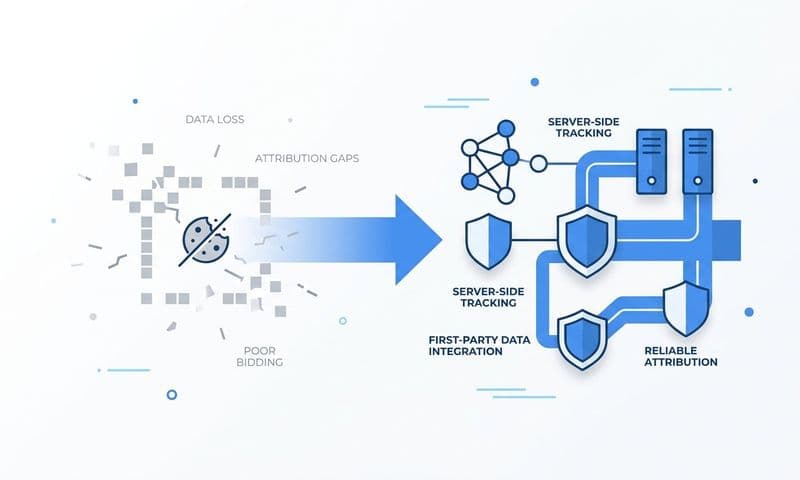
Browser pixels have become increasingly unreliable. Ad blockers prevent them from firing. Safari's Intelligent Tracking Prevention limits the data they can collect. iOS privacy changes have reduced signal quality across mobile. If your entire tracking setup depends on a pixel loading in a user's browser, you are already working with incomplete data.
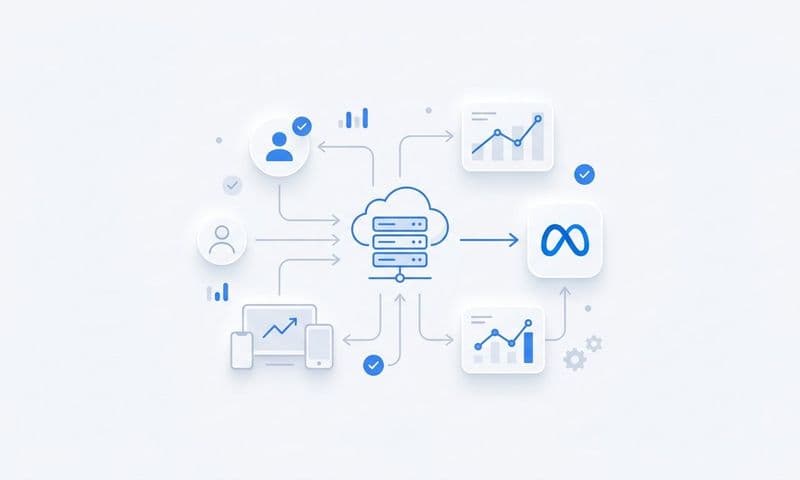
Server-side tracking solves this. Instead of relying on a script running in the user's browser, server-side tracking sends conversion events directly from your server to your analytics and ad platforms. The data does not pass through the browser at all, so it is not affected by blockers or privacy restrictions. Implementing a Conversion API integration, whether for Meta, Google, or another platform, is now a foundational requirement for accurate ROI tracking, not an advanced feature.
Alongside server-side tracking, UTM parameters are your other critical infrastructure layer. Every ad campaign, ad set, and individual creative needs consistent UTM tags so traffic source data flows cleanly into your analytics tools and attribution platform. Without this, you cannot trace a conversion back to the specific campaign or channel that drove it.
Create a UTM naming convention and enforce it across your entire team. A simple structure might look like: utm_source=linkedin, utm_medium=paid-social, utm_campaign=q2-demo-push, utm_content=creative-variant-a. The exact format matters less than consistency. Fragmented UTM data, where the same campaign appears as five different source names in your reports, is one of the most common causes of broken attribution. Learn more about what UTM tracking is and how it helps your marketing before finalizing your naming convention.
First-party data enrichment is the third layer. When someone clicks an ad and lands on your site, they are initially anonymous. As they move through your funnel, filling out forms, signing up for trials, and engaging with your product, you can tie that session data back to an identified user. This is what makes downstream revenue attribution possible. Without it, you can track that a form was filled, but you cannot connect it to the deal that closed six weeks later.
Before launching any campaign, test your tracking end to end. Submit a test form, trace the event through your analytics, confirm it appears in your attribution platform, and verify the UTM data is intact. Discovering a tracking gap after a campaign has run for three weeks means losing data you can never recover.
Step 3: Connect Your Ad Platforms to Your CRM and Revenue Data
Here is where most B2B SaaS teams hit the wall. They have ad platform data in one place and CRM data in another, and no reliable way to connect them. This is the gap that turns accurate ROI tracking from a concept into a real operational challenge.
Bridging this gap is not optional. It is the entire point. If you cannot trace a closed-won deal back to the ad that first brought that buyer into your funnel, you do not have ROI tracking. You have activity reporting.
Start by integrating your ad platforms with your CRM. When a lead comes in through a paid campaign, the UTM parameters and source data from that session should flow directly into the contact and opportunity record in your CRM. This means when a deal closes, you can look at the contact record and see exactly which campaign, ad set, and creative they originally came from.
Most modern CRMs support this through native integrations or custom fields. The key is making sure the handoff between your website tracking and your CRM is seamless. A form submission should capture UTM data and pass it to the CRM automatically, not rely on a salesperson to manually enter source information.
Next, connect your billing or subscription data to your attribution layer. This is where the real ROI calculation happens. Connecting a tool like Stripe to your attribution platform means you can see actual recurring revenue, not just pipeline value, traced back to the originating ad. That is the difference between knowing a campaign generated $50,000 in pipeline and knowing it generated $18,000 in closed revenue. The best marketing attribution tools for B2B SaaS are designed specifically to close this gap between ad spend and actual revenue.
Map your CRM deal stages to the conversion event hierarchy you defined in Step 1. If your CRM has stages like MQL, SQL, Opportunity, and Closed-Won, each of those should correspond to a tracked conversion event that your attribution tools can recognize and report on.
Platforms like Cometly are built specifically for this integration challenge. Cometly pulls together ad spend data, CRM events, and revenue data into a single unified view, so you are not manually stitching together exports from three different tools every time you want to check ROI. It creates the single source of truth that B2B SaaS teams need to make confident budget decisions.
Once the integration is in place, test it by tracing a known deal from closed-won in your CRM all the way back to the original ad click. If the data chain is intact, you have a functioning revenue attribution system. If it breaks anywhere along the path, you have found the gap to fix.
Step 4: Choose the Right Attribution Model for Your Sales Cycle
With your tracking infrastructure in place and your systems connected, you now need to decide how to distribute credit across the touchpoints in a buyer's journey. This is where attribution model selection comes in, and it is a decision that has a significant impact on how you interpret performance data.
There is no universally correct attribution model. The right choice depends on your average sales cycle length, the number of meaningful touchpoints before conversion, and how your team uses attribution data to make decisions.
Last-click attribution gives 100% of the credit to the final touchpoint before conversion. It is simple and easy to understand, but it consistently over-credits closing channels like branded search and under-credits the awareness and nurture channels that built intent in the first place. For B2B SaaS with multi-touch journeys, last-click often paints a distorted picture.
First-touch attribution gives all credit to the channel that first brought the buyer into your funnel. This is useful for understanding which channels generate net-new pipeline, but it ignores everything that happened between the first click and the closed deal. Useful for one specific question, not for overall ROI evaluation.
Linear attribution distributes credit equally across all touchpoints in the journey. It is more balanced than single-touch models and works reasonably well for longer B2B sales cycles where multiple channels each play a meaningful role.
Time-decay attribution gives more credit to touchpoints closer to the conversion, with credit decreasing as you move further back in time. This can be a good fit for sales cycles where later-stage touchpoints are genuinely more influential in closing decisions.
Data-driven attribution uses your actual conversion path data to assign credit based on which touchpoints statistically correlate with conversion. This is the most accurate model available, but it requires sufficient conversion volume to be statistically meaningful. If you are running lower-volume campaigns, data-driven attribution may not have enough signal to produce reliable results.
The practical approach for most B2B SaaS teams is to run multiple models in parallel during an evaluation period. Look at how your channel mix performs under last-click, linear, and data-driven attribution simultaneously. Where the models agree, you have high confidence. Where they diverge significantly, you have a signal worth investigating before making budget decisions based on any single model. Exploring multi-channel attribution for ROI can help you understand how different models interact across your full channel mix.
Step 5: Build Your ROI Reporting Dashboard
Your tracking infrastructure is in place, your systems are connected, and you have selected an attribution model. Now you need to surface all of that data in a format your team can actually act on.
A good ROI dashboard answers one central question: which ads and channels are generating the most revenue relative to what we are spending? Every metric on the dashboard should connect back to that question.
The core metrics to include are:
Cost per acquisition (CPA) by channel and campaign: Not cost per lead, but cost per qualified conversion event, whether that is a demo attended, an opportunity created, or a closed-won account. This tells you what you are actually paying for outcomes, not activity.
Return on ad spend (ROAS) tied to actual revenue: ROAS calculated against closed-won revenue, not estimated conversion values. This is the number that tells you whether your ad spend is generating real business returns.
Pipeline generated per dollar spent: Useful for campaigns targeting longer sales cycles where deals have not yet closed. This metric lets you evaluate campaign efficiency even when the full revenue impact takes months to materialize.
Customer acquisition cost (CAC) by source: Breaking CAC down by channel reveals which acquisition sources are most efficient over time, which is critical for scaling decisions.
Segment your dashboard by channel, campaign, ad set, and creative. Performance at the channel level can mask underperforming campaigns, and performance at the campaign level can mask underperforming creatives. You need visibility at every level of the hierarchy to make precise optimization decisions.
Include a time-lag view in your reporting. For B2B SaaS companies with sales cycles longer than 30 days, a standard 7-day or 30-day attribution window will undercount the true revenue contribution of your campaigns. Build in reporting that accounts for the typical delay between first ad click and closed deal in your business. Reviewing how to calculate marketing ROI accurately will help you structure these time-lag calculations correctly.
Cometly provides real-time pipeline and revenue attribution dashboards that connect ad spend directly to closed-won revenue. Rather than manually pulling data from multiple platforms and stitching it together in a spreadsheet, your team gets a live view of ROI across every channel and campaign, with the ability to drill down to the ad creative level.
Set up automated alerts for significant drops in conversion rate or spikes in CPA. Waiting for a weekly review to catch a tracking break or a campaign going off the rails is expensive. Real-time alerts let your team respond quickly without having to manually monitor dashboards every day.
Step 6: Feed Enriched Data Back to Ad Platforms to Improve Performance
Accurate ROI tracking is not just an internal reporting exercise. It is also the foundation for improving the performance of your campaigns going forward. The data you collect about which touchpoints lead to actual revenue can be sent back to your ad platforms to make their optimization algorithms significantly more effective.
Here is the core idea: Meta, Google, and other ad platforms use conversion signals to train their bidding algorithms. If the only signal you are sending them is "someone filled out a form," their algorithms optimize toward users who fill out forms. That sounds reasonable until you realize that many form fills never become paying customers.
When you send downstream CRM events back to the platform, such as "demo attended," "opportunity created," or "closed-won," the algorithm learns what your actual buyers look like. It can then optimize toward finding more people who match that profile, not just anyone willing to click a button on a landing page. This is precisely how ad tracking tools help you scale ads using accurate data rather than surface-level engagement signals.
Use the Conversions API to send these enriched, server-side conversion events directly to Meta and Google. This is the same infrastructure you set up in Step 2, but now you are using it to pass revenue-correlated signals back upstream rather than just capturing them internally.
One critical technical requirement: implement event deduplication. When both your browser pixel and your server-side tracking are firing simultaneously, the same conversion can be counted twice if deduplication is not in place. This inflates your reported conversion numbers and causes ad platform algorithms to optimize on inaccurate data. Deduplication ensures each event is counted exactly once regardless of how many times it is reported.
This feedback loop between your attribution data and your ad platforms is one of the highest-leverage optimizations available to B2B SaaS marketing teams. Better signals produce better targeting, which produces better leads, which produces more accurate attribution data, which produces even better signals. The compound effect over time is substantial.
Putting It All Together: Your ROI Tracking Checklist
You now have a complete framework for building accurate ROI tracking for ads from the ground up. Before moving into execution, here is a quick-reference checklist to audit your current setup or validate a new one:
Step 1: Conversion events defined. Have you mapped your full funnel from micro-conversions to closed-won revenue? Have you assigned monetary values or pipeline weights to each event? Have you aligned with sales on what qualifies as a meaningful conversion?
Step 2: First-party tracking infrastructure in place. Is server-side tracking or a Conversion API integration active? Are UTM parameters applied consistently across every campaign with a documented naming convention? Is first-party data enrichment connecting anonymous clicks to identified users?
Step 3: Ad platforms connected to CRM and revenue data. Does lead source data from UTMs flow automatically into your CRM? Is your billing data connected to your attribution layer? Can you trace a closed deal back to the originating ad?
Step 4: Attribution model selected and aligned to your sales cycle. Have you evaluated multiple models? Is your chosen model appropriate for your average deal cycle length and touchpoint volume?
Step 5: ROI dashboard built with pipeline and revenue metrics. Does your dashboard show CPA, ROAS, and CAC tied to actual revenue? Does it include a time-lag view? Are automated alerts configured?
Step 6: Enriched conversion data flowing back to ad platforms. Are downstream CRM events being sent to Meta and Google via server-side API? Is event deduplication in place?
This is not a one-time setup. It is an ongoing process that improves as you accumulate more conversion data, refine your event definitions, and build up the signal volume needed for data-driven attribution to work at its best.
Cometly handles steps 2 through 6 in a unified system built specifically for B2B SaaS teams. From server-side tracking and Conversion API integration to real-time pipeline dashboards and ad platform signal enrichment, it replaces the fragmented stack of disconnected tools with a single, accurate source of truth for ad ROI. Get your free demo and see how Cometly connects every ad dollar to real revenue outcomes.