

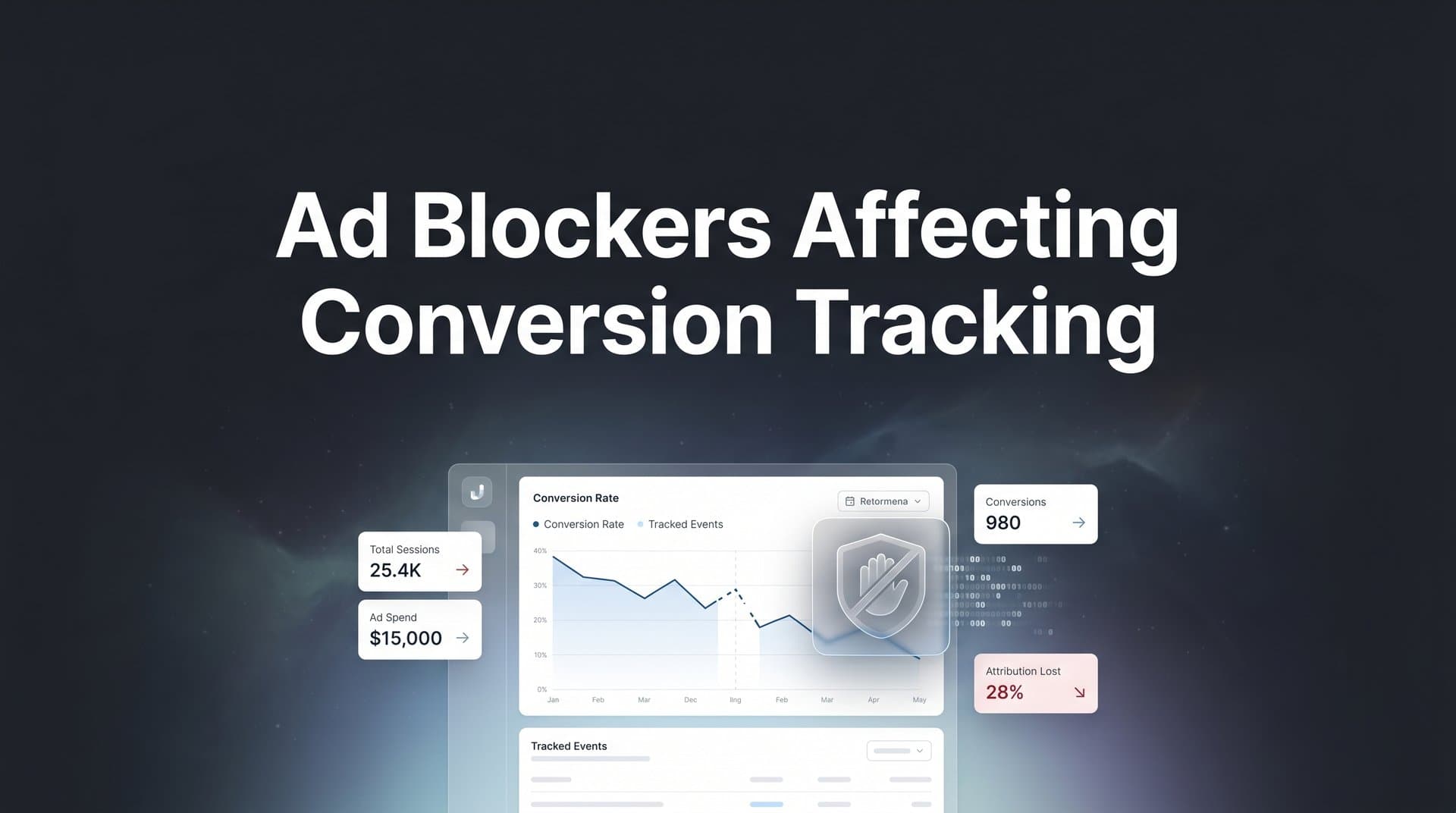
You're running campaigns across Meta, Google, TikTok, and LinkedIn. The ads are converting. Customers are buying. But when you check your attribution dashboard, the numbers don't add up. Conversions are missing. Revenue appears lower than it should be. Your ROAS looks terrible, even though your bank account tells a different story.
Welcome to the invisible problem plaguing modern digital marketing: ad blockers silently erasing your conversion data before it ever reaches your tracking tools.
This isn't a minor technical glitch. When ad blockers prevent tracking pixels from firing, you lose the conversion signals that feed your ad platform algorithms. You make budget decisions based on incomplete data. You optimize campaigns toward the wrong audiences. And you struggle to prove the actual value of your marketing efforts to stakeholders who only see what the broken tracking reports.
The challenge has intensified in 2026. Ad blocker adoption continues climbing, browser privacy features have become more aggressive, and the combination creates a data black hole that swallows conversion events whole. For marketers trying to scale profitably, this represents an existential threat to accurate measurement and optimization.
Here's what you need to understand: how ad blockers actually intercept your tracking infrastructure, why the missing data costs you more than you realize, and the server-side solutions that can recover the conversion signals you're currently losing. This isn't about gaming the system or violating user privacy. It's about implementing compliant tracking methods that capture the data you need to run effective marketing campaigns.
How Ad Blockers Intercept Your Tracking Pixels
Ad blockers operate as gatekeepers between your website and the tracking scripts you've installed. When someone visits your site with an ad blocker active, the software scans every network request your page attempts to make. It compares these requests against massive filter lists—databases containing millions of known tracking domains, script patterns, and advertising resources.
The most widely used filter list is EasyList, which identifies tracking pixels from Meta, Google, TikTok, LinkedIn, and virtually every major ad platform. When your Meta Pixel tries to fire, the ad blocker recognizes the request to facebook.com/tr or connect.facebook.net and blocks it entirely. The JavaScript never executes. The tracking pixel never loads. The conversion signal never gets sent.
This blocking happens at multiple levels. Ad blockers intercept the initial script load, preventing the tracking code from even downloading to the user's browser. They block outgoing network requests that attempt to send conversion data to ad platform servers. They strip tracking parameters from URLs. They delete third-party cookies before they can record user behavior.
The technical mechanism is surprisingly simple but devastatingly effective. Ad blockers use pattern matching to identify tracking resources. They look for specific domain names, URL structures, and script behaviors that signal advertising or analytics activity. When they find a match, they return an empty response or block the request entirely, as if the tracking server doesn't exist.
For marketers, this creates a cascade of failures. Your Meta Pixel doesn't fire, so Facebook never learns that someone converted after clicking your ad. Your Google Ads tag gets blocked, so Google can't attribute the conversion to the right campaign. Your analytics tools miss the session data entirely. UTM parameters might survive in some cases, but without the pixel fire to record the conversion event, the attribution chain breaks. Understanding how ad blockers prevent conversion tracking is essential for developing effective countermeasures.
The sophistication of modern ad blockers extends beyond simple domain blocking. They analyze JavaScript behavior to identify tracking scripts that try to disguise themselves. They detect fingerprinting attempts. They block pixels that load asynchronously or through dynamic script injection. Even if you try to implement your tracking code cleverly, filter lists update constantly to catch new evasion techniques.
What makes this particularly challenging is the invisibility of the problem. From your perspective as a marketer, everything looks normal. Your tracking code is installed correctly. Your pixels show as active in the platform interfaces. But for users with ad blockers, those pixels simply never fire. You see reduced conversion counts in your dashboards without any error messages or warnings explaining why.
The impact varies by audience. Tech-savvy users, privacy-conscious consumers, and certain professional demographics have higher ad blocker adoption rates. If your target market skews toward these groups, you might be missing conversion data from your most valuable customers while still capturing signals from less engaged audiences. This creates a distorted view of campaign performance that leads to systematically flawed optimization decisions.
The Real Cost of Missing Conversion Data
When conversion signals disappear into the ad blocker void, the damage extends far beyond incomplete reports. You're not just missing numbers on a dashboard. You're making critical business decisions based on fundamentally incorrect data.
Start with ROAS calculations. If you spent $10,000 on ads and your tracking shows $25,000 in revenue, you calculate a 2.5x return. But what if ad blockers prevented you from seeing another $15,000 in actual conversions? Your real ROAS is 4x, not 2.5x. You might kill a campaign that's actually printing money because the tracking makes it look mediocre. Addressing inaccurate conversion tracking data should be a top priority for any performance marketing team.
This happens constantly. Marketers pause profitable campaigns, shift budgets away from high-performing channels, and double down on the wrong audiences—all because their conversion data is incomplete. The irony is brutal: the customers who care enough about privacy to use ad blockers might be your best customers, but they're invisible in your attribution reports.
The algorithmic consequences compound the problem. Meta's algorithm, Google's Smart Bidding, TikTok's optimization engine—they all learn from conversion signals. When you feed these systems incomplete data, they optimize toward the wrong patterns. Facebook thinks certain audiences don't convert, so it stops showing ads to similar users. Google's automated bidding undervalues keywords that actually drive revenue. The machine learning models train on corrupted data sets.
Think about what this means for campaign optimization. You run a conversion campaign on Meta. The algorithm is supposed to find people likely to convert and bid aggressively for their attention. But if 30% of your actual conversions never get reported because of ad blockers, Meta's algorithm learns from a skewed sample. It identifies patterns in the 70% of conversions it can see, missing the characteristics of your most privacy-conscious customers entirely.
The attribution gaps create organizational dysfunction too. Your marketing team reports numbers that don't match what finance sees in actual revenue. Sales blames marketing for sending low-quality leads, while marketing insists the campaigns are performing well. Leadership questions the entire marketing budget because ROI looks weak, even though the business is growing. You spend hours in meetings trying to reconcile reports that will never match because the underlying tracking is broken.
Budget allocation becomes guesswork. You can't confidently scale the channels that actually work because your data suggests they're underperforming. You might over-invest in channels with lower ad blocker usage simply because they report more complete data, even if they drive less actual revenue. The distortion systematically misallocates marketing spend.
For performance marketers running on tight margins, this data loss can mean the difference between profitability and failure. If you're optimizing for a target CPA of $50 but only seeing 70% of conversions, your reported CPA is $71. You think you're losing money when you're actually hitting your targets. You make the wrong call and shut down campaigns that should be scaled.
Why Browser Privacy Changes Compound the Problem
Ad blockers don't operate in isolation. They're part of a broader privacy ecosystem that includes browser-level tracking restrictions, each adding another layer of data loss.
Safari's Intelligent Tracking Prevention has been blocking third-party cookies and limiting first-party cookie lifespans since 2017, with increasingly aggressive updates every year. Firefox's Enhanced Tracking Protection does similar blocking by default. Even Chrome, despite its delayed timeline, continues moving toward privacy features that restrict cross-site tracking. Implementing privacy compliant conversion tracking methods has become essential for sustainable marketing measurement.
These browser protections work differently than ad blockers but achieve similar results. ITP doesn't block your Meta Pixel from loading—it allows the script to run but severely limits what it can do. Third-party cookies get deleted. First-party cookies expire after seven days of inactivity. Cross-site tracking gets blocked even when no ad blocker is present.
The mobile landscape adds another dimension. iOS App Tracking Transparency requires apps to ask permission before tracking users across other apps and websites. Many users decline, creating yet another gap in your conversion data. When someone clicks your Instagram ad, converts on your website via Safari on iOS, and has both ATT restrictions and an ad blocker active, the chances of capturing that conversion through traditional pixel tracking approach zero.
What makes this particularly painful is the stacking effect. A single user might have Safari's ITP active, use an ad blocker extension, and have ATT set to deny tracking. Each layer blocks different aspects of your tracking infrastructure. ITP limits cookies, the ad blocker prevents pixel fires, and ATT blocks the mobile app identifier. Together, they create a fortress around user data that standard tracking methods cannot penetrate.
Browser vendors continue tightening restrictions. Safari now caps cookie lifespans even more aggressively. Firefox blocks fingerprinting scripts. Chrome's Privacy Sandbox aims to eliminate third-party cookies entirely while providing privacy-preserving alternatives. Each update erodes the effectiveness of traditional tracking methods. Many marketers also struggle with cross device conversion tracking problems that compound these browser-based challenges.
For marketers, this means the problem isn't static. Your tracking setup that worked reasonably well last year degrades as browsers implement new restrictions and ad blocker filter lists expand. You're fighting a losing battle if you rely solely on client-side, browser-based tracking. The privacy trends point in one direction: less data available through traditional pixels, not more.
Server-Side Tracking: The Primary Solution
Server-side tracking fundamentally changes where and how conversion data gets collected. Instead of relying on JavaScript pixels that run in the user's browser—where ad blockers can intercept them—you collect conversion events on your own server and send them directly to ad platforms through their APIs.
Here's how it works in practice. A customer completes a purchase on your website. Your backend systems record the transaction in your database. Your server then sends a conversion event to Meta's Conversions API, Google's enhanced conversions endpoint, and any other platforms you're using. This happens at the server level, completely bypassing the browser where ad blockers operate. The server-side conversion tracking benefits extend far beyond just ad blocker mitigation.
The technical advantage is clear: ad blockers can only block what happens in the browser. They have no ability to intercept requests your server makes directly to ad platform APIs. When your server tells Meta that a conversion happened, that signal gets through regardless of what privacy tools the user has active.
First-party data collection is the foundation that makes server-side tracking work. You collect conversion data through your own systems—your checkout process, your CRM, your backend database—using your own domain and infrastructure. Since this data collection happens as part of your core business operations, ad blockers typically allow it. Users expect your website to process their orders and manage their accounts.
Once you have the conversion data in your systems, you can send it to ad platforms through their official server-side APIs. Meta provides the Conversions API specifically for this purpose. Google offers enhanced conversions and the Measurement Protocol. TikTok has its Events API. These tools are designed to receive conversion data from your server rather than from browser pixels.
The implementation requires technical work but delivers substantial results. You need to set up server-side tracking infrastructure, configure API credentials for each ad platform, map your conversion events to the platform-specific formats, and ensure proper data transmission. Many businesses use server-side tag management systems or attribution platforms to handle this complexity rather than building everything from scratch.
One critical advantage: server-side tracking often captures more accurate data even beyond ad blocker mitigation. You can send enriched conversion information that includes customer lifetime value, product categories, subscription status, and other business data that browser pixels cannot access. This gives ad platforms better signals for optimization, improving campaign performance beyond just recovering lost conversions.
The privacy compliance aspect matters too. Server-side tracking respects user privacy choices when implemented correctly. You're still honoring opt-outs and consent preferences. You're simply using a more reliable technical method to transmit the data that users have consented to share. This is fundamentally different from trying to circumvent privacy tools through deceptive tracking methods.
For marketers concerned about data accuracy, server-side tracking provides ground truth. Your server knows exactly what transactions occurred because it processed them. There's no question about whether the pixel fired or the cookie was available. You have definitive conversion data that you can confidently send to ad platforms, eliminating the uncertainty that plagues browser-based tracking.
Building a Resilient Attribution Strategy
Server-side tracking solves the technical problem of getting conversion data to ad platforms, but complete attribution requires a broader strategy that connects every touchpoint in the customer journey.
The most resilient approach combines server-side tracking with deep CRM integration. When someone fills out a lead form, that contact enters your CRM. When they book a demo, your CRM records it. When they eventually convert to a customer, your CRM tracks the revenue. By connecting your CRM to your attribution system, you create a continuous record of the customer journey that survives ad blockers, browser restrictions, and cookie deletions. This approach is critical for fixing conversion tracking gaps that plague most marketing organizations.
This integration enables true multi-touch attribution. You can see that a customer first clicked a LinkedIn ad, then visited through organic search, then clicked a retargeting ad on Meta, then converted after receiving an email. Each touchpoint gets recorded in your systems rather than relying on fragile browser cookies that might disappear. You build attribution models based on actual customer paths through your marketing funnel.
The key is moving beyond pixel-based tracking as your single source of truth. Pixels still have value for capturing initial touchpoints and feeding real-time signals to ad platforms. But when you layer in CRM data, backend conversion tracking, and server-side event transmission, you create redundancy. If the pixel gets blocked, you still capture the conversion through your server. If the cookie gets deleted, you still have the CRM record linking the customer to their original source.
Feeding enriched conversion data back to ad platforms creates a powerful optimization loop. Instead of just telling Meta that a conversion happened, you can send additional context: this was a high-value customer, they purchased premium products, they came from a specific industry segment. Ad platforms use this enriched data to improve their targeting algorithms, finding more customers who match the characteristics of your best converters.
This approach particularly benefits B2B marketers with longer sales cycles. When someone converts weeks or months after their initial ad interaction, browser-based attribution often breaks down entirely. Cookies expire, attribution windows close, and the connection between ad click and eventual revenue gets lost. But when your CRM tracks the lead from first touch through closed deal, you maintain the attribution chain regardless of how much time passes. Companies running ads across multiple platforms should explore cross-platform conversion tracking solutions to unify their data.
The data quality improvements extend throughout your marketing operations. Your email platform can trigger campaigns based on ad interactions recorded in your attribution system. Your sales team can see which marketing channels generated each lead. Your finance team can reconcile marketing-attributed revenue with actual bookings. Everyone works from the same source of truth rather than conflicting reports from different tools.
For practical implementation, start with your highest-value conversion events. If you're an e-commerce business, prioritize purchase tracking. If you're B2B SaaS, focus on demo requests and trial signups. Get server-side tracking working for these critical events first, then expand to lower-funnel actions. This phased approach lets you capture the most important data immediately while building out comprehensive tracking over time.
Your Action Plan: Recovering Lost Conversion Data
Fixing ad blocker-related data loss requires systematic implementation, not quick fixes. Start with an honest audit of your current tracking vulnerability.
Install an ad blocker on your own browser and test your conversion flow. Fill out a lead form with the ad blocker active. Complete a purchase. Check whether your tracking platforms received the conversion signals. Many marketers discover that their pixels are completely blocked for users with standard ad blocking tools—they just never tested it before. Following best practices for tracking conversions accurately starts with understanding your current data gaps.
Review your attribution reports for suspicious patterns. If you're seeing conversion rates that seem too low, revenue that doesn't match what your finance team reports, or ROAS calculations that conflict with actual profitability, ad blocker data loss might be the culprit. Compare your pixel-tracked conversions against backend transaction records to quantify the gap.
Prioritize server-side implementation for your most critical conversion events. If purchases drive your business, set up server-side purchase tracking first. If lead generation is your primary goal, ensure lead form submissions send server-side events. Focus your initial effort where it will recover the most valuable missing data.
Establish baseline metrics before you implement solutions. Document your current conversion counts, ROAS, and attribution patterns. After you deploy server-side tracking, compare the new data against these baselines. You should see conversion counts increase as you capture events that were previously blocked. This measurement proves the value of your implementation and justifies the technical investment. Learning how to fix conversion tracking errors will help you troubleshoot issues as they arise.
Don't try to build everything at once. Server-side tracking, CRM integration, and advanced attribution are interconnected but can be implemented incrementally. Get basic server-side conversion tracking working first. Then add CRM integration. Then layer in multi-touch attribution. Each phase delivers value independently while building toward a comprehensive solution.
Work with your technical team or choose tools that handle the complexity for you. Server-side tracking requires backend development, API integration, and ongoing maintenance. If you don't have engineering resources, look for attribution platforms that provide server-side tracking infrastructure as a managed service. The investment in proper tooling pays for itself through recovered conversion data and improved campaign performance.
Moving Forward with Confidence
Ad blockers are not going away. Browser privacy features will continue strengthening. The marketers who thrive in this environment will be those who adapt their tracking infrastructure to work with these realities rather than against them.
The solution is not about finding clever workarounds to track users who have explicitly chosen privacy tools. It's about implementing server-side tracking methods that respect user preferences while still capturing the conversion data you need to optimize campaigns effectively. When you collect data through your own backend systems and transmit it directly to ad platforms, you bypass the technical limitations of browser-based tracking without violating user trust.
The data you recover through proper server-side implementation changes everything. You see your actual ROAS instead of artificially deflated numbers. You make budget decisions based on complete conversion data. You feed ad platform algorithms the signals they need to find your best customers. You prove marketing value with numbers that match what finance sees in revenue reports.
This is the new baseline for professional marketing attribution. Relying solely on browser pixels in 2026 is like running campaigns without conversion tracking at all—you're flying blind, making decisions based on incomplete information, and leaving money on the table. The marketers who implement server-side tracking and robust attribution systems gain a decisive advantage over competitors still struggling with data loss.
Your next step is evaluating your current tracking setup and identifying where ad blockers are costing you conversion data. Test your flows with ad blockers active. Audit your conversion counts against backend records. Quantify the gap between what your tracking reports and what actually happened. Then prioritize the implementation work that will recover your missing data and restore confidence in your marketing metrics.
Ready to elevate your marketing game with precision and confidence? Discover how Cometly's AI-driven recommendations can transform your ad strategy—Get your free demo today and start capturing every touchpoint to maximize your conversions.


