

You pull up your Facebook Ads dashboard and see 120 conversions. You open Google Analytics and see 67. Same campaign. Same time window. Completely different story.
If you have ever stared at two screens wondering which number to believe, you are not alone. This disconnect is one of the most common and frustrating problems in digital marketing today, and it costs teams real money in the form of misallocated budgets, broken trust with leadership, and optimization decisions built on faulty signals.
Here is the important thing to understand before we go any further: this gap is not a bug. It is not a glitch in the matrix. It is a structural reality of how different platforms measure, attribute, and report data. Ad platforms like Meta, Google, and LinkedIn each operate their own independent measurement systems, and they were never designed to agree with each other or with your analytics tool.
The good news is that once you understand why these discrepancies happen, you can stop being confused by them and start managing them. This article breaks down the root causes of ad platform reporting not matching analytics, explains what the gap actually costs you as a marketer, and walks through how to build a reliable single source of truth that connects your ad spend to real revenue.
Why Two Platforms Can See the Same Campaign Differently
Think of each ad platform as a referee who only watches their own player. Meta is watching Meta. Google is watching Google. And your analytics tool is sitting in the stands trying to track the whole field at once. They are all watching the same game, but they are not looking at the same things.
Every major ad platform uses its own attribution logic, counting windows, and event definitions. When Meta says "conversion," it might mean something slightly different from what Google means when it says the same word. A conversion in Meta could be triggered by a form submission event configured in Events Manager. A conversion in Google Ads might be tied to a goal defined in Google Analytics. These definitions are set independently, and small configuration differences compound into large reporting gaps.
There is also a structural incentive problem worth acknowledging. Ad platforms are self-reporting systems. Meta, Google, LinkedIn, and TikTok each have a financial interest in demonstrating that their platform drove results. This does not mean they are deliberately misleading you, but it does mean their attribution models are designed to maximize credit for their own channel. A neutral cross-platform analytics tool has no such incentive. It simply reports what it observes based on the tracking data it receives. This is why platform-native dashboards almost always show higher conversion numbers than your analytics platform.
Beyond attribution logic, there are more mundane sources of discrepancy that are easy to overlook. Time zone mismatches between platforms cause conversion counts to shift across date boundaries. If your Meta account is set to Pacific Time and your Google Analytics property is set to Eastern Time, a conversion that happens at 11 PM on a Tuesday in California gets recorded on Wednesday in your analytics. Over a week, these small shifts add up.
Data processing lag is another quiet contributor. Ad platforms often process and finalize conversion data over a window of 24 to 72 hours. If you pull a report the same day a campaign runs, you may be comparing finalized analytics data to still-processing ad platform data. The numbers will look different simply because one system has finished counting and the other has not.
Understanding these structural differences is the first step. It reframes the problem from "something is broken" to "these systems were never designed to match, and here is why."
Attribution Windows and Model Conflicts: The Root Cause of Most Discrepancies
If you want to understand why ad platform reporting does not match analytics, attribution windows are where you need to spend the most time. This is where the majority of discrepancies originate, and it is also the most misunderstood piece of the puzzle.
An attribution window defines how far back a platform looks to claim credit for a conversion. Meta's default attribution window, for example, has historically included a 7-day click window and a 1-day view-through window. That means if someone sees a Meta ad on Monday and converts on the following Sunday without ever clicking, Meta will claim that conversion. Google Analytics, which requires a click to attribute a session, will not see that conversion as coming from Meta at all. It might show up as direct traffic or organic search, depending on how the user actually arrived at the site when they converted.
This is not a hypothetical edge case. View-through attribution is responsible for a meaningful portion of the gap between Meta-reported conversions and analytics-reported conversions, particularly for upper-funnel awareness campaigns where users see ads but do not immediately click.
The conflict between attribution models adds another layer. Last-click attribution, which is the default in many analytics tools, gives 100% of the credit to the final touchpoint before conversion. First-touch attribution gives all the credit to the very first interaction. Multi-touch attribution distributes credit across multiple touchpoints in the customer journey. These models produce completely different numbers from the same underlying data.
Here is where it gets particularly messy. When a user sees a Meta ad, clicks a Google ad two days later, and then converts through an organic search the following week, consider what each platform reports. Meta claims the conversion within its view-through window. Google Ads claims the conversion because the user clicked a Google ad before converting. Your analytics tool, using last-click, attributes it to organic search. All three platforms are reporting the same conversion, and your total reported conversion count across platforms now exceeds your actual conversion count.
This phenomenon, often called double or triple counting, is one of the primary reasons why the sum of conversions across all your ad platforms will almost always be higher than the total conversions your analytics tool reports. It is not that your analytics tool is missing data. It is that each platform is applying its own rules to the same pool of real conversions.
The practical implication is significant. When you compare platform-reported ROAS across channels, you are comparing numbers that were calculated using different rules. It is like comparing race times where each runner used a different stopwatch with different start and stop triggers. The comparison looks meaningful, but it is not apples to apples.
Tracking Failures That Silently Corrupt Your Data
Attribution logic explains a lot of the discrepancy, but tracking failures introduce a different kind of problem: data that simply goes missing or ends up in the wrong bucket. These failures are often invisible until you know what to look for.
Browser-based pixel tracking has become increasingly unreliable over the past several years. Apple's iOS privacy changes, beginning with iOS 14, gave users the ability to opt out of cross-app tracking, which significantly reduced the data available to pixel-based measurement systems. Ad blockers and browser-level cookie restrictions have compounded this effect. The result is that client-side pixels, the tracking snippets that fire in a user's browser, now miss a meaningful portion of conversion events. Your analytics tool may undercount conversions simply because the tracking code never fired.
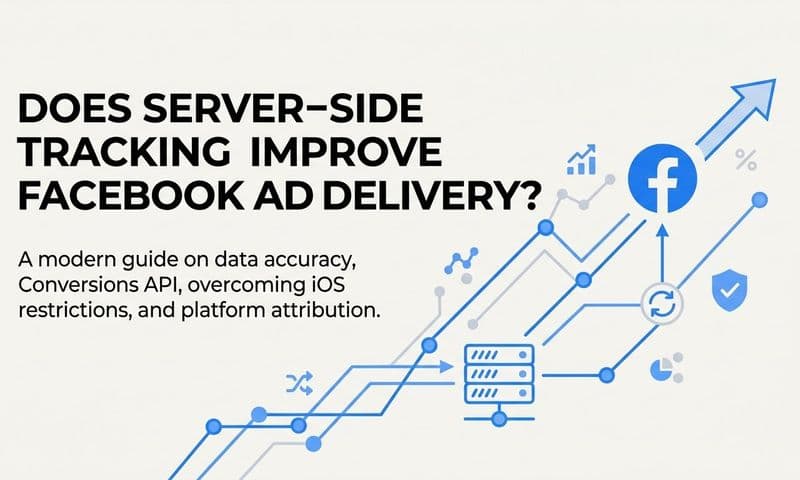
Server-side tracking is more resilient to these restrictions because it sends conversion data directly from your server to the ad platform, bypassing the browser entirely. This is why Meta's Conversion API and Google's Enhanced Conversions have become increasingly important. They recover data that pixel tracking loses, which is why you may actually see conversion counts increase after implementing server-side solutions. The events were always happening. You just were not capturing them.
UTM parameters are the primary mechanism that analytics tools use to identify where traffic comes from. When UTMs are stripped from a URL, your analytics platform cannot identify the source, and the session gets dumped into the direct traffic bucket. UTM stripping happens more often than most marketers realize. Redirect chains, link shorteners, certain mobile apps, and even some email clients remove UTM parameters before the user reaches your site. Every session that loses its UTM becomes an unattributed conversion in your analytics, making channels look weaker than they actually are.
Duplicate conversion events create a different kind of noise. If a thank-you page fires a conversion event but a user refreshes the page, you may record two conversions for one action. If your pixel fires and your Conversion API fires for the same event without deduplication logic in place, you get double-counted conversions on the platform side. Misconfigured goals in analytics tools can trigger on page views that happen multiple times in a session, inflating goal completion counts.
Cross-device journeys add another layer of complexity. A user who sees your ad on their phone during their commute and then converts on their laptop at home is effectively invisible to most pixel-based tracking systems. The mobile session and the desktop session are treated as two separate users. The mobile impression gets no credit, and the desktop conversion may appear as direct traffic. This is a real and common pattern in B2B buying behavior, where research often happens on mobile but purchase decisions happen on desktop. Customer journey analytics tools are specifically designed to stitch these fragmented touchpoints together into a coherent view.
What These Discrepancies Actually Cost You as a Marketer
It is tempting to treat the reporting gap as a technical nuisance, something to acknowledge and move on from. But the real cost of ad platform reporting not matching analytics is measured in budget, credibility, and compounding optimization errors.
The most direct cost is budget misallocation. When you trust inflated platform-reported ROAS at face value, you scale campaigns that look like winners in the platform dashboard but are not actually driving revenue. Meanwhile, channels that are genuinely contributing to pipeline, perhaps through upper-funnel touchpoints that last-click attribution ignores, appear weak and get defunded. Over time, you end up over-investing in channels that are good at claiming credit and under-investing in channels that are good at driving results.
Reporting credibility is another real cost that is easy to underestimate. When your marketing team presents conversion numbers to leadership that contradict what the finance team sees in the CRM, or what the sales team reports as actual pipeline, trust in the marketing function erodes. Leadership starts to question whether marketing analytics and reporting mean anything at all. This is a difficult position to recover from, and it often leads to marketing teams being held to stricter scrutiny or losing budget authority.
The third cost is the most insidious because it compounds over time. Ad platform algorithms learn from the conversion signals you send them. If your conversion events are misconfigured, duplicated, or based on front-end events that do not correlate with actual revenue, the algorithm optimizes toward those signals. It finds more users who trigger those events, not more users who actually become customers. The longer this continues, the more your campaigns drift away from targeting people who convert into revenue and toward targeting people who convert into metrics.
Accurate data is not just a reporting nicety. It is the foundation that every downstream decision rests on. Getting it right is worth the investment.
Building a Single Source of Truth Across All Your Ad Channels
The solution to ad platform reporting not matching analytics is not to find the one platform that is "right" and ignore the others. Every platform has a legitimate role to play. The solution is to build a measurement architecture where you have one authoritative source for cross-channel performance decisions, while still using platform-native data for platform-specific optimization.
Start by standardizing on one attribution model and one reporting tool as your official source of record. This does not mean you stop looking at Meta Ads Manager or Google Ads. It means you stop using those dashboards to compare performance across channels. Platform dashboards are built for optimizing within that platform. They are not built for cross-channel comparison. When you need to answer "which channel is driving the most revenue," that answer should come from your neutral, centralized reporting layer.
Implementing server-side tracking is the most impactful technical step you can take to improve data quality. Conversion API integrations for Meta and Google's Enhanced Conversions reduce the data loss caused by browser restrictions, ad blockers, and iOS privacy changes. When you send cleaner, more complete conversion signals back to ad platforms, you also improve the quality of data their algorithms use to optimize your campaigns. Better data in means better targeting out.
The most important step, and the one that most teams skip, is connecting ad spend data directly to CRM and revenue data. Front-end conversion events like form submissions and free trial sign-ups are useful leading indicators, but they are not revenue. A lead that never closes is not a win. When you can trace a closed-won deal back to the specific ad campaign, ad set, and even the ad creative that first touched that customer, you have something genuinely valuable: attribution validated against actual business outcomes.
This kind of end-to-end attribution requires integrating your ad platform data with your CRM and, ideally, your billing or revenue data. It is more complex to set up than pixel-based tracking, but it produces numbers that leadership can trust because they match what the business actually experienced.
UTM governance is a simpler but equally important piece. Create a standardized UTM naming convention and enforce it across every campaign, every channel, and every team member who launches ads. Audit your UTM coverage regularly. Any campaign running without proper UTMs is generating unattributed traffic that inflates your direct channel and makes every other channel look weaker.
Turning Data Clarity Into Smarter Ad Decisions
Once you have resolved the structural discrepancies and built a reliable measurement system, something shifts in how you make decisions. You stop spending time debating which number is correct and start spending time acting on what the data is telling you.
With accurate cross-channel attribution, you can identify which campaigns and channels are driving real pipeline and closed revenue, not just which ones are generating the most conversion events in their own dashboards. This distinction matters enormously in B2B marketing, where the gap between a lead and a closed deal can span months and involve multiple stakeholders. A channel that looks weak on front-end metrics might be responsible for a disproportionate share of your highest-value customers.
Accurate data also makes A/B testing meaningful. When your conversion tracking is unreliable, test results are noisy. You cannot confidently say that creative A outperformed creative B when the underlying measurement is inconsistent. Clean data makes tests conclusive faster, which accelerates the pace at which you can learn and iterate.
There is also a compounding benefit when you feed enriched conversion signals back to ad platforms. When Meta and Google receive high-quality conversion data that is tied to real revenue events rather than generic form submissions, their algorithms can identify patterns in the users who actually become customers. Over time, this improves targeting precision across your campaigns, lowering cost per acquisition and increasing the quality of leads entering your pipeline.
Platforms like Cometly are built specifically to close this gap for B2B SaaS teams. Cometly unifies data from your ad platforms, CRM, and website behavior into a single attribution view, connecting every touchpoint from the first ad click to closed-won revenue. Instead of toggling between Meta Ads Manager, Google Ads, and your analytics tool and trying to reconcile three different stories, you get one consistent view of what is actually driving growth. The AI-driven recommendations surface which ads and campaigns are performing, so you can scale with confidence rather than guesswork.
The Bottom Line on Reporting Discrepancies
Ad platform reporting and analytics tools will almost never match perfectly. That is expected, and it is okay. What is not okay is ignoring the gap or letting it drive decisions based on inflated or misleading numbers.
The discrepancies exist because each platform uses different attribution windows, different event definitions, and different counting logic. They exist because browser-based tracking is increasingly unreliable. They exist because cross-device journeys and UTM stripping push conversions into buckets where they cannot be properly attributed. These are structural realities, not random errors.
The path forward is not to trust one platform blindly. It is to build a measurement system that connects every touchpoint to actual revenue, standardizes on a single source of truth for cross-channel decisions, and uses server-side tracking to recover data that browser restrictions would otherwise lose.
When your attribution is accurate and your data is clean, marketing becomes a much more confident function. You can defend your numbers. You can scale what works. You can cut what does not. And you can have conversations with leadership that are grounded in the same revenue reality they see in the CRM.
If you are ready to stop reconciling conflicting dashboards and start making decisions from a single, reliable view of your marketing performance, Get your free demo of Cometly today and see exactly which ads and channels are driving your revenue.