There is a tension sitting at the center of modern marketing that most teams quietly wrestle with every day. On one side, you have the pressure to track every ad click, every form fill, every conversion, and connect it all back to revenue. On the other side, you have GDPR and a growing body of privacy regulation that fundamentally restricts how that tracking can happen.
For B2B SaaS marketing teams, this tension is not abstract. It shows up in consent banners that users dismiss, in attribution gaps that make your campaign data unreliable, and in the nagging uncertainty about whether your tracking setup is actually compliant. Many teams treat this as a legal problem to hand off to someone else. That is a mistake.
GDPR compliance is not just a legal issue. It is a measurement issue. When your tracking infrastructure is not built for a privacy-first environment, you lose visibility into real conversions, your ad platforms optimize on incomplete signals, and your budget decisions are based on distorted data. The good news is that compliance and accurate attribution are not in conflict. When you build the right infrastructure, you can have both. This guide is written for B2B SaaS marketing operators who want to understand exactly how to do that.
How GDPR Reshaped the Mechanics of Ad Tracking
GDPR came into effect in May 2018 and established a comprehensive framework for how personal data can be collected, processed, and stored. For marketers, the regulation created a direct challenge to how ad tracking had worked for the previous decade.
At its core, GDPR requires that any processing of personal data have a valid lawful basis. For advertising purposes, that lawful basis is almost always explicit user consent. This matters because most standard tracking technologies, including cookies, tracking pixels, and behavioral retargeting scripts, process personal data. They capture IP addresses, device identifiers, browsing behavior, and other signals that can identify or profile an individual. Under GDPR, deploying these technologies without a valid lawful basis is a violation.
The types of tracking most directly affected include third-party cookies used for cross-site behavioral targeting, retargeting pixels placed by ad platforms like Meta and Google, cross-site tracking that follows users across different domains, and fingerprinting techniques that attempt to identify users through device characteristics. All of these involve processing personal data, and all of them require a proper legal basis under GDPR when applied to EU residents. Understanding what a tracking pixel is and how it works is essential context for any marketer navigating these requirements.
It is also worth understanding how GDPR works alongside the ePrivacy Directive, sometimes called the Cookie Law. The ePrivacy Directive specifically governs the use of cookies and similar tracking technologies in the EU. Together, these two regulations create a layered compliance requirement: you need a lawful basis under GDPR and you need to follow the cookie consent rules under ePrivacy.
The geographic scope is broader than many US-headquartered companies assume. GDPR applies to any organization that processes the personal data of EU residents, regardless of where that organization is based. If your B2B SaaS company runs ads targeting European markets, has EU-based leads in your CRM, or serves customers in EU member states, GDPR applies to you. There is no exemption for being headquartered outside the EU.
For B2B SaaS companies with longer sales cycles and global prospect pools, this is especially relevant. You may be tracking a prospect across multiple touchpoints over several months, collecting behavioral data, and passing that data to ad platforms for retargeting. Each of those actions involves personal data processing that must be handled in compliance with GDPR.
Two Risks That Compound Each Other
Non-compliant ad tracking creates two distinct categories of risk. Most marketers focus on one and underestimate the other. Understanding both, and how they interact, is essential for making the case for investment in proper infrastructure.
The first is regulatory risk. Data protection authorities across EU member states have become increasingly active in enforcing GDPR, particularly in areas related to ad tracking, analytics tools, and data transfers to third countries. Fines under GDPR are scaled to global annual revenue, with maximum penalties reaching up to four percent of global turnover. Beyond fines, enforcement actions can require companies to stop processing data, delete collected data, or overhaul their tracking infrastructure under regulatory supervision. The reputational cost of a public enforcement action is often as significant as the financial penalty.
The second risk is measurement risk, and this one directly affects your ability to run effective campaigns. When a user declines consent through a cookie banner, standard browser-based pixels cannot fire. The conversion event is never recorded. The ad platform never receives the signal. Your attribution model shows a gap. Over time, as consent decline rates accumulate across your traffic, the gaps in your conversion data become substantial enough to distort your understanding of which campaigns are actually working. Fixing conversion tracking gaps caused by consent-related data loss is one of the most impactful steps a B2B marketing team can take.
This data loss has a compounding effect on ad platform performance. Platforms like Meta and Google rely on conversion signals to train their optimization algorithms. When a meaningful portion of conversions go untracked because of consent-related data loss, the algorithm is working with an incomplete picture. It may shift budget toward campaigns that appear to be performing better simply because they happen to capture more consented traffic. Your bidding strategies, audience targeting, and budget allocation all degrade as a result.
Here is where the two risks connect in a way that makes the problem especially costly. A non-compliant tracking setup does not just expose you to regulatory penalties. It also produces unreliable data that leads to poor campaign decisions and wasted ad spend. You are paying the cost of non-compliance twice: once in legal exposure and once in measurement quality. Building a compliant tracking infrastructure is not just about avoiding fines. It is about having data you can actually trust.
Consent Management: The Foundation Your Tracking Stack Needs
If GDPR compliance for ad tracking has a starting point, it is the Consent Management Platform, or CMP. A CMP is the technical layer that collects user consent preferences, stores them in a format that can be audited, and communicates those preferences to the rest of your tracking stack. Without a properly configured CMP, everything downstream is built on a shaky foundation.
Here is how it is supposed to work. A user arrives on your site and is presented with a consent banner. They make a choice: accept all tracking, reject all tracking, or select specific categories. The CMP records that choice and passes a consent signal to your tag management system, which then controls which tracking scripts and pixels are allowed to fire. If the user declined advertising cookies, the ad platform pixels remain blocked. If they consented, the pixels fire and conversion data flows to the ad platform.
In practice, this flow is frequently broken. Common failure points include CMPs that are not properly integrated with tag managers, consent signals that are passed incorrectly or incompletely, and tag manager configurations that allow pixels to fire before consent is captured. Each of these gaps creates both a compliance problem and a data quality problem. You may think your tracking is consent-compliant when it is actually firing on users who have declined, or you may be blocking tracking that users have actually consented to, creating unnecessary data loss. Exploring a cookieless tracking solution can help teams reduce their reliance on consent-dependent browser technologies altogether.
Google Consent Mode is one mechanism that has emerged to help manage this more gracefully. It allows Google tags to adjust their behavior based on the consent status passed by a CMP. When a user declines consent, Google tags can still collect aggregated, non-identifiable modeling data that helps Google's algorithms estimate conversions without processing personal data. This is not a workaround for consent requirements, but it does help reduce the measurement gap that occurs when users decline.
For B2B SaaS teams, the practical implication is clear. You need a CMP that is properly configured, integrated with your tag manager, and tested to ensure consent signals are flowing correctly to every tracking tool in your stack. This is not a one-time setup task. It requires ongoing maintenance as you add new tracking tools, update your tag manager configurations, or change your consent banner design. Treating the CMP as a living part of your marketing infrastructure, rather than a checkbox you tick once, is what separates compliant teams from exposed ones.
Server-Side Tracking: Attribution Built for a Privacy-First World
Browser-based pixel tracking was designed for a different era. It worked well when third-party cookies were universally supported, ad blockers were rare, and privacy regulations were minimal. That era is over. Server-side tracking and Conversion APIs represent the infrastructure shift that modern ad measurement requires.
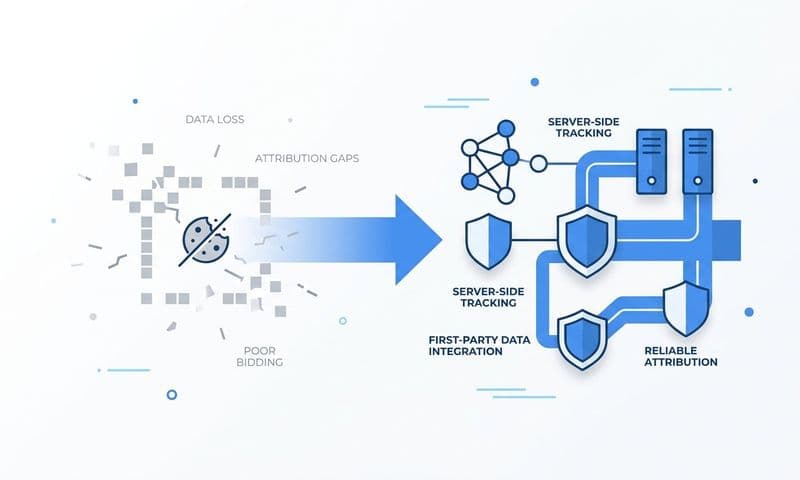
The core difference is where data processing happens. With a browser-based pixel, a small piece of JavaScript runs in the user's browser and sends conversion data directly from the browser to the ad platform. This approach is vulnerable to ad blockers, browser-level restrictions like Safari's Intelligent Tracking Prevention, and consent-related blocking. When any of these intervene, the conversion event is lost.
With server-side tracking, the conversion event is captured by your own server first. Your server processes the event, applies any necessary data transformations, and then sends the conversion data directly to the ad platform via an API. Because this happens server-to-server rather than browser-to-server, it is not affected by ad blockers or browser restrictions. The data pathway is more reliable and more stable. The benefits of server-side tracking extend well beyond compliance, delivering measurably more complete conversion data across every channel.
Conversion APIs, including Meta's Conversion API and Google's Enhanced Conversions, are the ad platform implementations of this approach. They allow you to send conversion events from your server directly to the ad platform, supplementing or replacing browser-based pixel data. When properly configured alongside a consent management layer, Conversion APIs can significantly reduce the data loss that occurs when browser-based tracking is blocked or restricted.
It is important to be precise about what server-side tracking does and does not solve. It does not eliminate the need for consent. If a user has declined advertising cookies, you still cannot use their personal data for ad tracking purposes, even via a server-side API. What server-side tracking does solve is the technical failure points that cause data loss even when consent has been properly obtained. Users who consent but happen to use an ad blocker or a privacy-focused browser will have their conversions captured through the server-side pathway rather than lost entirely.
The broader strategic shift here is toward first-party data. Rather than relying on third-party cookies and cross-site tracking that depend on infrastructure you do not control, first-party data collection means gathering data directly from your own users through your own properties, with their consent. This data is more reliable, more durable, and more defensible from a compliance standpoint. For B2B SaaS companies, first-party data includes CRM records, form submissions, product usage events, and pipeline milestones. These are signals you own, and they form the foundation of sustainable attribution.
Building a Compliant Attribution Framework for B2B SaaS
Understanding the individual components of compliant ad tracking is useful. Assembling them into a coherent attribution framework is where the real work happens. For B2B SaaS teams, a compliant attribution setup has four interconnected layers.
Consent layer: This is your CMP, properly configured and integrated with your tag management system. Every tracking tool in your stack should be gated behind consent signals. Your consent banner should be honest and clear, and your consent records should be stored in a format that can be audited if needed. This layer is non-negotiable and everything else depends on it.
First-party data strategy: Identify the data points you can collect directly from your own users and prospects, with their consent, through your own properties. This includes form submissions, email engagement, product events, and CRM data. Build your tracking architecture around these first-party signals rather than relying on third-party behavioral data that is increasingly restricted.
Server-side event tracking: Implement server-side tracking and Conversion API integrations to send conversion events from your server to your ad platforms. This reduces technical data loss and makes your attribution data more complete for users who have consented. Prioritize the conversion events that matter most for your B2B funnel: form fills, demo requests, trial signups, and pipeline milestones. Following best practices for tracking conversions accurately ensures that these critical signals are captured consistently and reliably.
Centralized attribution platform: Bring your ad platform data, CRM data, and website event data into a single attribution platform where you can analyze the full customer journey. B2B SaaS companies have long sales cycles with multiple touchpoints, and multi-touch attribution is essential for understanding which channels and campaigns are actually contributing to pipeline and revenue. A centralized platform lets you compare attribution models, analyze customer journeys, and make budget decisions based on complete, accurate data.
The connection between CRM data and ad platform data is particularly important for B2B SaaS attribution. When a prospect clicks an ad, fills out a form, enters your CRM as a lead, progresses through a sales cycle, and eventually converts to a paying customer, you want to be able to trace that entire journey back to the original ad interaction. This requires a compliant integration layer that can match CRM records to ad click data without violating privacy requirements. Tracking closed-won revenue back to specific ad interactions is what transforms attribution from a reporting exercise into a genuine budget optimization tool.
Multi-touch attribution built on this foundation gives you something far more valuable than last-click data. It shows you which campaigns are generating awareness, which are driving consideration, and which are closing deals. For teams managing significant ad budgets across multiple channels, this visibility is the difference between confident budget allocation and guesswork.
Accurate Tracking and Compliance: Two Goals, One Infrastructure
The shift in mindset that matters most is this: compliance and accurate measurement are not opposing forces. They feel that way when your tracking infrastructure was built for a pre-GDPR world and you are trying to retrofit compliance onto it. But when you build the right infrastructure from the ground up, compliance and measurement quality reinforce each other.
A properly configured consent layer ensures that the data you do collect is clean and defensible. Server-side tracking ensures that consented conversions are captured reliably. First-party data strategies ensure that your attribution is built on signals you own and control. A centralized attribution platform ensures that all of this data comes together into a single source of truth that connects ad spend to pipeline and revenue.
This is exactly the environment Cometly is built for. Cometly is a marketing attribution and analytics platform designed for B2B SaaS companies that need to track every consented touchpoint across the full customer journey. It connects your ad platforms, CRM, and website through server-side tracking and Conversion API integrations, capturing conversion events reliably even as browser-based tracking becomes less dependable.
With Cometly, you can analyze ad performance across every channel, compare multi-touch attribution models, and trace revenue back to the specific campaigns and ads that drove it. The platform integrates with Stripe and your CRM so that pipeline events and closed-won revenue are connected to ad data in real time. AI-driven recommendations help you identify which campaigns are performing and where to scale, all based on accurate, first-party data that respects user privacy.
For B2B SaaS teams navigating the intersection of ad performance and data privacy, Cometly provides the infrastructure to do both well without compromise.
Your Next Steps Toward Compliant, Confident Attribution
GDPR compliance and strong ad attribution are not in conflict. They become complementary when your tracking infrastructure is designed with both in mind. Marketers who invest in the right foundation, starting with a properly configured CMP, moving to server-side tracking and Conversion API integrations, and centralizing everything in a reliable attribution platform, will come out ahead. Their data will be cleaner, their campaign decisions will be more confident, and their legal exposure will be dramatically reduced.
The marketers who continue to rely on legacy pixel-based tracking and hope that consent issues will sort themselves out are facing a compounding problem. Their data quality will continue to decline as browser restrictions tighten and consent rates fluctuate. Their regulatory exposure will remain unresolved. And their budget decisions will be increasingly based on incomplete information.
The path forward is clear. Build for a privacy-first world, capture every consented touchpoint, and connect your ad spend to real pipeline and revenue. That is what modern B2B SaaS attribution looks like, and it is entirely achievable with the right platform in place.
Ready to build an attribution setup that is both compliant and accurate? Get your free demo and see how Cometly helps B2B SaaS teams track every consented touchpoint and connect ad spend to real revenue.