
If you are running paid ads without proper tracking in place, you are spending money without knowing what is actually working. Every click, every impression, every dollar spent disappears into a black box, and your budget decisions end up being educated guesses at best.
Ad tracking setup for beginners can feel overwhelming at first. There are pixels to install, UTM parameters to configure, attribution models to choose, and APIs to connect. It sounds like a lot, and honestly, it is, if you try to tackle it without a clear sequence.
But here is the thing: the core concepts are straightforward once you understand what you are trying to measure and why. The goal is simple. You want to know which ads are driving clicks, which clicks are turning into leads, and which leads are becoming revenue. Everything else is just the infrastructure that makes that visibility possible.
This guide is designed for marketers, growth teams, and SaaS founders who are new to ad tracking or who have attempted a setup before but are not confident their data is reliable. It covers every layer of a complete tracking stack, from defining your conversion goals before you touch a single setting, to using validated attribution data to make smarter budget decisions.
The same principles apply whether you are running campaigns on Meta, Google, LinkedIn, or TikTok. The platforms differ, but the foundation is the same. You need a consistent way to capture what happens after someone clicks your ad, connect that behavior to your CRM, and trace it all the way to a closed deal.
By the end of this guide, you will have a working tracking setup that captures the full customer journey from the first ad impression to revenue. You will also understand how to use that data to stop guessing and start scaling with confidence.
Let's get into it.
Step 1: Define Your Conversion Events Before Touching Any Settings
Most beginners make the same mistake: they jump straight into installing pixels and configuring tags before they have decided what they actually want to track. This leads to bloated event lists, inconsistent data, and reports that are hard to act on.
A conversion event is any action a user takes that represents meaningful progress toward a business outcome. For B2B SaaS companies, the most important conversion events typically include demo requests, free trial signups, paid plan activations, and contact form submissions. These are your macro-conversions, the actions that directly connect to revenue.
There are also micro-conversions to consider: page visits, content downloads, video views, and scroll depth. These are useful for understanding engagement, but they should not be confused with the events that actually drive pipeline. Tracking micro-conversions alongside macro-conversions without clear prioritization creates noise that makes it harder to read your data.
The practical rule is to identify two or three macro-conversions that matter most to your business right now, and build your tracking around those. For most B2B SaaS companies at an early stage, that means a demo request and a free trial signup. Everything else is secondary.
It also helps to map your conversion events to funnel stages before you start any technical configuration. Think of it this way:
Top of funnel: Content downloads, newsletter signups, and landing page visits indicate awareness and early interest.
Middle of funnel: Demo requests, webinar registrations, and free trial signups indicate intent and active evaluation.
Bottom of funnel: Paid plan activations and closed-won opportunities represent revenue and are the ultimate measure of campaign success.
When your conversion events are mapped to funnel stages, your attribution reports become much easier to interpret. You can see not just whether a campaign is generating activity, but where in the funnel that activity is concentrated.
Before you log into any ad platform or tag manager, open a simple spreadsheet. List each conversion event, the funnel stage it belongs to, the URL or trigger that fires it, and whether it is a macro or micro-conversion. This document becomes your tracking spec, and it will save you significant time during setup and auditing later.
Getting this step right is the difference between tracking conversions accurately and tracking that just generates data for its own sake.
Step 2: Install Your Tracking Pixel and Set Up First-Party Data Collection
Once you know what you want to track, the next step is getting the right code on your website. This is where the pixel comes in.
A tracking pixel is a small piece of JavaScript that loads on your web pages and fires event data back to ad platforms when specific actions occur. When someone visits your demo request confirmation page, the pixel fires and tells Meta or Google that a conversion happened. That data is then used to measure campaign performance and train the platform's optimization algorithms.
For Meta campaigns, you will install the Meta Pixel through Meta Events Manager. For Google Ads, you will use the Google Ads conversion tracking tag. Both can be deployed through Google Tag Manager, which is the recommended approach because it lets you manage all your tags in one place without editing your site's code directly every time you need to make a change.
The installation process itself is relatively straightforward. You add your tag manager container snippet to your site, then configure triggers inside tag manager that tell each pixel when to fire. A purchase confirmation page, a thank-you page after a demo request, or a post-signup screen all make natural trigger points.
Here is where most beginners run into trouble: they install the pixel but never verify that it is firing correctly on the right pages. The pixel might be present on the site but not configured to fire on the conversion page. Or it fires on every page load, which inflates your event counts. Always use the platform's native debugging tools, such as Meta's Pixel Helper browser extension or Google Ads tag diagnostics, to confirm that each event fires exactly when and where it should.
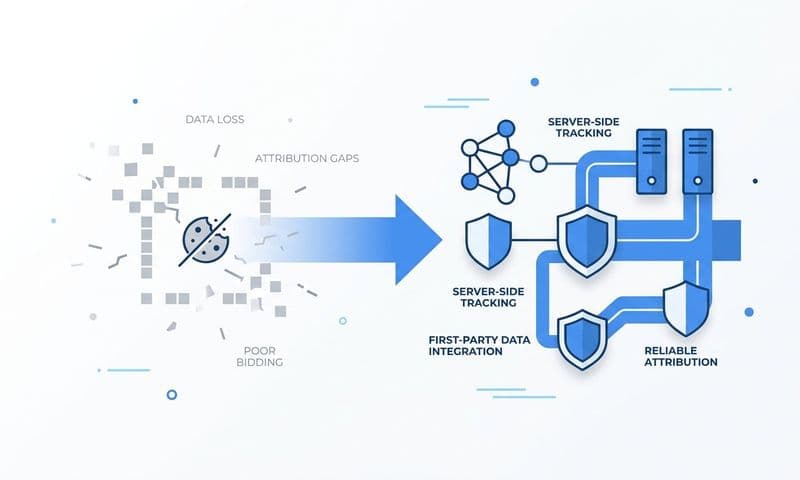
Now, about first-party data. Browser-based pixels have become significantly less reliable over the past few years. Ad blockers, iOS privacy changes, and third-party cookie restrictions mean that a meaningful portion of conversion events never make it back to the ad platform. Some estimates in the industry suggest this data loss can be substantial, though the exact figure varies depending on your audience and traffic sources.
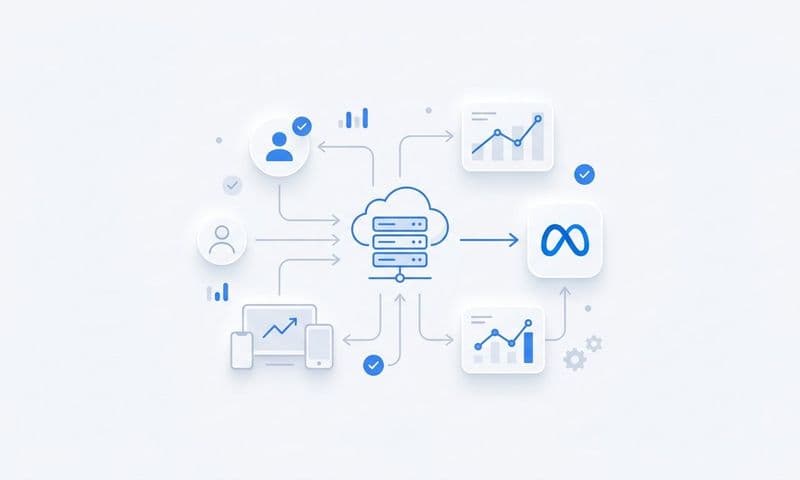
This is why server-side tracking is more accurate and has become a best practice rather than an advanced option. Instead of relying on a browser to fire the pixel, server-side tracking sends conversion data directly from your server to the ad platform. It bypasses browser limitations entirely, which means more of your conversions get captured and reported accurately.
The difference between client-side and server-side tracking comes down to where the event data originates. Client-side means the user's browser does the work. Server-side means your server does the work. Server-side is more reliable, more complete, and less vulnerable to the privacy and technical barriers that affect browser-based pixels.
For now, getting your pixel installed and verified is the priority. In Step 5, we will cover the Conversion API setup that adds the server-side layer on top of your pixel for maximum data accuracy.
Step 3: Connect Your CRM and Ad Platforms to a Single Attribution System
Ad platform data tells you how many clicks and reported conversions your campaigns generated. CRM data tells you which of those leads actually became customers. The problem is that these two data sets live in completely separate systems, and most teams never connect them.
This gap is especially costly for B2B SaaS companies. A lead that converts in your CRM three weeks after clicking an ad will never show up as a revenue outcome in your Google Ads or Meta dashboard. The ad platform sees a form submission. It does not see the deal that closed. Without connecting these systems, you are optimizing for form fills instead of revenue, which can lead your budget in the wrong direction entirely.
UTM parameters are the bridge that makes this connection possible. UTMs are tags you add to your ad URLs that carry information about the campaign, channel, and creative that drove each click. When a lead fills out your form, your CRM captures those UTM values alongside the contact record. Now you have a traceable link between a specific ad and a specific lead.
A consistent UTM naming convention is essential. If one team member uses "meta" as the source and another uses "facebook," you end up with fragmented data that is hard to aggregate. Standardize across five parameters:
utm_source: The platform where the ad ran, such as meta, google, or linkedin.
utm_medium: The channel type, such as cpc, paid-social, or email.
utm_campaign: The campaign name, ideally matching the name in your ad platform.
utm_content: The specific ad or creative, useful for A/B testing different versions.
utm_term: The keyword or audience segment, particularly relevant for search campaigns.
Document your naming convention in a shared reference and enforce it across every team member who builds campaigns. One inconsistent UTM can break your ability to trace a closed deal back to its source.
UTMs alone, however, only get you part of the way there. To see a complete picture of how your ads are influencing pipeline and revenue, you need a marketing attribution platform that pulls together data from your ad platforms, your CRM, and your website into a single view.
This is where a platform like Cometly becomes essential. Cometly connects your ad accounts, CRM, and website data through more than 70 native integrations, so you do not have to manually export and reconcile reports from five different tools. Every touchpoint in the customer journey, from the first ad click to a closed-won opportunity, is visible in one place. That single source of truth is what makes reliable attribution possible for B2B SaaS teams.
Step 4: Choose an Attribution Model That Matches Your Sales Cycle
You have your pixel installed, your UTMs configured, and your systems connected. Now you need to decide how credit for conversions gets assigned across the touchpoints in your customer journey. That decision is your attribution model, and choosing the wrong one can seriously distort how you read campaign performance.
Here is a quick breakdown of the most common models in plain language:
First-touch attribution: Gives 100 percent of the credit to the first ad or channel a prospect ever interacted with. Useful for understanding what drives initial awareness, but it ignores everything that happened between that first touch and the conversion.
Last-touch attribution: Gives 100 percent of the credit to the final interaction before conversion. This is the default in many ad platforms and CRMs, but it systematically undervalues upper-funnel campaigns that build awareness and intent over time.
Linear attribution: Distributes credit equally across every touchpoint in the journey. It is more balanced than single-touch models, though it treats a quick homepage visit the same as a demo request, which may not reflect actual influence.
Data-driven attribution: Uses machine learning to assign credit based on which touchpoints most frequently appear in converting paths. It is the most accurate model when you have enough conversion volume to train it, and it is the direction most sophisticated marketing teams are moving toward.
For B2B SaaS companies, single-touch models are almost always the wrong choice. When a sales cycle spans several weeks and involves multiple ad exposures, content interactions, and sales conversations, attributing the entire deal to one touchpoint misrepresents how your marketing actually works. Multi-touch models give you a more honest view of channel contribution.
The practical challenge is that different models produce different conclusions about which campaigns are performing well. A campaign that looks strong under last-touch attribution might look average under linear attribution, because the last click was a branded search and the real influence happened three weeks earlier through a LinkedIn ad.
Cometly addresses this directly by letting you compare attribution models side by side. You can see how each model changes your view of campaign performance without having to rebuild your reports from scratch. That flexibility is particularly valuable when you are trying to make a case internally for shifting budget toward upper-funnel channels that do not get credit under last-touch.
The success indicator for this step: you can see which channels influenced each conversion across multiple touchpoints, not just the last click. When you reach that level of visibility, your budget decisions start reflecting the full picture of how your marketing works.
Step 5: Set Up the Conversion API for Reliable Server-Side Event Tracking
Your pixel is capturing browser-based events, but as covered in Step 2, browser-based tracking has real limitations. The Conversion API, often called CAPI, is the solution that fills the gaps your pixel misses.
The Conversion API is a server-to-server integration that sends conversion data directly from your server to Meta, Google, or other ad platforms. Instead of waiting for a browser to fire a JavaScript tag, your server sends the event data directly after the conversion occurs. This means ad blockers, browser privacy settings, and cookie restrictions have no effect on whether the conversion gets recorded.
For Meta specifically, CAPI is now considered essential for maintaining signal quality. When your pixel loses data due to browser limitations, Meta's optimization algorithm has less information to work with, which affects targeting, bidding, and overall campaign efficiency. CAPI restores that signal and often improves it, because server-side data tends to be cleaner and more complete.
The key events to send via CAPI for a B2B SaaS setup include:
Lead: Fires when a prospect submits a form or requests a demo. This is your primary top-of-funnel conversion event.
Purchase or Subscribe: Fires when a user activates a paid plan. This is your bottom-of-funnel revenue event and the most valuable signal you can send back to ad platforms.
Custom events: Any other actions specific to your product, such as completing onboarding, activating a key feature, or upgrading a plan.
There is one critical technical detail to get right: event deduplication. When you run both a pixel and CAPI simultaneously, the same conversion can be reported twice, once by the browser and once by the server. Ad platforms use an event ID to match and deduplicate these events, so they only count the conversion once. If you skip deduplication, your reported conversion numbers will be inflated, which corrupts your performance data and misguides your optimization decisions.
Setting up CAPI correctly typically requires some engineering involvement, but platforms like Cometly automate the server-side tracking and CAPI integration process. Cometly handles the event matching, deduplication logic, and data transmission without requiring your engineering team to build and maintain a custom integration. That means you get the accuracy benefits of server-side tracking without the technical overhead.
Before running live campaigns with your CAPI setup, use the test event tool inside Meta Events Manager or Google's tag diagnostics to verify that events are being received correctly and that deduplication is working as expected. A few minutes of testing here prevents weeks of corrupted data later.
Step 6: Validate Your Tracking Data and Audit for Gaps
Here is a step that many beginners skip entirely: validation. Once your tracking is configured, it is tempting to assume it is working and move on to running campaigns. But tracking setups break more often than you might expect, and the only way to know your data is reliable is to check it systematically.
A basic tracking audit covers four areas. Start with pixel fires. Use your ad platform's event manager to confirm that each conversion event is firing on the correct page and not firing on pages where it should not. A thank-you page pixel that also fires on the homepage will overcount conversions significantly.
Next, check your UTM parameters. Pull a sample of recent leads from your CRM and verify that UTM values are being captured correctly on each record. Missing UTMs usually mean a campaign URL was built without proper tagging or that the UTM values are not being passed through your form or landing page correctly.
Then look at your attribution reports. Compare the conversion numbers reported in your ad platform against the leads recorded in your CRM for the same time period. Some variance is normal, but large discrepancies, such as your ad platform reporting twice as many conversions as your CRM recorded, indicate a tracking problem that needs to be diagnosed.
Common gaps to look for include untracked conversion pages, where a new landing page was launched without the pixel installed; duplicate events, where the same conversion fires multiple times due to a misconfigured trigger; and missing UTMs on campaigns that were set up without following your naming convention.
Cometly's real-time event monitoring makes this audit process faster and more reliable. You can see conversion events as they happen, verify that the data matches what you expect, and identify discrepancies between your ad platform data and CRM records without manually exporting and comparing spreadsheets.
The success indicator for this step is straightforward: your attribution platform, CRM, and ad platform data are consistent within a reasonable margin. When those three data sources roughly agree, you can trust your reports and make decisions based on them.
Step 7: Use Your Tracking Data to Make Budget Decisions
Tracking setup is not the end goal. It is the foundation that makes everything else possible. Once your tracking is validated and reliable, the real work begins: using your data to make smarter decisions about where to invest your ad budget.
Start with your attribution reports. Look at which campaigns and channels are driving pipeline, not just clicks or form fills. For B2B SaaS, the metric that matters most is revenue influence: which campaigns are appearing in the journeys of prospects who eventually become paying customers. A campaign that generates many leads but few customers is less valuable than a campaign that generates fewer leads but a higher proportion of closed deals.
Cometly's AI recommendations surface this kind of insight automatically. Instead of manually sorting through campaign data to find patterns, the AI identifies which ads and campaigns are performing well across your tracked channels and flags where you have opportunities to scale or where you are spending on campaigns that are not contributing to revenue. That reduces the analysis burden on your team and speeds up the decision-making cycle.
There is also a compounding benefit to sending enriched conversion data back to Meta and Google. When you feed high-quality server-side conversion signals back to ad platform algorithms, those algorithms get better at finding users who are likely to convert. Over time, better data quality leads to improved targeting, more efficient bidding, and better campaign performance overall. It is a feedback loop: accurate tracking improves your data, better data improves the algorithm, and a better algorithm improves your results.
Build a regular review cadence around your attribution dashboard. A weekly review of campaign performance against pipeline contribution, combined with a monthly review of attribution model accuracy and conversion event relevance, keeps your tracking aligned with your business goals as they evolve.
One final point worth emphasizing: tracking is not a one-time setup. Your funnel will change. New campaigns will launch. Your product will evolve. Revisit your conversion events and attribution model regularly to make sure your tracking still reflects what actually matters to your business. A tracking setup that was accurate six months ago may no longer capture the right signals if your go-to-market motion has shifted.
Your Complete Ad Tracking Checklist
You now have a complete picture of what a reliable ad tracking setup looks like from the ground up. Before you move into active campaign management, run through this checklist to confirm every layer is in place.
1. Conversion events defined and mapped to funnel stages in a tracking spec document.
2. Tracking pixel installed and verified on all key conversion pages using platform debugging tools.
3. UTM naming convention documented and applied consistently across all campaigns and team members.
4. CRM connected to ad platform data through a marketing attribution platform with a unified view of the customer journey.
5. Attribution model selected based on your sales cycle length, with the ability to compare models side by side.
6. Conversion API configured with event deduplication enabled and tested before live campaigns run.
7. Tracking audit completed with ad platform data, CRM records, and attribution reports cross-referenced for consistency.
Accurate tracking is the foundation of every profitable ad campaign. Without it, you are making budget decisions in the dark. With it, every dollar you spend is connected to a measurable outcome, and every optimization decision is backed by data you can trust.
Cometly brings all of these layers together in one place, from first ad click to closed-won revenue. It connects your ad platforms, CRM, and website data, automates server-side tracking and CAPI integration, lets you compare attribution models side by side, and uses AI to surface recommendations about where to scale and where to cut. If you want to skip the manual setup complexity and get reliable attribution data faster, Get your free demo and see how Cometly can give you the visibility your ad campaigns deserve.