
Most marketing teams are not short on data. They have dashboards full of impressions, click-through rates, cost-per-click figures, and conversion counts. What they are often short on is clarity: which channels are actually driving revenue, and where should the next dollar go?
That gap between data abundance and decision confidence is where budget waste lives. And for B2B SaaS teams operating under tighter scrutiny on every dollar spent, that gap is expensive.
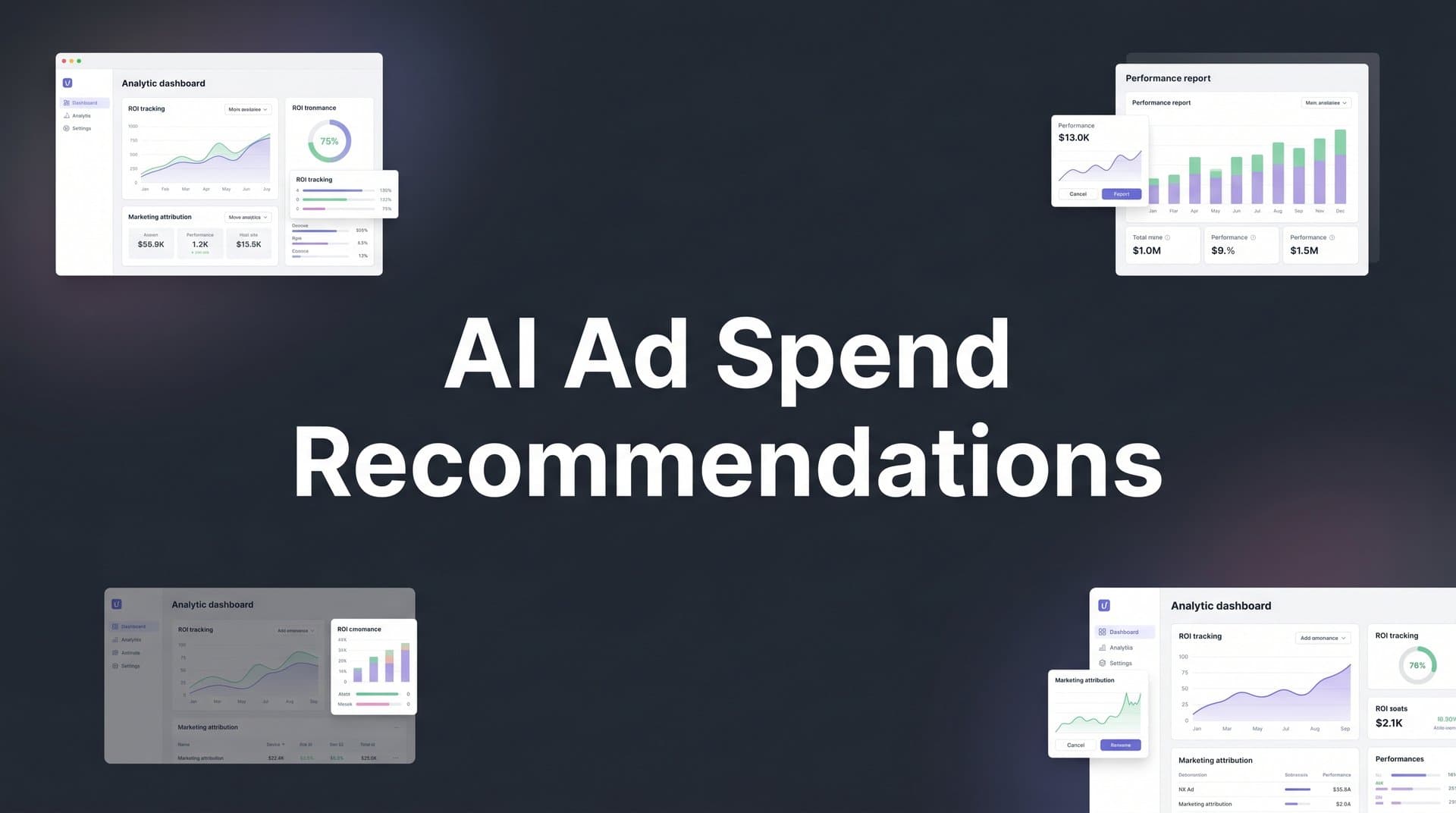
AI ad spend recommendations represent a fundamental shift in how growth teams approach budget allocation. Rather than waiting for a monthly report to reveal what went wrong, AI continuously analyzes performance signals across every active channel and surfaces guidance on where to invest, where to pull back, and what is likely to perform better with increased spend. It moves budget decisions from reactive to proactive, from gut-driven to data-driven.
This article breaks down how AI ad spend recommendations actually work, what signals they rely on, why attribution data is the foundation everything else depends on, and how B2B SaaS teams can build a practical workflow around AI guidance to improve ROI across every campaign cycle.
Why Traditional Budget Allocation Keeps Marketers Guessing
Ask most marketing teams how they decide where to shift budget, and the honest answer involves some combination of recent performance reports, channel intuition, and whoever made the strongest case in the last planning meeting. That process feels analytical. In practice, it is riddled with blind spots.
The first problem is the metrics marketers typically rely on. Click-through rate, cost-per-click, and even cost-per-lead are surface-level signals. They tell you how an ad performed at the top of the funnel, but they say nothing about whether those clicks turned into qualified pipeline or closed revenue. A campaign with a strong CTR and a low CPC might be generating high volumes of low-quality leads that never progress past the first sales call. Meanwhile, a higher-cost channel driving fewer but better-fit prospects gets deprioritized because the numbers look worse on paper.
Single-touch attribution makes this worse. When budget decisions are informed by last-click or first-touch models, credit flows to a single touchpoint while every other interaction in the customer journey goes unrecognized. In B2B SaaS, where a prospect might engage with a LinkedIn ad, attend a webinar, read a comparison page, and click a Google search ad before requesting a demo, that last click gets all the credit. The channels that built awareness and intent get none. Over time, teams systematically over-invest in channels that look good in attribution reports but are only capturing demand that other channels created.
There is also the problem of timing. Human-driven budget analysis happens on a lag. A marketer reviewing last week's performance data is already a week behind. By the time an analyst identifies that a particular campaign has been burning through budget with declining returns, a meaningful portion of the monthly allocation has already been spent inefficiently. The insight arrives too late to change the outcome.
This combination of misleading metrics, distorted attribution, and slow decision cycles creates a situation where even experienced marketing teams are consistently misallocating spend. The solution is not more manual analysis. It is a fundamentally different approach to how performance data gets processed and turned into budget guidance.
What AI Ad Spend Recommendations Actually Are
The term gets used loosely, so it is worth being precise. AI ad spend recommendations are data-driven budget guidance generated by machine learning models that analyze historical performance, conversion patterns, and attribution data across all active channels simultaneously. The output is actionable: shift budget from this campaign to that one, increase investment in this channel, reduce spend on this audience segment because it is approaching saturation.
This is meaningfully different from rules-based automation, which many marketers have already encountered in ad platforms. Rules-based automation follows fixed logic: if cost-per-acquisition exceeds a threshold, pause the campaign. If ROAS drops below a target, reduce the bid. These rules are useful, but they are static. They respond to conditions you anticipated in advance and cannot adapt to patterns you did not program in.
AI models learn from patterns rather than following predetermined rules. They observe how performance signals change over time, how different channels interact with each other in the customer journey, and how budget shifts in one area affect outcomes in another. They can detect a diminishing returns curve before it becomes obvious in a weekly report. They can identify that two channels are targeting the same audience and competing against each other in ways that inflate costs without increasing reach.
The inputs that drive reliable AI recommendations are specific. Conversion events are foundational: the AI needs to know what actions matter, whether that is a demo request, a trial signup, or a pipeline stage advancement. Customer journey touchpoints give the model a picture of how prospects move through the funnel and which channels appear at which stages. Cost-per-acquisition trends over time help the model understand whether a channel's efficiency is improving or deteriorating. Channel overlap analysis reveals where audiences are being reached multiple times across platforms. And revenue attribution data tied to closed deals or pipeline stages gives the model a direct connection between ad spend and business outcomes.
Without these inputs, AI recommendations are limited to optimizing for the metrics it can see, which often means top-of-funnel activity rather than downstream revenue. With them, the model can surface guidance that reflects what actually drives qualified pipeline, not just what generates clicks.
The Attribution Foundation That Makes AI Recommendations Reliable
Here is the uncomfortable truth about AI-driven budget guidance: it is only as trustworthy as the data feeding it. A model trained on incomplete, biased, or inaccurate conversion signals will produce recommendations that confidently point in the wrong direction. The sophistication of the AI does not compensate for poor data quality. It amplifies the problem.
This is why attribution accuracy is not a nice-to-have feature alongside AI recommendations. It is the prerequisite. Before any AI model can generate reliable budget guidance, the conversion data it processes needs to reflect what is actually happening across the customer journey.
Multi-touch attribution is what gives AI a complete picture rather than a snapshot. Instead of crediting a single touchpoint with the conversion, multi-touch models distribute credit across every interaction in the journey, weighted by each channel's contribution to the final outcome. For B2B SaaS teams, where a deal might involve a dozen touchpoints over several months, this matters enormously. The AI can see that paid social drove initial awareness, organic search captured mid-funnel research intent, and a retargeting campaign closed the loop before the demo request. Each channel gets appropriate credit, and the model learns which combinations of touchpoints produce the highest-quality pipeline.
When AI is trained on single-touch data instead, it inherits the same biases those models create. It over-recommends investment in last-click channels because that is where the conversion credit lives in the data. The result is AI-generated guidance that feels sophisticated but is systematically steering budget toward the wrong channels.
Server-side tracking and first-party data play an equally important role. Browser-based pixel tracking has become increasingly unreliable. Ad blockers, browser privacy restrictions, and the ongoing deprecation of third-party cookies mean that a meaningful portion of conversion events never make it into the data layer at all. When those gaps exist, the AI is working with an incomplete picture of what is driving results.
Server-side tracking addresses this by sending conversion events directly from the server rather than relying on a browser pixel. Conversion API integrations, such as Meta's Conversion API or Google's Enhanced Conversions, pass first-party event data directly to ad platforms, bypassing the browser entirely. The result is cleaner, more complete conversion data with proper deduplication logic to prevent the same event from being counted twice when both pixel and server-side events fire. That clean data is what AI models need to generate recommendations you can actually act on with confidence.
How AI Analyzes Performance Signals to Generate Budget Guidance
Understanding what AI does with performance data helps marketers interpret recommendations more intelligently and apply human judgment where it matters most.
The most immediate function is pattern recognition across campaigns. AI continuously monitors performance trends across every active ad platform, not in a weekly review but in real time. It tracks how key metrics shift as spend scales, identifying when a campaign is growing efficiently and when it is approaching diminishing returns. That diminishing returns curve is something human analysts often catch too late, after significant budget has already been absorbed with declining output. AI can flag it early, before the waste compounds.
Cross-channel budget reallocation is where AI recommendations become particularly valuable for teams running campaigns across multiple platforms simultaneously. The model weighs channel-level return on ad spend, pipeline contribution, and customer acquisition cost together, not in isolation. A channel with a strong ROAS but low pipeline contribution might look attractive until the model factors in that the deals it generates have shorter sales cycles but smaller contract values. Another channel with a higher CPA might be consistently sourcing enterprise-tier opportunities that close at a higher revenue figure. AI surfaces these relationships and recommends reallocating budget toward the channels that drive the outcomes that matter most to the business.
Predictive modeling extends AI's value beyond current performance. Rather than only analyzing what has happened, AI uses trend data to forecast which channels and campaigns are likely to perform better with increased investment going forward. This is particularly useful during planning cycles, when teams are deciding how to allocate budget across the next quarter. Instead of extrapolating from last quarter's averages, AI can identify emerging performance signals that suggest a channel is gaining momentum, or flag early indicators that a previously strong channel is losing efficiency before the decline becomes obvious in aggregate reports.
Audience saturation signals are another dimension AI monitors that human analysts rarely track systematically. When an ad set has reached a significant portion of its target audience, frequency increases and performance typically declines. AI can detect this pattern across platforms and recommend either broadening the audience definition, rotating creative, or shifting budget to channels where the target audience has not yet been saturated. This kind of cross-platform visibility is nearly impossible to maintain manually when running campaigns across several channels at once.
Putting AI Recommendations Into Practice for B2B SaaS Teams
Receiving an AI recommendation is the beginning of the process, not the end. How a growth team interprets and acts on that guidance determines whether it translates into better outcomes or just creates a new layer of complexity.
The first thing to understand is the difference between a confidence-weighted suggestion and a hard directive. AI recommendations come with varying degrees of certainty based on the volume and quality of data available. A recommendation backed by months of consistent conversion data across a well-tracked channel carries more weight than one generated from a campaign that has only been running for two weeks. Treating every recommendation with the same level of urgency is a mistake. The human judgment layer is what calibrates how aggressively to act on any given suggestion.
Context matters in ways AI cannot always account for. A recommendation to shift budget away from a channel might conflict with a strategic partnership, a seasonal campaign, or a brand-building initiative that does not show up in conversion data but serves a longer-term purpose. Growth teams should treat AI guidance as a high-quality input into the decision, not as a replacement for strategic thinking.
Connecting recommendations to pipeline and revenue outcomes is what gives teams the confidence to act. When attribution data ties ad spend directly to closed-won revenue and pipeline stage progression, the recommendation is not abstract. You can see that the AI is suggesting moving budget toward a channel that has consistently contributed to qualified pipeline at a lower cost per opportunity. That context transforms a recommendation from a data point into a business decision.
A practical workflow for acting on AI ad spend recommendations involves a few key steps. Start by reviewing recommendations on a defined cadence, whether that is weekly or bi-weekly, rather than reacting to every signal in real time. This prevents over-optimization and gives campaigns enough time to accumulate meaningful data between adjustments. When a recommendation involves a significant budget shift between channels, test it at a controlled scale first rather than moving the full allocation immediately. Measure the downstream impact on pipeline and revenue over a defined window, not just the immediate effect on top-of-funnel metrics. Then feed those results back into the attribution model so the AI is learning from the outcomes of its own recommendations.
This feedback loop is what separates teams that extract compounding value from AI recommendations over time from those that treat each recommendation as a one-off decision. The more consistently you act on recommendations, measure outcomes, and return that data to the model, the more accurate and useful the next round of guidance becomes. Teams that want a deeper foundation for this approach can explore how SaaS growth teams attribute revenue to specific marketing efforts as a starting point.
Turning Better Data Into Smarter Spending Decisions
The quality of AI ad spend recommendations is ultimately a function of the data infrastructure underneath them. Teams that have unified their ad platform data, CRM events, and conversion tracking into a single source of truth are working with the complete dataset that AI needs to generate reliable guidance. Teams that are still operating with fragmented data across disconnected platforms are asking AI to make recommendations with an incomplete picture.
This is where platforms like Cometly create a meaningful advantage. By connecting ad platform data, CRM pipeline events, and server-side conversion tracking into one attribution layer, Cometly gives AI models the complete, enriched dataset they need to surface budget guidance that reflects actual revenue impact. The AI is not just analyzing click data or cost metrics. It is analyzing the full customer journey from first ad interaction to closed-won deal, with every touchpoint weighted by its contribution to pipeline and revenue.
The compounding advantage of continuous learning is significant over time. As AI processes more attribution data across more campaign cycles, its pattern recognition improves. Early recommendations reflect the data available at the time. Later recommendations incorporate everything the model has learned about how your specific audience moves through your specific funnel, which channels drive the highest-quality opportunities, and which budget configurations produce the best return. Each cycle makes the next round of guidance more accurate.
Feeding enriched conversion events back to ad platforms adds another layer of benefit. When first-party conversion data is sent back to Meta, Google, and other platforms through Conversion API integrations, those platforms' own AI optimization algorithms improve. They gain a clearer signal about which users are converting and why, which improves targeting, reduces wasted impressions, and compounds the impact of internal budget recommendations. Better data flowing into the AI produces better recommendations internally. Better conversion signals flowing back to ad platforms produce better targeting externally. Both loops reinforce each other.
For B2B SaaS teams under pressure to justify every dollar of ad spend, this combination of accurate attribution, AI-driven recommendations, and enriched platform data is what makes confident budget allocation possible. It is not about removing human judgment from the process. It is about giving that judgment a far better foundation to work from.
Your Next Steps Toward Smarter Ad Budgets
The shift from reactive to proactive budget allocation does not happen by adding more dashboards or running more reports. It happens when AI has access to the complete, accurate attribution data it needs to surface guidance that reflects real revenue impact across every channel and every touchpoint in the customer journey.
That foundation starts with attribution. Multi-touch attribution models, server-side tracking, and first-party conversion data are not technical details. They are the inputs that determine whether your AI recommendations are reliable or misleading. Get the data layer right, and the AI recommendations that follow become genuinely actionable.
For B2B SaaS growth teams, the practical path forward is clear: unify your attribution data, connect it to pipeline and revenue outcomes, and build a workflow that treats AI recommendations as high-confidence guidance that still benefits from human context and strategic judgment.
Cometly is built to be the attribution foundation that makes this possible. It connects your ad platforms, CRM, and website into a single source of truth, tracks every touchpoint from first click to closed-won revenue, and feeds enriched conversion data back to ad platforms to improve targeting alongside your internal budget decisions. Get your free demo today and see how Cometly connects your ad spend to pipeline and revenue in real time, so every budget decision you make is backed by data you can trust.