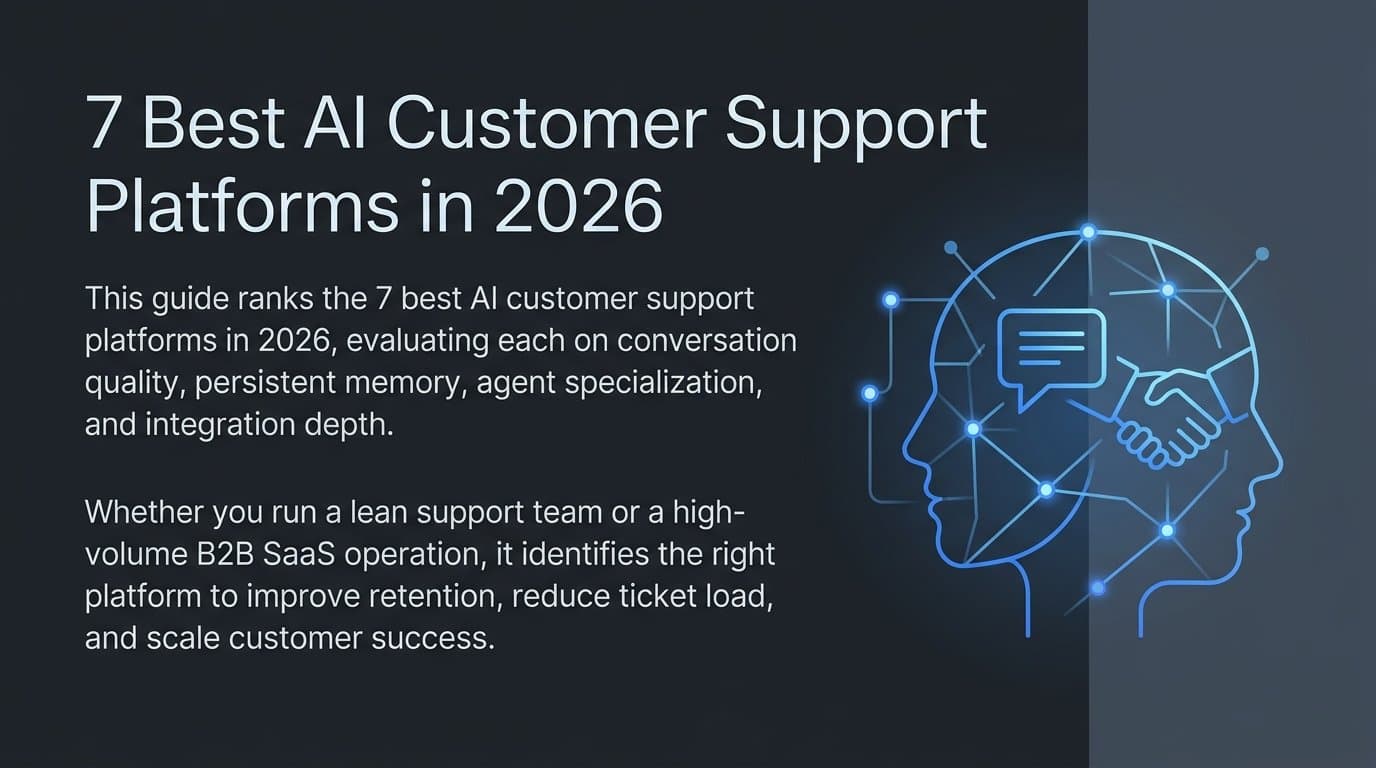
AI customer support has moved well past the era of scripted chatbots and canned responses. Today's leading platforms can hold meaningful conversations, remember customer history across sessions, close deals, and resolve complex issues without a human ever stepping in. For B2B SaaS companies and growing businesses, the platform you choose has a direct impact on retention, expansion revenue, and customer satisfaction.
This list covers the top AI customer support platforms available in 2026, evaluated on conversation quality, memory and context retention, agent specialization, integration depth, and scalability. Whether you are running a lean support team or scaling a high-volume operation, there is a platform here built for your needs.
What Is the Best AI Customer Support Platform?
An AI customer support platform uses large language models, grounded in your help documentation and customer data, to resolve support conversations end to end — answering questions, taking actions, and escalating when it reaches the edge of what it knows. The best AI customer support platform is defined by four measurable qualities: how many conversations it resolves independently, how rarely it invents answers, how cleanly it hands off to humans, and how much context it carries between interactions.
The distinction matters because the category has split. Traditional customer support software organizes tickets for humans to answer, while AI-first systems resolve a large share of them outright. Most customer support platforms now advertise an AI agent, but real-world resolution rates range from under 20 percent to over 60 percent depending on guardrails, grounding, and handoff design.
In 2026, AI in support is table stakes; the question is which vendor's AI you can trust in front of customers. Choosing the best AI customer support platform comes down to a disciplined evaluation — benchmark resolution rates, probe hallucination guardrails, inspect the handoff, and test on your own data before rollout. The framework after the rankings walks through each step.
1. Halo AI
Best for: B2B SaaS teams that want AI agents with persistent memory, customer success, and sales in one platform.
Halo AI is a next-generation AI customer support platform built around persistent memory, offering both customer success agents and sales agents in a single unified system.
 7 Best AI Customer Support Platforms in 2026
Where This Tool Shines
Most AI support tools treat every conversation as if it is the first one. Halo AI is built differently. Its built-in memory system retains context across every interaction, so the AI agent knows who the customer is, what they have asked before, what problems they have experienced, and where they currently sit in their journey. This is not a minor feature. It is the foundation of a fundamentally better customer experience.
What makes Halo AI particularly compelling for B2B SaaS teams is the dual-agent model. Customer success agents handle onboarding, retention, and issue resolution. Sales agents identify upsell and cross-sell opportunities and move conversations toward revenue outcomes. Both run on the same memory architecture, meaning every agent interaction is informed by the full customer history. No other platform on this list combines these two functions with this level of contextual depth.
Key Features
Built-in Persistent Memory: Retains customer context, preferences, and history across every conversation, enabling AI agents that genuinely know your customers over time rather than starting from scratch each session.
Customer Success Agents: Purpose-built agents designed to handle onboarding flows, retention conversations, and issue resolution with full context of the customer relationship.
AI Sales Agents: Dedicated agents that identify upsell and cross-sell opportunities, qualify leads, and drive revenue conversations alongside the support function.
Proactive Outreach: Agents can initiate contact based on customer signals rather than waiting for inbound tickets, shifting the model from reactive support to proactive customer success.
Dual-Function Platform: Serves both support and revenue teams from a single platform, eliminating the need to stitch together separate tools for success and sales conversations.
Best For
Halo AI is the strongest choice for B2B SaaS companies that want their AI agents to act like experienced team members rather than scripted bots. It is particularly valuable for teams managing long customer lifecycles where context retention across months of interactions makes a measurable difference in outcomes.
Pricing
Contact Halo AI directly at haloagents.ai for current pricing details. Pricing is tailored based on team size and use case.
2. Intercom Fin
Best for: Teams already in the Intercom ecosystem looking for instant AI-powered ticket resolution.
Intercom Fin is Intercom's AI agent built on large language models, designed to resolve customer questions instantly using your existing knowledge base and support content.
 7 Best AI Customer Support Platforms in 2026
Where This Tool Shines
If your team is already running support through Intercom, Fin integrates directly into your existing workflows without requiring a platform migration. It draws on your help center content to generate accurate, on-brand responses and handles a wide range of common support questions without human involvement.
Fin's handoff logic is well-designed. When a conversation exceeds the AI's confidence threshold, it transfers cleanly to a human agent with full conversation context intact. This makes it a practical choice for teams that want to automate routine volume while keeping humans in the loop for complex issues.
Key Features
AI Resolution Engine: Answers customer questions directly in the Intercom messenger using your knowledge base and support documentation as its source of truth.
Seamless Human Handoff: Transfers conversations to live agents when needed, preserving full context so customers never have to repeat themselves.
Deep Intercom Integration: Works natively with Intercom's inbox, workflow automation, and reporting tools without additional setup.
Knowledge Base Training: Trained on your existing help center content, meaning quality of responses scales with the quality of your documentation.
Multilingual Support: Handles conversations across major languages, making it suitable for global support operations.
Best For
Intercom Fin is best suited for companies already invested in the Intercom platform that want to add AI resolution without switching tools. It works well for teams with a well-maintained knowledge base and moderate support volume.
Pricing
Available as an add-on to Intercom plans with pricing based on the number of resolutions. Contact Intercom for current rates.
3. Zendesk AI
Best for: Enterprise support teams managing high ticket volumes that need intelligent triage and agent assist at scale.
Zendesk AI is the AI layer built into Zendesk's enterprise support platform, covering intelligent triage, agent assist, and automated responses across large support operations.
 7 Best AI Customer Support Platforms in 2026
Where This Tool Shines
Zendesk AI is built for scale. Its intelligent triage system automatically categorizes, prioritizes, and routes incoming tickets based on content and intent, reducing the manual work that slows down large support teams. For organizations handling thousands of tickets per week, this kind of automation has a meaningful impact on response times.
The agent assist feature is particularly strong. It surfaces suggested replies, relevant knowledge base articles, and next-step recommendations in real time as agents work through tickets. This shortens handle time and improves consistency across a large support team without requiring agents to search for information manually.
Key Features
Intelligent Ticket Triage: Automatically categorizes and routes incoming support requests based on AI analysis of content, intent, and priority.
Agent Assist: Provides human agents with suggested replies, knowledge recommendations, and contextual guidance in real time during live conversations.
Automated Resolution: Handles common, repetitive support requests without human involvement, freeing agents for complex issues.
AI-Generated Insights: Surfaces trends, patterns, and performance data across support operations to inform team decisions.
Full Suite Integration: Works natively across Zendesk's ticketing, messaging, and voice products within a single platform.
Best For
Zendesk AI is the right choice for enterprise teams with established Zendesk deployments and high support volume. It is better suited to reactive, ticket-based support than proactive customer success outreach.
Pricing
Included in select Zendesk Suite plans with advanced AI features available as add-ons. Contact Zendesk for current enterprise pricing.
4. Freshdesk Freddy AI
Best for: SMBs and growing support teams that want AI-powered self-service, agent assist, and analytics at an accessible price point.
Freshdesk Freddy AI is Freshdesk's AI suite spanning self-service bots, real-time agent assistance, and analytics designed to help support teams work faster and smarter.
 7 Best AI Customer Support Platforms in 2026
Where This Tool Shines
Freddy AI covers three distinct layers of support intelligence: self-service for customers, real-time assistance for agents, and analytics for team leaders. This breadth makes it a practical all-in-one AI layer for teams that do not want to buy separate tools for each function.
The pricing accessibility is a genuine differentiator. Many enterprise AI support platforms carry price tags that put them out of reach for smaller teams. Freshdesk's positioning makes Freddy accessible to SMBs and growing companies that want AI capabilities without an enterprise budget.
Key Features
Freddy Self Service: An AI bot that handles customer-facing question resolution automatically, reducing inbound ticket volume for the support team.
Freddy Copilot: Provides human agents with real-time suggestions, draft responses, and contextual recommendations as they work through tickets.
Freddy Insights: Generates AI-powered analytics across support operations, surfacing trends and performance gaps for team leaders.
SMB-Accessible Pricing: Designed to be affordable for smaller teams, not just enterprise organizations with large technology budgets.
Freshdesk Integration: Built natively into Freshdesk's ticketing and help desk platform, requiring no additional integration work for existing Freshdesk users.
Best For
Freshdesk Freddy AI is well-suited for SMBs and mid-market teams already using Freshdesk that want to add AI capabilities across self-service, agent assist, and analytics without a major platform change.
Pricing
Freddy AI features are available across Freshdesk plans at competitive price points. Contact Freshworks for current rates and plan details.
5. Drift
Best for: Revenue-focused teams that want AI-powered lead qualification and meeting booking on their website.
Drift is a conversational AI platform, now part of Salesloft, focused on qualifying website visitors, booking meetings, and driving pipeline through AI-powered chat interactions.
 7 Best AI Customer Support Platforms in 2026
Where This Tool Shines
Drift's core strength is pipeline generation. Its AI engages website visitors in real time, qualifies them based on firmographic and behavioral signals, and routes high-value conversations to the right sales rep or books a meeting automatically. For marketing and sales teams that want to convert more website traffic into pipeline, Drift is purpose-built for that outcome.
The integration with CRM and sales engagement tools is well-developed. Drift can pull in account data to personalize conversations and push qualified lead information directly into your sales workflow. This makes it a natural fit for teams running account-based strategies.
Key Features
AI Lead Qualification: Engages and qualifies website visitors automatically based on behavior, firmographics, and intent signals.
Automated Meeting Booking: Books meetings with the right sales rep directly within the chat conversation without manual coordination.
Personalized Playbooks: Delivers tailored conversation experiences based on visitor segment, behavior, and account data.
CRM Integration: Connects with major CRM and sales engagement platforms to sync lead data and conversation history.
Revenue Reporting: Ties conversational interactions to pipeline and revenue outcomes so teams can measure the direct impact of chat.
Best For
Drift is best for B2B marketing and sales teams focused on converting website traffic into pipeline. It is less focused on post-sale customer success and better suited to top-of-funnel and mid-funnel revenue conversations.
Pricing
Enterprise-focused pricing. Contact Drift or Salesloft directly for current plan details and custom quotes.
6. Ada
Best for: Customer experience teams that need to deploy automated AI support at scale without engineering resources.
Ada is a no-code AI agent builder that enables CX teams to create, deploy, and manage automated support agents without requiring engineering involvement.
 7 Best AI Customer Support Platforms in 2026
Where This Tool Shines
Ada's defining advantage is accessibility for non-technical teams. Building and managing AI agents on Ada does not require writing code or submitting engineering tickets. CX teams can create conversation flows, update content, and adjust agent behavior directly in the platform. This dramatically shortens the time from decision to deployment.
Ada also handles multilingual support across dozens of languages, making it a strong option for companies with a global customer base. The analytics dashboard gives CX leaders clear visibility into resolution rates, containment, and where conversations are dropping off.
Key Features
No-Code Agent Builder: Enables CX teams to create and manage AI agents without engineering support, reducing deployment time significantly.
Multilingual Support: Handles customer conversations across dozens of languages, supporting global support operations from a single platform.
CRM and Platform Integration: Connects with major CRMs and support platforms to give AI agents access to relevant customer data during conversations.
High-Volume Automation: Designed to handle large volumes of repetitive support requests efficiently, reducing load on human agents.
Performance Analytics: Provides a clear dashboard for measuring AI resolution rates, containment, and conversation quality over time.
Best For
Ada is a strong fit for mid-market and enterprise CX teams that need to scale automated support quickly without engineering bottlenecks. It works particularly well for companies with high volumes of repetitive inbound requests across multiple languages.
Pricing
Custom pricing based on volume and features. Contact Ada directly for a quote tailored to your team's needs.
7. Tidio
Best for: Small businesses and e-commerce brands that want AI-powered chat at an affordable price with minimal setup.
Tidio is an accessible AI customer support platform designed for small businesses and e-commerce brands that want to add AI-powered chat without a large budget or technical team.
Where This Tool Shines
Tidio removes the barriers to entry for AI customer support. Setup is fast, the interface is straightforward, and the pricing is accessible for teams that are not working with enterprise budgets. For e-commerce brands in particular, Tidio's integrations with Shopify and WooCommerce make it easy to connect chat directly to product and order data.
The Lyro AI chatbot handles a solid range of common customer questions automatically, reducing the volume that reaches human agents. For small teams where every hour of support time matters, this kind of automation can have an outsized impact on daily operations.
Key Features
Lyro AI Chatbot: Tidio's AI bot that automatically resolves common customer questions, reducing inbound volume for small support teams.
Live Chat with AI Assist: Combines live agent chat with AI-assisted response suggestions to help small teams respond faster and more consistently.
E-Commerce Integrations: Native integrations with Shopify and WooCommerce make it easy to connect chat to product, order, and customer data.
Fast Setup: Designed to go live quickly with minimal technical requirements, making it accessible for teams without dedicated IT support.
Affordable Plans: Pricing tiers designed for startups and small businesses, including a free plan for teams getting started.
Best For
Tidio is the right choice for small businesses, startups, and e-commerce brands that want AI-powered chat without the complexity or cost of enterprise platforms. It is better suited to straightforward support use cases than complex B2B customer journeys.
Pricing
Free plan available. Paid plans start at accessible price points designed for small businesses and growing teams. Visit Tidio's website for current plan details.
How to Evaluate AI Quality Before You Commit
Every vendor here claims high resolution rates, and every demo looks flawless because demos run on curated questions. Cut through the claims by testing four things directly. The same discipline applies whether you are choosing the best customer support platform overall or an AI-first tool — but with AI agents the stakes are higher, because a bad answer reaches your customer with no human in between.
Resolution Rate Benchmarks
Resolution rate is the percentage of conversations the AI closes completely — no human involvement, no customer follow-up within 72 hours. It is not deflection: a customer who gives up on a bot and emails the next day counts as deflected, not resolved, and the gap between the two metrics is routinely 15 to 25 points. Expect a well-configured agent to resolve 30 to 45 percent of conversations in month one, 50 to 65 percent by month three, and 70 percent or more in top-quartile, documentation-heavy deployments. Treat any claim above 80 percent at launch with skepticism.
Before you switch anything on, pull reopen rates and CSAT from your customer support ticketing software to set a human baseline — an AI resolution only counts if it matches or beats it. A mature customer support automation platform lets you audit every conversation it marks resolved and see which knowledge source produced each answer; if a vendor cannot show that audit trail, treat their number as marketing.
Hallucination Guardrails and Knowledge-Base Grounding
Grounding means the agent answers only from approved sources — your help center, product docs, and past resolved conversations — not from the model's general training data. Strong platforms cite the specific article behind each answer, decline questions their sources do not cover, and hard-block sensitive moves like quoting refund amounts or promising policy exceptions unless explicitly documented.
Run a simple test: ask 20 questions your documentation does not answer. The best platforms escalate or admit uncertainty on all 20; weak ones improvise on half, and those invented discount policies and fabricated timelines are what end up in customer screenshots. Also check update latency — when you correct a doc, grounded answers should change within minutes, not after a retraining cycle.
Human Handoff Quality
Roughly a third of conversations will always need a person, so the handoff is a third of your customer experience, not an edge case. A quality handoff delivers the full transcript, an AI-written summary of what was already tried, detected sentiment, and routing to the right team. The failure mode to test for is the repeat loop — customers re-explaining their issue after escalation. Halo AI's persistent memory is a notable strength here, since context that carries across sessions also carries across the handoff.
If a separate customer support software ticketing system sits behind your chat layer, confirm the AI can create, tag, and prioritize tickets in it natively rather than dumping raw transcripts into a queue. In a trial, track the share of escalated customers who repeat information the AI already collected — best-in-class deployments keep that under 10 percent.
Testing an AI Agent Before Rollout
Never launch to all of your traffic on day one. Run one to two weeks in shadow mode, where the AI drafts replies and humans review before sending. Then grade a golden set of 100 to 200 real historical questions on accuracy, groundedness, and tone — above 90 percent is a reasonable go-live bar.
From there, ramp in stages — 10, 50, then 100 percent of traffic — or expand topic by topic. If you operate an omnichannel customer support platform, test each channel separately; an agent that performs well in web chat can stumble on email, where questions arrive longer and less structured. Review low-rated AI conversations weekly for the first 90 days — teams that treat rollout as ongoing QA are the ones that reach the 60-percent-plus resolution tier.
Frequently Asked Questions About the Best AI Customer Support Platforms
What makes the best AI customer support platform?
The best AI customer support platform combines a high independent resolution rate (50 to 65 percent within three months), strict knowledge-base grounding so the agent cannot invent answers, clean human handoff with full context transfer, and persistent memory across conversations. Fit matters too: Halo AI leads for B2B SaaS teams that want memory-driven success and sales agents, while a tool like Tidio fits small e-commerce teams.
How accurate are AI customer support agents?
Well-grounded agents answer documented questions with 90 to 95 percent accuracy in 2026, but accuracy degrades fast at the edges of your documentation — which is why refusal behavior matters as much as correctness. On the same platform, teams that update docs weekly see materially higher accuracy than teams with stale help centers.
How do AI support agents learn?
Modern agents do not retrain a custom model on your data. They use retrieval: at answer time, the platform searches your help center, docs, and resolved tickets, then generates a response grounded in what it found. Improvement comes from fixing documentation, correcting draft answers during review, and — on platforms with persistent memory like Halo AI — accumulating per-customer context that informs every subsequent conversation.
How do you roll out an AI support agent safely?
Use a four-stage sequence: two weeks of shadow mode with humans approving every draft, a golden-set test of 100 to 200 real past questions with a 90 percent pass bar, a staged traffic ramp from 10 to 50 to 100 percent, and weekly review of low-rated conversations for 90 days. Configure guardrails first — documented topics only, no financial commitments, a conservative escalation threshold.
Which Platform Is Right for Your Team
The best AI customer support platform depends on what you are actually trying to solve. Here is a quick breakdown to help you match the right tool to your situation.
If persistent memory and a dual-function support-plus-sales model are priorities, Halo AI is the clear standout. Its built-in memory architecture is the most sophisticated on this list, and the combination of customer success agents and sales agents in a single platform is genuinely unique. For B2B SaaS companies managing long customer lifecycles, this is the platform built closest to how your customers actually experience support over time.
For teams already running on Intercom, Fin is the natural next step. It adds AI resolution without disrupting your existing workflow. For enterprise organizations with Zendesk deployments and high ticket volumes, Zendesk AI's triage and agent assist capabilities are mature and well-integrated. Freshdesk Freddy AI is the strongest option for SMBs that want breadth of AI capability at an accessible price.
If your primary goal is pipeline generation from website traffic, Drift's conversational AI is purpose-built for that outcome. Ada is the right call for CX teams that need to deploy at scale without engineering support, particularly across multiple languages. And for small businesses or e-commerce brands just getting started with AI chat, Tidio offers the fastest path from zero to live.
When evaluating any platform on this list, prioritize three things: how the platform handles memory and context across sessions, whether it supports proactive outreach or only reactive ticketing, and how deeply it connects with your existing CRM and product data. These three factors will tell you more about long-term fit than any feature checklist.
AI customer support is moving fast. The gap between platforms that treat conversations as isolated events and those that build a persistent, evolving understanding of each customer will only widen. The teams that invest in memory-driven, proactive AI now will be in a significantly stronger position as the technology continues to mature. Whichever way you lean, run the evaluation framework above against your shortlist — a two-week shadow-mode trial will tell you more than any demo.
Ready to elevate your marketing game with precision and confidence? Discover how Cometly's AI-driven recommendations can transform your ad strategy—**Get your free demo** today and start capturing every touchpoint to maximize your conversions.
Related Customer Support Resources
Customer support automation software — which support tasks to automate, the ROI math behind automation, and what should stay human.
Customer service platform — how service platforms compare to help desks and CRMs, and when consolidation pays off.
Customer service management platform — platforms for QA reviews, agent coaching, workload balancing, and support team performance reporting.
Customer service platform for small business — picks for small teams that need same-day setup without a dedicated admin.
Best customer support software for small business — a budget-focused guide with per-seat pricing math and the hidden costs to watch for.
Customer support platforms examples — which platform pattern fits a SaaS startup, e-commerce brand, agency, or enterprise team.
Customer care platform — tools for proactive outreach, CSAT and NPS programs, and lifecycle touchpoints beyond reactive support.
Customer service automation platform — how to balance automated replies with human touch, including escalation design and brand tone control.
Customer support management software — support operations tooling for capacity planning, workload dashboards, and staffing models.
Customer support platform — what a support platform is, its core components, and when a team needs one.
Free customer support software — what free tiers actually include, where the paywalls sit, and when upgrading beats staying free.