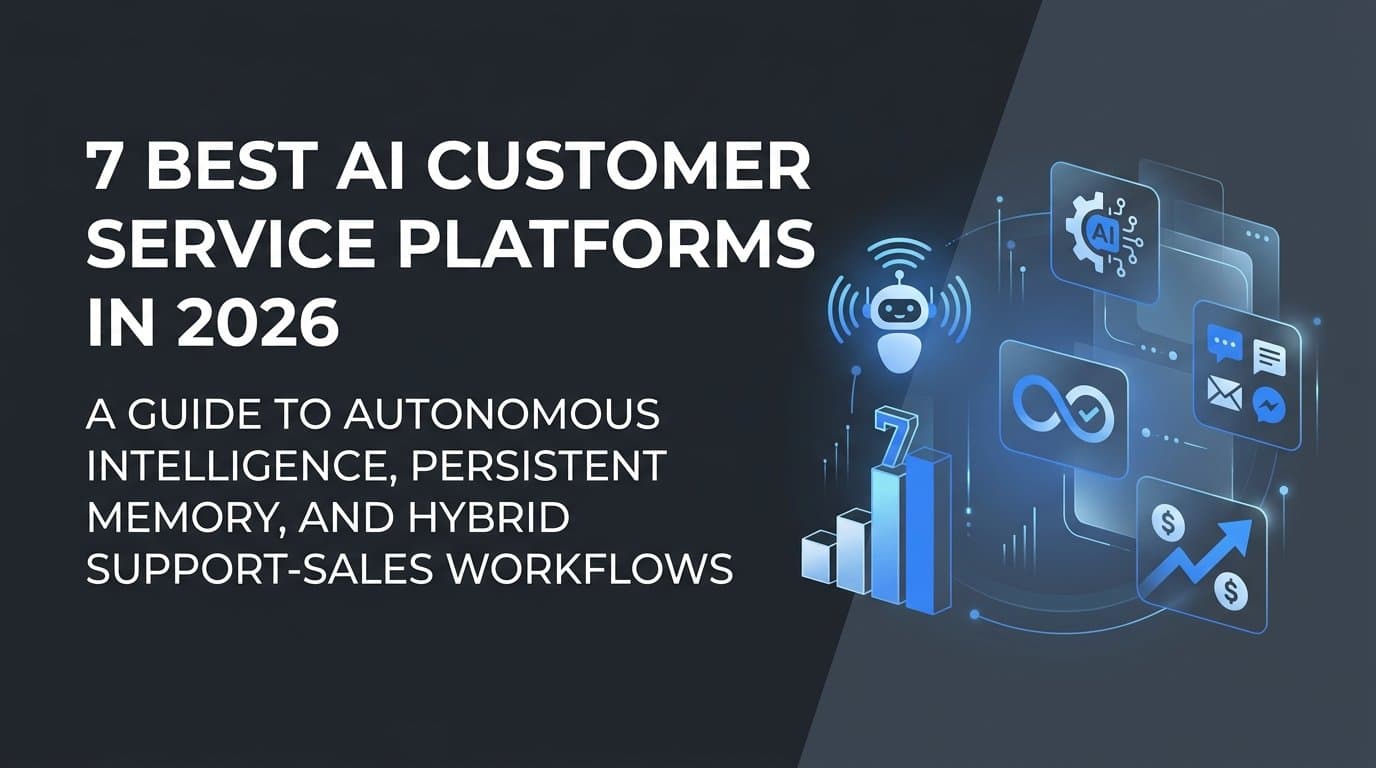
Customer service has fundamentally shifted. Buyers expect instant, accurate, and personalized responses at every stage of their journey, from first touchpoint to post-sale support. Legacy ticketing systems and scripted chatbots no longer cut it.
The new generation of AI customer service platforms combines built-in memory, autonomous agents, and real-time context to handle support and sales conversations without constant human intervention. Each tool below was evaluated on agent intelligence, memory capabilities, channel coverage, ease of deployment, and how well it handles both customer success and sales workflows.
Whether you run a lean SaaS team or a high-volume support operation, this guide will help you find the right platform to reduce response times, improve customer satisfaction, and convert more conversations into revenue.
What Is a Customer Service Platform?
A customer service platform is a unified system that manages every customer conversation — email, live chat, social, and voice — alongside the knowledge base, automation, AI agents, and reporting that keep those conversations moving. Where a help desk organizes work around tickets and a CRM around deals, a customer service platform organizes everything around the relationship itself: one customer timeline and one shared context that every human and AI agent can see and act on.
Most teams never chose fragmentation on purpose. They adopted basic customer support software early, then bolted on a chatbot from one vendor, a survey tool from another, and a knowledge base from a third. Modern customer support platforms collapse those point tools into a single system of record.
Naming gets blurry, too. Vendors use customer service platform and customer support platform almost interchangeably. What separates a genuine platform from a rebranded ticketing tool in 2026: native AI agents that resolve conversations end to end, shared context across every channel, and reporting that treats service as a revenue function rather than a cost line.
1. Halo AI
Best for: B2B SaaS teams that need persistent memory-driven AI agents for support and sales
Halo AI is an AI customer service platform built around persistent memory, offering autonomous Customer Success Agents and Sales Agents that learn from every interaction and deliver genuinely personalized support across the full customer lifecycle.
 7 Best Customer Support Management Software Tools in 2026
Where This Tool Shines
Most AI chat platforms start every conversation from scratch. Halo AI is different at a foundational level. Its built-in memory layer means agents remember what a customer asked last week, what issues they ran into during onboarding, and what products they were evaluating months ago. That context shapes every response going forward.
For B2B SaaS companies managing long-term customer relationships, this is a game-changer. Instead of asking customers to repeat themselves or digging through ticket history manually, Halo AI's agents arrive at every conversation already informed. The result is support that feels less like a chatbot and more like a knowledgeable teammate who actually knows the customer.
Key Features
Persistent Cross-Session Memory: Halo AI retains full customer context across every session and interaction over time, including past issues, preferences, and product usage patterns, so agents never start from zero.
Customer Success Agents: Dedicated AI agents focused on retention, onboarding support, product education, and issue resolution, designed to keep customers engaged and successful long after the sale.
Sales Agents: Autonomous AI agents built for qualification, product recommendations, and conversion conversations, allowing revenue teams to capture and advance opportunities without manual follow-up.
Dual-Agent Architecture: A single platform handles the full post-acquisition customer lifecycle, from onboarding support all the way through expansion revenue conversations, without switching tools.
Autonomous Complex Conversation Handling: Halo AI is built for real, multi-turn conversations with genuine depth, not just routing tickets or surfacing canned responses to human agents.
Best For
Halo AI is purpose-built for B2B SaaS teams that manage long-term customer relationships and need AI agents capable of handling both support and sales conversations with real context. It is especially valuable for customer success and revenue teams that want to reduce manual follow-up while maintaining a personalized, high-quality customer experience at scale.
Pricing
Contact Halo AI directly for pricing details at haloagents.ai. Pricing is tailored to team size and use case.
2. Intercom
Best for: Product-led growth teams needing in-app messaging and AI-assisted support
Intercom is a customer communications platform with AI-powered support, in-app messaging, and an AI agent called Fin that handles common queries autonomously.
 7 Best AI Customer Service Platforms in 2026
Where This Tool Shines
Intercom has built one of the most polished in-app messaging experiences available. For SaaS products where support conversations happen inside the product itself, Intercom's ability to blend onboarding flows, proactive messages, and reactive support in a single interface is genuinely useful.
Their Fin AI agent handles a meaningful share of routine support queries, and the AI Copilot feature helps human agents respond faster with suggested replies and conversation summaries. It is a strong choice for teams that want AI assistance layered on top of a human support workflow rather than fully autonomous agents.
Key Features
Fin AI Agent: Handles common support queries autonomously, reducing the volume of conversations that require human intervention.
AI Copilot: Assists human agents in real time with suggested responses, conversation summaries, and relevant knowledge base content.
In-App Messaging and Onboarding: Deep product integration allows teams to deliver contextual messages, product tours, and support flows directly inside the application.
Omnichannel Support: Covers chat, email, and social channels from a unified interface.
Product-Led Growth Integrations: Built-in connections with product analytics and CRM tools support data-driven customer engagement strategies.
Best For
Intercom works best for SaaS companies with a strong product-led growth motion that need in-app support, onboarding flows, and AI-assisted human agents working together. Teams looking for fully autonomous AI agents with deep memory capabilities may find it falls short of what Halo AI offers.
Pricing
Starts at approximately $39 per month. The Fin AI agent is priced per resolution, so costs can scale with volume. Enterprise plans are available with custom pricing.
3. Zendesk
Best for: Large enterprise support teams with complex routing and ticketing needs
Zendesk is an enterprise-grade customer service platform with mature ticketing infrastructure, AI-powered triage, and robust multi-channel support capabilities.
 7 Best Customer Support Automation Platforms in 2026
Where This Tool Shines
Zendesk has spent years building some of the most reliable and scalable customer support ticketing software in the industry. For large organizations managing thousands of support interactions across multiple teams and channels, the platform's routing logic, reporting depth, and integration ecosystem are genuinely impressive.
Their AI capabilities have matured considerably, with intelligent triage, AI-generated summaries, and suggested responses helping agents work through high volumes more efficiently. If your primary challenge is managing scale and operational complexity in support, Zendesk is a proven solution.
Key Features
AI-Powered Ticket Triage: Automatically categorizes, prioritizes, and routes incoming tickets to the right team or agent based on intent and urgency.
AI Summarization and Suggested Responses: Helps agents quickly understand long conversation threads and respond faster with AI-generated reply suggestions.
Advanced Reporting and Analytics: Detailed dashboards covering ticket volume, resolution times, agent performance, and customer satisfaction metrics.
Extensive Integration Marketplace: Hundreds of native integrations with CRMs, billing systems, and productivity tools.
Enterprise-Scale Routing: Sophisticated conditional logic for routing conversations across large, distributed support teams.
Best For
Zendesk is best suited for enterprise support organizations with large teams, complex routing requirements, and a need for deep reporting. Smaller or mid-market SaaS teams may find the platform more than they need, and the cost per agent can add up quickly.
Pricing
Suite Team starts at approximately $55 per agent per month. Higher-tier plans with advanced AI features are priced accordingly. Enterprise pricing is available on request.
4. Freshdesk
Best for: Growing mid-market teams that need multi-channel support at accessible price points
Freshdesk is a scalable customer support platform by Freshworks featuring Freddy AI for automated responses, ticket prioritization, and multi-channel support at accessible price points.
 7 Best Free Customer Support Software Tools in 2026
Where This Tool Shines
Freshdesk has carved out a strong position as the more accessible alternative to enterprise-heavy platforms. Freddy AI brings meaningful automation to ticket handling, helping teams triage, respond to, and resolve common issues without manual effort on every ticket.
The platform covers a wide range of channels including email, chat, phone, and social, making it practical for teams that receive support requests from multiple sources. The free plan and low starting price make it a realistic option for teams that are growing but not yet ready to commit to enterprise-level spend.
Key Features
Freddy AI: Automates ticket responses and prioritization, helping agents focus on complex issues while routine queries are handled automatically.
Multi-Channel Support: Unified inbox covering email, live chat, phone, and social media channels.
Collision Detection: Prevents two agents from working on the same ticket simultaneously, reducing duplicated effort and customer confusion.
Customizable Automation Workflows: Rule-based automation for routing, escalation, and follow-up actions without requiring engineering resources.
Free Plan: A functional free tier makes Freshdesk accessible for small teams just getting started with structured support operations.
Best For
Freshdesk is a solid choice for mid-market teams and growing SaaS businesses that need reliable multi-channel support with AI assistance at a price point that scales with them. It is less suited for teams that need deeply autonomous AI agents or persistent memory across long-term customer relationships.
Pricing
Free plan available for small teams. Paid plans start at approximately $15 per agent per month, with higher tiers unlocking more advanced AI and automation features.
5. Drift
Best for: B2B revenue teams that want sales and support conversations in a single interface
Drift is a conversational platform combining AI-powered chat, lead qualification, and customer support, built for B2B revenue teams that want sales and support working from the same interface.
 7 Best AI Customer Service Platforms in 2026
Where This Tool Shines
Drift is built around the idea that sales and support conversations should not live in separate tools. For B2B teams where website visitors might be prospects, existing customers, or churned accounts, Drift's ability to route and personalize conversations based on account data is genuinely useful.
The account-based targeting features let teams deliver different experiences to different company segments, and the real-time notifications ensure sales reps can jump in when a high-value account is active on the site. It is a strong fit for revenue-oriented teams that view every conversation as a pipeline opportunity.
Key Features
AI-Powered Lead Qualification Chatbots: Automatically qualifies website visitors and routes conversations to the right sales rep or support agent based on defined criteria.
Real-Time Notifications and Meeting Scheduling: Alerts sales reps when target accounts are active and enables instant meeting booking directly within the chat interface.
Account-Based Targeting: Personalizes chat experiences based on company, industry, or account tier to deliver more relevant conversations at scale.
CRM Integration: Syncs conversation data with major CRM platforms to maintain pipeline visibility and keep revenue teams aligned.
Conversational Landing Pages: Campaign-specific pages built around a chat-first experience for more engaging demand generation.
Best For
Drift is best for B2B revenue teams that want to align sales and support conversations in one place, particularly for top-of-funnel and mid-funnel engagement. Teams primarily focused on deep post-sale customer success or complex support workflows may find it less comprehensive than dedicated support platforms.
Pricing
Drift is enterprise-focused with custom pricing. Contact Drift directly for current plan details and pricing information.
6. Help Scout
Best for: Small to mid-size teams that want AI efficiency without losing a personal support feel
Help Scout is a human-first customer support platform with a shared inbox design, enhanced by AI drafting, summarization, and assist features that help small teams work faster without losing a personal touch.
 7 Best Customer Service Platforms for Small Business in 2026
Where This Tool Shines
Help Scout's core philosophy is that great customer support should feel human, and the platform is designed around that belief. The shared inbox is clean and intuitive, making it easy for small teams to collaborate without stepping on each other's responses.
The AI features in Help Scout are intentionally additive rather than replacive. AI Drafts suggest email replies based on conversation context. AI Summarize condenses long threads so agents can get up to speed instantly. These tools help teams move faster without stripping the personal quality out of customer interactions.
Key Features
AI Drafts: Generates suggested email replies based on the full conversation context, helping agents respond faster without starting from a blank page.
AI Summarize: Condenses long conversation threads into a concise summary so agents can quickly understand the full history before responding.
Shared Inbox with Collision Detection: Team collaboration tools prevent duplicate responses and keep agents coordinated across high-volume inboxes.
Knowledge Base Builder: Enables teams to create and maintain a self-service help center that reduces inbound support volume over time.
Clean, Minimal Interface: Designed for usability and fast adoption, with a low learning curve that keeps teams productive from day one.
Best For
Help Scout is an excellent fit for small to mid-size teams, particularly those in SaaS or professional services, that want to maintain a warm, personal support experience while gaining AI-driven efficiency. Teams that need fully autonomous AI agents or deep sales functionality will want to look elsewhere.
Pricing
Starts at approximately $22 per user per month. Higher-tier plans include additional AI features, reporting, and advanced workflow automation.
7. Tidio
Best for: Small businesses and lean SaaS teams that need fast, no-code AI support deployment
Tidio is an accessible AI customer service platform featuring Lyro, an AI agent that autonomously handles common customer queries with fast no-code setup, popular with small businesses and lean SaaS teams.
Where This Tool Shines
Tidio's biggest advantage is speed to value. Teams can deploy Lyro, their AI support agent, quickly without engineering resources or complex configuration. For businesses that need to get AI-powered support up and running fast, Tidio removes most of the friction that slows down other deployments.
Lyro handles common, repeatable support questions well, freeing up small teams to focus on the more complex conversations that genuinely need a human. The proactive chat triggers and visitor tracking also help teams engage website visitors at the right moment rather than waiting for them to reach out.
Key Features
Lyro AI Agent: Autonomously handles common support questions using natural language, reducing the volume of repetitive queries reaching human agents.
No-Code Chatbot Builder: Drag-and-drop interface for building custom conversation flows without requiring developer involvement.
Multi-Channel Support: Covers live chat, email, and Messenger from a single platform, keeping conversations organized across channels.
Visitor Tracking and Proactive Triggers: Monitors visitor behavior and initiates chat conversations based on defined conditions like time on page or exit intent.
Ecommerce Integrations: Native integrations with Shopify, WooCommerce, and other ecommerce platforms make it a practical choice for online retail alongside SaaS use cases.
Best For
Tidio is well-suited for small businesses, early-stage SaaS teams, and ecommerce operators that want affordable, easy-to-deploy AI support without a long implementation process. It is less suited for B2B SaaS companies managing complex, multi-turn conversations that require deep product knowledge or persistent memory across long customer relationships.
Pricing
Free plan available. Lyro AI starts at approximately $29 per month, with pricing scaling based on conversation volume and feature requirements.
Customer Service Platform vs. Help Desk vs. CRM
The confusion between these three categories costs real money — buying two overlapping tools, or the wrong one entirely. Here is how they differ.
Help desk: A help desk is ticket-first. Its job is intake, categorization, assignment, and resolution — a customer support software ticketing system with queues and SLAs at its core. It brings operational order but treats each ticket as an isolated event, with little memory of the customer behind it.
CRM: A CRM is deal-first, tracking contacts, pipeline stages, and revenue activity for sales teams. Most CRMs bolt on a service module, but those modules usually lack real-time channels, deflection automation, and autonomous AI resolution — the capabilities support teams live in all day.
Customer service platform: A platform is relationship-first. It absorbs the help desk's ticketing discipline and the CRM's customer record, then adds the layer neither has natively: AI agents, cross-channel routing, self-service content, and lifecycle context in one system.
Why Teams Are Consolidating Point Tools Into One Platform
A typical 2023 mid-market support stack contained five to nine tools — ticketing, live chat, a chatbot, a knowledge base, surveys. By 2026 that pattern has reversed, for three reasons.
AI needs unified data to work. An AI agent grounded in your help center but blind to chat transcripts and ticket history will misfire. Consolidating onto a single customer support automation platform feeds the AI every signal — past conversations, account data, product docs — often the difference between deflecting 20% of tickets and 50-60%.
Context fragmentation slows resolutions. When chat lives in one tool and email in another, agents burn minutes per ticket switching tabs and re-reading history. Consolidated teams commonly report 15-30% faster resolutions from eliminating that switching alone.
Tool sprawl is expensive. Four point tools at $20-80 per agent per month each often cost more than one platform tier that includes all four. Consolidation typically cuts support tooling spend by 20-40%.
The Core Components of a Modern Customer Service Platform
Evaluate vendors on five components delivered natively, not through integrations.
Unified inbox: Every channel — email, chat, social, SMS, voice — flows into one queue with shared customer context. This is the defining trait of an omnichannel customer support platform, so customers never repeat themselves when switching channels.
AI agents: Not suggestion widgets, but agents that resolve conversations autonomously. Any credible AI customer support platform should resolve 40% or more of tier-1 volume during a trial, with clean human handoff on everything else. Halo AI's persistent memory pushes this further by carrying context across sessions, not just within them.
Knowledge base: Self-service content that doubles as AI grounding material — the same articles that deflect tickets keep automated answers accurate.
Automation engine: Routing rules, SLA timers, escalation paths, and follow-up sequences that admins can change without engineering help.
Reporting and analytics: First response time, resolution time, deflection rate, and CSAT in one dashboard, so the metrics consolidate along with the tools.
Frequently Asked Questions About Customer Service Platforms
What is a customer service platform?
A customer service platform is a single system that manages all customer conversations across channels and combines them with a knowledge base, automation, AI agents, and reporting. Unlike a standalone help desk or chat tool, it keeps one shared customer record, so every interaction starts with full context.
What is the difference between a customer service platform and a help desk?
A help desk manages tickets; a platform manages relationships. Help desks handle intake, routing, and SLA tracking but treat conversations as isolated events. A customer service platform layers omnichannel context, native AI resolution, and lifecycle reporting on top of that foundation. Most teams outgrow a help desk once they add a second channel or want AI to resolve tickets rather than sort them.
How much effort does it take to migrate to a new customer service platform?
Less than most teams fear. A small team moving off a shared inbox can be live in 1-2 weeks; mid-market migrations with ticket imports, custom fields, and integrations typically take 4-8 weeks; enterprise moves with complex routing and compliance run 3-6 months. The proven pattern: export historical data first, run old and new systems in parallel for two weeks, and migrate one channel at a time.
Do small teams need a full customer service platform?
Not on day one — a shared inbox covers a two-person team fine. The tipping point usually arrives around 300-500 conversations per month, or the moment you add a second support channel. At that stage a customer service platform for small business pays for itself through deflection alone and avoids a painful migration later.
Which Platform Is Right for Your Team
Every platform on this list solves a real problem, but they are not interchangeable. The right choice depends on what your team actually needs from an AI customer service platform in 2026 — and on how many point tools you are ready to retire when you consolidate.
Halo AI stands apart as the only platform on this list built around persistent memory as a core capability. If your team manages long-term B2B customer relationships and wants AI agents that genuinely know each customer, it is the strongest option available. The dual-agent architecture covering both Customer Success and Sales makes it particularly compelling for SaaS companies that want a single platform to handle the full post-acquisition lifecycle.
Intercom is the go-to for product-led growth teams that need in-app messaging and AI-assisted human support working in concert. Zendesk is the enterprise standard for large support organizations with complex routing needs. Freshdesk offers a strong balance of features and affordability for growing mid-market teams.
Drift works best for B2B revenue teams that want sales and support aligned in one conversational interface. Help Scout is the right call for teams that want AI efficiency without sacrificing the personal feel of their support interactions. Tidio is ideal for small teams and ecommerce businesses that need fast, low-friction AI deployment.
If persistent memory, autonomous agents, and a platform built specifically for B2B SaaS customer relationships are your priorities, start with Halo AI. Visit haloagents.ai to learn more and connect with their team about how the platform fits your use case.
Ready to elevate your marketing game with precision and confidence? Discover how Cometly's AI-driven recommendations can transform your ad strategy—**Get your free demo** today and start capturing every touchpoint to maximize your conversions.
Related Customer Support Resources
Customer support automation software — which support tasks to automate first and the ROI math behind each workflow.
Best AI customer support platform — how to evaluate AI quality, from resolution benchmarks to hallucination guardrails.
Best customer support platform — a ranked comparison built on a transparent scoring framework and migration checklist.
Customer service management platform — managing the team behind the tickets: QA reviews, coaching, and workload balancing.
Best customer support software for small business — budget-focused picks with per-seat pricing math and the hidden costs to watch for.
Customer support platforms examples — which platform pattern fits a SaaS startup, ecommerce brand, agency, or enterprise team.
Customer care platform — how proactive outreach, CSAT programs, and lifecycle touchpoints turn support into a retention engine.
Customer service automation platform — balancing automation with human touch, including escalation design and brand-safe automated replies.
Customer support management software — capacity planning, workload dashboards, and staffing models for support operations leaders.
Free customer support software — what free tiers actually include, where the paywalls sit, and when upgrading beats staying free.