Customer support has changed fundamentally. Buyers expect instant, accurate, personalized responses at every stage of their journey, from first question to renewal. Legacy ticketing systems and scripted chatbots no longer cut it. The best customer support platforms today use AI with built-in memory, contextual awareness, and multi-agent workflows to handle everything from onboarding questions to upsell conversations.
This list covers the top platforms built for teams that want to move faster, resolve issues smarter, and turn support into a growth lever. Each tool was evaluated on AI capability, memory and context retention, agent specialization, integration depth, and real-world usability for B2B SaaS teams. Whether you are a startup scaling your first support function or an enterprise looking to replace a bloated helpdesk, this guide will help you find the right fit.
What Defines the Best Customer Support Platform in 2026?
The best customer support platform is the one that resolves the largest share of customer issues at the lowest cost per resolution without degrading the customer experience. In practice, that means four things working together: an AI agent that resolves tier-1 questions autonomously, a unified inbox for every channel, automation that removes repetitive triage work, and reporting that shows where time and money go. Modern customer support platforms bundle all of this into one system, replacing the patchwork of point tools most teams accumulated over the past decade.
The terminology here is famously messy. Vendors describe near-identical products as a help desk, an AI support agent, or a customer service platform depending on which buyer they are courting. Ignore the labels and ask three questions instead: Can the system resolve issues on its own? Does it retain customer context between conversations? Can it route what it cannot resolve to a human with full history attached?
The stakes in 2026 are higher than even two years ago. AI agents are table stakes: teams on a modern platform typically deflect 40-60% of tier-1 tickets automatically, so a team still hand-answering password resets is paying an inefficiency tax on every conversation. Choosing the best customer support platform is no longer a tooling decision; it is a cost-structure decision, which is why the broader customer support software market has consolidated around AI-first architectures.
1. Halo AI
Best for: B2B SaaS teams that need AI with persistent memory and specialized agents for success and sales.
Halo AI is an AI-native customer support platform built around persistent memory and specialized agents for customer success and sales conversations.
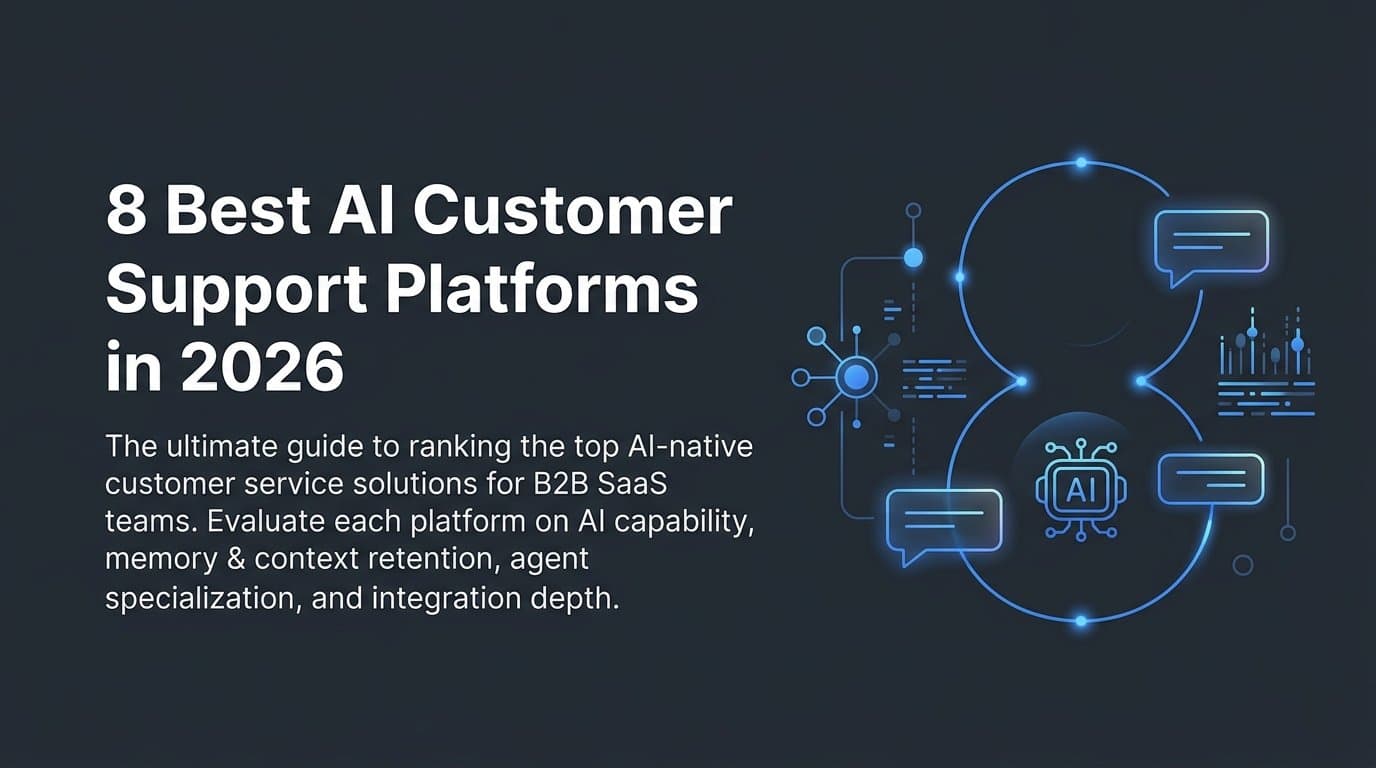
 8 Best AI Customer Support Platforms in 2026
Where This Tool Shines
Most AI support tools treat every conversation as a blank slate. A customer comes back a week later with a follow-up question, and the AI has no idea who they are or what was discussed. Halo AI solves this at the foundation level with a built-in memory system that retains customer context, history, preferences, and outcomes across every single session.
This changes the entire quality of the interaction. Instead of asking a customer to re-explain their situation, Halo AI can reference prior conversations, understand where the customer is in their lifecycle, and respond with genuine intelligence. It is the difference between a support experience that feels frustrating and one that feels like talking to someone who actually knows you.
Key Features
Built-In Persistent Memory: Halo AI stores and recalls customer history, preferences, prior issues, and outcomes across every interaction, eliminating the start-from-scratch experience common with other AI tools.
Customer Success Agents: Specialized AI agents designed for onboarding, adoption, and retention conversations that proactively surface relevant information based on where the customer is in their lifecycle.
Sales Agents: Dedicated AI agents trained to handle product questions, qualification, and upsell conversations, bridging the gap between support and revenue generation.
Multi-Agent Architecture: Different agent types handle different conversation intents automatically, so the right agent is always responding to the right question without manual routing.
Cross-Channel Context Retention: Memory persists whether a customer reaches out via chat, email, or another channel, so context is never lost between touchpoints.
Best For
Halo AI is the top choice for B2B SaaS companies that want AI support to feel genuinely intelligent rather than generic. It is particularly powerful for teams managing complex customer lifecycles where context from past conversations directly impacts onboarding, retention, and expansion outcomes.
Pricing
Contact Halo AI directly for pricing details via haloagents.ai. Custom plans are available based on team size and use case.
2. Intercom
Best for: Mid-market SaaS teams wanting a polished conversational inbox with strong AI automation and integrations.
Intercom is a conversational support platform with AI-assisted inbox, Fin AI agent, and a broad integration ecosystem for mid-market SaaS teams.
 8 Best AI Customer Support Platforms in 2026
Where This Tool Shines
Intercom has built one of the most recognizable support experiences in SaaS. Their Fin AI agent handles tier-1 queries autonomously, which means your human agents spend less time on repetitive questions and more time on complex issues that actually require judgment.
The shared inbox experience is clean and well-designed, and the AI copilot that assists human agents in real time is a genuine productivity booster. For teams that already live in a CRM-heavy workflow, Intercom's integration depth makes it easy to bring customer data into every conversation.
Key Features
Fin AI Agent: Handles tier-1 support queries autonomously, resolving common questions without human intervention.
AI Copilot for Agents: Assists human support reps in real time with suggested replies and relevant context during live conversations.
Proactive Messaging: Triggers outbound messages and product tours based on user behavior, turning support into a proactive touchpoint.
300+ Integrations: Connects with major CRM, billing, and analytics tools to bring full customer context into the support inbox.
Conversation Analytics: Detailed reporting on resolution rates, response times, and CSAT scores to track support performance over time.
Best For
Mid-market SaaS teams with dedicated support staff who want a polished, well-integrated platform. Intercom works best when teams can invest time in setup and want to combine proactive messaging with reactive support.
Pricing
Starts at approximately $39/month. Enterprise pricing is available for larger teams with more complex needs. Check the Intercom website for current plan details.
3. Zendesk
Best for: Enterprise support teams with complex workflows, omnichannel needs, and large agent headcounts.
Zendesk is the enterprise-grade helpdesk standard with omnichannel ticketing, AI-powered triage, and deep customization for large support operations.
 8 Best AI Customer Support Platforms in 2026
Where This Tool Shines
Zendesk has earned its reputation as the default choice for enterprise support. The platform handles high ticket volumes across multiple channels without breaking a sweat, and the SLA management tools give operations teams the control they need to maintain service standards at scale.
The AI capabilities have matured significantly, with automated ticket routing, auto-tagging, and agent suggestions that reduce manual triage work. For large teams with complex escalation paths and reporting requirements, Zendesk remains one of the most capable platforms available.
Key Features
AI-Powered Ticket Routing: Automatically tags and routes incoming tickets to the right team or agent based on content and intent.
Omnichannel Support: Unified inbox across email, live chat, phone, and social media channels for consistent customer experiences.
SLA Management: Advanced tools for setting, tracking, and reporting on service level agreements across different customer tiers.
Zendesk AI: Automated answers and real-time agent suggestions to speed up resolution without increasing headcount.
Extensive App Marketplace: Hundreds of integrations and apps to extend functionality across your existing tech stack.
Best For
Large enterprise teams with high ticket volumes, multiple support tiers, and complex reporting needs. Zendesk can feel heavy for smaller SaaS companies, but it is hard to beat for organizations that need serious customization and scalability.
Pricing
Starts at approximately $55/agent/month. Enterprise plans with advanced AI and customization are priced higher. Visit Zendesk's website for current pricing tiers.
4. Freshdesk
Best for: Growing SaaS teams that want a full-featured helpdesk with AI automation at an accessible price point.
Freshdesk is a full-featured helpdesk from Freshworks with Freddy AI for automated replies, routing, and self-service deflection at an accessible price point.
 8 Best AI Customer Support Platforms in 2026
Where This Tool Shines
Freshdesk hits a sweet spot between capability and affordability. Freddy AI handles a meaningful portion of incoming ticket volume through suggested replies, automatic categorization, and self-service deflection, which keeps resolution times down without requiring a large team.
The free plan makes it genuinely accessible for early-stage teams, and the upgrade path is smooth as volume grows. Collision detection, which prevents two agents from working the same ticket simultaneously, is a small but meaningful feature that saves real frustration on busy days.
Key Features
Freddy AI: Suggests replies, categorizes tickets automatically, and powers self-service deflection to reduce manual workload.
Omnichannel Inbox: Handles support across email, live chat, phone, and social channels from a single unified view.
AI-Powered Self-Service Portal: Customers can find answers independently through a searchable knowledge base, reducing inbound ticket volume.
Collision Detection: Alerts agents when another team member is already working on the same ticket to prevent duplicated effort.
Free Plan: A functional free tier makes Freshdesk accessible for small teams before they need to commit to a paid plan.
Best For
Growing SaaS teams that need solid AI automation and omnichannel support without the enterprise price tag. Freshdesk is a strong choice for teams transitioning from basic email support to a structured helpdesk workflow.
Pricing
Free plan available for small teams. Paid plans start at approximately $15/agent/month. Check Freshdesk's pricing page for the latest plan details.
5. Drift
Best for: B2B SaaS teams that want to combine real-time support with lead qualification in a single conversational platform.
Drift is a conversational platform that combines real-time chat, AI qualification, and support routing for B2B SaaS teams that want support and pipeline in one place.
 8 Best AI Customer Support Platforms in 2026
Where This Tool Shines
Drift occupies a unique position in this list because it blurs the line between support and sales. If your team handles a lot of inbound conversations that could go either direction, qualifying a prospect or resolving a customer issue, Drift's architecture is built for exactly that overlap.
The account-based targeting features let you personalize conversations based on who is visiting your site, which makes every interaction feel more relevant. The built-in meeting scheduling also removes friction from the handoff between a chat conversation and a live sales or success call.
Key Features
AI Chatbot for Qualification and Support: Handles real-time visitor qualification and support routing without requiring a human to be online.
Intelligent Live Chat Routing: Directs conversations to the right team member or department based on intent and context.
Built-In Meeting Scheduling: Lets prospects and customers book calls directly within the chat flow, removing handoff friction.
Account-Based Targeting: Personalizes conversations based on company, industry, or behavioral signals for more relevant interactions.
CRM Integration: Syncs conversation context with major CRM platforms so sales and support teams always have full history.
Best For
B2B SaaS teams where support and sales conversations frequently overlap. Drift works well when the same platform needs to handle inbound questions from both prospects and existing customers.
Pricing
Contact Drift for current pricing. Premium and enterprise plans are available depending on team size and feature requirements.
6. Help Scout
Best for: Small to mid-size SaaS teams that prioritize a clean, human-first support experience with practical AI assistance.
Help Scout is a human-first support platform with a clean shared inbox, AI draft suggestions, and a self-service Beacon widget built for small to mid-size SaaS teams.
 7 Best Customer Service Platforms for Small Business in 2026
Where This Tool Shines
Help Scout has always been the platform that support teams actually enjoy using. The interface is clean and intuitive, onboarding is fast, and the learning curve is minimal. For teams that have been burned by overly complex helpdesks, Help Scout feels like a breath of fresh air.
The AI-generated reply drafts speed up response times without making interactions feel robotic, because agents still review and personalize before sending. The Beacon widget for in-app self-service is well-executed and keeps customers from having to leave your product to get help.
Key Features
AI Reply Drafts: Generates suggested responses for agents to review and send, reducing time spent writing from scratch.
Beacon Widget: An in-app self-service tool that surfaces knowledge base articles and live chat without pulling customers out of your product.
Docs Knowledge Base: A well-designed self-service portal with AI-powered search to help customers find answers independently.
Customer Profiles: Full conversation history attached to each customer record so agents always have context before they reply.
Agent-Friendly Interface: One of the cleanest, most intuitive UIs in the support category, with minimal setup required.
Best For
Small to mid-size SaaS teams that want a reliable, well-designed support platform without heavy configuration. Help Scout is ideal for teams where agent experience and simplicity matter as much as raw feature count.
Pricing
Starts at approximately $20/user/month. Visit Help Scout's pricing page for current plan options and feature breakdowns.
7. Gorgias
Best for: High-volume support teams that need powerful automation rules and deep platform integrations to handle repetitive queries at scale.
Gorgias is a support platform with powerful automation rules and macros, built for teams handling high-volume, repetitive queries with deep platform integrations.
 8 Best AI Customer Support Platforms in 2026
Where This Tool Shines
Gorgias is built for speed and volume. If your team handles hundreds or thousands of similar questions every month, the macro and automation system can eliminate a significant portion of manual work. You define the rules once, and Gorgias handles the repetitive execution automatically.
The revenue statistics feature is a standout, giving teams visibility into the actual business impact of each support ticket. For SaaS teams that want to measure support as a revenue function rather than a cost center, this kind of data is genuinely useful for making the case internally.
Key Features
Automation Rules and Macros: Handles repetitive tickets automatically based on predefined rules, dramatically reducing manual agent workload.
Deep Platform Integrations: Native connections with Shopify, WooCommerce, and similar platforms bring order and customer data directly into the support view.
Unified Inbox: Consolidates email, chat, social, and SMS into a single workspace so agents never have to switch between tools.
Revenue Statistics per Ticket: Tracks the revenue impact of individual support conversations to help teams measure support as a business driver.
AI Auto-Responder: Automatically replies to common question types without agent involvement, reducing first response time.
Best For
Teams managing high volumes of repetitive support queries who want to automate as much as possible. Gorgias is a strong fit for SaaS companies with transactional support needs and a desire to tie support activity to revenue outcomes.
Pricing
Starts at approximately $10/month for small volumes, with pricing that scales based on ticket count. Check Gorgias's website for current tier details.
8. Tidio
Best for: Startups and small teams that need entry-level AI support with minimal setup time and a free starting point.
Tidio is an entry-level AI support platform featuring the Lyro AI chatbot that autonomously handles common questions with minimal setup for startups and small teams.
Where This Tool Shines
Tidio removes almost every barrier to getting AI support up and running. The Lyro AI chatbot can be deployed quickly and starts handling common questions almost immediately, which makes it genuinely useful for teams that do not have weeks to spend on configuration and training.
The visual flow builder gives non-technical team members the ability to build custom chatbot sequences without writing code. For early-stage SaaS companies that need basic AI deflection without a large investment or a long implementation timeline, Tidio delivers solid value.
Key Features
Lyro AI Chatbot: Autonomously handles tier-1 support questions based on your existing knowledge base with minimal setup required.
Live Chat Widget: Easy-to-install website widget that activates live chat for visitors who need human assistance.
Visual Flow Builder: Drag-and-drop interface for building custom chatbot conversation sequences without technical knowledge.
Email and Messenger Integration: Connects support across email and social messaging channels for a unified view of conversations.
Analytics Dashboard: Tracks conversation volume, resolution rates, and chatbot performance to help teams understand what is working.
Best For
Startups and small SaaS teams that are setting up their first AI support function. Tidio is the right choice when speed of deployment and low cost matter more than advanced features or deep customization.
Pricing
Free plan available. Lyro AI starts at approximately $29/month. Check Tidio's pricing page for current plan options as features and tiers evolve.
How We Ranked These Platforms: The Scoring Framework
Every listicle claims to have "evaluated" its tools. Here is exactly how we did it: five weighted criteria, tested against real support scenarios for a B2B SaaS team handling 1,000 to 5,000 monthly conversations. The weights reflect what actually moves cost per resolution in 2026.
AI capability (30%): The biggest driver of support economics. We scored autonomous resolution quality, memory across sessions, knowledge-base grounding, and handoff quality. If AI quality is your dominant criterion, our ranking of the best AI customer support platform options goes deeper on this dimension alone.
Channel coverage (20%): We checked whether email, live chat, social, and SMS land in one threaded view with shared customer context, or whether each channel is a bolted-on silo. A true omnichannel customer support platform earns full marks here.
Automation depth (20%): Beyond the AI agent, we measured rules, macros, auto-tagging, routing, and follow-up automation against one benchmark: can the platform eliminate at least 30% of manual agent actions within 90 days? Standalone customer support automation software exists precisely because many platforms are weak here; the best ones make a separate tool unnecessary.
Pricing transparency (15%): We rewarded published pricing and predictable per-seat or per-resolution costs, and penalized hidden AI credits, onboarding fees, and "contact sales" walls. We also checked how each entry tier stacks up against free customer support software, the realistic alternative for the smallest teams.
Time-to-value (15%): How long from signup to first AI-resolved ticket? Tidio and Freshdesk measured in hours, Halo AI and Intercom in days, Zendesk in weeks.
How the Scores Shook Out
Halo AI took the top spot on AI capability — persistent memory and specialized success and sales agents are structural advantages no competitor matched. Zendesk and Intercom scored well on channels and automation but gave back points on pricing transparency; Freshdesk was the most balanced mid-priced performer; Tidio won time-to-value outright. No platform scored perfectly on all five, which is why the "best" answer depends on your weighting, not ours.
Migration Checklist: Switching Platforms Without Losing History
The biggest hidden cost of a new platform is the switch itself. Teams that migrate carelessly lose ticket history, break automations, and watch CSAT dip for a quarter. Six steps prevent the most common failures.
Step 1 — Audit what you actually use: Export your rules, macros, tags, and saved views, then mark which ones fired in the last 90 days. Most teams find 50-70% of their configuration is dead weight that should not be migrated at all.
Step 2 — Map your data before exporting it: Match ticket fields, customer attributes, and conversation threads between systems before running any export. Unmapped fields are where history silently disappears.
Step 3 — Rebuild automations selectively: Recreate only your top ten rules by fire-frequency, then add others as need proves out. Teams moving to a dedicated customer support automation platform often find native AI replaces half their legacy rules outright.
Step 4 — Train the AI before cutover: Feed the new platform your knowledge base, canned replies, and six to twelve months of resolved conversations. An AI agent launched on an empty knowledge base underperforms for weeks.
Step 5 — Run in parallel for two weeks: Route 10-20% of new conversations through the new platform, then compare first response time, resolution rate, and escalation quality on identical traffic.
Step 6 — Cut over and measure: Migrate on your quietest weekday, keep read-only access to the old system for 90 days, and track baseline metrics weekly. A well-run migration recovers to baseline within two weeks and improves by week six.
Frequently Asked Questions About the Best Customer Support Platforms
What is the best customer support platform?
For B2B SaaS teams in 2026, Halo AI is the best customer support platform overall: its persistent memory and specialized customer success and sales agents produce measurably better resolutions than session-based AI tools. That said, "best" depends on your weighting — Zendesk leads for enterprise scale, Freshdesk for value, and Tidio for fastest deployment. Apply the five-criteria framework above to your own team before trusting any ranking, including this one.
How do you compare customer support platform vendors?
Build a weighted scorecard before you take a single demo, then force every vendor through the same test: the same 10-15 real tickets from your queue, the same knowledge base import, the same escalation scenario. Score each platform 1-5 per criterion, multiply by your weights, and get total first-year cost in writing — including AI usage fees, onboarding charges, and required add-ons. The spread between sticker price and real first-year cost regularly exceeds 40%.
What should a trial evaluation checklist include?
Six items: import your real knowledge base, run 10-15 genuine tickets through the AI agent and grade every answer, trigger one deliberate escalation to test handoff quality, time the setup in hours, connect your two most important integrations, and have your least technical teammate complete a full workflow unassisted. Set a pass bar before the trial starts — for example, 80% accurate AI answers and setup under eight hours — so evidence makes the decision, not the slickest sales engineer.
How long does it take to switch to a new support platform?
Teams under ten agents typically migrate in one to two weeks; teams of 10-50 should plan four to eight weeks including a parallel-running period; enterprise migrations run three to six months. AI training is the step most teams underestimate: budget at least a week of grading and correcting AI answers before full cutover.
How much does a top-tier support platform cost?
Entry pricing in this list runs from free (Freshdesk, Tidio) to roughly $55/agent/month (Zendesk), with AI usage often billed on top — commonly around $0.99 per AI-resolved conversation. A realistic all-in budget for a ten-agent team is $500-1,500/month; enterprise deployments regularly exceed $5,000/month.
Which Platform Is Right for Your Team?
The right customer support platform depends on where your team is today and where you need to go. Here is a practical breakdown to help you decide.
If you are a B2B SaaS team that wants AI support to feel genuinely intelligent, Halo AI is the clear leader. The built-in persistent memory is what separates it from every other tool on this list. When your AI knows who a customer is, what they have asked before, what plan they are on, and where they are in their lifecycle, every interaction becomes faster and more effective. The specialized customer success and sales agents add another layer of intelligence that most platforms simply cannot match. For teams where context and continuity matter, Halo AI is the platform to evaluate first.
For mid-market teams with a strong integration ecosystem in place, Intercom offers a polished experience with solid AI automation. If you are running a large enterprise support operation with complex workflows and high ticket volumes, Zendesk is the proven standard. Growing teams that need affordability alongside real AI capability will find Freshdesk hits the right balance.
Help Scout is the best fit for teams that prioritize simplicity and agent experience. Drift works well when support and sales conversations overlap significantly. Gorgias suits high-volume teams that want aggressive automation. And Tidio is the fastest path to AI deflection for startups just getting started.
The best next step is to book a demo with the tool that fits your situation most closely. Start with Halo AI if persistent memory and specialized agents align with your goals. Most platforms on this list offer trials or demos, so you can validate fit before committing. Run each contender through the trial evaluation checklist above and let the scores, not the sales pitch, make the call.
Ready to elevate your marketing game with precision and confidence? Discover how Cometly's AI-driven recommendations can transform your ad strategy. Get your free demo today and start capturing every touchpoint to maximize your conversions.
Related Customer Support Resources
AI customer support platform — how AI agents train on your docs, stay grounded, and escalate cleanly to humans.
Customer support software ticketing system — the full ticket lifecycle, from intake and categorization through SLAs and escalation.
Customer support ticketing software — the ticketing metrics that matter, with target benchmarks for response and resolution times.
Customer service management platform — managing the team behind the tickets: QA reviews, coaching, and workload balancing.
Customer service platform for small business — picks for small teams that need setup in a day without a dedicated admin.
Best customer support software for small business — budget-focused comparisons with worked per-seat and total-cost math.
Customer support platforms examples — which platform pattern fits a SaaS startup, an ecommerce brand, or an enterprise team.
Customer care platform — how proactive care differs from reactive support, plus CSAT, NPS, and retention plays.
Customer service automation platform — which service moments to automate versus keep human, and how to design escalations.
Customer support management software — capacity planning, staffing models, and the ops dashboards support leaders rely on.