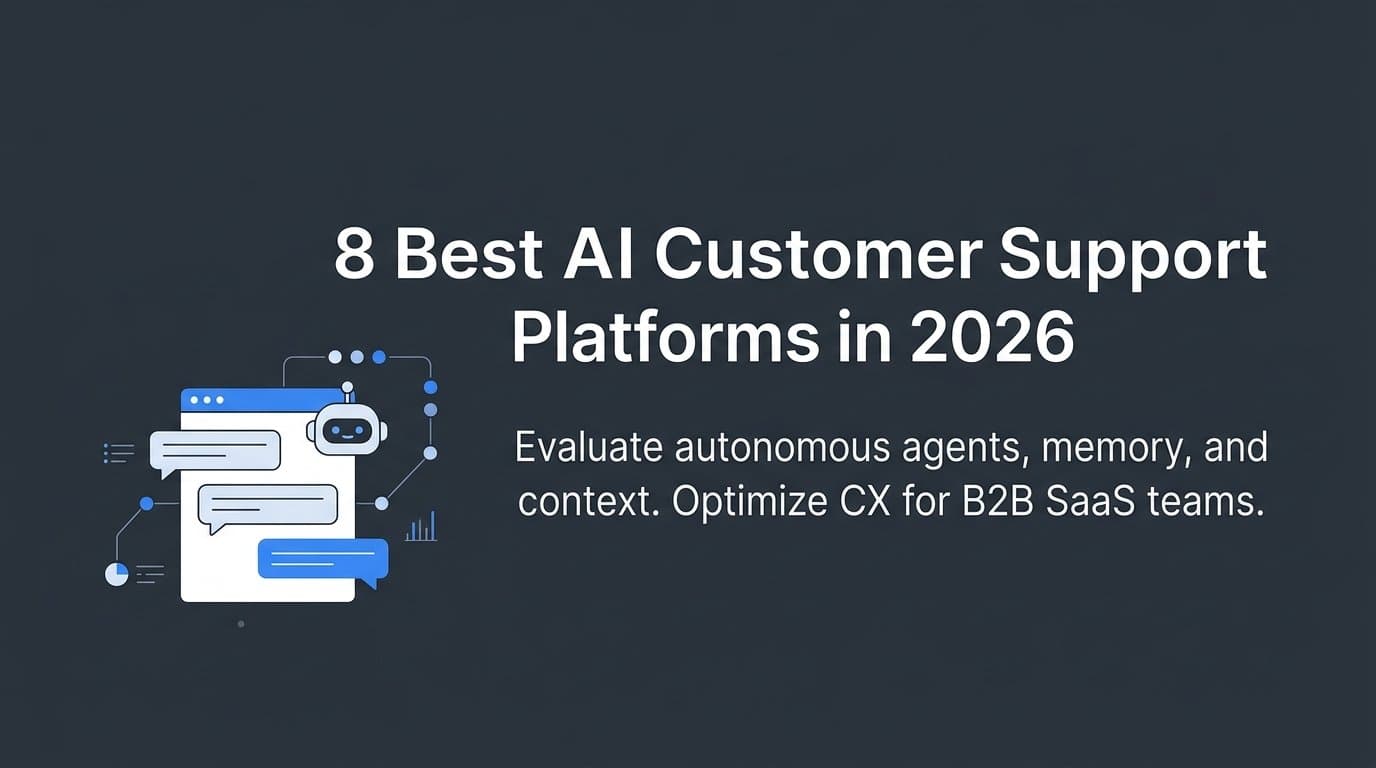
AI customer support has evolved far beyond scripted chatbots and basic ticket deflection. The best platforms in 2026 handle nuanced conversations, retain context across sessions, and operate as fully autonomous agents across support, success, and sales functions. For B2B SaaS teams managing complex customer relationships and high-volume pipelines, the right platform can meaningfully reduce resolution time, improve customer experience, and free your human team to focus on work that actually requires them.
This guide covers the top AI customer support platforms available today, evaluated on agent capabilities, memory and context retention, integrations, and overall value. Whether you are scaling your first support function or replacing a legacy helpdesk, there is a platform here suited to your needs.
We ranked Halo AI at the top because its built-in memory system and dual-agent architecture set a new standard for what AI customer support can actually do.
What Is an AI Customer Support Platform?
An AI customer support platform is software that uses large language models to understand customer questions, retrieve accurate answers from your company's knowledge, take actions like updating an account, and escalate to a human when a conversation exceeds its confidence. Traditional customer support software organizes conversations into queues for people to work through; an AI customer support platform works a meaningful share of that queue on its own. Teams running mature AI agents typically resolve 40–60% of tier-1 tickets without human involvement.
The category has split into two camps. AI-native products such as Halo AI were architected around autonomous agents from day one, with memory, grounding, and escalation built into the core. Legacy vendors instead retrofit AI onto a conventional customer service platform, which works but often limits how deeply the agent can act on customer data. Both approaches appear on this list.
Who needs one? Any team whose ticket volume grows faster than its headcount. Most customer support platforms now bundle some AI, but a true AI customer support platform is defined by three capabilities: it trains continuously on your docs and ticket history, it grounds every answer in verifiable sources, and it knows when to hand a conversation to a human. This guide evaluates eight tools against those criteria.
1. Halo AI
Best for: B2B SaaS teams that need persistent memory and autonomous agents across the full customer lifecycle.
Halo AI is a next-generation AI customer support platform built around persistent memory and a dual-agent architecture that covers both customer success and sales functions in a single platform.
 8 Best AI Customer Support Platforms in 2026
Where This Tool Shines
Most AI support tools treat every conversation as a fresh start. Halo AI is built differently. Its built-in memory system retains context across every customer interaction, meaning the agent remembers past conversations, prior issues, customer preferences, and account history without the customer ever having to repeat themselves. This is not a workaround or a bolt-on feature. It is structural to how Halo AI operates.
The result is a customer experience that feels more like talking to a knowledgeable team member than a scripted bot. For B2B SaaS companies where customer relationships span months or years, this distinction matters enormously. The memory layer directly reduces resolution time, improves customer satisfaction, and enables the AI to have genuinely informed conversations at every stage of the customer journey.
Key Features
Built-in Persistent Memory: The agent recalls prior conversations, customer details, and historical context across all sessions, eliminating the need for customers to re-explain their situation every time they reach out.
Customer Success Agents: Dedicated agents designed for post-sale support, onboarding guidance, product adoption tracking, and proactive retention conversations, all informed by full account history.
Sales Agents: Autonomous agents capable of qualifying inbound leads, answering product questions, and advancing early pipeline conversations without human intervention.
Dual-Agent Architecture: Both customer success and sales agent roles exist within a single platform, reducing tool sprawl and giving revenue teams a unified AI layer across the entire customer lifecycle.
Context-Aware Responses: Every response is shaped by the full history of the customer relationship, not just the current session, enabling more accurate, relevant, and personalized interactions at scale.
Best For
Halo AI is purpose-built for B2B SaaS companies where customer lifetime value depends on consistent, informed engagement. It is the strongest choice for teams that need both customer success and sales coverage from a single AI platform, and for any organization where context retention is a non-negotiable requirement.
Pricing
Contact Halo AI directly for current pricing details. Given the platform's dual-agent architecture and enterprise-grade memory capabilities, pricing is tailored to team size and use case.
2. Intercom Fin
Best for: Teams already in the Intercom ecosystem that want an LLM-powered AI agent with smooth human handoff.
Intercom Fin is Intercom's AI agent built on large language models, designed to resolve support queries by drawing on a company's knowledge base and handing off to human agents when needed.
 8 Best AI Customer Support Platforms in 2026
Where This Tool Shines
Fin integrates natively into Intercom's messenger and inbox, which means teams already using Intercom get meaningful AI capabilities without adding a new platform to their stack. Its LLM foundation allows it to handle a wide range of support queries with natural, conversational responses rather than rigid, scripted flows.
The handoff experience is one of Fin's strongest points. When a query exceeds what the AI can confidently resolve, it passes the conversation to a human agent with full context intact. For support teams that operate a blended model of AI and human agents, this transition is smooth and reliable.
Key Features
LLM-Powered Query Resolution: Fin draws on your knowledge base to answer support questions with contextually accurate, natural-language responses.
Smooth Human Handoff: Complex or sensitive queries are escalated to human agents without losing conversation context.
Native Intercom Integration: Deeply embedded in Intercom's messenger, inbox, and workflow tools for a unified support experience.
Multi-Channel Deployment: Supports web, mobile, and email channels from a single configuration.
Resolution Analytics: Dashboard tracking for AI resolution rates, deflection performance, and overall support efficiency.
Best For
Intercom Fin is best suited for teams already invested in the Intercom platform that want to layer in AI resolution without switching tools. It works well for SaaS companies with a well-maintained knowledge base and a blended support model.
Pricing
Fin is included in Intercom plans, with usage billed per resolution. Intercom plans start at approximately $39 per month, with Fin costs scaling based on volume.
3. Zendesk AI
Best for: Enterprise support teams with high ticket volume that need intelligent triage and agent assist built into their existing helpdesk.
Zendesk AI is the AI layer embedded across the Zendesk Suite, covering intelligent triage, agent assist, automated responses, and a self-service bot for large-scale support operations.
 8 Best AI Customer Support Platforms in 2026
Where This Tool Shines
Zendesk AI is not a standalone product. It is woven into the Zendesk Suite, which means teams get AI-powered capabilities without any separate integration or migration. For enterprise operations running thousands of tickets per day, the intelligent triage and routing features alone can deliver meaningful efficiency gains by ensuring tickets reach the right agent or team immediately.
If you're evaluating vendors, our AI product photo editor breakdown can help.
The agent assist functionality is particularly valuable for large support teams. AI-suggested replies help agents respond faster and more consistently, reducing variance in response quality across a distributed team. Combined with the self-service bot for deflecting common queries, Zendesk AI covers multiple layers of the support funnel simultaneously.
Key Features
Intelligent Triage and Routing: Automatically categorizes and routes tickets based on intent and sentiment, reducing manual sorting and misrouted tickets.
AI-Suggested Replies: Recommends responses to human agents based on ticket content and historical data, accelerating resolution without removing the human from the loop.
Self-Service Bot: Deflects common queries before they reach the agent queue, reducing overall ticket volume.
Native Suite Integration: AI features are built directly into Zendesk with no additional integration required.
Advanced Analytics: Tracks AI performance, resolution rates, and deflection metrics across the full support operation.
Best For
Zendesk AI is best suited for enterprise teams with complex routing needs, large agent pools, and high ticket volumes. It is a strong choice for organizations already on Zendesk that want to add AI capabilities without changing platforms.
Pricing
Zendesk Suite plans start at approximately $55 per agent per month. AI features are available on higher tiers. Contact Zendesk for enterprise pricing.
4. Freshdesk Freddy AI
Best for: Growing teams that want accessible AI support capabilities without enterprise-level pricing.
Freshdesk Freddy AI is Freshdesk's native AI layer that handles ticket summarization, suggested replies, and a self-service bot, making AI-powered support accessible for teams that are scaling but not yet at enterprise scale.
 8 Best AI Customer Support Platforms in 2026
Where This Tool Shines
Freddy AI's greatest strength is accessibility. It delivers a meaningful set of AI capabilities at a price point that growing teams can actually afford. Ticket summarization is a standout feature: agents can quickly understand the full context of a long or complex ticket without reading every message, which speeds up resolution and reduces cognitive load on support staff.
The no-code bot builder allows teams to create custom conversation flows without engineering resources, which is a significant advantage for smaller organizations that cannot dedicate developer time to support tooling. Freddy is more assistant-oriented than fully autonomous, which suits teams that want AI to augment their agents rather than replace them entirely.
Key Features
Ticket Summarization: Automatically generates concise summaries of long tickets so agents can get up to speed quickly before responding.
Suggested Replies: AI-generated response recommendations drawn from past tickets and the knowledge base.
Freddy Self Service Bot: Handles common queries autonomously before they reach the agent queue.
No-Code Bot Builder: Allows teams to design custom conversation flows without writing code.
Integrated Reporting: Tracks bot performance, deflection rates, and agent productivity in one dashboard.
Best For
Freshdesk Freddy AI is a strong fit for mid-sized SaaS teams and growing businesses that want AI-augmented support without the cost or complexity of enterprise platforms. It works best when AI is used to assist human agents rather than operate fully autonomously.
Pricing
Freddy AI features are available on Freshdesk Growth plans and above, starting at approximately $15 per agent per month. Pricing scales with plan tier and feature depth.
5. Drift (Salesloft)
Best for: Revenue teams that want AI-powered chat focused on lead qualification and pipeline acceleration.
Drift is a conversational AI platform with strong pipeline-focused features, now part of Salesloft, designed to qualify inbound leads, engage website visitors, and support revenue teams through AI-powered chat.
 8 Best AI Customer Support Platforms in 2026
Where This Tool Shines
Drift's core strength is at the top of the funnel. Its AI is optimized for engaging website visitors in real time, qualifying inbound interest, and routing high-value prospects to the right sales rep or booking a meeting directly in the conversation. For teams where the primary goal is pipeline generation rather than post-sale support, Drift delivers a focused and effective experience.
Following the Salesloft acquisition, Drift is increasingly positioned as part of a broader revenue platform, which means its CRM integrations and pipeline analytics have deepened. Teams using Salesforce or HubSpot will find the handoff between Drift conversations and CRM records relatively seamless.
Key Features
AI Lead Qualification Bots: Engages and qualifies inbound visitors automatically, routing high-intent prospects to the right rep or calendar.
Real-Time Visitor Engagement: Identifies and initiates conversations with target accounts visiting your site.
CRM Integrations: Native integrations with Salesforce and HubSpot for clean handoffs and record updates.
Meeting Booking in Chat: Allows prospects to book a meeting directly within the AI conversation without leaving the page.
Revenue Analytics: Reporting tied to pipeline creation and conversion outcomes rather than just support metrics.
Best For
Drift is best suited for sales-led SaaS companies that want AI to drive pipeline from inbound traffic. It is less specialized for post-sale customer support and works best as a complement to a dedicated support platform.
Pricing
Contact Drift or Salesloft for current pricing. Historically positioned for mid-market to enterprise buyers, with pricing reflecting that positioning.
6. Ada
Best for: Support teams that want full control over AI conversation design without requiring engineering resources.
Ada is a no-code AI agent builder that allows support teams to create automated conversation flows with action-taking capabilities, deployed across web, mobile, and messaging channels.
 8 Best AI Customer Support Platforms in 2026
Where This Tool Shines
Ada gives support teams an unusual level of control over how their AI agent behaves. The no-code visual builder lets teams design multi-step conversation flows, define escalation paths, and connect to backend systems for dynamic responses, all without writing a single line of code. For organizations that have specific conversation requirements or complex support workflows, this level of customization is genuinely valuable.
The action-taking capabilities set Ada apart from simpler chatbot tools. Rather than just answering questions, Ada agents can check order status, update records, trigger workflows, and perform other backend actions based on conversation context. This moves the platform from a deflection tool to a functional support layer.
Key Features
No-Code Visual Builder: Design multi-step AI conversation flows with a drag-and-drop interface, no engineering required.
Action-Based Automation: Agents can take real actions such as checking order status, updating records, and triggering downstream workflows.
Multi-Channel Deployment: Deploy across web, mobile app, SMS, and social messaging channels from a single configuration.
API Integration for Dynamic Responses: Connect to backend systems to pull real-time data into AI responses.
Conversation-Level Reporting: Detailed analytics on individual conversation performance and overall deflection outcomes.
Best For
Ada is well suited for mid-market and enterprise support teams that need customizable conversation design and action-taking capabilities without relying on developers. It is particularly strong for teams with complex, multi-step support workflows.
Pricing
Contact Ada for current pricing. The platform is positioned for mid-market and enterprise buyers, with pricing reflecting the depth of its customization and automation capabilities.
7. Tidio
Best for: Small businesses and early-stage SaaS teams that need fast, affordable AI support with minimal setup.
Tidio is an accessible AI customer support platform featuring Lyro AI, which handles support conversations autonomously with a simple setup process and pricing designed for smaller teams.
Where This Tool Shines
Tidio's defining advantage is speed to value. Lyro AI can be up and running in a short amount of time, handling support conversations autonomously without requiring extensive configuration or a large knowledge base to start. For early-stage teams that need AI support coverage quickly and cannot dedicate weeks to implementation, Tidio removes most of the friction.
The unified inbox consolidates live chat, email, and social messages in one place, which is a meaningful operational improvement for small teams managing multiple channels manually. Pre-built templates for common support scenarios further reduce setup time and allow teams to launch with a functional AI agent almost immediately.
Key Features
Lyro AI: Handles support conversations autonomously out of the box, with minimal configuration required to get started.
Fast Setup: Designed for quick deployment without extensive technical resources or a large pre-existing knowledge base.
Unified Inbox: Consolidates live chat, email, and social channel messages in a single interface.
Pre-Built Templates: Ready-made conversation templates for common support scenarios to accelerate deployment.
Affordable Pricing: Tiered pricing designed specifically for small businesses and early-stage teams.
Best For
Tidio is the right choice for small businesses, e-commerce teams, and early-stage SaaS companies that need functional AI support quickly and affordably. It is less suited for complex B2B support scenarios that require deep customization or persistent memory.
Pricing
A free plan is available. Paid plans start at approximately $29 per month. Lyro AI conversations are available as an add-on, with volume-based pricing.
8. Forethought
Best for: Operations-focused teams that want AI productivity gains without migrating away from their existing helpdesk.
Forethought is an AI platform built to work inside existing helpdesks, using AI to triage, tag, and resolve tickets without requiring teams to switch platforms.
Where This Tool Shines
Forethought's core value proposition is additive rather than disruptive. Rather than asking teams to replace their helpdesk, Forethought layers AI capabilities on top of tools like Zendesk and Salesforce Service Cloud. This makes it a low-friction option for enterprise teams that have significant investment in their existing support infrastructure and cannot justify a platform migration.
The AI triage system is particularly strong. Forethought automatically categorizes, prioritizes, and routes incoming tickets based on content and historical patterns, which reduces the manual sorting burden on support operations teams. The suggested response functionality draws from historical ticket data, meaning the AI improves over time as it processes more of your organization's support history.
Key Features
AI Triage: Automatically categorizes and prioritizes incoming tickets based on content, intent, and historical patterns.
Suggested Responses: AI-generated reply recommendations drawn from historical ticket data and your knowledge base.
Helpdesk Integration: Works natively within Zendesk, Salesforce, and other major helpdesks without requiring platform migration.
Autonomous Resolution: Handles common, repeatable support queries without human agent involvement.
Productivity Reporting: Tracks deflection rates, resolution times, and agent productivity improvements over time.
Best For
Forethought is best suited for mid-market and enterprise support teams with established helpdesk infrastructure who want AI-driven efficiency gains without the disruption of switching platforms.
Pricing
Contact Forethought for current pricing. The platform is designed for mid-market and enterprise buyers, with pricing tailored to ticket volume and integration requirements.
How AI Support Agents Actually Work: Training, Grounding, and Guardrails
Feature lists blur together in this category, so it helps to understand the machinery underneath. The gap between a flashy demo and the best AI customer support platform in production comes down to four things: what the agent learns from, how its answers stay grounded, how gracefully it hands off to humans, and whether you can measure its quality month over month.
How AI Agents Train on Your Docs and Ticket History
Modern AI agents do not learn the way most buyers assume. Rather than fine-tuning a model on your data, a customer support automation platform typically builds a retrieval index: help articles, product docs, and policy pages are chunked, converted into embeddings, and searched in real time whenever a customer asks a question. The model composes its answer using only the retrieved passages, which is why knowledge base hygiene is the single biggest predictor of AI performance — an agent reading stale docs gives confidently stale answers.
We compare the leading options in our AI product ad generator roundup.
Resolved ticket history is the second training source, and often the more valuable one: thousands of past conversations teach the agent how your team phrases answers and which edge cases recur. Platforms differ sharply here. Some ingest history once at setup, while others — Halo AI is the standout example — maintain a persistent memory layer that accumulates per-customer context with every interaction, so the agent gets smarter about individual accounts, not just your product.
Grounding and Guardrails: Keeping Answers Accurate
Grounding means the agent can only assert what it can trace to a source. Strong platforms enforce this with retrieval-augmented generation, source citations on answers, and confidence thresholds below which the agent declines to answer rather than improvise. The difference is measurable: tightly grounded agents hallucinate on well under 2% of responses, while an unconstrained model can fabricate details in 15–20% of complex answers.
Guardrails govern behavior beyond accuracy: restricted action scopes (the agent can issue a $50 credit but needs approval for $500), topic blocklists for legal and security questions, PII redaction, and brand-tone controls. During evaluation, red-team the agent deliberately — ask it about competitors, feed it ambiguous refund scenarios, and try to get it to promise features that do not exist. How a platform fails tells you more than how it succeeds.
Escalation to Humans: Designing the Handoff
Escalation is where deployments earn or lose customer trust. A well-designed customer service automation platform escalates on four triggers: low retrieval confidence, negative sentiment, an explicit request for a human, and high-stakes keywords such as cancellation, legal, or outage. The handoff should carry a structured summary of what was asked, what the AI tried, and what remains unresolved, so the human never asks the customer to repeat themselves.
Channel continuity matters just as much. If a conversation starts in chat and escalates to email, an omnichannel customer support platform preserves the full transcript and context across the switch. Set a hard target: escalations reach a human in under two minutes during business hours, with honest expectations when coverage is offline.
Measuring AI Resolution Quality Over Time
The headline metric is AI resolution rate — the share of conversations the agent closes without human help — but it is easy to game. An agent that prematurely marks tickets solved shows a great resolution rate and delivers a terrible experience. Pair it with reopen rate (AI-resolved conversations reopened within seven days should stay under 5%) and CSAT on AI-resolved tickets, which should sit within about 5 points of your human-agent CSAT. Your customer support ticketing software should tag AI-touched tickets automatically so these cohorts are easy to compare.
Quality also requires human auditing. High-performing teams sample 25–50 AI-resolved conversations per week, score them on accuracy, tone, and policy compliance, and feed every failure back into the knowledge base. Roll those scores into the dashboards your customer support management software already produces and review the trend monthly: resolution rate should climb quarter over quarter, and a plateau usually signals content gaps, not model limitations.
Frequently Asked Questions About AI Customer Support Platforms
What is an AI customer support platform?
An AI customer support platform is software that uses large language models to resolve customer inquiries autonomously. It reads questions in natural language, retrieves answers from your documentation and past tickets, takes actions such as checking an order, and escalates to human agents when its confidence is low. Mature deployments resolve 40–60% of tier-1 tickets with no human involvement.
How do AI customer support agents work?
Most use retrieval-augmented generation: help docs and resolved tickets are indexed as embeddings, the most relevant passages are retrieved for each question, and the model composes an answer grounded in those sources. The agent improves as documentation expands and audited failures get corrected — not because the model retrains on your conversations. Platforms with persistent memory, such as Halo AI, add per-customer context that accumulates across every interaction.
Is customer data safe with an AI customer support platform?
Reputable vendors are SOC 2 Type II certified, GDPR compliant, and contractually commit to never training foundation models on your customer data. Ask three questions before buying: whether PII is redacted before text reaches the model, where data is stored and for how long, and whether you can exclude specific fields or conversation types from AI processing entirely.
Will an AI customer support platform replace human agents?
In practice it augments far more than it replaces. AI absorbs the repetitive 40–60% of volume — password resets, order status, how-to questions — while humans handle escalations, edge cases, and high-value accounts. Most teams redeploy rather than cut: agents shift toward proactive success work, QA of AI conversations, and knowledge base curation, which is exactly what makes the AI better over time.
Which AI Customer Support Platform Is Right for You?
The platforms on this list cover a wide range of use cases, team sizes, and budget levels. Here is a quick-reference guide to help you match your needs to the right tool.
Choose Halo AI if you are a B2B SaaS team that needs persistent memory and autonomous agents across both customer success and sales functions. The built-in memory system is genuinely differentiated, and the dual-agent architecture means you are not cobbling together separate tools to cover the full customer lifecycle. For subscription businesses where long-term relationships drive revenue, Halo AI is the most purpose-built option on this list.
Choose Zendesk AI or Forethought if you are an enterprise team with high ticket volume and existing helpdesk infrastructure. Zendesk AI is the right call if you are already on Zendesk and want AI embedded natively. Forethought is the better choice if you want AI productivity gains without migrating away from your current platform.
Choose Intercom Fin if your team is already in the Intercom ecosystem and you want LLM-powered resolution with reliable human handoff. It is a natural extension of a platform many SaaS teams already rely on.
Choose Ada or Drift for specialized use cases. Ada is the strongest option for teams that need highly customizable conversation design and action-taking capabilities. Drift is the right fit for sales-led teams focused on pipeline generation from inbound traffic.
Choose Freshdesk Freddy AI or Tidio if you are scaling and budget-conscious. Freddy AI offers solid AI-assist capabilities at accessible pricing for growing teams. Tidio is the fastest path to functional AI support for small businesses and early-stage startups.
When evaluating any platform on this list, prioritize three criteria above all others: memory and context retention across sessions, flexibility in agent roles, and the depth of integration with your existing CRM and support stack. Feature counts are easy to inflate. What actually separates the best platforms is whether the AI behaves like it knows your customers, not just your knowledge base. Then run a two-week pilot on a narrow slice of tickets, measure resolution and reopen rates against the benchmarks above, and expand scope only as the numbers hold.
If you are also working to understand which marketing channels and campaigns are driving the customers your support team is now serving, Get your free demo of Cometly and see how AI-driven attribution connects every touchpoint from first ad click to closed-won revenue.
Related Customer Support Resources
Customer support platform — a comprehensive guide to the core components every platform needs, from shared inbox to reporting.
Best customer support platform — our ranked comparison with a scoring framework across AI capability, automation depth, and pricing.
Customer support software ticketing system — ticket lifecycle fundamentals, queues, SLAs, and tagging taxonomies explained.
Customer support automation software — which support tasks to automate first, the ROI math, and what should stay human.
Customer service management platform — tools for QA reviews, agent coaching, workload balancing, and performance reporting.
Customer service platform for small business — picks a small team can set up in a day without a dedicated admin.
Best customer support software for small business — budget-focused comparisons with worked per-seat pricing examples.
Customer support platforms examples — which platform pattern fits a SaaS startup, an ecommerce brand, or an enterprise team.
Customer care platform — how proactive outreach and CSAT programs turn support into a retention engine.
Free customer support software — what free tiers actually include, where the paywalls sit, and when upgrading beats free.