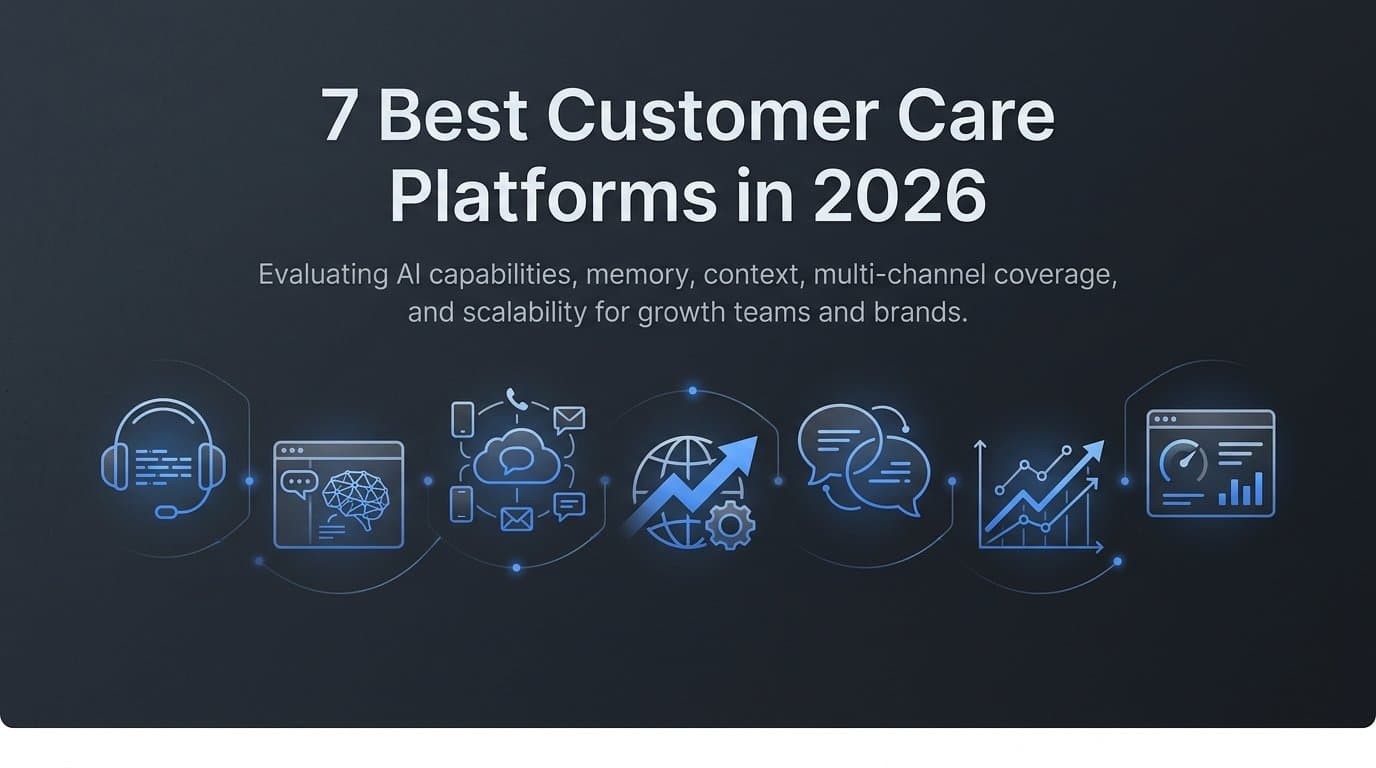
Customer care has shifted from a cost center to a competitive advantage. B2B SaaS companies, e-commerce brands, and growth teams are under pressure to deliver fast, personalized support at scale without ballooning headcount. The right customer care platform makes that possible by combining AI agents, persistent memory, and multi-channel coverage into a single system.
This list focuses on platforms that go beyond basic ticketing to deliver proactive, intelligent customer experiences. We evaluated each tool on AI capabilities, memory and context retention, agent specialization, ease of integration, and scalability. Whether you need a platform that handles customer success, converts inbound leads, or manages high-volume support queues, the options below represent the strongest choices available in 2026.
What Is a Customer Care Platform?
A customer care platform is software that manages the full relationship between a business and its customers, not just the moments when something breaks. A traditional customer support platform exists to receive problems and resolve them efficiently. A customer care platform adds the outbound half of the relationship: proactive check-ins, CSAT and NPS programs, lifecycle messaging, and retention workflows. Support tooling optimizes for closing tickets. Care tooling optimizes for keeping customers.
The difference matters more in 2026 than ever. AI agents now resolve the majority of routine tier-1 questions, so the reactive queue is no longer where a team earns its keep. Standout teams spend that freed-up capacity catching at-risk accounts before they churn and reaching out at the lifecycle moments that matter most: day-7 onboarding, first renewal, a sudden usage drop-off. A customer care platform makes that proactive posture operational rather than aspirational.
Who needs one? Any business where retention drives the economics: B2B SaaS with annual contracts, subscription e-commerce, agencies with repeat clients. The complication is that most customer support platforms now market themselves in care language, so the real buying challenge is separating genuine proactive capability from a reactive help desk wearing a new label.
1. Halo AI
Best for: AI-native teams that need persistent memory and specialized agent types for customer success and sales.
Halo AI is an AI-native customer care platform built around persistent memory and specialized agent types that deepen over time.
 7 Best Customer Care Platforms in 2026
Where This Tool Shines
Most AI chat tools treat every conversation as if it never happened before. Halo AI takes the opposite approach. Its built-in memory architecture builds a persistent profile for each customer that grows richer with every interaction, meaning the agent remembers prior issues, product preferences, onboarding friction points, and even communication style without requiring the customer to repeat themselves.
The second major differentiator is agent specialization. Halo AI offers two distinct agent types: Customer Success Agents focused on retention, onboarding, and proactive outreach, and Sales Agents focused on inbound qualification, product education, and conversion. These are not the same bot wearing a different hat. They behave differently, prioritize different outcomes, and engage customers in ways that match the stage of the relationship.
Key Features
Persistent Memory Architecture: Retains full customer context across every session, building a profile that deepens over time without manual configuration.
Customer Success Agents: Dedicated AI agents trained for retention, proactive outreach, and post-sale relationship management.
Sales Agents: Specialized AI agents that handle inbound qualification, answer product questions, and move prospects through the funnel autonomously.
Personalized Interactions at Scale: Conversations adapt based on what the agent already knows about the customer, creating genuinely human-feeling exchanges.
Smart Escalation: Identifies the right moment to hand off to a human agent, preserving context so the transition is seamless.
Best For
Halo AI is particularly well-suited for B2B SaaS companies where customer relationships are long-term and context-rich. If your team is spending significant time on repetitive customer success touchpoints or inbound qualification conversations, Halo AI's memory-driven agents can handle that volume while actually improving the quality of each interaction over time.
Pricing
Contact Halo AI directly for pricing details. Given the platform's enterprise-grade memory architecture and specialized agent capabilities, pricing is tailored to team size and use case.
2. Intercom
Best for: SaaS teams that want a mature conversational support platform with AI layered on top of existing help content.
Intercom is a conversational support platform with a mature messenger product and Fin AI agent built for SaaS customer communication.
 7 Best Customer Care Platforms in 2026
Where This Tool Shines
Intercom's Fin AI agent answers customer questions using your existing help center content, which means teams with well-maintained documentation can get meaningful deflection without building anything from scratch. The messenger product itself is one of the most polished in the market, handling chat, email, and in-app messaging from a unified inbox.
Intercom also excels at proactive engagement. Product tours, outbound messages triggered by user behavior, and in-app announcements give customer success and product teams tools to guide users before they ever submit a ticket.
Key Features
Fin AI Agent: Resolves customer questions automatically using your help center content as its knowledge base.
Unified Inbox: Consolidates chat, email, and in-app messaging into a single workspace for support teams.
Proactive Messaging: Trigger outbound messages and product tours based on user behavior and lifecycle stage.
Integration Ecosystem: Connects with a wide range of SaaS tools including CRMs, analytics platforms, and data warehouses.
Conversation Reporting: Detailed analytics on resolution rates, response times, and team performance.
Best For
Intercom is a strong fit for SaaS companies that already have a solid knowledge base and want AI to put it to work. Teams looking for proactive lifecycle messaging alongside reactive support will find the combination particularly useful.
Pricing
Plans start at approximately $39 per month. Pricing scales with usage volume and seat count, so larger teams should request a custom quote.
3. Zendesk
Best for: Enterprise support teams with complex routing needs, high ticket volume, and multi-channel operations.
Zendesk is an enterprise-grade customer care platform with omnichannel ticketing, advanced routing, and AI-assisted agent tools built for large support operations.
 8 Best AI Customer Support Platforms in 2026
Where This Tool Shines
Zendesk's core strength is workflow automation at scale. Its routing logic, SLA management, and custom triggers give operations teams precise control over how tickets move through the system. For organizations managing thousands of tickets per day across email, chat, voice, and social channels, that level of configurability is difficult to replicate elsewhere.
AI features have matured significantly, with agent assist tools that surface relevant articles, suggest responses, and auto-triage incoming tickets based on intent and sentiment. The reporting suite is equally robust, offering custom dashboards and deep analytics for support leadership.
Key Features
Omnichannel Support: Handles email, live chat, voice, and social media from a single platform with unified ticket history.
Advanced Routing and Automation: Complex workflow rules, skill-based routing, and SLA management for large team operations.
AI Agent Assist: Surfaces suggested replies, relevant knowledge base articles, and auto-triage recommendations in real time.
Custom Reporting: Build tailored dashboards and export detailed analytics for executive and operational reporting.
Third-Party Marketplace: Hundreds of integrations available through the Zendesk marketplace covering CRM, billing, and analytics tools.
Best For
Zendesk is the right choice for enterprise support teams and scaling companies with complex operational requirements. Smaller teams may find the setup and configuration overhead significant relative to simpler alternatives.
Pricing
Suite Team plans start at approximately $55 per agent per month. Enterprise plans with advanced AI and customization options are priced higher and available by request.
4. Freshdesk
Best for: Growing SaaS and SMB teams that want AI-assisted support with accessible pricing and easy setup.
Freshdesk is a full-featured help desk platform with Freddy AI built in, offering ticket automation, suggested replies, and collaboration tools at an accessible price point.
 7 Best Free Customer Support Software Tools in 2026
Where This Tool Shines
Freshdesk hits a practical sweet spot for teams that need solid AI assistance without the configuration complexity of enterprise platforms. Freddy AI handles suggested replies, ticket summarization, and automatic triage, reducing the manual overhead that slows down growing support teams. Setup is genuinely straightforward, which matters when you don't have a dedicated ops team to manage the rollout.
The collaborative inbox is another strength. Team notes, internal assignments, and shared ticket ownership make it easy for smaller teams to work together without stepping on each other's responses.
Key Features
Freddy AI: Powers suggested replies, ticket summarization, and automatic priority assignment to reduce agent workload.
Automated Ticket Triage: Routes and categorizes incoming tickets based on content, intent, and predefined rules.
Collaborative Inbox: Shared ticket ownership with internal notes and team assignments for coordinated responses.
Multi-Channel Support: Handles email, live chat, and phone from a unified workspace.
Self-Service Portal: Built-in knowledge base builder lets teams publish help articles and reduce inbound volume.
Best For
Freshdesk is ideal for growing companies and SMB teams that want meaningful AI capabilities without the cost or complexity of enterprise platforms. The free plan makes it accessible for early-stage teams testing their support workflow.
Pricing
A free plan is available for up to 10 agents. Paid plans start at approximately $15 per agent per month, with higher tiers unlocking advanced automation and analytics.
5. Drift
Best for: Revenue teams that want to blend inbound sales qualification with real-time conversational support on the website.
Drift is a conversational platform built at the intersection of sales and support, using AI chat to qualify website visitors and move them through the funnel in real time.
 7 Best Customer Care Platforms in 2026
Where This Tool Shines
Drift is less about traditional ticket management and more about converting website traffic into pipeline. Its AI-powered chat engages visitors based on behavior, firmographic data, and intent signals, routing high-value prospects directly to sales reps or booking meetings on their behalf. For teams running account-based strategies, that kind of intelligent routing is genuinely valuable.
The playbook system lets revenue teams define conversation flows for different visitor segments, ensuring that a first-time visitor from a target account gets a different experience than a returning customer looking for support.
Key Features
AI-Powered Visitor Qualification: Engages website visitors in real time based on behavior, intent, and firmographic signals.
Conversation Playbooks: Route conversations differently based on visitor segment, page context, and account status.
In-Chat Meeting Scheduling: Prospects can book time with a sales rep directly inside the chat window without leaving the page.
CRM and Marketing Automation Integration: Syncs conversation data with your CRM and marketing stack for full funnel visibility.
Revenue Reporting: Tracks chat-influenced pipeline and revenue to connect conversational activity to business outcomes.
Best For
Drift is best suited for B2B companies with a strong inbound motion where website traffic represents a meaningful source of pipeline. It complements rather than replaces a traditional help desk for post-sale support needs.
Pricing
Contact Drift directly for current pricing. Premium plans with advanced AI and account-based features are available for larger revenue teams.
6. Help Scout
Best for: Small teams and founder-led companies that want to deliver personal, human-feeling support with AI assistance.
Help Scout is an email-first customer support platform designed to feel human, with AI Summarize and Assist features that help small teams respond faster without losing their voice.
 7 Best Customer Service Platforms for Small Business in 2026
Where This Tool Shines
Help Scout is built around the idea that support should feel like a conversation between real people, not a ticket number exchange. The shared inbox is clean and intuitive, and the AI features are designed to assist rather than replace the human on the other end. AI Summarize condenses long threads into quick context, while AI Assist helps agents refine their draft replies before sending.
The Beacon widget brings help center content and chat directly into your product or website, giving customers a self-service option that feels native rather than bolted on.
Key Features
AI Summarize and Assist: Condenses long conversation threads and helps agents refine replies without changing their tone or voice.
Docs Knowledge Base: Built-in knowledge base for publishing help articles and reducing repetitive inbound questions.
Customer Profiles: Each contact includes full conversation history, giving agents immediate context without digging through old threads.
Beacon Widget: Embeds help center content and live chat directly into your product or website for in-context support.
Team Performance Reporting: Simple, clear reporting on response times, conversation volume, and customer satisfaction.
Best For
Help Scout is the right fit for small support teams, early-stage SaaS companies, and founder-led businesses that prioritize relationship quality over ticket throughput. It is not designed for high-volume automation at enterprise scale.
Pricing
Plans start at approximately $22 per user per month. Higher tiers include additional AI features, reporting depth, and team management tools.
7. Gorgias
Best for: E-commerce brands on Shopify, BigCommerce, or WooCommerce that need order-aware support and AI auto-reply at high volume.
Gorgias is a customer care platform purpose-built for e-commerce brands, with deep Shopify integration and AI auto-reply for high-volume order-related support.
 7 Best Customer Care Platforms in 2026
Where This Tool Shines
Gorgias solves a specific and common e-commerce problem: agents wasting time switching between their support inbox and their Shopify admin to look up order details. With Gorgias, order data, shipping status, and return eligibility appear directly inside each support ticket. Agents can trigger refunds, edit orders, and manage returns without leaving the platform.
The AI auto-reply feature handles the most common order-related questions automatically, including order status, tracking links, and return initiation. For high-volume brands where a significant portion of tickets are variations of the same question, that deflection adds up quickly.
Key Features
Deep E-Commerce Integrations: Native connections to Shopify, BigCommerce, and WooCommerce with order data visible inside every ticket.
AI Auto-Reply: Automatically resolves common questions about order status, tracking, and returns without agent involvement.
In-Ticket Order Actions: Agents can trigger refunds, edit orders, and manage returns directly from the support interface.
Revenue Attribution: Tracks revenue influenced by support interactions to connect customer care activity to business outcomes.
Multi-Store Management: Manage support across multiple storefronts from a single Gorgias dashboard.
Best For
Gorgias is the clear choice for e-commerce brands running on major platforms who need order-aware support at scale. It is less relevant for pure SaaS companies or businesses without a transactional commerce component.
Pricing
Plans start at approximately $10 per month for up to 50 tickets. Pricing scales with ticket volume, making it accessible for growing brands at any stage.
Care vs. Support: What Actually Changes When You Make the Shift
Every tool on this list can operate as a conventional customer service platform, receiving inbound questions and resolving them. The real gap shows up in what happens when no ticket exists. Four capabilities separate a care operation from a support desk.
Proactive Outreach Replaces Waiting for Tickets
Only about 1 in 26 unhappy customers actually complains; the rest quietly leave. A care-oriented team monitors usage, billing events, and sentiment signals, then starts the conversation before frustration converts to churn. This is where an AI customer support platform with persistent memory earns its cost: Halo AI's Customer Success Agents run onboarding check-ins and renewal-window outreach automatically, informed by each account's full history.
CSAT and NPS Become Operating Metrics, Not Report Decorations
Most teams collect satisfaction scores; few operationalize them. A care program treats CSAT and NPS as triggers: a CSAT response below 3 out of 5 opens a follow-up task within 24 hours, and an NPS detractor at a high-value account alerts a human instead of landing in a spreadsheet. Aim for CSAT of 75-85% and a relationship NPS above 30. The platform's job is closing that loop automatically.
Lifecycle Touchpoints Protect Revenue at Predictable Moments
Churn rarely surprises anyone who is watching. It clusters at predictable points: the first 30 days, seat renewals, price changes, and champion turnover. A care platform maps outreach to those moments with a welcome sequence, a 30-day value review, and a health check 60 days before renewal. Consistency across channels matters here, too: an omnichannel customer support platform keeps the renewal email, the in-app message, and the chat thread working from the same customer context.
Support Shifts From Cost Center to Revenue Protector
Acquiring a new customer costs five to 25 times more than retaining an existing one, and a 5% improvement in retention can lift profits by 25% or more. If your care program touches $2M in annual renewals and improves gross retention by three points, that is $60,000 in protected ARR, usually several times the cost of the platform running it. Gorgias and Halo AI both make this explicit by attributing revenue to care interactions — exactly the reporting a support leader needs to defend the budget.
How to Measure Customer Care Quality
Most customer support software reports on speed: first response time, resolution time, tickets closed per agent. Speed still matters, but care quality needs a second scoreboard. Five metrics belong on it.
CSAT: The percentage of interactions rated positively. Target 80% or higher, and track AI-handled and human-handled conversations separately. A gap wider than 10 points means your automation needs work.
Relationship NPS: Surveyed quarterly across the whole customer base, not just after tickets. B2B SaaS medians sit around 25-30; above 40 is exceptional.
Customer Effort Score: How hard was it to get help? Effort predicts loyalty better than delight. Keep the average under 2 on a 5-point scale.
Proactive contact ratio: The share of conversations your team initiates. Pure support desks sit near zero; mature care operations start 20-30% of all customer contact.
Care-influenced retention: Gross revenue retention among accounts that received proactive touchpoints versus those that did not.
One prerequisite: none of this is measurable while your team is drowning in tier-1 volume. Pair the care program with a customer support automation platform to clear the reactive queue first.
Frequently Asked Questions About Customer Care Platforms
What is a customer care platform?
A customer care platform combines reactive support tools (shared inbox, ticketing, AI answers) with proactive relationship management: outreach triggered by lifecycle events, CSAT and NPS programs with closed-loop follow-up, and retention reporting. It is the difference between a system that waits for customers to report problems and one that works to prevent them.
What is the difference between customer care, support, and success?
Customer support is reactive: a customer reports an issue and the team resolves it, measured in response and resolution times. Customer success is account-based: named CSMs own revenue outcomes for high-value accounts, measured in net revenue retention. Customer care sits between them, applying success-style attention across the entire customer base at scale, using AI and automation where a dedicated human CSM would be uneconomical.
How do you measure customer care quality?
Track five numbers monthly: CSAT (target 80%+), relationship NPS (30+ is strong for B2B), Customer Effort Score (under 2 on a 5-point scale), proactive contact ratio (20-30% of conversations started by your team), and gross revenue retention for accounts receiving care touchpoints. Always segment AI-handled versus human-handled interactions, because averages hide automation failures.
Can AI handle customer care, or only support tickets?
Both, at different maturity levels. Reactive resolution is proven: a customer service automation platform reliably deflects 40-60% of routine tickets. Proactive care is newer but advancing fast: memory-based agents can run onboarding check-ins and renewal reminders autonomously. The safe pattern is AI-initiated, human-escalated: let AI start the proactive conversation and route anything involving money, contracts, or visible frustration to a person.
Choosing the Right Customer Care Platform for Your Team
The best customer care platform depends entirely on what your business actually needs. There is no universal winner, but there are clear patterns that point to the right fit.
If you want AI that genuinely knows your customers: Start with Halo AI. Its persistent memory architecture and specialized agent types represent a meaningful step forward from stateless chatbots. For B2B SaaS teams managing long-term customer relationships, the combination of Customer Success Agents and Sales Agents can replace significant manual effort while improving the quality of every interaction.
If you run a large enterprise support operation: Zendesk's routing logic, omnichannel coverage, and reporting depth are hard to match at scale. The setup investment pays off when ticket volume and team complexity justify it.
If you are a SaaS team already invested in conversational support: Intercom's Fin AI agent is worth exploring if you have a well-maintained knowledge base. The proactive messaging capabilities add genuine value for lifecycle-driven teams.
If you run an e-commerce brand: Gorgias is purpose-built for your workflow. The Shopify integration alone eliminates enough context-switching to make the decision straightforward.
If you are a small team that values relationship quality: Help Scout keeps support feeling human while AI Assist helps you move faster.
Before committing to any platform, define what success looks like. Is it ticket deflection rate? Time to resolution? Revenue influenced by support? Knowing your metric makes it easier to evaluate trial results honestly and choose with confidence. If care is the goal, weight retention and CSAT movement more heavily than raw ticket throughput; these platforms differ far more on the proactive side than the reactive one.
Ready to elevate your marketing game with precision and confidence? Discover how Cometly's AI-driven recommendations can transform your ad strategy. Get your free demo today and start capturing every touchpoint to maximize your conversions.
Related Customer Support Resources
Best customer support platform — a ranked comparison with a transparent scoring framework and migration checklist.
Best AI customer support platform — how to evaluate AI answer quality, hallucination guardrails, and human handoff before rollout.
Customer support automation software — which support tasks to automate, the ROI math, and what should stay human.
Customer support software ticketing system — ticket lifecycle fundamentals, queues, SLAs, and tagging taxonomies.
Customer support ticketing software — the ticketing metrics that matter, with target benchmarks for each.
Customer service management platform — QA reviews, agent coaching, workload balancing, and performance reporting.
Customer support management software — capacity planning, staffing models, and the dashboards support leaders rely on.
Customer service platform for small business — picks that set up in a day without a dedicated admin.
Best customer support software for small business — total cost of ownership math and the hidden fees to watch for.
Customer support platforms examples — which platform pattern fits a SaaS startup, an ecommerce brand, an agency, or an enterprise team.
Free customer support software — what free tiers really include, where the limits bite, and when upgrading beats staying free.