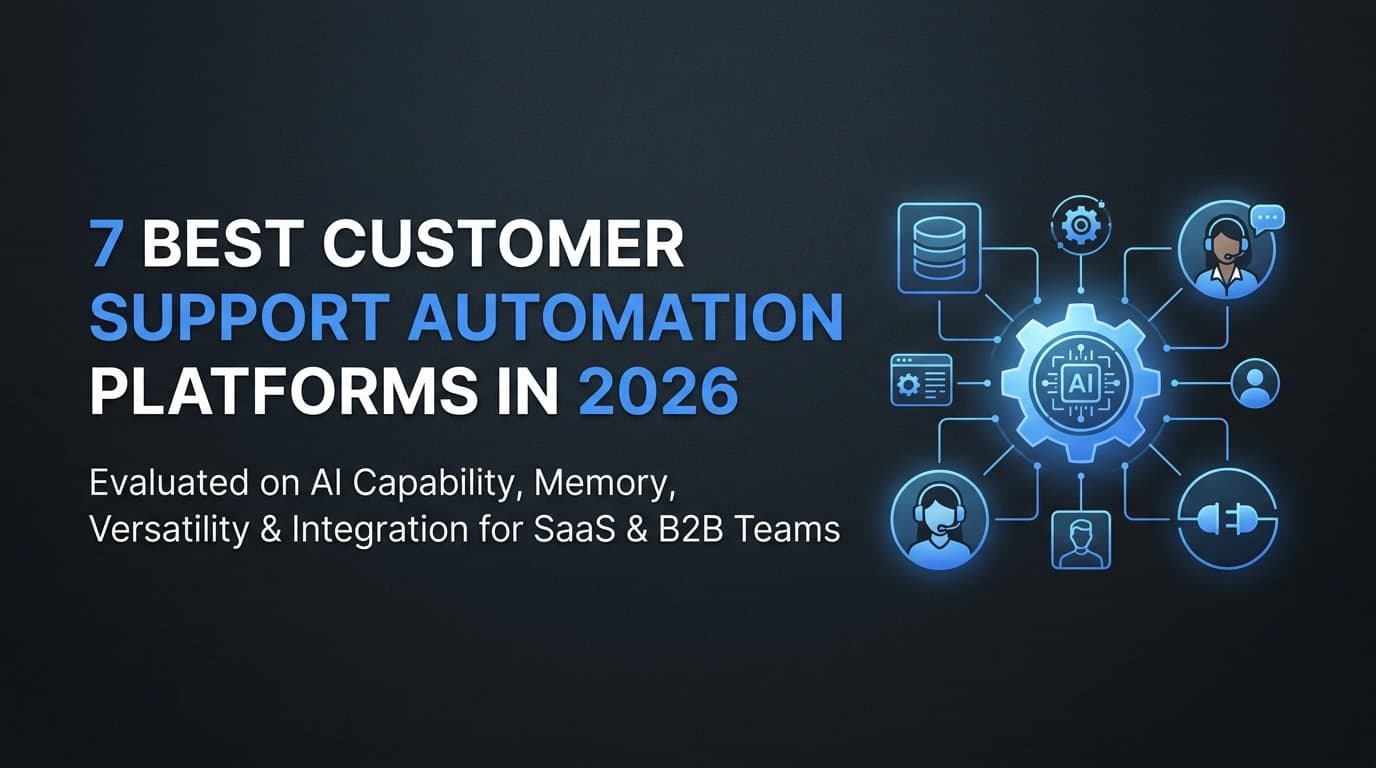
Customer support automation has shifted from a nice-to-have to a competitive necessity for fast-growing SaaS businesses. The right platform can handle repetitive queries at scale, retain customers proactively, and free your human team to focus on high-value conversations. But not all platforms are built the same.
Some excel at reactive ticket deflection. Others bring persistent memory, proactive sales outreach, and full customer lifecycle coverage into a single agent layer. This list covers the best customer support automation platforms available in 2026, evaluated on AI capability, memory and context retention, agent versatility, integration depth, and real-world usability for SaaS and B2B teams.
Whether you are a startup looking for your first automated support layer or a scaling company replacing a legacy helpdesk, this guide will help you find the right fit.
What Is a Customer Support Automation Platform?
A customer support automation platform is software that resolves, routes, and manages customer inquiries with minimal human involvement, combining AI agents, chatbots, workflow rules, and knowledge base content into a single automated layer. Where traditional customer support software organizes tickets for humans to work through, an automation platform works the queue itself, answering repetitive questions instantly and escalating only what genuinely needs a person.
In 2026, the category is defined by AI agents rather than decision-tree chatbots. A modern customer support automation platform typically resolves 40–70% of inbound volume autonomously and drafts responses for agents on the rest. The best platforms layer in memory and proactive outreach so automation drives retention and revenue instead of stopping at deflection.
The typical buyer is a support or operations leader handling more than a few hundred conversations per month — the point where hiring stops scaling linearly. For the broader category, see our guide to choosing a customer support platform; this article focuses on tools where automation is the core competency.
1. Halo AI
Best for: SaaS teams that need persistent memory, customer success automation, and sales expansion in one platform.
Halo AI is an AI customer support platform built around a core capability that most competitors simply do not offer: genuine, built-in persistent memory that retains full customer context across every interaction over time.
 7 Best Customer Support Automation Platforms in 2026
Where This Tool Shines
Most AI support tools treat every conversation like the first one. Halo AI does the opposite. Its persistent memory layer means the platform remembers what a customer discussed weeks or months ago, what problems they encountered, what features they use, and where they are in their lifecycle. That context compounds in value the longer a customer is with you.
This makes Halo AI uniquely powerful for post-sale workflows. Instead of reactive support, you get proactive customer success agents that check in, identify risk signals, and surface expansion opportunities before a customer even raises a concern.
Key Features
Built-in Persistent Memory: Retains complete customer context across all sessions, so agents never start from scratch and conversations feel genuinely continuous.
Customer Success Agents: Dedicated AI agents handle onboarding guidance, retention workflows, and proactive check-ins based on longitudinal customer knowledge.
Sales Agents: Purpose-built agents identify expansion opportunities, qualify inbound interest, and support revenue growth alongside the support function.
Longitudinal Customer Knowledge: The platform's understanding of each customer deepens over time, making every interaction smarter and more personalized than the last.
Unified Success and Revenue Coverage: A single platform covers both post-sale customer success and revenue expansion workflows, eliminating the need for separate tools.
Best For
Halo AI is the strongest fit for B2B SaaS companies that want to move beyond reactive ticket handling. If your team cares about retention, proactive customer health monitoring, and turning support interactions into expansion revenue, Halo AI is built specifically for that intersection. It is especially valuable for teams that have outgrown generic chatbots and need AI that actually knows their customers.
Pricing
Contact Halo AI directly for pricing details at haloagents.ai. Custom plans are available based on team size and use case requirements.
2. Intercom
Best for: Product-led SaaS companies wanting a unified inbox with powerful AI ticket resolution.
Intercom is a conversational support platform featuring the Fin AI agent, a unified inbox, and in-product messaging designed for SaaS and product-led growth companies.
 7 Best Customer Support Automation Platforms in 2026
Where This Tool Shines
Intercom's Fin AI agent is one of the more capable autonomous resolution engines on the market. It draws on your help content and large language model reasoning to handle a wide range of support queries without human involvement. For teams managing high ticket volume, this deflection capability is genuinely impactful.
The unified inbox is another strong point. Combining chat, email, and in-app messaging into a single view gives support teams a cleaner workflow and faster response times across channels.
Key Features
Fin AI Agent: Handles autonomous ticket resolution using large language models trained on your help documentation.
Unified Inbox: Combines chat, email, and in-app messaging into one interface for streamlined team collaboration.
In-Product Messaging and Tours: Supports user onboarding with contextual messages and guided product tours.
Extensive Integration Marketplace: Connects with a wide range of CRM, analytics, and productivity tools.
AI Conversation Routing: Automatically routes and tags conversations based on content and intent.
Best For
Intercom works best for SaaS companies with established help documentation and moderate to high support volume. Teams that want a polished, all-in-one inbox with strong AI deflection and in-app engagement tools will find it a natural fit.
Pricing
Starts at approximately $39 per month. Costs scale significantly with seat count and usage volume, so larger teams should evaluate total cost carefully before committing.
3. Zendesk
Best for: Enterprise teams managing high-volume, multi-channel support operations with complex SLA requirements.
Zendesk is the enterprise-grade ticketing and support platform with AI-powered answer bots, intelligent triage, and agent assist features built for large-scale, multi-channel operations.
 7 Best Customer Support Automation Platforms in 2026
Where This Tool Shines
Zendesk's strength is its depth. For organizations running support across email, chat, phone, social, and self-service simultaneously, few platforms match its operational maturity. SLA management, advanced reporting, and multi-brand support are areas where Zendesk has spent years building serious infrastructure.
The AI layer has improved considerably, with intelligent triage routing tickets based on content analysis and agent assist surfacing relevant knowledge base articles during live conversations. It is not the most cutting-edge AI on this list, but it integrates reliably into complex enterprise workflows.
Key Features
AI-Powered Answer Bots: Automate ticket deflection by surfacing relevant help articles before a ticket is created.
Intelligent Triage and Routing: Analyzes ticket content to assign priority and route to the right team automatically.
Agent Assist: Provides real-time suggestions to human agents during live support conversations.
Multi-Channel Support: Covers email, chat, phone, and social from a single platform.
Advanced SLA Management: Configurable service level agreements with detailed reporting dashboards for accountability.
Best For
Zendesk is the right choice for enterprise support organizations with complex workflows, multiple channels, and strict SLA requirements. Smaller teams may find it over-engineered and expensive relative to their actual needs.
Pricing
Suite plans start at approximately $55 per agent per month. Enterprise pricing is available for organizations with larger teams and more advanced requirements.
4. Freshdesk
Best for: Growing teams that need omnichannel automation at a competitive price point without sacrificing core AI capabilities.
Freshdesk is an omnichannel support automation platform powered by Freddy AI, offering ticket categorization, automated responses, and self-service portals built for teams that are scaling without enterprise budgets.
 7 Best Free Customer Support Software Tools in 2026
Where This Tool Shines
Freshdesk hits a practical sweet spot between capability and cost. Freddy AI handles the routine work: categorizing tickets, tagging by topic, suggesting responses, and surfacing knowledge base articles to agents mid-conversation. For teams drowning in repetitive queries, this automation layer makes a noticeable difference.
The self-service portal is also well-built. Customers can find answers independently, and the AI-powered article suggestions improve deflection rates without requiring constant manual curation from your team.
Key Features
Freddy AI: Automates ticket categorization, tagging, and response suggestions to reduce manual workload for support agents.
Omnichannel Inbox: Consolidates email, chat, phone, and social support into a unified interface.
Self-Service Portal: AI-powered article suggestions help customers resolve issues independently before reaching your team.
Workflow Automation: Configurable rules handle ticket routing and escalation based on content, priority, and team availability.
Agent Assist: Surfaces relevant knowledge base content in real time to help agents resolve tickets faster.
Best For
Freshdesk is an excellent choice for growing SaaS and B2B teams that want a solid omnichannel customer support platform without the enterprise price tag. It is particularly well-suited for teams transitioning from manual email-based support to a more structured, automated workflow.
Pricing
A free plan is available for small teams. Paid plans start at approximately $15 per agent per month, making it one of the more accessible options on this list.
5. Drift
Best for: B2B teams where customer support and revenue generation workflows need to operate from the same platform.
Drift is a conversational platform combining AI-powered support chat with pipeline generation tools, designed for B2B teams where customer support and revenue workflows intersect.
 7 Best Customer Support Automation Platforms in 2026
Where This Tool Shines
Drift is built around the idea that conversations are not just support interactions: they are revenue opportunities. Its AI chatbots qualify inbound leads, book meetings, and route high-intent visitors to the right sales or success rep in real time. For B2B teams with a strong inbound motion, this dual function is genuinely useful.
The playbook system is a standout feature. You can build automated routing logic based on visitor behavior, company size, intent signals, and CRM data, which means your highest-value prospects get a different experience from general support traffic.
Key Features
AI Chatbots for Lead Qualification: Qualifies inbound interest and books meetings automatically based on visitor behavior and intent signals.
Conversational Landing Pages: Replaces static forms with interactive chat experiences designed to capture pipeline.
Playbooks: Automated routing logic that personalizes the conversation experience based on visitor data and CRM attributes.
CRM and Marketing Automation Integrations: Connects with major CRM and marketing platforms to keep data synchronized across your revenue stack.
Live Chat with AI Assist: Human agents receive AI-generated response suggestions during live conversations to speed up resolution.
Best For
Drift is the strongest fit for B2B companies with an active inbound motion that want their support chat to contribute directly to pipeline. It is less suited for teams that need deep post-sale customer success automation or persistent memory across long customer relationships.
Pricing
Contact Drift directly for current pricing. Premium and enterprise tiers are available with pricing based on usage and team configuration.
6. Tidio
Best for: Smaller SaaS and ecommerce teams that need fast deployment and accessible pricing without a steep learning curve.
Tidio is a live chat and AI chatbot platform featuring the Lyro AI engine, designed for fast deployment and accessible pricing for teams that need automation up and running quickly.
 7 Best Customer Support Automation Platforms in 2026
Where This Tool Shines
Tidio's biggest advantage is its speed to value. The Lyro AI engine can be configured to handle common support queries in a matter of hours, not weeks. For smaller teams without dedicated ops resources, that fast time-to-deployment matters significantly.
The visual automation builder is another practical strength. Non-technical team members can create chatbot flows using a drag-and-drop interface, which removes the engineering dependency that slows down automation rollouts at many small companies.
Key Features
Lyro AI Chatbot: Handles automated resolution of common support queries using conversational AI trained on your help content.
Live Chat with Quick-Response Templates: Speeds up human agent responses with pre-built reply templates for frequent questions.
Visual Automation Flow Builder: No-code interface for building chatbot conversation flows without engineering support.
Multi-Channel Integration: Connects website chat with email and Messenger for a broader coverage footprint.
Analytics Dashboard: Tracks conversation volume, resolution rates, and chatbot performance over time.
Best For
Tidio is the right choice for small to mid-sized teams that prioritize ease of setup and affordability over advanced AI capabilities. It is a strong starting point for companies deploying their first automated support layer.
Pricing
A free plan is available. Lyro AI plans start at approximately $29 per month, making Tidio one of the most accessible entry points on this list.
7. Ada
Best for: Enterprise support teams that want to build and iterate on AI agents across multiple channels without relying on engineering resources.
Ada is a no-code AI customer service automation platform that allows support teams to build, deploy, and iterate on AI agents across multiple channels without requiring technical resources.
 7 Best Customer Support Automation Platforms in 2026
Where This Tool Shines
Ada's core value proposition is autonomy for non-technical teams. Support managers and operations leads can build sophisticated AI agent workflows, update them as products evolve, and deploy across channels without filing a single engineering ticket. For organizations where the support team is separated from technical resources, this independence is a real operational advantage.
The multilingual support is also notably strong. For companies serving global customer bases across multiple languages, Ada handles that complexity more reliably than many alternatives in this category.
Key Features
No-Code AI Agent Builder: Enables non-technical support teams to create, deploy, and iterate on AI agents without engineering involvement.
Multilingual Support: Handles customer interactions across multiple languages for global customer bases.
Deep Platform Integrations: Connects with CRM, ticketing, and support platforms to pull context and push data across your stack.
Automated Human Handoff: Smoothly escalates conversations to human agents when queries exceed the AI agent's defined scope.
Performance Analytics: Identifies gaps in AI agent coverage and tracks accuracy improvements over time.
Best For
Ada is best suited for enterprise support teams with global operations that need a customer service automation platform they can iterate on quickly without engineering bottlenecks. Its no-code approach and multilingual capabilities make it particularly valuable for companies with diverse, international customer bases.
Pricing
Contact Ada directly for pricing. Plans are enterprise-focused with custom configurations based on channel coverage, volume, and integration requirements.
The Customer Support Automation Maturity Model
Most teams do not fail at support automation because they picked the wrong vendor — they fail because they skipped stages. Maturity moves through three phases, and each builds the knowledge quality, escalation processes, and customer trust the next depends on. Before comparing features, figure out which stage your team is actually in.
Stage 1: Deflection — FAQ Bots and Self-Service
Stage 1 automation answers the questions customers ask hundreds of times a month: password resets, billing dates, shipping status, plan limits. The tooling — FAQ bots, help center suggestions, keyword-triggered replies — sits in front of your customer support ticketing software and stops routine tickets from being created at all. Expect to deflect 20–40% of inbound volume, almost entirely tier-1 questions; the main investment is help content quality, not AI tuning.
You have outgrown Stage 1 when: the bot handles easy questions but anything account-specific still waits in a queue, and agents spend their day on lookups the bot cannot perform.
Stage 2: Agent Copilots — AI Working Alongside Humans
Stage 2 puts AI behind your agents instead of in front of your customers. Copilots draft replies, summarize long threads, suggest knowledge base articles mid-conversation, auto-tag and route by intent, and translate on the fly. A human still approves every message, making this the lowest-risk way to introduce large language models. Teams typically cut handle times 25–40% and ramp new agents in weeks instead of months, because the copilot encodes your best agents' answers into everyone's responses.
You have outgrown Stage 2 when: agents send copilot drafts with little or no editing on most conversations — the human approval step has become the bottleneck.
Stage 3: Autonomous Resolution — AI Agents That Close Tickets
Stage 3 platforms resolve conversations end to end. The AI agent authenticates the customer, pulls account data, takes real actions such as refunds, plan changes, and resets, then closes the ticket — escalating with full context when it reaches the edge of its scope. The economics change here: mature deployments autonomously resolve 50–70% of total volume, and humans shift to complex cases and proactive work. Vendor quality also varies most at this stage, which is why grounding, guardrails, and handoff behavior dominate any serious evaluation of the best AI customer support platform.
Halo AI shows what a Stage 3 AI customer support platform looks like when autonomy extends beyond deflection: its agents retain persistent memory of every interaction, so autonomous resolution becomes the foundation for proactive retention and expansion work.
How to Progress Through the Stages Safely
Instrument before you automate: Baseline ticket volume by category, resolution times, and CSAT before switching anything on, so every stage transition is judged against real numbers instead of vendor claims.
Expand scope by intent, not by percentage: Grant the AI specific intents — order status first, then subscription changes, then refunds under a defined dollar cap — and verify quality on each before adding the next.
Keep a human review loop at every stage: Sample 5–10% of automated resolutions weekly and grade them like agent conversations. Slipping review scores expose knowledge gaps months before CSAT visibly dips.
Make escalation a feature, not a failure: A customer who types "agent" should reach one in seconds, with the full AI transcript attached. When you compare customer support automation software, test the handoff before you test the bot — teams that hide the escape hatch watch satisfaction crater even when resolution rates look strong.
Frequently Asked Questions About Customer Support Automation Platforms
What is a customer support automation platform?
A customer support automation platform is software that uses AI agents, chatbots, and workflow rules to resolve customer inquiries, route tickets, and assist human agents with minimal manual effort. Unlike a basic help desk that organizes work for people, an automation platform takes action itself — answering questions autonomously, triaging by intent, and escalating only genuine edge cases.
What is a good ticket deflection rate benchmark?
Stage 1 FAQ bots typically deflect 20–40% of inbound volume; mature Stage 3 deployments autonomously resolve 50–70%. Well-run SaaS teams deflect 40–60% of tier-1 tickets within their first quarter of AI agent rollout. Track reopen rates and CSAT alongside deflection — a bot that closes tickets customers immediately reopen is hiding volume, not removing it.
When should you add autonomous AI resolution?
Add autonomous resolution once three conditions hold: your knowledge base covers your top 20 support intents, agents send copilot drafts with minimal editing on at least half of conversations, and you run weekly QA on automated resolutions. Most teams get there after 3–6 months in the copilot stage. Start with 2–3 low-risk intents and expand only while review scores hold at or above your human baseline.
How much does a customer support automation platform cost?
Freshdesk starts around $15 per agent per month and Tidio's Lyro AI near $29 per month. Mid-market platforms like Intercom start near $39 per month but scale with usage, and many vendors add a per-resolution AI fee of roughly $1 on top of seat costs. Enterprise platforms such as Ada and Halo AI use custom pricing, so model total cost at your real ticket volume — per-resolution fees can exceed seat fees at scale.
Which Platform Is Right for Your Team
The right customer support automation platform depends almost entirely on what stage your business is at and what problem you are actually trying to solve.
If you want the most advanced AI capability on this list, particularly persistent memory and proactive customer success automation, Halo AI stands apart. Its built-in memory layer is genuinely differentiated: no other platform on this list compounds customer knowledge over time the way Halo does. For B2B SaaS teams focused on retention and expansion, it is the strongest choice available in 2026.
For high-volume SaaS teams that need a polished unified inbox with strong AI deflection, Intercom remains a reliable option. Teams with complex enterprise operations and strict SLA requirements will find Zendesk the most mature fit. If budget is a constraint but you still need solid omnichannel automation, Freshdesk delivers strong value. B2B teams blending support with pipeline generation should look closely at Drift. For fast, accessible deployment at small scale, Tidio is hard to beat on simplicity and price. And for enterprise teams that need no-code agent building with global language coverage, Ada is purpose-built for that challenge.
Evaluate each platform against your actual support volume, team technical capacity, and whether your priority is deflection, retention, or revenue expansion. Most of these tools offer trials or demos, so test before you commit. Above all, match the platform to your automation stage: buy copilot capability before you need autonomy, and confirm the vendor can carry you through Stage 3.
As you scale your support operations, having equally strong visibility into which marketing channels and campaigns are driving the customers you are now supporting becomes just as critical. Get your free demo of Cometly to see how AI-driven attribution connects every touchpoint to revenue, so your growth decisions are always grounded in accurate data.
Related Customer Support Resources
Best customer support platform — a ranked comparison with a transparent scoring framework and a migration checklist.
Customer support platforms — the category landscape and which type of platform fits which team.
Customer support platforms examples — how a SaaS startup, ecommerce brand, agency, and enterprise team each choose.
Customer service platform — how service platforms differ from help desks and CRMs, and when consolidation pays off.
Customer service management platform — QA reviews, agent coaching, workload balancing, and performance reporting.
Customer support management software — capacity planning, staffing models, and ops dashboards for support leaders.
Customer support software ticketing system — ticket lifecycle fundamentals, queues, SLAs, and tagging taxonomies.
Customer service platform for small business — picks a small team can set up in a day without a dedicated admin.
Best customer support software for small business — budget-focused buying with per-seat pricing math and hidden-cost warnings.
Customer care platform — proactive outreach, CSAT and NPS programs, and retention-focused support.
Free customer support software — what free tiers include, where the paywalls sit, and when upgrading wins.