
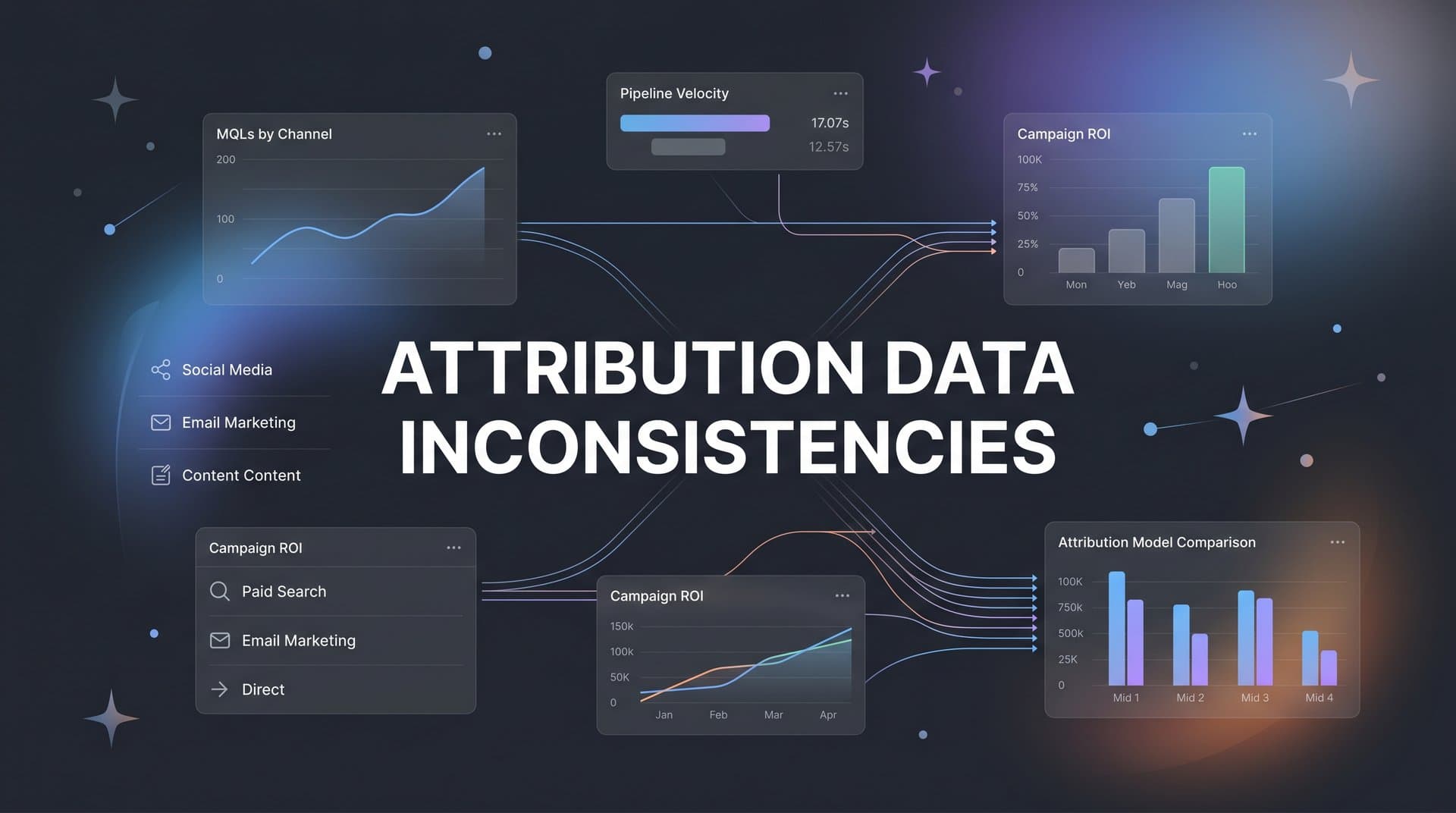
You pull reports from Google Ads, Meta, and your CRM at the end of the month. Google says you generated 87 conversions. Meta claims 64. Your CRM shows 31 closed deals. All three are reporting on the same campaigns, the same time period, and the same audience. So which number is right?
This is one of the most common and costly frustrations in B2B SaaS marketing today. Attribution data inconsistencies show up in nearly every growth team's reporting stack, and they rarely get easier to explain in a leadership meeting. When your numbers don't match, trust erodes, budget decisions get made on faulty signals, and the entire marketing operation starts flying blind.
Here's the important thing to understand: these inconsistencies are not a sign that your tools are broken. They are a symptom of something deeper. Disconnected tracking systems, conflicting attribution models, and compounding data gaps all contribute to a situation where every platform tells a different version of the same story. The good news is that once you understand why these gaps exist, you can build the infrastructure to close them.
This article walks through the root causes of attribution data inconsistencies, what they cost you if left unaddressed, and the practical steps you can take to build a reliable, unified picture of your marketing performance.
The Many Sources Behind Mismatched Marketing Data
To understand why your numbers never seem to agree, you first need to understand how each platform counts conversions in the first place. And the answer is: completely differently from one another.
Meta, Google Ads, and LinkedIn each use their own attribution windows and methodologies. Meta historically defaults to a 7-day click and 1-day view window, meaning any conversion that happens within seven days of a click or one day of a view gets credited to that ad. Google Ads typically uses a 30-day click window by default. LinkedIn operates on its own set of defaults as well. When a prospect clicks a Meta ad on Monday, sees a Google Display ad on Wednesday, and converts on Friday, both platforms claim that conversion. Neither is technically lying. They are each following their own rules. But the result is double-counting that inflates your total reported conversions well beyond what actually happened.
This overlap is not an edge case. It is built into the system by default. And for B2B SaaS teams running multi-channel campaigns, it compounds quickly. Understanding attribution window performance across each platform is one of the first steps toward diagnosing where your numbers diverge.
The second major source of inconsistency is signal loss from browser-based pixel tracking. For years, marketers relied on JavaScript pixels placed on their website to fire conversion events back to ad platforms. That approach has become increasingly unreliable. iOS privacy changes, the gradual deprecation of third-party cookies, and the widespread use of ad blockers all degrade the signal that browser-based pixels can capture. When a pixel fails to fire because a browser blocked it, that conversion simply disappears from the platform's reporting. The conversion still happened. Your CRM knows about it. But the ad platform doesn't, creating a gap between what actually occurred and what gets reported.
The third layer of inconsistency comes from the structural disconnect between your CRM and your ad platforms. These systems were not built to talk to each other natively. They use different data structures, different timing, and different definitions of what counts as a conversion. A lead that enters your CRM on Tuesday might not be associated with a specific campaign until a sales rep updates the record on Thursday. Offline conversions, delayed deal closures, and manual data entry all introduce lag. By the time you try to reconcile your ad platform reports with your CRM pipeline data, you are comparing numbers that were generated under entirely different conditions.
None of these issues is insurmountable on its own. But together, they create an environment where attribution challenges in marketing analytics are the norm rather than the exception, and where every report you pull tells a slightly different story.
How Attribution Models Create Different Versions of the Truth
Even if your tracking were perfect, you would still face inconsistencies if different teams or tools are using different attribution models. Attribution models are the rules that determine how credit for a conversion gets distributed across the touchpoints in a customer journey. Change the model, and you change the story entirely.
Consider a B2B SaaS prospect who first encounters your brand through a LinkedIn awareness ad, later clicks a Google Search ad after searching for your category, reads a blog post through organic search, and then converts after clicking a retargeting ad on Meta. That is a single customer journey with four distinct touchpoints. Here is what happens when you apply different models:
First-touch attribution gives 100% of the credit to the LinkedIn awareness ad. LinkedIn looks like your best-performing channel. Google, organic, and Meta get nothing.
Last-click attribution gives 100% of the credit to the Meta retargeting ad. Now Meta looks like your top channel. Everything that happened before the final click is invisible.
Linear attribution splits credit equally across all four touchpoints, giving each channel 25%. This feels fairer but may not reflect the actual influence each touchpoint had on the decision.
Data-driven attribution uses machine learning to assign fractional credit based on which touchpoints statistically contributed most to conversion. This is generally the most accurate model, but it requires a significant volume of conversion data to function reliably. You can explore how data-driven attribution works in practice before committing to it as your primary model.
None of these models is wrong. Each is designed to answer a slightly different question. The problem arises when your paid media team is optimizing based on last-click data, your demand gen team is reporting on first-touch, and your leadership dashboard is pulling from a data-driven model. You are not just looking at different numbers. You are looking at fundamentally incomparable reports, built on different assumptions, that cannot be reconciled without knowing which model produced them.
This is especially problematic in B2B SaaS, where the customer journey often spans weeks or months and involves multiple touchpoints across paid, organic, email, and direct channels. Last-click attribution systematically undervalues upper-funnel channels like awareness campaigns and content, which rarely get credit even when they initiate the journey. First-touch attribution undervalues the channels that close deals. Neither model gives you an accurate picture of how your full marketing mix is contributing to revenue.
Multi-touch attribution is designed to solve this by distributing credit across the full customer journey. But it only works correctly when you have complete and accurate touchpoint data feeding into it. For most teams, that is precisely what is missing, which is why multi-touch attribution often surfaces new inconsistencies rather than resolving the old ones.
The Real Cost of Ignoring Attribution Inconsistencies
Attribution data inconsistencies might seem like a reporting problem. In reality, they are a business problem with direct financial consequences.
The most immediate cost is budget misallocation. When a channel appears to perform well because it is double-counting conversions or receiving inflated credit from a favorable attribution model, teams scale spend on campaigns that are not actually driving pipeline or revenue. You pour more budget into what looks like your best-performing channel, only to find that pipeline growth does not follow. By the time you realize the signal was misleading, you have already spent the budget.
This dynamic is particularly damaging in B2B SaaS, where the gap between a marketing-qualified lead and closed-won revenue can span an entire quarter. If you are optimizing toward top-of-funnel metrics that do not correlate with actual revenue, your entire growth strategy is built on a faulty foundation. Understanding B2B revenue attribution at the pipeline level is what separates teams that scale confidently from those that guess.
The second cost is organizational. Inconsistent data erodes trust between marketing and finance or leadership. When the CMO presents a report showing strong campaign performance and the CFO pulls up the CRM showing flat pipeline, the credibility gap becomes a conversation about whether marketing can be trusted at all. Justifying ad spend and securing budget for growth initiatives becomes significantly harder when your numbers cannot withstand scrutiny.
The third cost is less visible but arguably the most compounding. Poor attribution data feeds directly back into ad platform algorithms. Modern ad platforms like Meta and Google rely heavily on the conversion signals you send them to power automated bidding, audience targeting, and campaign optimization. When the conversion events you are sending are based on inflated, duplicated, or inaccurate data, the algorithm optimizes toward the wrong signals. It targets audiences that look like your reported conversions, not your actual customers. It allocates budget toward placements and creatives that appear to convert based on flawed data. Over time, this compounds into a performance feedback loop that is very difficult to unwind.
The bottom line is that attribution data inconsistencies are not a minor inconvenience to be explained away in footnotes. They directly affect where your budget goes, how your team is perceived internally, and how effectively your ad platforms can optimize on your behalf.
Server-Side Tracking and First-Party Data as the Foundation for Clean Attribution
If browser-based pixel tracking is one of the primary sources of signal loss, the solution is to move your conversion tracking off the browser and onto your server. This is what server-side tracking accomplishes, and it is increasingly the standard approach for teams that need accurate attribution data.
With server-side tracking, conversion events are sent directly from your server to ad platforms rather than relying on a JavaScript pixel firing in a user's browser. Because the event originates from your server, it bypasses the ad blockers, browser privacy restrictions, and cookie limitations that degrade browser-based tracking. The result is a more complete and reliable signal that better reflects what actually happened on your website and in your funnel.
Conversion APIs take this a step further by allowing you to pass enriched, deduplicated event data directly to ad platforms. Meta's Conversion API (CAPI) and Google's Enhanced Conversions are two of the most widely used implementations. Instead of relying solely on browser pixels to report a purchase or a lead form submission, you send that event data from your own server with additional context, such as hashed email addresses and other first-party identifiers, that improve the platform's ability to match the event to a real user. This improves event match quality, reduces the discrepancy between platform-reported and actual conversions, and gives ad platform algorithms better data to optimize against. Teams that have worked through how to fix attribution discrepancies in data consistently point to server-side implementation as the highest-leverage starting point.
First-party data is the other critical foundation. Data collected directly from your users through your own CRM, product, and website is more reliable and more durable than third-party cookie-based tracking. It does not disappear when a browser update changes privacy defaults. It does not get blocked by an ad blocker. And because it lives in your own systems, you control how it is structured, how it is used, and how it flows into your attribution reporting.
For B2B SaaS teams, this means connecting your CRM data, including pipeline stages, deal values, and closed-won revenue, to your ad platform event data. When you can pass a CRM-confirmed conversion back to Meta or Google as a server-side event, you are giving the platform the most accurate possible signal. You are also creating the foundation for revenue-level attribution rather than lead-level attribution, which is where B2B marketing measurement needs to operate.
Server-side tracking and first-party data are not optional upgrades. In a privacy-first environment where browser-based signals continue to degrade, they are the baseline infrastructure for any team that wants clean, reliable attribution data. Setting up the right data infrastructure for marketing attribution is what makes everything downstream more accurate and more actionable.
Building a Single Source of Truth Across Your Marketing Stack
Even with server-side tracking in place and Conversion APIs connected, you still face a challenge: your data lives in multiple systems. Google Ads has its dashboard. Meta has its Ads Manager. LinkedIn has its Campaign Manager. Your CRM has its pipeline reports. Each one shows a slice of the picture, and none of them shows the full story.
This is where a unified attribution platform becomes essential. The goal is to bring all of your ad platform data, CRM data, and website event data into a single place where it can be analyzed together, under consistent definitions and a consistent attribution model. When you can see all of your touchpoints in one view, you eliminate the need to manually reconcile reports across disconnected tools. You stop arguing about which number is right and start working from a shared version of the truth. Centralizing your data in an attribution data warehouse is one of the most effective ways to achieve this kind of unified visibility.
Standardizing on one attribution model across all reporting is a critical step that many teams overlook. You might use different models for different optimization purposes, for example, data-driven attribution for bidding and multi-touch for strategic planning. But when it comes to the reports that inform budget decisions and leadership conversations, everyone needs to be working from the same model. Otherwise, you are back to comparing fundamentally incomparable numbers.
The most important connection to make is between your ad spend and your pipeline and closed-won revenue. Many B2B SaaS marketing teams measure success at the lead or MQL level because that is where the data is most readily available. But leads are a proxy metric. What leadership actually cares about is revenue. When you can connect a specific ad campaign to the pipeline it generated and the revenue it ultimately closed, you replace vanity metrics with the kind of revenue-level attribution tracking that earns budget and builds trust.
Cometly is built specifically for this purpose. It connects your ad platforms, CRM, and website data into a single attribution platform, tracking every touchpoint from first ad click to closed-won revenue. With multi-touch attribution, server-side conversion tracking, and native integrations with tools like Stripe, Cometly gives B2B SaaS teams the complete, accurate picture of marketing performance that fragmented reporting stacks simply cannot provide. Its AI-driven insights surface which ads and campaigns are actually driving revenue, so you can scale what works with confidence rather than guessing based on platform-reported metrics.
A single source of truth is not just a reporting convenience. It is the infrastructure that makes every downstream decision, from budget allocation to channel strategy to creative testing, more reliable and more defensible.
From Data Chaos to Attribution Clarity
Resolving attribution data inconsistencies is not a one-time project. It is an ongoing discipline. But it starts with a clear-eyed audit of where your current setup is breaking down.
Begin by mapping your tracking infrastructure. Identify where you are relying on browser-based pixels without server-side backup, where your CRM data is not connected to your ad platform events, and where your attribution windows are creating overlap and double-counting. These gaps are where inconsistencies originate, and closing them is the first step toward cleaner data.
Next, implement server-side tracking and Conversion API integrations for your primary ad platforms. Connect your CRM pipeline data so that revenue-level events, not just lead form submissions, are flowing back into your attribution reporting. This gives your ad platform algorithms better signals and gives your reporting a more accurate foundation.
Then consolidate your reporting into a single platform where all of your data sources can be analyzed together under a consistent attribution model. Align your team on which model governs budget decisions, and make sure everyone is working from the same numbers.
Finally, build attribution hygiene into your regular workflow. Review your tracking setup regularly, audit for new gaps as your stack evolves, and keep cross-team alignment on reporting standards so that inconsistencies do not creep back in over time.
Attribution accuracy is achievable. It requires the right infrastructure, a commitment to first-party data, and a platform that connects every piece of the puzzle. When you have that in place, you stop spending time explaining why your numbers don't match and start spending it on the decisions that actually grow your business.
If your attribution data is creating more questions than answers, it is time to take a closer look at the infrastructure behind it. Get your free demo and see how Cometly brings together multi-touch attribution, server-side tracking, and revenue data into one platform so your team can stop guessing and start scaling with confidence.