You've built a sophisticated B2B SaaS funnel. A prospect sees your LinkedIn ad, reads a blog post three days later, attends a webinar, downloads a guide, and finally books a demo six weeks after that first click. Then your attribution tool reports that the demo request came from "direct" traffic, and your LinkedIn campaign looks like it produced nothing.
This is one of the most common and costly problems in B2B SaaS marketing. The funnel is complex, the sales cycle is long, and the attribution data is telling you a story that doesn't match reality. Budget gets pulled from channels that are quietly doing the heavy lifting, mid-funnel nurture programs get defunded because they show zero ROI, and growth stalls in ways that are genuinely hard to diagnose.
Attribution for multi-step funnels is not just a technical challenge. It's a strategic one. When you can't see which touchpoints are actually moving prospects through your pipeline, every budget decision is a guess. And in a competitive SaaS market, guessing is expensive.
This article breaks down exactly why standard attribution fails in complex funnels, which models are actually suited to multi-step B2B journeys, how to set up tracking that captures every stage, and how to read that data to make smarter decisions. By the end, you'll have a clear picture of what a full-funnel attribution system looks like and how to build one that connects every touchpoint to real revenue.
Why Single-Touch Attribution Breaks Down in Complex Funnels
Single-touch attribution was built for a simpler world. A user clicks an ad, lands on a page, and buys something. Credit the click, move on. That model works reasonably well for e-commerce with short purchase cycles. It falls apart almost immediately in B2B SaaS.
Think about what a typical B2B SaaS buyer journey actually looks like. A prospect discovers your brand through a paid social ad. They don't convert. Weeks later, they find a blog post through organic search. They sign up for a newsletter. They get an email sequence. They register for a webinar. They attend. They download a case study. They book a demo. They go through a trial. They become a customer. That entire journey might span two to four months and involve a dozen or more distinct touchpoints across multiple channels.
Under a first-touch model, LinkedIn gets all the credit. Under a last-touch model, the demo booking page gets all the credit. Everything in between, the blog post, the webinar, the email sequence, the case study, registers as invisible. And when something is invisible in your attribution data, it tends to get cut from the budget.
This creates a specific kind of attribution blind spot that is particularly damaging for B2B SaaS teams. The channels that nurture and accelerate deals, retargeting campaigns, educational content, email sequences, mid-funnel offers, often appear to have zero ROI under single-touch models. They don't initiate the journey and they don't get credit for closing it, so the data suggests they're wasted spend. Teams cut them. Pipeline slows. The connection between the budget cut and the pipeline slowdown is hard to trace, so the cycle repeats.
There's another dimension that makes this worse in B2B specifically. Multi-step funnels often involve multiple decision-makers. A champion discovers your product, a manager evaluates it, a procurement team approves it. Each stakeholder may have their own touchpoints with your brand, and those touchpoints may span different devices, different sessions, and different time periods. The gap between the first marketing touch and the closed-won revenue event can be months wide. That gap is where attribution breaks, and where budget decisions go wrong.
Accurate attribution for multi-step funnels is not a nice-to-have. It's the foundation of every budget decision your team makes. Without it, you're optimizing against a model that doesn't reflect how your customers actually buy.
The Anatomy of a Multi-Step Funnel and Its Attribution Challenges
Before you can fix attribution, it helps to understand exactly where the data breaks. B2B SaaS funnels typically move through three broad stages, and each one creates its own attribution challenges.
At the awareness stage, prospects encounter your brand through paid ads on LinkedIn, Google, or Meta, organic search results, social content, or referrals. These touchpoints are often the easiest to track because they happen in the browser and most ad platforms provide click data. But even here, cross-device journeys create gaps. A prospect who sees your LinkedIn ad on their phone and then searches for your brand on their work laptop may not be connected as the same user in your analytics.
The consideration stage is where attribution gets significantly harder. This is where retargeting campaigns, content consumption, webinars, email sequences, and product demos do their work. Many of these touchpoints happen outside the paid click environment. A prospect opens an email, reads a blog post, watches a recorded demo, or has a discovery call with a sales rep. Browser-based pixels often miss these events entirely, especially when they involve CRM interactions or offline conversations.
The decision stage involves sales outreach, free trials, proposals, and contract negotiations. Almost all of this happens outside your website. It lives in your CRM, in email threads, in sales calls. These are the touchpoints closest to revenue, and they're the ones most attribution tools are least equipped to capture.
The core challenge is that stitching these stages together requires connecting data from fundamentally different systems. Your ad platforms know about clicks and impressions. Your website analytics knows about sessions and page views. Your CRM knows about lead stages, opportunities, and deal values. Your payment processor knows about actual revenue. These systems don't naturally talk to each other, and most attribution tools only connect one or two of them.
When these layers are disconnected, you end up with attribution data that covers the top of the funnel reasonably well and becomes increasingly unreliable as you move toward revenue. That's the worst possible scenario, because the decisions that matter most, which channels are actually driving closed deals, are the ones you have the least accurate data on.
The other major gap is time. In B2B SaaS, a marketing touch and the revenue event it eventually influences might be separated by weeks or months. Standard attribution windows, often set to 7 or 28 days, simply don't capture this. A content piece that influenced a deal that closed four months later gets zero credit, even if it was the touchpoint that moved a prospect from passive awareness to active evaluation.
Attribution Models That Actually Work for Multi-Step Funnels
Not all attribution models are created equal, and the one you choose has a direct impact on how you read your data and where you allocate budget. Here's how the major models stack up for complex B2B SaaS funnels.
Linear attribution distributes credit equally across every touchpoint in the customer journey. If a prospect had six interactions before converting, each one gets roughly 17% of the credit. This model is useful for getting a complete picture of which channels are participating in deals, but it can dilute the perceived value of genuinely high-impact touchpoints. A brief retargeting impression gets the same credit as a 45-minute product demo, which may not reflect reality.
Time-decay attribution gives more credit to touchpoints that occurred closer to the conversion event. The logic is that recency implies influence. This works reasonably well for shorter sales cycles where the final few interactions genuinely do carry more weight. For longer B2B cycles, however, it systematically undervalues top-of-funnel awareness campaigns that may have initiated the buying process months before the deal closed.
Position-based models, often called U-shaped and W-shaped attribution, offer a practical middle ground for B2B SaaS teams. The U-shaped model gives extra credit to the first touch (which initiated the relationship) and the lead creation event (which converted an anonymous visitor into a known prospect), distributing the remaining credit across the touchpoints in between. The W-shaped model adds a third emphasis point at opportunity creation, acknowledging the moment a lead became a qualified sales opportunity.
These models work well for B2B SaaS because they honor the milestones that matter most in a pipeline-driven business: acquisition, lead conversion, and opportunity creation. They're also intuitive enough that marketing and sales teams can align around them without needing to understand complex statistical models. A deeper look at comparison of attribution models can help you decide which structure fits your pipeline best.
Data-driven and algorithmic attribution is the most sophisticated option. Rather than applying a fixed rule, it uses your actual conversion data to assign dynamic credit weights based on which touchpoints statistically correlate with closed deals. If webinar attendance consistently appears in the journeys of prospects who convert to customers, the model gives it more credit. If a particular ad format consistently appears in journeys that stall, it gets less.
The trade-off is data volume. Algorithmic models need a meaningful number of conversions to produce reliable weights. If your deal volume is low, the model may not have enough signal to be accurate. For teams with higher conversion volumes, though, data-driven attribution is the most accurate approach available and the one most likely to surface genuine insights about which touchpoints drive revenue.
The practical takeaway: most B2B SaaS teams should move beyond single-touch models immediately. Position-based models offer a strong starting point because they're structured, explainable, and built around the pipeline milestones that already exist in your CRM. As data volume grows, layering in data-driven attribution gives you the ability to validate and refine your budget decisions with statistical confidence.
How to Set Up Tracking Across Every Funnel Stage
Choosing the right attribution model is only half the equation. The other half is making sure you're actually capturing the data those models need to work. This is where most teams run into problems, because tracking a multi-step B2B funnel requires a fundamentally different approach than tracking a simple e-commerce conversion.
Server-side tracking and Conversion API integration are no longer optional for accurate attribution. Browser-based pixels, the traditional method for tracking ad conversions, miss a significant and growing portion of events. Ad blockers, browser privacy restrictions, and cookie limitations all reduce the reliability of client-side tracking. Server-side tracking bypasses the browser entirely, sending conversion data directly from your server to ad platforms. This means CRM events, form fills, and revenue milestones that never touch the browser are captured and attributed correctly.
Connecting ad platforms to CRM and revenue data is the critical link in multi-step funnel attribution. When a prospect clicks a paid ad, that click needs to be tagged with UTM parameters that follow them through your entire funnel. Those parameters need to be captured at every form fill, passed into your CRM when a lead is created, and mapped to deal stages as the opportunity progresses. When a deal closes, the deal value needs to sync back to your attribution platform so you can see the actual revenue generated by each channel and campaign. Setting up a proper Salesforce attribution integration is one of the most effective ways to ensure this data flows without gaps.
This sounds straightforward, but it requires deliberate setup. UTM parameters need to be consistently structured. Your CRM needs to store them at the lead and opportunity level. Your attribution platform needs to be integrated with your CRM so it can read those stage transitions and revenue events. Each of these connections is a potential failure point, and gaps anywhere in the chain create attribution errors downstream.
Defining micro-conversions at each funnel stage is the practice that makes full-funnel attribution actually work. Rather than only tracking the final purchase or contract signature, you set up conversion events for every meaningful milestone: demo booked, trial started, MQL created, SQL qualified, opportunity opened, proposal sent. Each of these becomes a data point in your attribution model.
This matters for two reasons. First, it gives you attribution data across the entire funnel, not just at the end. Second, it gives your attribution platform enough signal to understand which touchpoints influence which stages. A channel that consistently contributes to demo bookings but rarely appears in closed-won journeys tells a very different story than one that appears in both. Without micro-conversion tracking, you can't see that distinction.
Reading Multi-Funnel Attribution Data to Make Smarter Budget Decisions
Once your tracking is set up and your attribution model is running, the next challenge is knowing how to read the data. Full-funnel attribution produces more information than single-touch models, and interpreting it correctly requires a shift in how you think about channel performance.
The most important distinction to understand is the difference between pipeline attribution and revenue attribution. Pipeline attribution shows you which channels are generating opportunities. Revenue attribution shows you which channels are contributing to closed deals. These two views often tell very different stories, and both are necessary for accurate budget decisions.
A paid social channel might generate a large volume of MQLs and look strong in pipeline attribution. But if those MQLs rarely progress to closed deals, revenue attribution will show a much weaker picture. Conversely, a retargeting campaign might generate very few new leads but appear consistently in the journeys of prospects who eventually close. Pipeline attribution makes it look like a minor contributor. Revenue attribution reveals it as a deal accelerator.
This is why looking at only one view is dangerous. Pipeline-only attribution leads teams to over-invest in top-of-funnel channels that generate activity but not revenue. Revenue-only attribution can make it look like mid-funnel channels don't matter, when in reality they're the reason deals close at all. Understanding multi-channel attribution for ROI helps teams build a more complete picture of how each channel contributes across the full journey.
Identifying channel roles in the funnel is one of the most valuable analyses full-funnel attribution enables. Some channels consistently open awareness. Others accelerate mid-funnel progression. Others close deals. Attribution data should inform budget allocation based on each channel's actual role, not its position in a default attribution model.
Paid social and organic content often function as awareness drivers. Retargeting and email sequences tend to accelerate consideration. Sales outreach and demos tend to be the final push toward a decision. When you can see these patterns in your data, you can build a budget structure that invests in each stage proportionally, rather than over-indexing on whatever channel happens to get last-touch credit.
AI-driven insights become particularly powerful once you have full-funnel data in place. When your attribution platform can see every touchpoint from first click to closed revenue, AI can surface patterns that would take a human analyst days to find: which campaign combinations produce the shortest path to revenue, which creative formats appear most often in high-value deals, which audience segments convert fastest. This turns your attribution data into a scaling playbook.
Building a Full-Funnel Attribution System That Actually Works
Let's talk about what this looks like in practice. A full-funnel attribution system for B2B SaaS requires connecting four core layers: your ad platforms, your website, your CRM, and your revenue source. Each layer contributes data that the others can't provide, and the value of the system comes from the connections between them.
Your ad platforms, whether that's Meta, Google, LinkedIn, or TikTok, provide click and impression data. Your website provides session and behavior data. Your CRM provides lead stage transitions, opportunity data, and deal values. Your revenue source, often Stripe or a similar payment processor, provides actual closed revenue tied to specific accounts. When these four layers are connected in a single multi-touch attribution platform, you can trace a complete line from a specific ad impression to a specific dollar of closed revenue.
The alternative is manual reconciliation: exporting data from each platform, matching it by UTM parameters or email address, and building spreadsheet models that are outdated the moment they're finished. This approach consumes significant analyst time and produces attribution data that's always looking backward. A connected attribution platform eliminates this problem by keeping all of these integrations live and up to date.
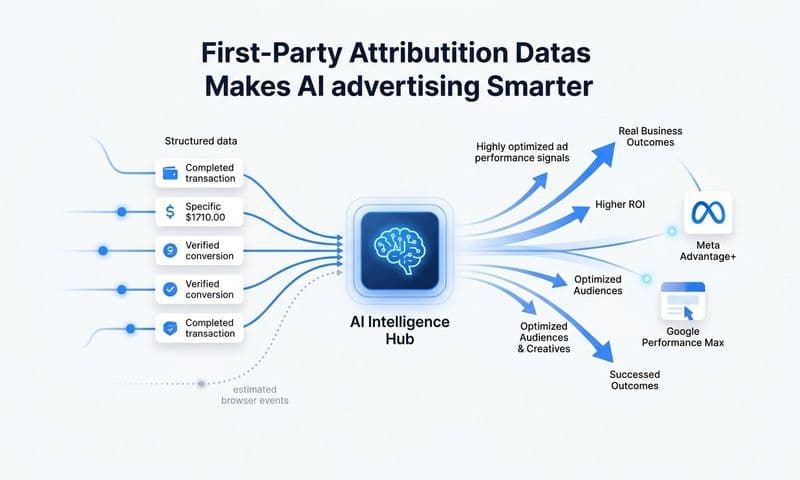
Feeding enriched data back to ad platforms is the compounding benefit that many teams overlook. Once you have full-funnel attribution data, you can send high-quality conversion signals back to Meta CAPI, Google Ads, and LinkedIn. Instead of sending a signal that says "this user clicked an ad," you're sending a signal that says "this user who clicked this ad eventually became a customer worth this much revenue." Ad platform algorithms use this richer signal to find more users who match the profile of your actual customers, not just users who are likely to click.
Over time, this creates a feedback loop: better attribution data produces better ad platform signals, which produces better targeting, which produces better results, which produces more attribution data. Teams that invest in full-funnel attribution early build a compounding advantage that's genuinely hard for competitors to replicate quickly.
This is exactly what Cometly is built to do. Cometly connects your ad platforms, website, CRM, and revenue data into a single attribution view, built specifically for B2B SaaS companies that need to track every touchpoint from first ad click to closed-won revenue. It supports multiple attribution models so you can compare how different models read your data, uses server-side tracking and Conversion API integration to capture events that browser pixels miss, and applies AI to surface which campaigns and channels are actually driving pipeline and revenue. With 70+ native integrations, it's designed to be the connective layer that eliminates the fragmentation problem at the core of multi-step funnel attribution.
The Bottom Line on Multi-Step Funnel Attribution
Multi-step funnels demand multi-touch attribution. That's not a complexity preference, it's a requirement. When your sales cycle spans months, involves multiple stakeholders, and touches a dozen channels, a single-touch model isn't just imprecise. It's actively misleading. It tells you to cut the channels that are quietly building your pipeline and double down on whatever happened to be the last click.
The teams that invest in full-funnel attribution gain a compounding advantage. They spend less on channels that generate noise without revenue. They scale what's actually working. They feed better conversion signals back to ad platforms, improving targeting over time. And they make budget decisions based on data that reflects how their customers actually buy, rather than how a simplified model assumes they do.
Building this system requires connecting your ad platforms, website, CRM, and revenue data in a way that most teams haven't done yet. But the payoff, knowing with confidence which touchpoints drive which outcomes at every stage of your funnel, is what separates teams that grow efficiently from teams that grow by guessing.
If you're ready to stop guessing and start seeing exactly which ads and channels are driving your pipeline and revenue, Get your free demo of Cometly today and see how full-funnel attribution can transform the way you allocate your marketing budget.