You've just spent $50,000 across Google Ads, Facebook campaigns, and LinkedIn sponsored content this quarter. Your sales team closed $200,000 in new business. But here's the question that keeps you up at night: which of those marketing channels actually drove those deals?
Most marketers are flying blind on this question. They see clicks, impressions, and engagement metrics, but can't connect those numbers to actual revenue. One channel might look like a star performer based on clicks, while another that seems underwhelming might actually be your biggest revenue driver.
This is the exact problem attribution marketing solves. It's the analytical framework that traces every customer interaction back to the marketing touchpoints that influenced their decision. Instead of guessing which campaigns work, you get a clear picture of what's driving real business outcomes.
In this guide, we'll break down everything you need to know about attribution marketing—from the fundamental concepts to practical implementation strategies. You'll learn how modern attribution works, why traditional tracking methods are failing marketers today, and how to build a system that gives you the confidence to scale your best-performing campaigns.
Understanding How Marketing Touchpoints Connect to Revenue
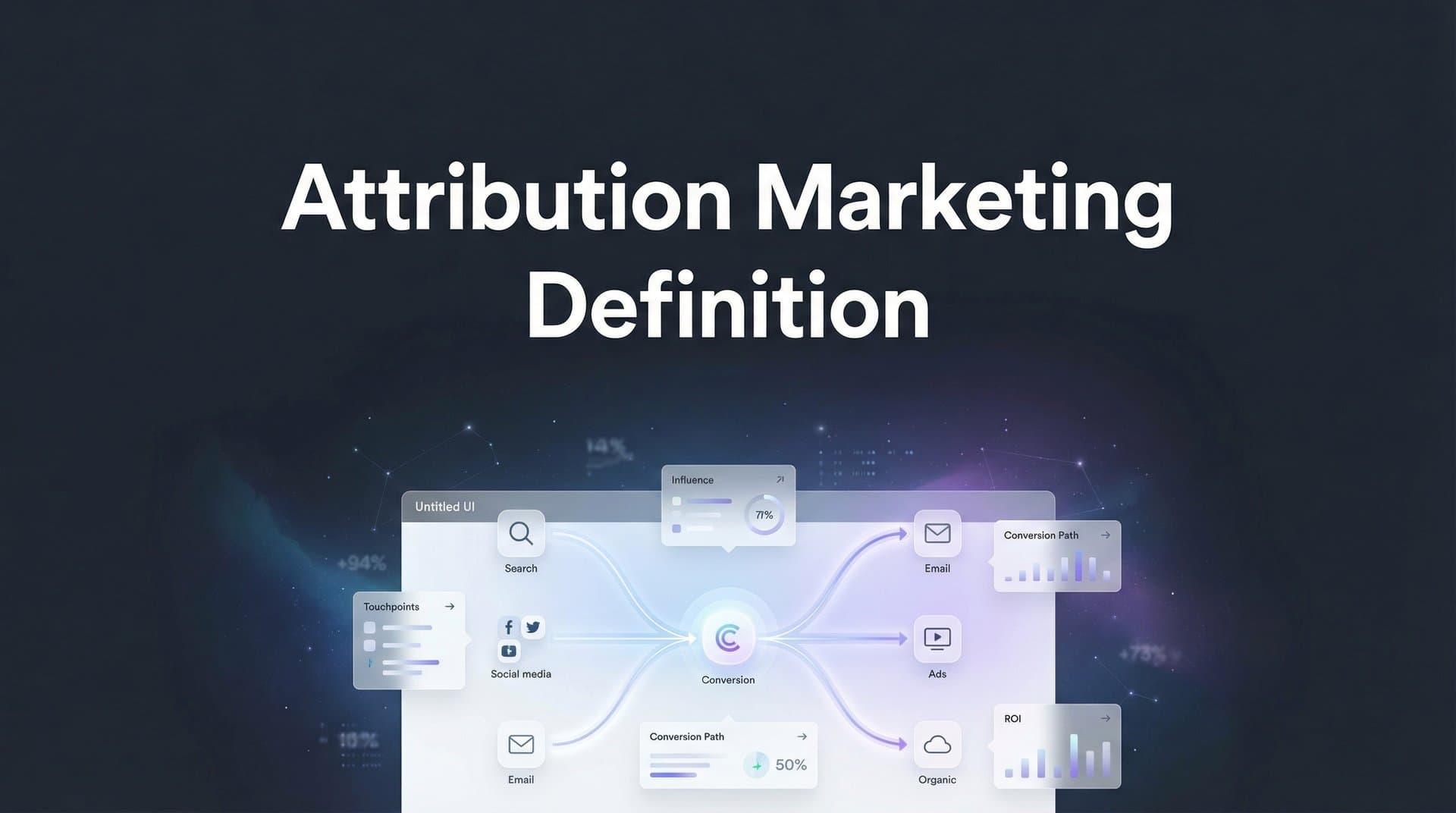
Attribution marketing is the process of identifying which marketing touchpoints contribute to conversions and revenue. Think of it as connecting the dots between every interaction a customer has with your brand and the moment they decide to buy. For a deeper dive into the fundamentals, explore our complete marketing attribution definition guide.
Here's why this matters more than ever: today's buyers don't see one ad and immediately purchase. They might discover your brand through a LinkedIn post, research your solution on Google, click a retargeting ad on Facebook, read your email newsletter, and then finally convert after visiting your website directly. That's five touchpoints in a single journey.
Without attribution, you're only seeing fragments of this story. You might know someone clicked your Facebook ad, but you have no idea if they were already familiar with your brand from LinkedIn, or if that ad was actually the deciding factor in their purchase decision.
Attribution marketing differs fundamentally from basic analytics. Basic analytics tells you what happened—1,000 people clicked your ad, 50 people visited your pricing page. Attribution tells you why it happened and which interactions actually mattered. Understanding this distinction is crucial, and our comparison of marketing attribution software vs traditional analytics breaks down the key differences.
The complexity of modern customer journeys makes this even more critical. B2B buyers might interact with your brand 7-13 times before purchasing. Ecommerce customers often browse multiple times across different devices before converting. If you're only tracking last-click conversions, you're missing 90% of the story.
This is where attribution becomes your competitive advantage. When you understand the full journey, you can identify which channels are introducing new prospects, which ones are nurturing consideration, and which ones are closing deals. You stop wasting budget on channels that look good on paper but don't actually contribute to revenue.
The goal isn't just to track touchpoints—it's to understand their relative value in driving business outcomes. Some interactions might be crucial for awareness but rarely lead directly to conversions. Others might be the final nudge that turns consideration into purchase. Effective channel attribution in digital marketing helps you see the difference.
Choosing the Right Attribution Model for Your Business
Attribution models are the frameworks that determine how much credit each touchpoint receives for a conversion. The model you choose fundamentally shapes how you interpret your marketing performance and where you allocate budget. Our comprehensive guide on attribution model definition in marketing covers each approach in detail.
Single-touch models are the simplest approach. First-touch attribution gives all credit to the initial interaction—the ad or channel that first introduced someone to your brand. Last-touch attribution does the opposite, crediting only the final touchpoint before conversion.
These models have their place. First-touch makes sense when your primary goal is measuring brand awareness and top-of-funnel performance. Last-touch works for businesses with short sales cycles where the final interaction truly is the deciding factor—think impulse purchases or promotional campaigns.
But for most businesses running multi-channel campaigns, single-touch models create blind spots. They ignore the nurturing that happens between discovery and purchase. If someone discovers you through organic search, engages with three email campaigns, and converts after clicking a retargeting ad, last-touch gives all credit to retargeting while ignoring everything that built the relationship.
Multi-touch attribution models distribute credit across multiple interactions. Linear attribution splits credit evenly across all touchpoints—if someone had five interactions before converting, each gets 20% credit. It's simple and acknowledges that multiple channels contributed, but it doesn't account for the reality that some touchpoints matter more than others.
Time-decay attribution recognizes that interactions closer to the conversion are typically more influential. Touchpoints get progressively more credit as they approach the purchase decision. This model works well for longer sales cycles where recent engagement often indicates buying intent.
Position-based attribution (also called U-shaped) gives the most credit to first and last touch—typically 40% each—while distributing the remaining 20% across middle interactions. This model acknowledges that discovery and final conversion are critical moments while still recognizing the nurturing that happens between them.
The most sophisticated approach is data-driven attribution, which uses machine learning algorithms to analyze your actual conversion paths and assign credit based on statistical patterns. Instead of applying a predetermined formula, it looks at which touchpoints are most strongly associated with conversions in your specific business. Learn how to build a marketing attribution model that fits your unique needs.
Data-driven models adapt to your unique customer journey. They might discover that email interactions are far more influential for your business than social media, or that certain ad channels work best in combination rather than isolation. This approach requires substantial data volume to be effective—typically thousands of conversions—but delivers the most accurate picture of channel performance.
The right model depends on your sales cycle, business model, and marketing goals. B2B companies with 3-6 month sales cycles often benefit from position-based or data-driven models that recognize the long nurturing process. Ecommerce businesses with shorter cycles might find time-decay or even last-touch sufficient. The key is choosing a model that reflects how your customers actually buy.
Why Cookie-Based Tracking No Longer Tells the Full Story
Traditional marketing attribution relied heavily on browser cookies to track user behavior across websites and ad platforms. For years, this worked reasonably well. Then the privacy landscape shifted dramatically, and suddenly the data marketers depended on became unreliable.
Apple's iOS 14.5 update in 2021 introduced App Tracking Transparency, requiring apps to ask permission before tracking users across other apps and websites. The result? Opt-in rates hovered around 15-25%, meaning the majority of iOS users became invisible to traditional tracking methods.
Browser restrictions compounded the problem. Safari began blocking third-party cookies by default. Firefox followed suit. Chrome announced plans to phase out third-party cookies entirely. What was once a comprehensive view of customer behavior became fragmented and incomplete.
The impact on attribution data has been severe. Many marketers now see significant discrepancies between what their ad platforms report and what actually shows up in their CRM or analytics. Facebook might claim 100 conversions from a campaign, while your actual sales data shows only 60. Google Ads reports strong performance, but the leads never materialize in your pipeline. These are among the most common attribution challenges in marketing analytics that teams face today.
This gap isn't just annoying—it fundamentally undermines your ability to make informed decisions. When you can't trust the conversion data, you can't confidently optimize campaigns, scale winners, or cut losers. You're back to making educated guesses about what's working.
The root problem is that cookie-based tracking depends on the user's browser to pass data between your website and ad platforms. When browsers block cookies or users opt out of tracking, that connection breaks. The ad platform can't see what happened after someone clicked your ad, so it either underreports conversions or makes assumptions that inflate performance.
Server-side tracking offers a solution by shifting data collection from the user's browser to your own server. Instead of relying on cookies that can be blocked, your server captures conversion events and sends them directly to ad platforms through their APIs. This first-party data collection is more reliable and respects privacy regulations while maintaining attribution accuracy.
The transition to server-side tracking isn't just about fixing broken data—it's about building a more resilient attribution foundation. As privacy regulations continue evolving and browser restrictions tighten, marketers who rely solely on pixel-based tracking will face growing blind spots. Those who implement server-side solutions maintain visibility into the customer journey regardless of browser settings or privacy updates.
The Business Impact of Inaccurate Attribution
When your attribution data is unreliable, every marketing decision becomes riskier. You might pause campaigns that are actually driving revenue because the ad platform can't see the full conversion path. Or you might scale campaigns that look successful but aren't actually profitable once you account for the true customer acquisition cost.
This data accuracy problem also affects ad platform optimization. Facebook, Google, and other platforms use conversion data to improve their targeting algorithms. When they receive incomplete or delayed conversion signals, their machine learning can't effectively identify which audiences and creative approaches work best. Your campaigns perform worse not because your targeting is wrong, but because the platform doesn't have accurate feedback to optimize toward.
Modern attribution requires a foundation of accurate, comprehensive data collection. That means implementing tracking methods that work across devices, respect privacy requirements, and capture the full customer journey from initial awareness through final conversion and beyond. Our guide on attribution marketing tracking covers the technical requirements in depth.
Building an Attribution System That Actually Works
Understanding attribution theory is one thing. Implementing a working system that delivers actionable insights is another. The process requires connecting multiple data sources, choosing appropriate models, and establishing workflows that turn attribution data into optimization decisions.
Start by connecting all your marketing touchpoints into a unified tracking system. This means integrating your ad platforms—Facebook, Google, LinkedIn, TikTok—with your website analytics and your CRM or sales system. Every interaction a prospect has with your brand should be captured and linked to a single customer profile.
The technical implementation typically involves several components. You need tracking code on your website to capture visitor behavior and conversion events. You need integrations with each ad platform to pull campaign and ad-level performance data. You need a connection to your CRM to see which marketing-influenced leads actually convert to customers and generate revenue.
Many businesses underestimate this integration complexity. It's not enough to install Google Analytics and call it done. You need to ensure that a user who clicks a Facebook ad, browses your site, and later converts after clicking an email link is tracked as one person across all those touchpoints. Without proper identity resolution, you're still seeing fragments instead of complete journeys.
Once your data collection is solid, select an attribution model that aligns with your business reality. If you're B2B with a 90-day sales cycle and multiple decision-makers, a multi-touch model that recognizes the long nurturing process makes sense. Our B2B marketing attribution guide covers strategies specifically for longer sales cycles.
The model choice should also consider your data volume. Data-driven attribution requires substantial conversion data to identify meaningful patterns—typically at least several hundred conversions per month. If you're working with smaller volumes, starting with position-based or time-decay models provides valuable insights without requiring massive data sets.
With attribution data flowing, establish regular review processes that turn insights into action. This isn't about checking dashboards occasionally—it's about building systematic optimization workflows. Weekly reviews might focus on campaign-level performance and quick budget adjustments. Monthly reviews can examine channel mix and strategic allocation decisions.
Translating Attribution Insights Into Budget Decisions
Attribution data becomes valuable when it changes how you spend money. The goal isn't just to know which channels contribute to conversions—it's to reallocate budget toward channels that drive the best returns and away from those that don't pull their weight.
Look for channels that are undervalued in last-click analysis but show strong influence in multi-touch attribution. You might discover that organic social posts rarely get last-click credit but frequently appear early in high-value customer journeys. That insight suggests maintaining or increasing social investment even if it doesn't show direct conversions.
Conversely, identify channels that look good in isolation but don't actually contribute much to conversion paths. A channel might drive clicks and engagement but rarely appear in the journeys of customers who actually buy. That's a signal to reduce spend or shift strategy rather than continuing to invest based on vanity metrics.
The most powerful optimization comes from understanding channel interactions. Some channels work best in combination—prospects who see both Google search ads and Facebook retargeting might convert at much higher rates than those exposed to either channel alone. Understanding cross-channel attribution and marketing ROI reveals these synergies so you can build integrated campaigns rather than optimizing channels in isolation.
Optimizing Ad Performance With Enriched Attribution Data
Modern attribution isn't just about understanding past performance—it's about feeding better data to ad platforms so they can optimize more effectively in real time. This creates a virtuous cycle where accurate attribution improves targeting, which improves results, which provides even better attribution data.
Ad platforms like Facebook and Google rely on conversion data to train their machine learning algorithms. When you send conversion events back to these platforms, their systems learn which user characteristics, behaviors, and contexts are associated with conversions. This powers lookalike audiences, automated bidding, and creative optimization.
The problem is that standard pixel-based tracking often sends incomplete or delayed conversion data. If the platform can't see conversions because of browser restrictions, or if conversion events are delayed by days because they happen offline, the algorithm is learning from incomplete information. It's like trying to teach someone to cook while only showing them half the recipe.
Server-side tracking with proper attribution enables you to send enriched conversion events that include the full context. You can pass back not just that a conversion happened, but the conversion value, the customer lifetime value prediction, and whether this was a high-quality lead or low-quality one. This enriched data helps ad platforms optimize toward the outcomes you actually care about.
Consider a B2B software company where not all leads are equal. A lead from a Fortune 500 company is worth far more than a lead from a small business that will never afford the product. With enriched conversion data, you can assign different values to these leads and teach the ad platform to prioritize high-value prospects. The algorithm learns to find more Fortune 500 decision-makers instead of just maximizing total lead volume.
This optimization extends to identifying underperforming campaigns before they waste significant budget. Attribution data reveals which campaigns are generating clicks and engagement but not actually contributing to conversions. You can pause these campaigns quickly rather than letting them run based on misleading engagement metrics.
The flip side is scaling winners with confidence. When attribution clearly shows that a campaign is driving high-value conversions, you can increase budget aggressively without second-guessing whether the results are real. This confidence to scale is often the difference between modest growth and explosive revenue expansion.
Real-time attribution also enables dynamic budget allocation. Instead of setting monthly budgets and hoping for the best, you can shift spend toward channels and campaigns that are performing well right now. If LinkedIn is suddenly driving high-quality leads while Facebook performance dips, you can reallocate budget within days rather than waiting for the next planning cycle. The right marketing attribution platform for revenue tracking makes this level of agility possible.
Moving Beyond Vanity Metrics to Revenue Impact
Attribution fundamentally changes how you evaluate marketing success. Instead of celebrating high click-through rates or engagement metrics that don't correlate with business outcomes, you focus exclusively on what drives revenue and customer acquisition.
This shift can be uncomfortable at first. Campaigns that looked successful based on traditional metrics might show minimal attribution value. Channels you thought were underperforming might reveal themselves as crucial awareness drivers that enable other channels to convert. But this clarity is exactly what enables profitable scaling.
The key is consistently asking: does this marketing activity contribute to conversion paths that generate revenue? If the answer is yes, invest more. If the answer is no, cut it or change the approach. Attribution gives you the data to answer this question with confidence rather than intuition.
Your Roadmap to Attribution Marketing Success
Attribution marketing transforms from abstract concept to practical advantage when you implement the right system. The journey starts with unified tracking across all touchpoints—connecting your ad platforms, website, and CRM into a single source of truth about customer behavior.
Choose an attribution model that reflects how your customers actually buy. For most businesses running multi-channel campaigns with moderate-to-long sales cycles, multi-touch models provide the nuanced view needed to optimize effectively. As your data volume grows, data-driven attribution offers the most sophisticated analysis of what's truly driving conversions.
Build your attribution foundation on accurate data collection. Cookie-based tracking is increasingly unreliable due to privacy restrictions and browser changes. Server-side tracking provides the accuracy and resilience you need to maintain visibility into customer journeys regardless of how the privacy landscape evolves.
Use attribution insights to drive concrete optimization decisions. Reallocate budget toward channels that contribute to high-value conversion paths. Feed enriched conversion data back to ad platforms so their algorithms can optimize toward your actual business goals. Scale campaigns with confidence when attribution clearly shows they're driving revenue.
The businesses that master attribution gain a decisive advantage. They stop wasting budget on channels that look good but don't convert. They identify winning campaigns early and scale aggressively. They optimize ad platform algorithms with accurate conversion data that improves targeting and reduces acquisition costs.
Attribution isn't optional for businesses running multi-channel paid advertising. It's the foundation that makes every other optimization possible. Without it, you're guessing about what works. With it, you're making data-driven decisions that compound into significant competitive advantages.
Taking the Next Step Toward Marketing Clarity
You now understand what attribution marketing is, why traditional tracking falls short, and how modern attribution systems work. The question becomes: what does your current attribution setup look like?
Many marketers discover they have significant gaps—tracking that covers some channels but not others, models that don't reflect their actual customer journey, or data accuracy problems that undermine optimization decisions. Identifying these gaps is the first step toward building a system that delivers reliable insights.
The good news is that modern attribution platforms handle the technical complexity while giving you the actionable insights you need. Instead of building custom integrations and wrestling with data pipelines, you can implement comprehensive attribution that starts delivering value within days rather than months.
Cometly provides the accurate, real-time attribution data that makes confident marketing decisions possible. From tracking every touchpoint across the customer journey to feeding enriched conversion data back to ad platforms, Cometly connects the dots between your marketing efforts and business outcomes. You see exactly which campaigns drive revenue, which channels deserve more budget, and where to cut spending that isn't contributing to growth.
Ready to elevate your marketing game with precision and confidence? Discover how Cometly's AI-driven recommendations can transform your ad strategy—Get your free demo today and start capturing every touchpoint to maximize your conversions.