

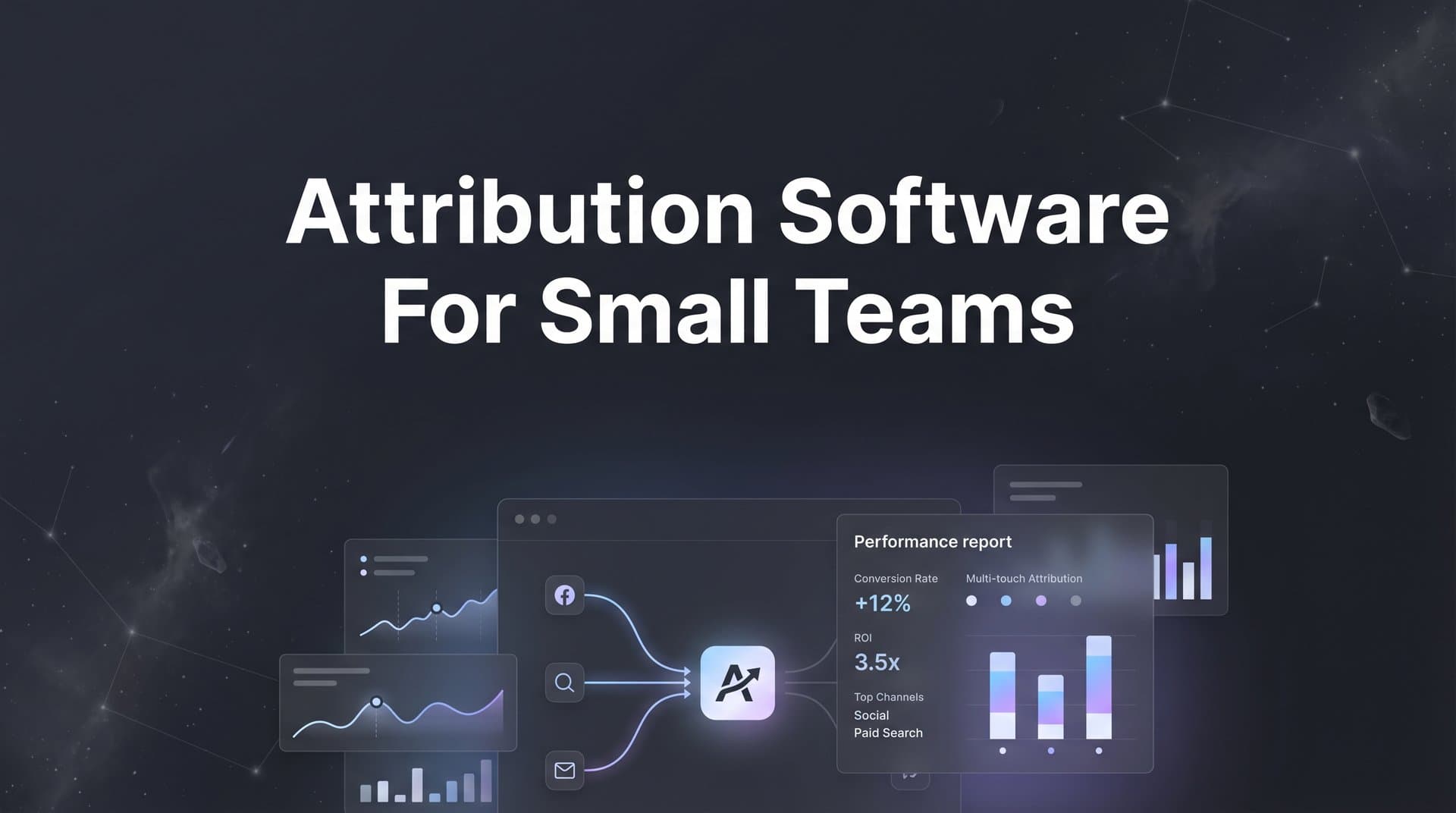
Small marketing teams face a unique challenge: they need enterprise-level attribution insights without enterprise-level complexity or budgets. When every dollar counts and you cannot afford to waste spend on underperforming channels, knowing exactly which touchpoints drive revenue becomes critical.
This guide covers nine attribution software options built for lean teams that need accurate data, quick setup, and actionable insights without dedicated analytics staff. We evaluated each tool based on ease of implementation, pricing accessibility, multi-channel tracking capabilities, and how well they serve teams with limited technical resources.
1. Cometly
Best for: Teams needing AI-powered attribution with server-side tracking that bypasses iOS limitations
Cometly is a marketing attribution platform that tracks the complete customer journey from initial ad click through CRM conversion, using AI to surface optimization opportunities.
 9 Best Attribution Software for Small Teams in 2026
Where This Tool Shines
Cometly addresses one of the biggest pain points for small teams: getting accurate attribution data despite iOS privacy changes and cookie deprecation. Its server-side tracking infrastructure captures conversion data that browser-based pixels miss, giving you a complete view of campaign performance.
The platform's AI recommendations go beyond showing you what happened. It analyzes performance patterns across your campaigns and suggests specific actions, like which ads to scale or which audiences to expand. For teams without dedicated analysts, this transforms raw data into clear next steps.
Key Features
Server-Side Tracking: Bypasses browser limitations to capture accurate conversion data even with iOS privacy restrictions and ad blockers active.
AI-Powered Recommendations: Identifies high-performing campaigns and suggests optimization actions based on real-time performance analysis.
Conversion Sync: Feeds enriched conversion data back to Meta, Google, and other ad platforms to improve their targeting algorithms.
Multi-Touch Attribution: Tracks every touchpoint in the customer journey across paid ads, organic channels, email, and CRM events.
Real-Time Analytics Dashboard: Displays campaign performance with actionable insights accessible to non-technical team members.
Best For
Small to mid-sized marketing teams running multi-channel campaigns who need accurate attribution without hiring data analysts. Particularly valuable for teams spending $10k+ monthly on paid ads across Meta, Google, TikTok, or other platforms where tracking accuracy directly impacts ROAS.
Pricing
Custom pricing based on ad spend volume. The platform scales with your growth, making it accessible for smaller teams while accommodating expansion.
2. Triple Whale
Best for: Ecommerce brands on Shopify needing profit-focused attribution and creative performance insights
Triple Whale is an attribution platform built specifically for ecommerce, combining pixel tracking with profit analytics and creative performance measurement.
 7 Best Funnel.io Alternatives for Marketing Data Analytics in 2026
Where This Tool Shines
Triple Whale understands that ecommerce teams care about profit, not just revenue. Its profit dashboard automatically factors in cost of goods sold, shipping costs, and ad spend to show true profitability by channel and campaign. This prevents the common mistake of scaling campaigns that drive revenue but erode margins.
The creative analytics feature helps small teams identify which ad creatives perform best without manual spreadsheet work. You can quickly see which images, videos, or copy variations drive the most profitable conversions across your ad accounts.
Key Features
First-Party Pixel: Shopify-specific tracking that captures conversion data more accurately than standard Facebook or Google pixels.
Profit Dashboard: Combines ad spend with COGS and shipping to show real profitability, not just top-line revenue.
Creative Analytics: Tracks performance by specific ad creative elements to identify winning visual and copy combinations.
Post-Purchase Surveys: Collects self-reported attribution data directly from customers to validate pixel tracking.
Shopify Integration: Deep native integration pulls product, order, and customer data automatically without complex setup.
Best For
Ecommerce brands running on Shopify who need to understand profitability by marketing channel. Especially useful for direct-to-consumer brands managing multiple product lines with varying margins.
Pricing
Starts at $129/month for smaller stores, with pricing tiers based on monthly revenue and feature requirements.
3. Northbeam
Best for: Data-savvy teams wanting machine learning attribution combined with predictive budget allocation
Northbeam is a marketing intelligence platform that combines multi-touch attribution with media mix modeling to predict optimal budget allocation across channels.
 9 Best Attribution Software for Small Teams in 2026
Where This Tool Shines
Northbeam goes beyond tracking what happened to predicting what will happen. Its media mix modeling analyzes historical performance patterns to forecast how budget shifts will impact overall revenue. For small teams making quarterly budget decisions, this removes much of the guesswork.
The platform's customer journey visualization makes complex attribution data accessible. You can see exactly how customers move between touchpoints before converting, helping you understand which channel combinations work best together rather than viewing each in isolation.
Key Features
Machine Learning Attribution: Uses ML models to assign credit across touchpoints more accurately than rules-based attribution.
Media Mix Modeling: Predicts performance outcomes for different budget allocation scenarios across channels.
Customer Journey Visualization: Shows common paths to conversion with visual journey maps across all marketing touchpoints.
Incrementality Testing: Measures true incremental impact of marketing activities beyond baseline conversions.
Cross-Channel Analysis: Unified view of performance across paid social, search, display, email, and organic channels.
Best For
Growing teams with some analytical capability who want to move beyond basic attribution into predictive planning. Best suited for businesses spending $50k+ monthly across multiple channels.
Pricing
Custom pricing typically in the mid-market range, based on ad spend volume and number of integrated channels.
4. Rockerbox
Best for: Omnichannel businesses tracking both digital and offline marketing like TV or podcast ads
Rockerbox is a unified measurement platform that attributes conversions across digital channels plus traditionally hard-to-track offline media like television and podcasts.
 9 Best Attribution Software Options by Monthly Pricing in 2026
Where This Tool Shines
Most attribution tools only track digital channels, leaving teams blind to how offline marketing influences online conversions. Rockerbox bridges this gap by connecting TV airings, podcast episodes, and direct mail campaigns to website traffic and conversions. This matters for small teams testing new channels who need to know if offline investments actually pay off.
The platform's multiple attribution model comparison lets you view the same data through different lenses. You can see first-touch, last-touch, and multi-touch attribution side by side, helping you understand how different perspectives change budget allocation decisions.
Key Features
Digital and Offline Attribution: Tracks online channels alongside TV, podcast, radio, and direct mail performance.
TV and Podcast Attribution: Connects specific airings or episodes to website traffic spikes and conversions.
Customer Journey Analysis: Maps complete paths to conversion including both online and offline touchpoints.
Attribution Model Comparison: View performance through multiple attribution models simultaneously to inform strategy decisions.
Channel Performance Benchmarking: Compare your channel mix performance against industry benchmarks.
Best For
Omnichannel businesses running both digital and traditional media who need unified measurement. Particularly valuable for consumer brands testing podcast sponsorships or local TV advertising.
Pricing
Custom pricing based on number of channels tracked and data volume, typically suited for mid-market budgets.
5. Ruler Analytics
Best for: B2B teams tracking phone calls, forms, and live chat back to marketing sources
Ruler Analytics is a B2B attribution platform specializing in connecting offline conversions like phone calls and live chat conversations to their originating marketing sources.
 8 Best Attribution Tools with Onboarding Support in 2026
Where This Tool Shines
Many B2B businesses generate leads through phone calls, but struggle to connect those calls back to specific marketing campaigns. Ruler's dynamic number insertion assigns unique phone numbers based on the visitor's source, so when someone calls, you know exactly which Google Ad or LinkedIn campaign drove it.
The platform excels at closed-loop reporting by integrating with CRMs to track leads through to revenue. For small sales teams, this means you can finally see which marketing sources generate not just leads, but qualified opportunities and closed deals.
Key Features
Call Tracking with Dynamic Number Insertion: Displays unique phone numbers based on visitor source to attribute calls accurately.
Form and Live Chat Attribution: Tracks form submissions and chat conversations back to their marketing origin.
CRM Integration: Connects to Salesforce, HubSpot, and other CRMs for closed-loop revenue attribution.
Revenue Attribution: Shows which marketing sources drive actual revenue, not just lead volume.
Keyword-Level Tracking: Attributes conversions to specific search keywords for granular PPC optimization.
Best For
B2B companies where phone calls and direct conversations drive significant lead volume. Ideal for service businesses, professional services firms, and B2B SaaS companies with sales-assisted conversions.
Pricing
Starts at $199/month with pricing tiers based on call volume and number of integrated channels.
6. Dreamdata
Best for: B2B SaaS teams running account-based marketing with long, complex sales cycles
Dreamdata is a B2B revenue attribution platform built for account-based marketing, connecting every marketing touchpoint to pipeline and revenue through deep CRM integration.
 8 Best Warehouse Attribution Solutions for E-commerce in 2026
Where This Tool Shines
B2B sales cycles involve multiple stakeholders from the same company engaging with your content over weeks or months. Dreamdata's account-based attribution groups all these individual interactions by company, showing you which content and campaigns influence deals at the account level rather than just individual visitor level.
The platform's pipeline influence reporting helps small marketing teams prove their impact on revenue. You can show exactly how marketing touchpoints contributed to each deal in your pipeline, making budget conversations with leadership much easier.
Key Features
Account-Based Attribution Models: Groups individual visitor actions by company account for accurate B2B attribution.
Deep CRM Integration: Syncs with Salesforce, HubSpot, and Pipedrive to connect marketing touches to pipeline stages and revenue.
Content Attribution: Tracks which blog posts, whitepapers, and webinars influence deals during long sales cycles.
Pipeline Influence Reporting: Shows marketing's contribution to each opportunity in your sales pipeline.
Multi-Touch Models: Offers various attribution models designed specifically for B2B buying journeys.
Best For
B2B SaaS companies and other businesses with complex, multi-stakeholder sales processes. Most valuable for teams with sales cycles longer than 30 days and average deal values above $5k.
Pricing
Free tier available for basic tracking. Paid plans start at $999/month with features scaling based on company size and needs.
7. Wicked Reports
Best for: Subscription businesses needing lifetime value attribution and cohort analysis
Wicked Reports is an attribution platform specializing in subscription and recurring revenue businesses, with cohort analysis and lifetime value tracking built for membership models.
 7 Best Northbeam Alternatives for Small Business in 2026
Where This Tool Shines
Subscription businesses make money over time, not at the point of initial purchase. Wicked Reports attributes revenue based on customer lifetime value rather than just first-order value, showing you which marketing sources acquire customers who stick around and generate recurring revenue.
The cohort analysis feature lets you compare customer groups acquired in different months or from different sources. You can see if customers from Facebook ads have higher retention than Google Ads customers, or if certain campaigns attract subscribers who cancel quickly.
Key Features
LTV-Based Attribution: Assigns marketing credit based on total customer lifetime value, not just initial purchase.
Cohort Analysis: Compares retention and revenue patterns across customer groups acquired in different periods or from different sources.
Email and SMS Attribution: Tracks revenue from email campaigns and SMS marketing alongside paid channels.
Recurring Revenue Tracking: Monitors monthly recurring revenue contribution by marketing source over time.
Churn Analysis: Identifies which acquisition sources produce customers with higher or lower churn rates.
Best For
Subscription box companies, membership sites, SaaS businesses, and any company where customer value accrues over months or years rather than in a single transaction.
Pricing
Starts at $250/month with pricing tiers based on monthly revenue and number of subscribers tracked.
8. Attributer
Best for: Teams wanting simple, lightweight attribution without complex implementation
Attributer is a lightweight attribution tool that captures UTM parameters and landing page data, then passes attribution information through form submissions directly to your CRM.
Where This Tool Shines
Attributer takes a refreshingly simple approach: it captures source data when someone visits your site, stores it in their browser, then passes it through any form they submit. This means your CRM automatically receives attribution data with every lead, without complex pixel implementations or JavaScript tracking.
The tool works with any form builder and any CRM that accepts form data. For small teams without developers, this plug-and-play approach gets attribution running in minutes rather than weeks of technical implementation.
Key Features
Simple JavaScript Tracking: One line of code captures source data without complex implementation requirements.
Works with Any Form Builder: Compatible with Gravity Forms, Typeform, HubSpot forms, and any other form system.
CRM Field Population: Automatically fills hidden form fields with attribution data that flows into your CRM records.
No Complex Implementation: Non-technical marketers can set up and maintain without developer assistance.
UTM Parameter Capture: Preserves campaign source data across visitor sessions until they convert.
Best For
Small teams without technical resources who need basic attribution data in their CRM. Perfect for businesses where most conversions happen through form submissions rather than ecommerce transactions.
Pricing
Starts at $50/month, making it one of the most affordable attribution solutions for small teams.
9. Google Analytics 4
Best for: Teams starting their attribution journey who need free, comprehensive analytics
Google Analytics 4 is Google's free analytics platform with built-in data-driven attribution modeling, suitable for small teams beginning to track marketing performance.
Where This Tool Shines
GA4's data-driven attribution model uses machine learning to assign credit across touchpoints based on actual conversion patterns in your data. Unlike rules-based models that apply the same logic to everyone, it adapts to how your specific customers actually behave before converting.
The platform's integration with Google Ads creates a closed feedback loop. Attribution insights from GA4 can inform Google Ads bidding strategies, and conversion data flows back to improve ad targeting automatically.
Key Features
Data-Driven Attribution Model: Machine learning model that assigns credit based on actual conversion patterns in your data.
Cross-Platform Tracking: Tracks user behavior across websites and mobile apps in a unified view.
Google Ads Integration: Seamless connection with Google Ads for attribution-informed bidding and targeting.
Conversion Path Analysis: Shows common sequences of touchpoints that lead to conversions.
Free Access: Full platform available at no cost for most small to mid-sized businesses.
Best For
Teams just starting with attribution who want to understand the basics before investing in specialized tools. Also suitable as a secondary attribution source to validate data from other platforms.
Pricing
Free for standard GA4. Enterprise version (GA4 360) available for larger organizations with advanced needs.
Making the Right Choice
The right attribution software depends on your business model, technical capacity, and primary marketing channels. Ecommerce teams on Shopify benefit most from Triple Whale's profit-focused approach, while B2B companies with phone-heavy lead generation need Ruler Analytics' call tracking capabilities.
For teams running multi-channel campaigns who need accurate data despite iOS limitations, Cometly's server-side tracking and AI recommendations provide actionable insights without requiring dedicated analysts. Subscription businesses should prioritize Wicked Reports' LTV-based attribution, and teams just starting their attribution journey can begin with Google Analytics 4's free platform.
Consider your implementation capacity honestly. Tools like Attributer and GA4 require minimal technical setup, while platforms like Northbeam and Dreamdata deliver more sophisticated insights but need more involved implementation. Match the tool's complexity to your team's ability to maintain it long-term.
Start by identifying your primary conversion type: ecommerce transactions, form submissions, phone calls, or B2B pipeline opportunities. This narrows your options significantly. Then evaluate pricing against your current ad spend. Most attribution tools become cost-effective when you're spending enough on ads that even small optimization improvements pay for the software.
Ready to elevate your marketing game with precision and confidence? Discover how Cometly's AI-driven recommendations can transform your ad strategy. Get your free demo today and start capturing every touchpoint to maximize your conversions.


