You're running paid campaigns across Google, Meta, LinkedIn, and maybe a few other channels. Leads are coming in, trials are starting, and deals are closing. But when someone asks which campaigns are actually driving revenue, you hesitate. The data from each platform tells a different story, and none of them quite add up.
This is one of the most common frustrations in B2B SaaS marketing, and it almost always traces back to the same root cause: attribution that was never set up properly in the first place. Attribution tool setup is not just a technical checkbox. It is the strategic foundation that every marketing decision, every budget allocation, and every optimization call will rest on going forward.
An attribution tool setup service handles the full process of connecting your ad platforms, configuring server-side tracking, mapping conversion events across your funnel, integrating your CRM, and selecting the right attribution model for your sales cycle. Done well, it gives you a single, accurate view of what is driving pipeline and revenue. Done poorly, or skipped entirely, it leaves you making expensive decisions based on incomplete or misleading data.
This article breaks down what a proper attribution setup involves, why the details matter more than most teams realize, and how to evaluate whether a service is actually equipped to get it right for your business.
The Hidden Cost of Getting Attribution Wrong From Day One
Attribution errors are not always obvious. They do not announce themselves. Instead, they quietly shape your decisions in the wrong direction, often for months before anyone realizes what is happening.
Here is a common scenario. A team is running campaigns across multiple channels. The last-click data in their ad platform shows that branded search is converting well, so they shift budget toward it. Meanwhile, a top-of-funnel LinkedIn campaign that was introducing the brand to new audiences gets cut for underperforming. What the data did not show was that LinkedIn was initiating most of the journeys that eventually converted through that branded search. Without proper multi-touch attribution, the team optimized themselves into a smaller pipeline.
This is what misconfigured attribution does. It creates a distorted picture of performance, and that distortion compounds over time. Bad setup creates bad data. Bad data creates bad decisions. Bad decisions compound across months of ad spend, hiring choices, and channel strategy. By the time the problem surfaces, the team has often burned significant budget on the wrong things and underinvested in what was actually working.
The compounding effect is particularly damaging for B2B SaaS companies with longer sales cycles. When it takes weeks or months for a lead to become a customer, every data point in that journey matters. A misconfigured event here, a missing CRM integration there, and suddenly you are looking at a funnel that appears to convert well at the top but cannot explain what happens next. Leadership loses confidence in marketing data, and the team loses the ability to make a defensible case for budget.
What makes this even more frustrating is that attribution setup is often treated as a one-time technical task. Someone installs a pixel, connects a few ad accounts, and considers it done. But a proper attribution setup accounts for your entire tech stack: your website, your ad platforms, your CRM, your payment processor, and the specific conversion events that matter to your business. It requires deliberate configuration, not just installation.
The good news is that getting it right from the start is entirely achievable. It just requires understanding what a complete setup actually involves, which is where most teams underestimate the scope.
What a Full Attribution Setup Actually Covers
When most people think about attribution setup, they picture installing a tracking pixel. That is roughly equivalent to thinking a website is just a homepage. The pixel is one small piece of a much larger system, and relying on it alone creates significant data gaps.
A proper attribution tool setup service covers several interconnected layers. Each one addresses a different part of the data collection and analysis problem.
Ad Platform Connections: This means linking your Meta, Google, LinkedIn, and any other active ad accounts so that campaign, ad set, and creative-level data flows into a central attribution view. Without this, you are stuck comparing siloed platform reports that each claim credit for the same conversions.
Server-Side Tracking and Conversion API Configuration: Browser-based pixels have become increasingly unreliable. iOS privacy updates, ad blockers, and browser cookie restrictions mean that pixel-only setups routinely miss a meaningful portion of conversions. Server-side tracking, including Meta's Conversion API and Google's Enhanced Conversions, sends event data directly from your server to the ad platform, bypassing browser limitations entirely. A proper setup implements both browser and server-side tracking together, with event deduplication to prevent the same conversion from being counted twice.
Conversion Event Mapping: This is where many setups fall short. Teams configure attribution to track form fills or trial signups and stop there. A complete setup maps conversion events across the entire funnel, from the first ad click through demo requests, trial activations, sales qualified leads, opportunities created, and ultimately closed-won revenue. Without this full funnel mapping, you can see where leads come from but not which sources actually produce customers.
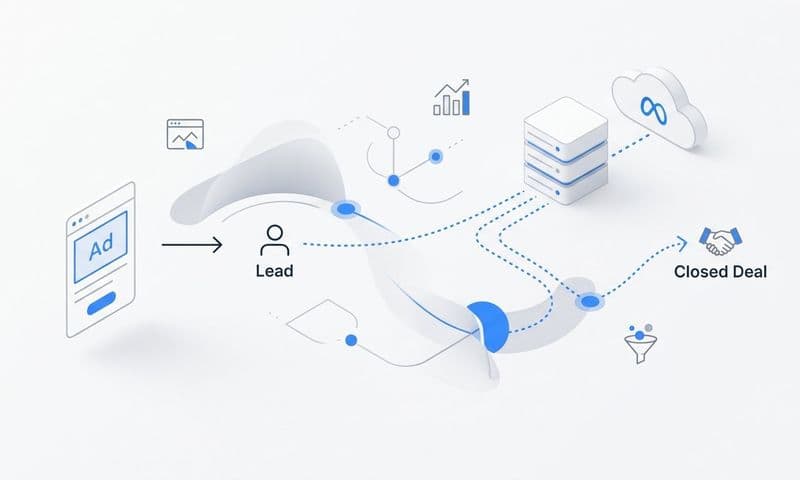
CRM Integration: Connecting your CRM to your attribution platform is what transforms lead attribution into revenue attribution. It allows you to trace a contact from the ad that first introduced them to your brand all the way through to the deal that closed in your CRM. This is the layer that gives marketing teams a defensible answer when leadership asks about marketing ROI.
Attribution Model Configuration: The setup service should help you choose and configure the attribution model that fits your business, not just apply a default. More on this in the next section.
The difference between a basic pixel install and a full attribution setup is the difference between knowing that conversions happened and understanding why they happened, which channels drove them, and what they were ultimately worth to the business.
Choosing the Right Attribution Model During Setup
Attribution model selection is one of the most consequential decisions made during setup, and it is often treated as an afterthought. The model you choose determines which touchpoints receive credit for a conversion, which directly shapes every report your team will act on going forward.
Here is a quick breakdown of the main models and when they apply.
First-Touch Attribution: Gives full credit to the first interaction a prospect had with your brand. Useful for understanding what is generating awareness and initiating new journeys, but it ignores everything that happened afterward.
Last-Click Attribution: Gives full credit to the final touchpoint before conversion. This is the default in many ad platforms and is reasonably useful for short purchase cycles, but it systematically undervalues upper-funnel channels in longer B2B sales processes.
Linear Attribution: Distributes credit equally across all touchpoints in the journey. It is more balanced than single-touch models and provides a fairer view of multi-channel contribution, though it does not distinguish between high-impact and low-impact interactions.
Time-Decay Attribution: Gives more credit to touchpoints closer to the conversion. This can make sense when recency is a strong signal of intent, but it still tends to undervalue early awareness touchpoints.
Data-Driven Attribution: Uses machine learning to assign credit based on the actual contribution of each touchpoint to conversion outcomes. It requires sufficient data volume to function accurately but tends to produce the most nuanced picture of channel performance.
For B2B SaaS companies with longer sales cycles and multiple decision-makers, multi-touch attribution models are generally more appropriate than last-click. A prospect might see a LinkedIn ad, attend a webinar, read a comparison article, click a retargeting ad, and then convert through a branded search. Last-click gives all the credit to branded search and none to the five touchpoints that built the case for conversion. That is a distorted view of what actually drove the deal.
A good setup service will walk through your sales cycle length, your typical channel mix, and your reporting goals before recommending a model. The model is not just a technical setting. It is a lens through which your entire marketing strategy will be evaluated. Getting it right during setup means your team starts with insights they can actually trust and act on.
Connecting Your Full Tech Stack: CRM, Ad Platforms, and Beyond
Attribution does not live in a single platform. It lives in the connections between platforms, and the quality of those connections determines the quality of your data.
A common limitation of many attribution setups is that they stop at the website. They track clicks, sessions, and form submissions, but they do not follow the lead into the CRM where the real revenue story unfolds. For B2B SaaS companies, this is a critical gap. The conversion that matters most is not the trial signup. It is the closed deal, and that data lives in your CRM.
Connecting your CRM to your attribution platform, whether that is HubSpot, Salesforce, or another system, is what enables pipeline attribution and revenue attribution. Pipeline attribution lets you see which campaigns are generating opportunities and what those opportunities are worth. Revenue attribution takes it further, showing you which campaigns and channels contributed to deals that actually closed. This is the level of insight that allows marketing to have a real conversation with finance and leadership about return on ad spend.
Payment processor integration adds another layer. Connecting a platform like Stripe to your attribution data means you can tie subscription revenue, upgrades, and renewals back to the original marketing source. This is particularly valuable for SaaS businesses where the initial conversion is often a trial or a low-touch signup, and the real revenue comes later through activation and expansion.
Beyond CRM and payment data, a properly connected stack also means your attribution platform can receive and process events from your product. Product-qualified leads, feature adoption milestones, and activation events can all be mapped as conversion signals, giving your attribution model richer data to work with.
The goal of connecting your full tech stack is a single source of truth for marketing performance. Without it, teams rely on platform-native reporting, which is inherently siloed and self-serving. Every ad platform claims credit for more than it deserves. Only a unified attribution view that pulls data across all platforms and connects it to CRM outcomes can give you an accurate picture of what is actually driving growth.
This is where native integrations matter. An attribution platform with pre-built connections to your CRM, ad platforms, and payment processors significantly reduces the setup complexity and the risk of data gaps. The more of your stack that connects through verified integrations, the more complete and reliable your attribution data will be.
What Proper Setup Unlocks: From Ad Performance to Revenue Intelligence
Once attribution is set up correctly, the shift in how your team operates is significant. You move from reporting on activity to reporting on outcomes. From tracking clicks and impressions to understanding which campaigns are generating pipeline and closing revenue.
The most immediate change is the ability to compare ad spend directly against pipeline value and closed revenue. Instead of asking whether your cost per lead is acceptable, you can ask whether your cost per closed deal is sustainable. That is a fundamentally different and more strategic question, and it is only possible when your attribution connects all the way from the first ad click to the CRM.
This level of visibility also changes how you evaluate creative and campaign performance. A campaign that generates a high volume of leads at a low cost per lead might look great on the surface. But if those leads rarely convert to opportunities and almost never close, the campaign is not performing well by the metric that actually matters. Proper attribution surfaces this reality quickly, so you can reallocate budget before it compounds into a larger problem.
AI-powered attribution platforms take this further. When your attribution data is accurate and complete, AI can analyze patterns across campaigns, channels, creatives, and audience segments to surface recommendations about what to scale and what to cut. These recommendations are only as good as the underlying data, which is why proper setup is the prerequisite for AI-driven optimization.
There is also a feedback loop benefit that many teams overlook. When you send enriched, properly tracked conversion data back to Meta and Google through server-side integrations, you are giving their machine learning algorithms better signals to work with. Better signals mean better targeting, more efficient delivery, and lower cost per acquisition over time. Ad platforms optimize based on the conversion data you send them. If that data is incomplete or delayed because of browser tracking limitations, their algorithms are working with a handicapped view of your best customers. Server-side tracking and Conversion API setup directly improves the quality of that feedback loop.
In short, proper attribution setup does not just improve your reporting. It improves the performance of your campaigns by giving both your team and the ad platforms the accurate data they need to make better decisions.
How to Evaluate an Attribution Setup Service Before You Commit
Not all attribution setup services are created equal. Some offer a basic integration walkthrough. Others provide a full implementation that accounts for your tech stack, sales cycle, and data architecture. Knowing what to ask before you commit can save you from a setup that looks complete but leaves critical gaps.
Here are the key questions to bring to any attribution setup conversation.
Do they support server-side tracking? Any setup service that only configures browser-based pixels is not equipped for the current privacy landscape. Ask specifically whether they implement Conversion API for Meta and Enhanced Conversions for Google, and whether they handle event deduplication when both browser and server-side tracking are running simultaneously.
Can they connect your CRM to your ad data? A setup that stops at the website or trial signup is lead attribution, not revenue attribution. Ask whether they can pull closed-won data from your CRM and connect it back to the original marketing source. This is the connection that enables real ROI measurement.
How do they handle attribution model selection? A good service will ask about your sales cycle, your channel mix, and your reporting goals before recommending a model. If they apply a default model without that conversation, they are not configuring attribution for your business. They are configuring it for a generic one.
Do they offer ongoing support or just a one-time setup? Attribution is not static. Your tech stack evolves, new ad platforms get added, and conversion events change. A one-time setup can become outdated quickly. Platforms that combine setup support with ongoing tooling and monitoring give you a much stronger foundation for sustained accuracy.
Is the platform built for B2B SaaS specifically? E-commerce attribution and B2B SaaS attribution have fundamentally different requirements. B2B SaaS involves longer sales cycles, multi-touch journeys, CRM-dependent revenue data, and often a product-led component. A platform designed for these dynamics will handle the nuances that a general-purpose tool might miss.
This is where Cometly is purpose-built for the challenge. Cometly is an attribution platform designed specifically for B2B SaaS companies, and it handles the full setup process from the start. That includes connecting your ad platforms, configuring server-side tracking and Conversion API, integrating your CRM to enable pipeline and revenue attribution, and setting up multi-touch attribution models that reflect your actual sales cycle. With over 70 native integrations and AI-powered campaign analysis built in, Cometly gives growth teams the accurate, revenue-connected data they need to make confident decisions about where to invest and where to pull back.
Building on a Foundation That Actually Holds
Every smart marketing decision your team makes will rest on the quality of your attribution data. If that foundation is shaky, built on incomplete tracking, disconnected platforms, or the wrong attribution model, the decisions built on top of it will be shaky too. And in a world where ad spend is significant and competition is intense, shaky decisions are expensive.
A proper attribution tool setup is not a luxury for well-resourced teams. It is a baseline requirement for any B2B SaaS company that wants to grow efficiently. The elements are clear: server-side tracking to capture data that browser pixels miss, CRM integration to connect leads to revenue, attribution model selection that reflects your actual sales cycle, and platform connections that create a single source of truth across all your channels.
When these pieces are in place, your team stops debating which channel deserves credit and starts making decisions grounded in what is actually driving pipeline and closed revenue. That shift changes how you allocate budget, how you evaluate campaigns, and how confidently you can present marketing performance to leadership.
If your attribution setup is incomplete, or if you have not set it up at all yet, the cost of waiting compounds every day your campaigns run. The right time to get it right is before another month of budget gets allocated based on data you cannot fully trust.
Ready to build your attribution on a foundation that connects every touchpoint to real revenue? Get your free demo and see how Cometly's AI-driven attribution platform is built specifically for B2B SaaS teams who need accurate, revenue-connected marketing data from day one.