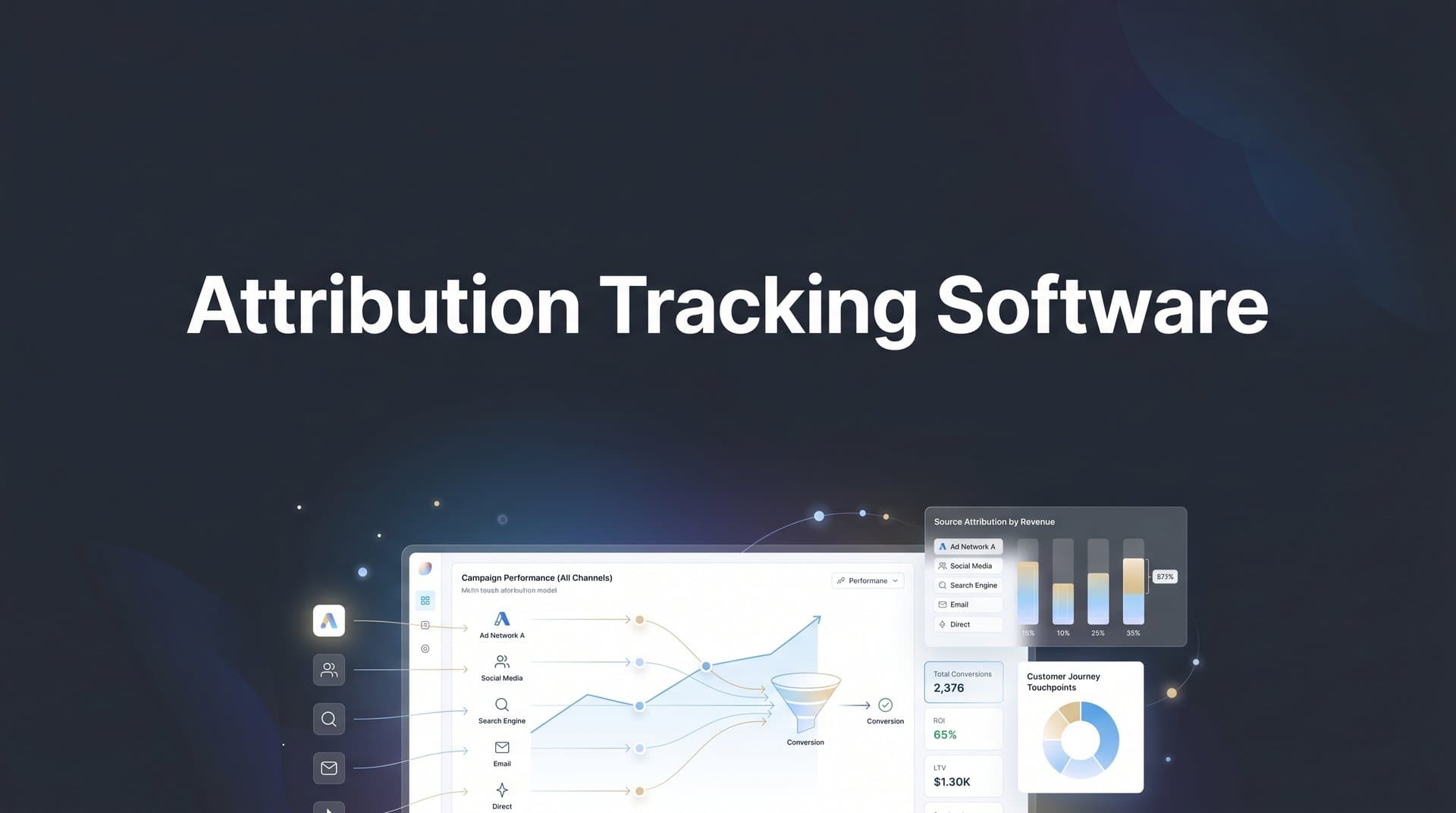
Knowing which ads actually drive revenue has never been harder. Privacy changes, cross-device journeys, and platform-native attribution gaps have left most marketing teams flying blind when it comes to budget decisions. Attribution tracking software solves this by stitching together every touchpoint across the full customer funnel, giving you a clear picture of what's working and what's wasting spend.
If you're trying to understand what marketing attribution really means or you're already familiar with the concept and just need the right tool, this list is for you. We evaluated these platforms on tracking accuracy, multi-touch attribution flexibility, integration depth, ease of use, and overall value for paid advertising teams.
Here are the top attribution tracking software platforms worth considering in 2026.
1. Cometly
Best for: AI-powered multi-touch attribution across all paid channels with real-time optimization
Cometly is an AI-powered marketing attribution platform that tracks every touchpoint from ad click to CRM event, delivering real-time multi-touch attribution and feeding enriched conversion data back to ad platforms for smarter optimization.
 9 Best Attribution Tracking Software for Smarter Ad Spend in 2026
Where This Tool Shines
Cometly goes beyond just reporting on what happened. Its AI layer actively identifies which campaigns and creatives are driving results across every channel, then surfaces actionable recommendations so you can scale what's working and cut what isn't. That combination of attribution data plus forward-looking guidance is rare in this space.
The platform also addresses one of the biggest pain points in modern attribution: data loss from browser restrictions and iOS privacy changes. Server-side tracking and Conversion Sync work together to capture events that would otherwise go untracked and send enriched signals back to Meta, Google, and other ad platforms, helping their algorithms optimize more effectively on your behalf.
Key Features
AI-Powered Ad Recommendations: Identifies top-performing campaigns and creatives across all channels and recommends where to shift budget for maximum return.
Server-Side Tracking: Captures conversion data accurately despite browser-level restrictions and iOS App Tracking Transparency limitations.
Conversion Sync: Sends enriched, conversion-ready events back to Meta, Google, and other ad platforms to improve targeting and algorithmic optimization.
Multi-Touch Attribution: Supports multiple attribution model comparisons so you can understand the full customer journey, not just the last click.
AI Chat: Lets you query your marketing data in plain language for fast, conversational insights without needing to build custom reports.
Best For
Cometly is built for digital marketers, growth teams, and agencies running paid campaigns across multiple platforms who want accurate attribution data combined with AI-driven optimization guidance. It's particularly valuable for teams that want to connect ad performance directly to CRM revenue and feed better data back to ad platform algorithms.
Pricing
Custom pricing based on ad spend volume. A free demo is available to explore the platform before committing.
2. Triple Whale
Best for: Shopify e-commerce brands wanting first-party attribution and creative analytics
Triple Whale is an e-commerce analytics and attribution platform built primarily for Shopify brands, combining a first-party pixel, creative performance analytics, and a unified ad dashboard.
 7 Best Funnel.io Alternatives for Marketing Data Analytics in 2026
Where This Tool Shines
Triple Whale was purpose-built for the Shopify ecosystem, which means its integrations are deep and its reporting is tailored to the metrics DTC brands care about most: ROAS, new customer acquisition cost, and creative performance. The creative analytics layer is particularly strong, helping teams identify which ad formats and visuals are actually moving the needle.
The post-purchase survey integration is a smart addition. It collects self-reported attribution data directly from customers, which adds a qualitative layer that pixel-based tracking alone can't provide.
Key Features
First-Party Pixel: Server-side tracking built specifically for Shopify stores to improve data accuracy and reduce attribution gaps.
Creative Analytics: Breaks down performance by individual ad creative to identify winning formats and concepts.
Unified Dashboard: Combines data from Meta, Google, TikTok, and other major ad platforms in a single view.
Customer Journey Mapping: Visualizes the touchpoints leading to conversion for e-commerce funnels.
Post-Purchase Survey Integration: Captures self-reported attribution data to complement pixel-based tracking.
Best For
Shopify-based DTC brands and e-commerce agencies managing multiple ad platforms who want a consolidated view of creative and channel performance alongside reliable first-party attribution data.
Pricing
Plans start around $100/month and scale based on store revenue. Enterprise options are available for larger brands.
3. Northbeam
Best for: DTC and e-commerce brands combining multi-touch attribution with media mix modeling
Northbeam is a machine-learning-powered attribution platform that layers multi-touch attribution on top of media mix modeling to help brands make smarter channel-level budget decisions.
 8 Best Warehouse Attribution Solutions for E-commerce in 2026
Where This Tool Shines
Northbeam's strength is in combining two methodologies that are often sold separately: granular multi-touch attribution and broader media mix modeling. This dual approach gives brands both the detailed view of individual touchpoints and the macro view of channel-level incrementality, which is especially useful when planning budget allocation across a complex channel mix.
Cross-device identity resolution is another standout capability. It helps connect fragmented user journeys across mobile, desktop, and different browsers, which is increasingly important as third-party tracking becomes less reliable.
Key Features
ML-Based Multi-Touch Attribution: Customizable attribution models powered by machine learning for more accurate credit distribution across touchpoints.
Media Mix Modeling: Channel-level budget optimization insights based on statistical modeling of historical spend and performance data.
Customizable Attribution Windows: Flexible lookback and attribution window settings to match different business cycles and campaign types.
Creative-Level Insights: Performance data broken down to the individual creative level for more informed creative testing decisions.
Cross-Device Identity Resolution: Connects user journeys across multiple devices and browsers for a more complete attribution picture.
Best For
DTC and e-commerce brands with significant ad spend who need both granular attribution and macro-level budget modeling. Generally best suited for brands spending at least $50K per month on paid advertising.
Pricing
Custom pricing. Northbeam is generally positioned for brands with $50K or more in monthly ad spend.
4. Hyros
Best for: High-ticket funnels, info products, and businesses with longer sales cycles
Hyros is an attribution tracking platform designed specifically for high-ticket offers, online education, and businesses where the path from click to purchase spans days or weeks.
 9 Best Attribution Tracking Software for Smarter Ad Spend in 2026
Where This Tool Shines
Most attribution tools are optimized for short e-commerce funnels where someone clicks an ad and buys within a day or two. Hyros takes a different approach, focusing on longer sales cycles where leads go through email sequences, webinars, phone calls, and multiple touchpoints before converting. That makes it a strong fit for coaches, course creators, and agencies selling high-ticket services.
The integrated call tracking is a meaningful differentiator. It lets you attribute phone call conversions back to the original ad source, which is critical for businesses where a significant portion of sales happen over the phone.
Key Features
Long-Funnel Attribution: Tracks customer journeys across extended sales cycles, including email sequences, webinars, and phone consultations.
Call Tracking Attribution: Connects phone call conversions back to the original ad click and traffic source.
AI Ad Optimization: Provides AI-driven recommendations for improving ad performance based on actual revenue data.
Print Tracking: Offers direct mail attribution capabilities for businesses using offline channels alongside digital ads.
Funnel Builder Integrations: Deep integrations with ClickFunnels, Kajabi, and similar platforms popular in the info product and coaching space.
Best For
Info product creators, high-ticket coaches, online course businesses, and agencies with longer sales cycles who need attribution that can follow a lead through weeks of touchpoints before a sale closes.
Pricing
Starts around $99/month. Higher tiers are available for businesses with larger ad spend volumes.
5. Rockerbox
Best for: Mid-market to enterprise brands running complex multi-channel campaigns
Rockerbox is a cross-channel attribution platform that combines multi-touch attribution, media mix modeling, and incrementality testing for brands with sophisticated measurement needs.
 9 Best Marketing Attribution Platforms for Startups in 2026
Where This Tool Shines
Rockerbox is built for brands that need more than a single attribution methodology. The platform bundles multi-touch attribution, media mix modeling, and incrementality testing into one place, giving enterprise teams the flexibility to triangulate their results across multiple measurement approaches rather than relying on any single model.
Offline channel tracking is another area where Rockerbox stands out. It can incorporate TV, direct mail, and podcast advertising into the attribution picture, which matters for brands that run integrated campaigns across both digital and traditional media.
Key Features
Deduplicated Multi-Touch Attribution: Removes double-counting across channels to provide accurate conversion path analysis.
Media Mix Modeling: Statistical channel-level modeling to guide budget allocation decisions at scale.
Incrementality Testing: Built-in tools to measure the true incremental lift of individual channels and campaigns.
Offline Channel Tracking: Incorporates TV, direct mail, and podcast advertising into the unified attribution model.
Data Warehouse Integrations: Flexible data export options for teams that want to bring attribution data into their own analytics infrastructure.
Best For
Mid-market and enterprise brands with complex, multi-channel media mixes that need to triangulate attribution across multiple methodologies. Best suited for teams spending $100K or more per month on advertising.
Pricing
Custom enterprise pricing. Generally positioned for brands with $100K or more in monthly ad spend.
6. Ruler Analytics
Best for: B2B lead generation teams connecting marketing touches to CRM revenue
Ruler Analytics is a closed-loop marketing attribution tool that connects website visits, form fills, phone calls, and live chat sessions back to the original marketing source and through to CRM revenue data.
 8 Best Attribution Tools with Onboarding Support in 2026
Where This Tool Shines
The closed-loop model is Ruler's defining characteristic. Rather than just tracking conversions on your website, it follows the lead all the way through to the CRM, connecting marketing touchpoints to actual revenue outcomes. For B2B teams where a lead might be nurtured for months before closing, this provides a much more accurate picture of marketing ROI than conversion-based attribution alone.
The call tracking with keyword-level attribution is especially useful for businesses that run search campaigns and need to understand which specific keywords are driving phone inquiries, not just clicks.
Key Features
Closed-Loop Attribution: Ties every marketing touchpoint back to CRM revenue, not just website conversions.
Call Tracking: Attributes phone calls back to the keyword, campaign, and channel that drove them.
Form and Live Chat Tracking: Captures attribution data from form submissions and chat interactions alongside calls and clicks.
Multi-Touch Attribution Models: Supports first click, last click, linear, and other attribution models for flexible analysis.
CRM Integrations: Native integrations with Salesforce, HubSpot, and other major CRM platforms to close the loop between marketing and sales data.
Best For
B2B marketing teams, lead generation businesses, and agencies that need to connect digital marketing activity to CRM pipeline and revenue rather than just tracking on-site conversions.
Pricing
Starts around $200/month. Higher tiers scale with data volume and feature requirements.
7. AppsFlyer
Best for: App-first businesses needing mobile attribution and fraud prevention
AppsFlyer is a leading mobile measurement partner (MMP) that provides mobile attribution, deep linking, fraud prevention, and audience analytics for businesses where the app is the primary conversion environment.
 9 Best Attribution Tracking Software for Smarter Ad Spend in 2026
Where This Tool Shines
AppsFlyer is the industry standard for mobile attribution, and its depth of support for the mobile ecosystem is unmatched in this list. It handles the complexities of SKAdNetwork, Privacy Sandbox, and the constantly shifting landscape of mobile privacy frameworks, which is a significant technical lift that most teams don't want to manage in-house.
Fraud prevention is baked into the core product rather than bolted on as an add-on. For mobile advertisers dealing with invalid traffic and install fraud, this is a meaningful operational advantage that protects ad spend from waste.
Key Features
Mobile Attribution: Tracks app installs and in-app events back to the specific ad, campaign, and channel that drove them.
SKAdNetwork and Privacy Sandbox Support: Built-in support for Apple and Google's privacy-focused attribution frameworks for iOS and Android.
Fraud Prevention: Detects and blocks invalid traffic and fraudulent installs to protect ad spend integrity.
Deep Linking: Supports both standard and deferred deep linking to improve user experience and re-engagement campaigns.
Audience Segmentation: Tools for building and activating audience segments for remarketing and lookalike campaigns.
Best For
Mobile app businesses, gaming companies, fintech apps, and any brand where the primary conversion environment is a mobile application rather than a website.
Pricing
Free tier available for up to 12,000 conversions per month. Paid plans scale with conversion volume and feature requirements.
8. Dreamdata
Best for: B2B SaaS companies needing account-based, multi-stakeholder attribution
Dreamdata is a B2B revenue attribution platform that maps multi-stakeholder buying journeys, connects marketing and sales data at the account level, and provides pipeline and revenue attribution for SaaS and B2B companies.
Where This Tool Shines
B2B buying decisions rarely involve a single person. Dreamdata is built around that reality, tracking attribution at the account level across multiple contacts and stakeholders rather than treating each individual visitor as a separate journey. This account-based approach produces attribution data that actually reflects how B2B deals are won.
The full journey mapping from first anonymous touch to closed deal is genuinely comprehensive. It captures the early research phase, the multi-touch nurture period, and the final sales handoff, giving marketing teams visibility into which channels and content assets are influencing pipeline at every stage.
Key Features
Account-Based Attribution: Tracks attribution across all contacts within a buying committee, not just individual leads.
Full Journey Mapping: Connects every touchpoint from the first anonymous visit through to closed-won revenue in the CRM.
CRM Integrations: Native connections with Salesforce and HubSpot to sync marketing attribution data with sales pipeline.
Content Attribution: Identifies which blog posts, whitepapers, and other assets are influencing pipeline and revenue.
Revenue Forecasting: Uses attribution data to model pipeline and forecast revenue based on current marketing activity.
Best For
B2B SaaS companies, enterprise software teams, and marketing operations professionals who need account-level attribution that reflects complex, multi-stakeholder buying processes.
Pricing
Free tier available for small teams. Paid plans start around $999/month and scale with data volume and team size.
9. Wicked Reports
Best for: Small to mid-size businesses and agencies tracking true ROI with cohort-based LTV data
Wicked Reports is a multi-touch attribution platform focused on connecting ad clicks to actual sales data, with cohort-based lifetime value tracking designed for SMBs and marketing agencies.
Where This Tool Shines
Wicked Reports takes a sales-first approach to attribution. Instead of just counting conversions, it ties ad spend back to real revenue from your CRM or order management system, which gives a more accurate picture of ROI than pixel-based conversion tracking alone. For businesses where a customer might buy multiple times over months or years, the cohort-based LTV reporting provides insights that single-purchase attribution completely misses.
The cold traffic versus retargeting breakdown is a practical feature that helps teams understand whether their top-of-funnel spend is actually acquiring new customers or just re-engaging people who would have converted anyway.
Key Features
First-Party Multi-Touch Attribution: Tracks the full customer journey using first-party data connected to real sales outcomes.
Cohort-Based LTV Reporting: Groups customers by acquisition cohort to track lifetime value over time and evaluate channel quality beyond initial conversion.
Real Sales ROI Tracking: Ties ad spend directly to revenue from CRM and order data rather than relying solely on platform-reported conversions.
Cold Traffic vs. Retargeting Analysis: Separates performance data by audience type to evaluate new customer acquisition efficiency.
Broad Integration Support: Connects with major ad platforms, CRMs, and email marketing tools to consolidate data in one attribution view.
Best For
Small to mid-size e-commerce and direct response businesses, as well as marketing agencies managing multiple client accounts, who want accurate multi-touch attribution tied to real sales data without enterprise-level pricing.
Pricing
Starts around $250/month. Pricing scales with the number of contacts and data volume tracked.
Which Attribution Tool Is Right for You?
Every platform on this list solves the same core problem: understanding which marketing activities actually drive revenue. But the right choice depends heavily on your business model, channel mix, and where you are in your growth journey.
If you're running paid campaigns across multiple channels and want AI-powered attribution combined with real-time optimization recommendations, Cometly is the most comprehensive option. Its server-side tracking, Conversion Sync, and AI Chat capabilities make it a strong fit for growth-focused marketing teams who want accurate data and actionable guidance in one platform.
For e-commerce brands on Shopify, Triple Whale and Northbeam are both excellent choices. Triple Whale leans into creative analytics and post-purchase surveys, while Northbeam adds media mix modeling for brands with more complex channel strategies. If you're selling high-ticket offers or running longer sales cycles, Hyros is purpose-built for that use case. Rockerbox is the strongest option for enterprise teams that need to triangulate attribution across multiple methodologies including offline channels.
On the B2B side, Ruler Analytics is well-suited for lead generation teams that need to connect digital marketing to CRM revenue, while Dreamdata handles the complexity of account-based attribution for SaaS and enterprise buying committees. For mobile-first businesses, AppsFlyer remains the industry standard. And for SMBs and agencies that want straightforward multi-touch attribution tied to real sales data, Wicked Reports delivers solid value at an accessible price point.
If you want to understand how multi-touch attribution models compare before making a decision, that's a good place to start before committing to any platform.
The best attribution tool is the one that fits your stack, matches your business model, and gives your team data they can act on. Ready to see how AI-powered attribution can change the way you allocate budget? Get your free demo and start capturing every touchpoint to maximize your conversions.