Picture this: it's Monday morning, and instead of reviewing campaign performance and planning optimizations, your team is buried in spreadsheets. Someone is downloading CSVs from Meta Ads Manager. Someone else is pulling Google Ads data. A third person is trying to reconcile why the numbers from the CRM don't match what the ad platforms are reporting. By the time the report is assembled and shared with stakeholders, it's Wednesday, and the data is already three days old.
This is the reality for many marketing teams running campaigns across multiple platforms. And it's not just a time problem. It's a strategic problem. Every hour spent on manual data wrangling is an hour not spent on optimization, creative testing, or audience strategy.
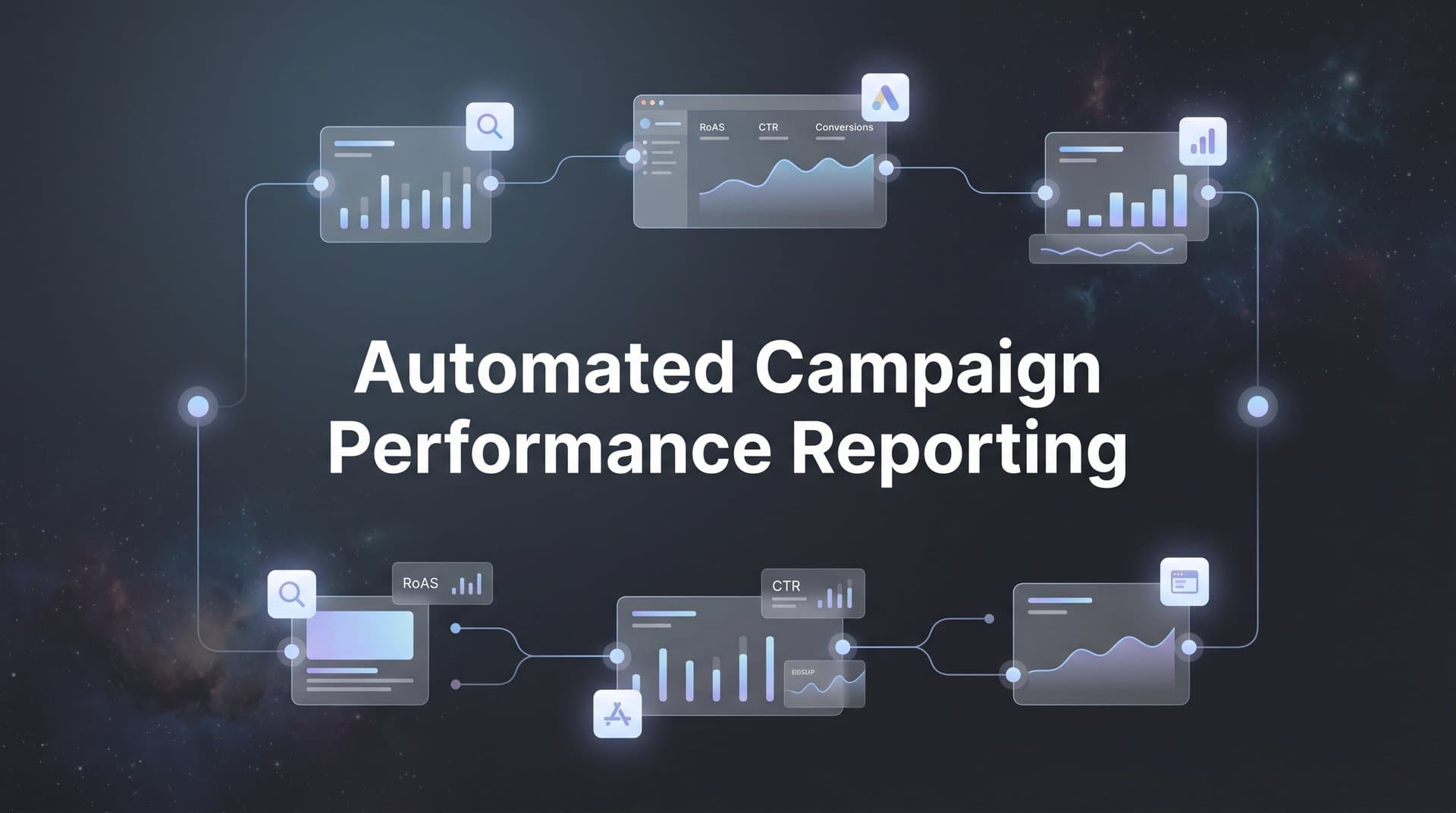
Automated campaign performance reporting changes this entirely. Instead of pulling data by hand, systems automatically connect to your ad platforms, normalize the data, and surface the insights you need, in real time, without the copy-paste chaos. The result is a reporting process that works for your team rather than against it.
In this article, you'll understand exactly how automated reporting works, what components to look for in a solution, which metrics belong in every report, and how to put the whole system into practice across your campaigns.
Why Manual Reporting Is Holding Your Marketing Team Back
Let's be honest about the cost of manual reporting. It's not just inconvenient. It actively slows down decision-making and introduces errors that can lead to misallocated budget and missed opportunities.
The time drain is significant. Marketing teams running campaigns across Meta, Google, TikTok, and LinkedIn are navigating four separate dashboards, each with its own interface, its own export format, and its own quirks. Pulling data from each platform, consolidating it into a single spreadsheet, and formatting it for stakeholders is a process that can consume a meaningful portion of the workweek. That's time taken directly away from the work that actually moves campaigns forward.
The error rate is higher than most teams realize. Copy-paste workflows are inherently fragile. A misaligned row in a spreadsheet, a metric pulled from the wrong date range, or a conversion definition that differs between platforms can quietly corrupt an entire report. And because these errors are hard to spot at a glance, they often go undetected until a decision has already been made based on flawed data. Many teams still rely on a marketing campaign tracking spreadsheet that compounds these risks at scale.
This is compounded by the fact that different ad platforms define metrics differently. Meta may count a conversion within a 7-day click window. Google might use a 30-day window by default. If you're comparing these numbers side by side without normalizing the attribution windows, you're not comparing apples to apples. You're comparing apples to something that looks like an apple but behaves completely differently.
Stale data creates delayed reactions. In paid advertising, timing matters. A campaign that starts underperforming on Tuesday shouldn't still be running at full spend on Friday because no one noticed until the weekly report was compiled. Manual reporting creates a lag between when something happens in your campaigns and when your team becomes aware of it. That lag has a real cost, measured in wasted budget and missed opportunities to redirect spend toward what's working.
The underlying issue is structural. Manual reporting treats data collection as a task to be completed rather than a continuous process. Automated reporting flips that model entirely.
The Building Blocks of Automated Campaign Performance Reporting
Understanding how automated reporting works under the hood helps you evaluate solutions more effectively and set realistic expectations for what the technology can do. At its core, an automated reporting system has three essential components: data connectors, processing and normalization, and delivery mechanisms.
Data connectors and integrations are the foundation. These are the technical bridges that allow a reporting platform to pull data directly from your ad platforms, CRM, and analytics tools without manual exports. A robust system will connect natively to Meta Ads, Google Ads, TikTok Ads, LinkedIn Ads, and other channels, as well as to your CRM and website tracking. This creates a single source of truth where all your campaign data lives together, rather than scattered across separate platforms. Choosing the right performance marketing reporting software is critical to getting these integrations right.
The quality of these integrations matters. Some systems rely on API connections that refresh data on a delay. Others use more sophisticated methods to pull data closer to real time. When evaluating a solution, pay attention to how frequently data is updated and whether the integration covers the specific platforms in your stack.
Real-time data processing and normalization is where the heavy lifting happens. Raw data from different platforms arrives in different formats with different metric definitions. A good automated reporting system handles the translation work, mapping platform-specific metrics to consistent definitions so you can make meaningful comparisons across channels.
Server-side tracking plays a critical role here. With the decline of third-party cookies and the impact of iOS privacy changes, client-side tracking has become less reliable. Server-side tracking captures conversion events directly from your server rather than relying on browser-based signals, which means more conversions are recorded accurately. This directly improves the quality of your automated reports because the underlying data is more complete.
Scheduled delivery and dynamic dashboards are how the processed data reaches the people who need it. Automated reporting systems typically offer two modes of access. First, scheduled reports that are pushed to stakeholders via email or Slack on a defined cadence, such as daily performance summaries or weekly executive reviews. Second, live dashboards that are always current and can be accessed on demand by anyone with the right permissions. A well-designed marketing performance dashboard makes this real-time access seamless for every team member.
The best systems support both. Executives who want a weekly digest get it automatically. Media buyers who need to check campaign performance at 9 AM before making bid adjustments can pull up a live dashboard without waiting for anyone to compile data. Everyone gets what they need, when they need it, without creating work for anyone else.
Key Metrics That Belong in Every Automated Report
Automated reporting is only as useful as the metrics it surfaces. Building a report around the wrong numbers, or including too many numbers without prioritization, creates noise instead of clarity. The metrics in your automated reports should tell a coherent story about what your campaigns are doing and where you should focus next.
Revenue-focused metrics anchor everything to business outcomes. Return on ad spend (ROAS) tells you how much revenue you're generating for every dollar spent on advertising. Cost per acquisition (CPA) tells you what it costs to win a customer or generate a lead. When these metrics are tied back to specific campaigns, ad sets, and channels, they give you the information you need to make budget allocation decisions with confidence. Understanding the right campaign performance metrics is essential for building reports that drive action.
Customer lifetime value is worth including if your data infrastructure supports it. A campaign that generates customers with high lifetime value may look less efficient on a CPA basis but be far more valuable in the long run. Connecting your CRM data to your reporting system is what makes this kind of analysis possible.
Funnel-stage metrics show you where the journey breaks down. Click-through rate tells you whether your creative and targeting are generating interest. Conversion rate tells you whether your landing pages and offers are compelling enough to turn that interest into action. Lead quality indicators, such as lead-to-opportunity rate or lead-to-close rate pulled from your CRM, tell you whether the people coming through your campaigns are actually worth having.
Tracking these metrics together across the funnel helps you diagnose problems accurately. A low conversion rate combined with a healthy CTR points to a landing page or offer problem. A high conversion rate with a low lead quality score points to a targeting or audience problem. Without funnel visibility, you're guessing at the cause of underperformance. Learning how to evaluate marketing performance metrics systematically prevents this kind of guesswork.
Cross-channel comparison metrics are where multi-touch attribution becomes essential. Most ad platforms default to last-click attribution, which gives full credit for a conversion to the final touchpoint before the purchase. This systematically undervalues channels that play important roles earlier in the customer journey, such as awareness-stage social ads or branded search.
Multi-touch attribution distributes credit across all the touchpoints that contributed to a conversion, giving you a more accurate picture of how your channels work together. When this data is included in your automated reports, you can see which combinations of channels drive the highest quality conversions, not just which channel happened to be last in the sequence. This changes how you think about budget allocation across your entire marketing mix.
From Raw Data to Actionable Insights: How AI Elevates Reporting
There's a meaningful difference between a report that shows you what happened and a system that tells you what to do about it. AI-powered reporting bridges that gap, transforming data from a retrospective record into an active decision-support tool.
Anomaly detection catches problems before they become expensive. When you're running campaigns across multiple platforms with dozens of ad sets, it's impossible to manually monitor every metric at every moment. AI-powered systems can continuously scan your performance data and flag significant deviations from expected patterns. If your CPA on a specific campaign suddenly spikes, or if conversion rates drop sharply on a previously strong ad set, an automated alert surfaces that information immediately rather than waiting for the next scheduled report.
This kind of early warning system has real value. Catching a budget-draining issue on day one rather than day five can preserve meaningful spend that would otherwise be wasted. It also gives media buyers the ability to act quickly, pausing underperformers or reallocating budget before the damage compounds. This is a core part of improving ad campaign performance in a scalable way.
AI-generated optimization recommendations move beyond flagging problems to suggesting solutions. By analyzing patterns across campaigns, audiences, creatives, and channels, AI can identify which elements are driving strong performance and which are dragging results down. This might surface as a recommendation to shift budget from one campaign to another, adjust bidding strategy on a specific ad set, or test a new audience segment that mirrors the characteristics of your highest-converting customers.
These recommendations don't replace the judgment of an experienced media buyer, but they do give that person a much better starting point. Instead of spending time searching for insights in a sea of data, the media buyer can evaluate specific, data-backed suggestions and make faster decisions.
Feeding better data back to ad platforms creates a virtuous cycle. This is one of the most underappreciated aspects of modern attribution platforms. When you capture enriched conversion data through server-side tracking and send it back to Meta via the Conversions API or to Google via offline conversion imports, you're giving those platforms' algorithms more accurate information to work with. Understanding which attribution model is best for optimizing ad campaigns is key to making this feedback loop effective.
Better conversion data means better targeting, because the platform's algorithm has a clearer picture of who actually converts and can find more people like them. Better targeting means better campaign performance. Better campaign performance generates better data for your reports. The whole system improves over time, and it starts with the quality of the conversion signals you're sending back to the platforms.
Cometly's Conversion Sync is built specifically to power this feedback loop, ensuring that enriched, conversion-ready events are sent back to Meta, Google, and other platforms so their algorithms can optimize more effectively on your behalf.
Setting Up Automated Reporting for Your Ad Campaigns: A Step-by-Step Approach
Knowing why automated reporting matters is one thing. Actually implementing it requires a structured approach. Here's how to build a reporting system that works from day one and scales as your campaigns grow.
Step 1: Audit your data sources and connect everything into one platform. Before you can automate anything, you need to know what you're working with. Make a list of every platform generating data that matters to your reporting: your ad platforms, your CRM, your website analytics, and any offline conversion sources. Then connect all of these to a single attribution platform that can serve as your central source of truth.
This step also includes setting up server-side tracking if you haven't already. Client-side tracking alone is no longer sufficient for accurate conversion data, especially given the impact of iOS privacy changes on browser-based signals. Getting your tracking infrastructure right at this stage means everything downstream, including your automated reports, will be built on accurate data. Investing in the right marketing campaign tracking software makes this foundation significantly easier to establish.
Don't skip UTM hygiene. Consistent UTM parameters across all your campaigns are what allow your reporting system to correctly attribute traffic and conversions to the right sources. If your UTM naming conventions are inconsistent, your reports will reflect that inconsistency.
Step 2: Define your KPIs and build report templates for different audiences. Not everyone who looks at your reports needs the same information. Executives want to understand revenue impact and overall return on investment. They need high-level summaries that connect ad spend to business outcomes without overwhelming detail. Media buyers need granular, ad-level data, including creative performance, audience breakdowns, and placement-level metrics, so they can make specific optimization decisions.
Build separate report templates for each audience. Define the KPIs that belong in each template and make sure everyone agrees on how those metrics are defined before the reports go live. This prevents the confusion that arises when different stakeholders are looking at different numbers and drawing different conclusions.
Step 3: Establish your reporting cadence, set performance alerts, and plan for iteration. Decide how often each stakeholder group needs a report. Daily summaries work well for active media buyers monitoring campaign performance. Weekly digests work better for marketing managers reviewing trends. Monthly or quarterly summaries serve executives and leadership teams focused on strategic allocation.
Set up performance threshold alerts in addition to scheduled reports. Define the conditions that should trigger an immediate notification, such as CPA exceeding a certain threshold, conversion rate dropping below a baseline, or daily spend pacing significantly off target. These alerts act as your early warning system between scheduled reports.
Finally, plan to iterate. Your first set of dashboards won't be perfect, and that's fine. As you learn which metrics your stakeholders actually use and which ones they ignore, refine your templates. As your campaigns evolve, update your KPIs and attribution models to reflect current priorities.
Common Pitfalls and How to Avoid Them
Automated reporting is a significant upgrade over manual processes, but it comes with its own set of traps. Knowing where teams commonly go wrong helps you avoid the same mistakes.
Over-relying on vanity metrics is the most common mistake. Impressions, reach, and follower counts are easy to track and easy to report, but they rarely connect to revenue. When you automate the delivery of metrics that don't drive decisions, you're just automating noise. Build your reports around metrics that are directly tied to business outcomes: revenue, CPA, ROAS, and conversion rates. If a metric doesn't help someone make a better decision, consider whether it belongs in the report at all. Focusing on measuring marketing campaign effectiveness rather than surface-level stats keeps your reporting grounded in what matters.
Automation amplifies bad data. If your tracking is broken, your UTMs are inconsistent, or your conversion events are misfiring, automating the reporting process will surface those errors faster and at greater scale. Garbage in, garbage out, and now it's delivered automatically to your entire stakeholder list. Before you automate anything, audit your data sources, verify your tracking setup, and confirm that your conversion events are firing correctly. Server-side tracking, proper UTM conventions, and regular data quality checks are prerequisites, not optional extras.
The set-it-and-forget-it mentality will eventually catch up with you. Automated reporting reduces the manual effort required to maintain reports, but it doesn't eliminate the need for human oversight. Attribution models need to be reviewed periodically to ensure they still reflect how your customers actually make decisions. Metric definitions may need to be updated as your business evolves. Stakeholder needs change as priorities shift. Schedule regular reviews of your reporting setup, at least quarterly, to make sure the system is still aligned with current goals and accurately reflecting campaign performance.
The teams that get the most out of automated reporting are the ones who treat it as a living system rather than a one-time project.
The Bottom Line: Reporting That Actually Drives Results
Automated campaign performance reporting is not just about saving time, although it does that too. It's about giving your team the real-time visibility and data confidence they need to make faster, smarter decisions about where to allocate budget and how to optimize campaigns.
When you eliminate the manual data wrangling, you free up your team to focus on strategy and optimization. When you replace stale weekly reports with live dashboards and real-time alerts, you stop reacting to problems after the fact and start getting ahead of them. When you incorporate multi-touch attribution into your reporting, you stop rewarding the last click and start understanding the full customer journey.
Cometly brings all of these capabilities together in one platform. Multi-touch attribution gives you an accurate view of which channels and campaigns are actually driving conversions. Server-side tracking ensures your data is complete and accurate even in a privacy-first environment. AI-powered recommendations surface optimization opportunities before they become obvious. And Conversion Sync feeds enriched conversion events back to Meta, Google, and other platforms so their algorithms can work harder for you.
The result is a reporting system that doesn't just tell you what happened. It helps you understand why it happened and what to do next.
Ready to elevate your marketing game with precision and confidence? Discover how Cometly's AI-driven recommendations can transform your ad strategy. Get your free demo today and start capturing every touchpoint to maximize your conversions.