Running paid campaigns across Meta, Google, TikTok, LinkedIn, and beyond is now standard practice for growth-focused marketing teams. But the data problem that comes with it is real: each platform reports its own conversions, attribution overlaps, and your actual revenue numbers rarely match what the dashboards claim. Siloed platform data leads to duplicated conversions, misattributed revenue, and budgets allocated to channels that look good on paper but underperform in reality.
A cross channel analytics platform solves this by pulling data from every touchpoint into a unified view, applying consistent attribution logic, and showing you the full customer journey from first click to closed deal. Instead of toggling between five dashboards and manually reconciling numbers, you get one source of truth.
The tools on this list were selected based on multi-platform data integration, attribution modeling depth, real-time reporting capabilities, ease of setup, and pricing transparency. Whether you need a full attribution platform, a behavioral analytics tool, or a data pipeline, there's a solution here for your stack. Here are the top cross channel analytics platforms worth your attention in 2026.
1. Cometly
Best for: Marketing teams and agencies focused on accurate paid ad attribution and AI-driven campaign optimization.
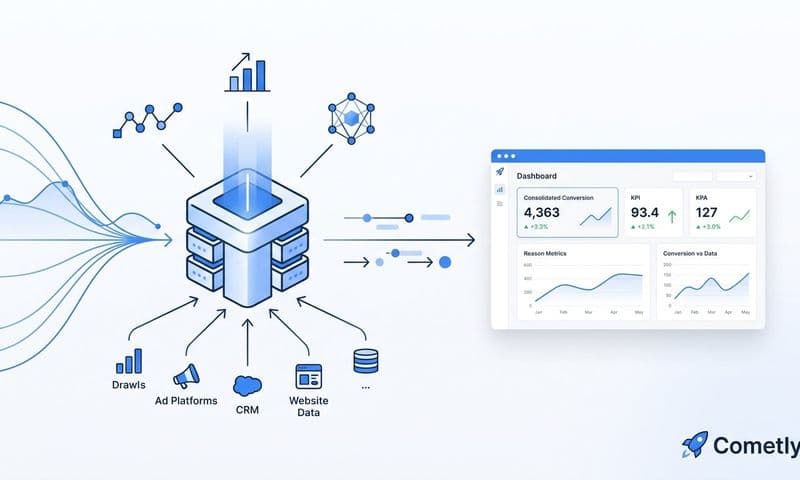
Cometly is an AI-powered marketing attribution platform that connects your ad platforms, CRM, and website to show exactly which ads and channels are driving revenue.
 9 Best Cross Channel Analytics Platforms in 2026
Where This Tool Shines
Cometly is built for the reality of modern paid advertising: fragmented data, browser tracking restrictions, and platform-reported numbers that rarely add up. Its server-side tracking captures conversion data that client-side pixels miss, giving you a more accurate picture of what's actually happening across your campaigns.
What sets Cometly apart is the combination of attribution accuracy and AI-driven action. Rather than just showing you data, it identifies which ads and campaigns are performing best and surfaces recommendations you can act on. The analytics dashboard brings everything together in one place, so you're not piecing together insights from multiple tools.
Key Features
Multi-Touch Attribution: Compare multiple attribution models side by side to understand how each channel contributes across the full customer journey.
Server-Side Tracking: Accurate data collection that works around browser restrictions and iOS privacy changes, so fewer conversions fall through the cracks.
Conversion Sync: Feeds enriched, conversion-ready event data back to Meta, Google, and other ad platforms to improve their targeting algorithms and ad ROI.
AI-Powered Recommendations: Automatically identifies top-performing ads and campaigns across every channel so you can scale what's working with confidence.
AI Chat: Natural language interface that lets you query your marketing data without writing a single SQL query or building a custom report.
Best For
Cometly is a strong fit for performance marketers, DTC brands, and agencies managing paid campaigns across multiple platforms who need accurate attribution data and actionable AI-driven insights. It's especially valuable for teams frustrated by the gap between platform-reported conversions and actual revenue.
Pricing
Custom pricing based on ad spend. Request a demo directly through the Cometly website to get details tailored to your team's needs.
2. Google Analytics 4
Best for: Teams already in the Google ecosystem looking for free, event-based cross-channel tracking.
Google Analytics 4 is Google's event-based analytics platform for tracking user interactions across websites and apps with built-in cross-channel reporting.
 11 Best Marketing Analytics Tools to Track and Optimize Campaign Performance in 2026
Where This Tool Shines
GA4's event-based data model is a significant upgrade from its predecessor, capturing granular user interactions that session-based tracking would miss. Its cross-device reporting and native Google Ads integration make it a natural fit for teams running Google campaigns who want to connect ad clicks to on-site behavior without complex setup.
The free tier is genuinely capable for small to mid-sized teams. Machine learning-powered predictive metrics add a layer of forward-looking insight that most free tools simply don't offer. The tradeoff is that GA4's interface has a steep learning curve, and its attribution capabilities are more limited compared to dedicated attribution platforms.
Key Features
Event-Based Data Model: Replaces session-based tracking with flexible event tracking for more precise user behavior analysis.
Cross-Device Tracking: Stitches together user journeys across devices and platforms using Google's identity graph.
Google Ads and BigQuery Integration: Native connections to Google's ad and data infrastructure make data export and analysis straightforward.
Predictive Metrics: Machine learning models surface purchase probability and churn likelihood to help prioritize audiences.
Free Tier: Generous data limits at no cost, with a 360 enterprise upgrade available for larger organizations.
Best For
Budget-conscious teams primarily running Google Ads who want solid web analytics and basic cross-channel reporting without paying for a dedicated attribution platform. Less ideal for teams running heavy spend across non-Google channels who need deeper attribution accuracy.
Pricing
Free for standard use. GA4 360 (enterprise tier) starts at approximately $50,000 per year, billed annually.
3. Triple Whale
Best for: Shopify-based ecommerce brands running paid ads across multiple channels who need real-time profit visibility.
Triple Whale is an ecommerce-focused analytics and attribution platform built primarily for Shopify brands managing paid advertising at scale.
 7 Best Funnel.io Alternatives for Marketing Data Analytics in 2026
Where This Tool Shines
Triple Whale was designed with ecommerce operators in mind, and it shows. The real-time profit and loss dashboard gives brands a live view of contribution margin, ad spend, and revenue in one place, something generic analytics tools simply don't provide. Creative analytics is another standout feature, helping teams understand which ad creatives are driving the most efficient conversions rather than just the most clicks.
Its first-party pixel and server-side tracking help recover conversion data lost to iOS privacy changes, making attribution more reliable for brands running heavy Meta spend. The Shopify-native integration means setup is relatively quick compared to more infrastructure-heavy platforms.
Key Features
First-Party Pixel: Server-side tracking that captures conversions more accurately despite browser and iOS restrictions.
Creative Analytics: Measures the performance of individual ad creatives across channels to inform content strategy.
Real-Time P&L Dashboard: Live view of revenue, ad spend, and profit margins across the business.
Multi-Touch Attribution: Customizable attribution models to understand how channels work together to drive purchases.
Shopify Integration: Native connection to Shopify order and customer data for accurate revenue attribution.
Best For
Shopify brands with meaningful paid ad budgets who want ecommerce-specific attribution, creative performance data, and real-time profitability in one dashboard. Less suited for B2B teams or brands on non-Shopify platforms.
Pricing
Starts around $100 per month and scales with revenue. Pricing tiers are available on the Triple Whale website.
4. Northbeam
Best for: DTC and ecommerce brands that need machine learning-based attribution and media mix modeling for budget allocation.
Northbeam is an attribution and media mix modeling platform that uses machine learning to help brands understand true channel performance beyond last-click reporting.
 9 Best Attribution Modeling Tools for Enterprises in 2026
Where This Tool Shines
Northbeam goes deeper than most attribution tools by combining multi-touch attribution with media mix modeling, giving brands both touchpoint-level insight and a macro view of how channel mix affects overall performance. This dual approach is particularly useful for brands spending across a wide range of channels where understanding incrementality matters as much as attribution.
Incrementality testing is built into the platform, allowing teams to measure the true lift of a channel rather than relying solely on modeled attribution. This is increasingly important as privacy changes make deterministic tracking harder across the board.
Key Features
ML-Based Multi-Touch Attribution: Machine learning models distribute credit across touchpoints based on actual contribution patterns, not fixed rules.
Media Mix Modeling: Provides budget allocation insights based on the relationship between spend and revenue at the channel level.
Incrementality Testing: Measures the true lift generated by a channel or campaign beyond what would have happened organically.
Cross-Channel Creative Analytics: Evaluates creative performance across platforms to guide content investment decisions.
Customizable Attribution Windows: Flexible lookback windows to match the reality of different sales cycles and buying behaviors.
Best For
Mid-to-large DTC and ecommerce brands with significant cross-channel ad spend who want sophisticated attribution modeling and incrementality measurement. Best suited for teams with some analytics maturity who can act on nuanced data.
Pricing
Custom pricing; typically starts in the mid-hundreds per month. Contact Northbeam directly for a quote based on your ad spend and data volume.
5. Segment (by Twilio)
Best for: Engineering and data teams building a unified customer data infrastructure to power analytics and marketing tools.
Segment is a customer data platform that collects, cleans, and routes user data from every touchpoint to analytics tools, data warehouses, and marketing platforms.
 8 Best Attribution-Focused Platforms vs Segment: Which Approach Fits Your Marketing Stack in 2026
Where This Tool Shines
Segment operates at the data infrastructure layer rather than the reporting layer. Instead of giving you a dashboard, it ensures that every tool in your stack receives clean, consistent, and complete data. For teams running multiple analytics and marketing tools, this eliminates the fragmentation problem at its root by creating a single data collection layer that feeds everything else.
Identity resolution is a core strength, stitching together anonymous and known user profiles across devices and sessions. This gives downstream tools a more complete picture of each customer, which directly improves attribution accuracy and personalization quality.
Key Features
Unified Customer Profiles: Combines data from 400+ sources into a single customer profile for each user.
Real-Time Data Routing: Sends event data to analytics platforms, ad tools, and data warehouses simultaneously in real time.
Identity Resolution: Links anonymous and identified user activity across devices and channels into cohesive profiles.
Privacy and Consent Management: Built-in controls to manage data collection in line with user consent preferences.
Data Quality Protocols: Enforces consistent event naming and schema standards across your entire data pipeline.
Best For
Companies with technical resources who want to build a scalable customer data foundation. Ideal when you're running multiple analytics and marketing tools and need consistent data flowing into all of them. Less suited for teams looking for a self-serve reporting solution without engineering support.
Pricing
Free tier available. Team plan starts at $120 per month. Business plan is custom pricing based on data volume and destinations.
6. Mixpanel
Best for: Product and growth teams that need deep behavioral analytics, funnel analysis, and retention tracking.
Mixpanel is a product and behavioral analytics platform that tracks user events across web and mobile to help teams understand engagement, retention, and conversion patterns.
 9 Best AI Marketing Analytics Tools in 2026
Where This Tool Shines
Mixpanel excels at answering the "what are users actually doing?" question. Its event-based model lets teams define and track any interaction, then analyze those events through funnels, cohorts, and retention curves without writing a line of SQL. For product-led growth teams, this level of behavioral insight is essential for understanding where users drop off and what drives long-term retention.
The self-serve query builder is genuinely powerful for non-technical users. Interactive dashboards update in real time, making it easy to share insights across teams without waiting on data analysts to pull reports.
Key Features
Flexible Event Tracking: Define and capture any user interaction with a customizable taxonomy that fits your product's logic.
Funnel Analysis: Visualize conversion rates at every step of a user flow with breakdown by user properties or cohorts.
Retention and Cohort Analysis: Understand how different user segments retain over time and what behaviors correlate with long-term engagement.
Self-Serve Query Builder: Build complex analyses through a visual interface without SQL knowledge required.
Real-Time Dashboards: Live data updates with interactive charts that can be shared across the organization.
Best For
SaaS companies, mobile apps, and product-led growth teams that need deep behavioral analytics. Mixpanel is less focused on paid ad attribution and more on understanding in-product user behavior and lifecycle patterns.
Pricing
Free tier supports up to 20 million events per month. Growth plan starts at $20 per month. Enterprise pricing is custom.
7. Adobe Analytics
Best for: Enterprise organizations that need advanced segmentation, custom attribution, and deep integration with a broader marketing technology stack.
Adobe Analytics is an enterprise-grade digital analytics platform offering advanced segmentation, attribution modeling, and AI-powered insights across web, mobile, and offline channels.
Where This Tool Shines
Adobe Analytics is built for scale and complexity. Its Analysis Workspace gives analysts a drag-and-drop environment for building custom reports and visualizations without relying on engineering. The platform handles data from web, mobile, call centers, and offline sources, making it one of the few tools that can genuinely unify digital and offline customer data at enterprise scale.
AI-powered anomaly detection and contribution analysis automatically surface unusual patterns in your data and help identify what's driving them. For large organizations with dedicated analytics teams, this accelerates time-to-insight significantly.
Key Features
Advanced Segmentation: Unlimited breakdown dimensions and segment combinations for granular audience analysis.
AI Anomaly Detection: Automatically flags statistical anomalies and helps identify contributing factors without manual investigation.
Cross-Channel Data Collection: Ingests data from web, mobile, offline, and third-party sources into a unified dataset.
Adobe Experience Cloud Integration: Deep connections with Adobe's broader marketing suite including Target, Campaign, and Audience Manager.
Analysis Workspace: Drag-and-drop report builder with freeform tables, flow diagrams, and cohort analysis tools.
Best For
Large enterprises with dedicated analytics teams, complex data environments, and existing investment in the Adobe ecosystem. The platform's power comes with significant cost and implementation complexity, making it less practical for small or mid-sized teams.
Pricing
Custom enterprise pricing with annual contracts. Contact Adobe directly for a quote. Typically positioned for organizations with substantial analytics budgets.
8. Supermetrics
Best for: Marketing teams that want to centralize cross-channel ad data into spreadsheets, dashboards, or data warehouses without engineering support.
Supermetrics is a marketing data pipeline tool that pulls data from 150+ advertising and analytics platforms into the reporting environments your team already uses.
Where This Tool Shines
Supermetrics sits in the data aggregation layer rather than the analytics layer. It doesn't analyze your data for you, but it makes sure your data is in the right place for analysis. For marketing teams that live in Google Sheets, Looker Studio, or Excel, Supermetrics removes the manual export-and-paste workflow that consumes hours every week.
The breadth of connectors is a genuine differentiator. With 150+ data sources covering virtually every major ad platform and analytics tool, Supermetrics can consolidate your entire marketing data footprint without custom integrations or developer involvement.
Key Features
150+ Data Source Connectors: Pulls data from virtually every major ad platform, analytics tool, and CRM into your preferred destination.
Reporting Integrations: Direct connections to Looker Studio, Google Sheets, Microsoft Excel, and BigQuery for flexible reporting setups.
Automated Data Refresh: Scheduled data pulls keep your reports and dashboards current without manual intervention.
Custom Metric Calculations: Blend and transform data from multiple sources using calculated fields and custom formulas.
No Engineering Required: Self-serve setup designed for marketers, not data engineers.
Best For
Marketing analysts and agencies that need to consolidate cross-channel data for reporting and want to use tools they're already comfortable with. Not a replacement for a full attribution platform, but an excellent complement to one.
For agencies managing multiple client accounts, dedicated agency client reporting tools can streamline how attribution data is packaged and shared with stakeholders.
Pricing
Starts at around $39 per month per destination. Pricing scales with the number of connectors and data volume. Check the Supermetrics website for current plan details.
9. Funnel.io
Best for: Data and marketing ops teams that need an automated, no-code data hub to collect, transform, and route cross-channel marketing data.
Funnel.io is an automated marketing data hub that collects, maps, and transforms cross-channel data for analysis in any BI tool or data warehouse.
Where This Tool Shines
Funnel.io handles the unglamorous but critical work of data normalization. When you're pulling data from 20 different platforms, each with its own naming conventions and metric definitions, the resulting dataset is a mess. Funnel's no-code mapping and transformation rules let you standardize everything into a consistent schema without writing custom ETL code.
With 500+ connectors and automatic currency conversion, Funnel is particularly well-suited for enterprise marketing teams and agencies managing international campaigns across dozens of platforms. The ability to backfill historical data is a meaningful advantage when onboarding new data sources mid-campaign.
Key Features
500+ Data Source Connectors: One of the broadest connector libraries in the market, covering ad platforms, analytics tools, and CRMs.
No-Code Data Transformation: Visual mapping and transformation rules to standardize metrics and dimensions across sources.
Automatic Currency Conversion: Normalizes spend data from international campaigns into a single currency for accurate comparisons.
BI and Warehouse Destinations: Sends clean, transformed data to Looker, Tableau, BigQuery, Snowflake, and other destinations.
Historical Data Backfill: Pulls historical data when connecting new sources so your analysis isn't limited to the onboarding date.
Best For
Enterprise marketing teams and agencies with complex, multi-platform data environments who need reliable, clean data flowing into BI tools or data warehouses. The higher price point reflects its positioning as an enterprise-grade data infrastructure tool.
Pricing
Starts around $1,000 per month. Custom enterprise pricing is available for larger data volumes and additional destinations.
Which Platform Is Right for Your Team?
The right cross channel analytics platform depends on what layer of the problem you're trying to solve. Here's a quick breakdown to help you decide.
If accurate paid ad attribution and AI-driven optimization are your primary goals, Cometly is the strongest choice. It combines server-side tracking, multi-touch attribution, conversion sync, and AI recommendations into one platform built specifically for performance marketers. It's the tool that closes the gap between what ad platforms report and what's actually driving revenue.
For teams deeply embedded in the Google ecosystem with tighter budgets, Google Analytics 4 covers the fundamentals well and integrates natively with Google Ads. Triple Whale and Northbeam are the go-to options for ecommerce and DTC brands that need Shopify-native attribution or machine learning-based media mix modeling.
Segment is the right choice if your priority is building a clean, scalable customer data foundation that feeds every tool in your stack. Mixpanel serves product and growth teams focused on behavioral analytics and retention rather than paid media attribution. Adobe Analytics is the enterprise option for organizations with dedicated analytics teams and complex data environments.
Supermetrics and Funnel.io sit in the data aggregation layer, making them excellent complements to attribution and analytics platforms rather than replacements for them.
If you're running paid campaigns across multiple channels and want to know exactly which ads are driving revenue, the best place to start is with accurate attribution. Get your free demo of Cometly and see how AI-powered attribution can transform the way you allocate budget and scale your campaigns.