
You're running paid search on Google, sponsored content on LinkedIn, retargeting ads on Meta, and a nurture email sequence in the background. Leads are coming in. Pipeline is growing. But when your CFO asks which campaigns are actually driving revenue, you find yourself staring at a spreadsheet full of clicks, impressions, and cost-per-lead numbers that don't tell the full story.
This is the reality for most B2B SaaS marketing teams. You're investing across multiple channels simultaneously, your buyers are taking complex, non-linear paths to conversion, and your reporting tools are giving you channel-specific snapshots instead of a unified view of what's actually working. The result is budget decisions made on incomplete data, with real money on the line.
Campaign attribution analysis is the discipline that changes this. It's the practice of connecting your marketing campaigns to the outcomes that actually matter: qualified leads, open pipeline, and closed-won revenue. When done right, it transforms your campaign data from a collection of surface metrics into a decision-making system that tells you exactly where to invest and where to stop spending. This guide breaks down how campaign attribution analysis works, what it reveals, where it typically breaks down, and how to use it to make smarter budget decisions.
The Signal Hidden Inside Your Campaign Data
Every campaign you run generates data. Clicks, impressions, open rates, cost-per-click. These metrics are easy to collect and easy to report. But they answer the wrong question. They tell you how your campaigns performed as media buys. They don't tell you which campaigns actually influenced a buyer's decision to convert.
Campaign attribution analysis reframes the question. Instead of asking "how many clicks did this campaign get?", it asks "which campaigns touched the prospects who became customers?" That shift in framing is everything. It moves your analysis from measuring activity to measuring influence.
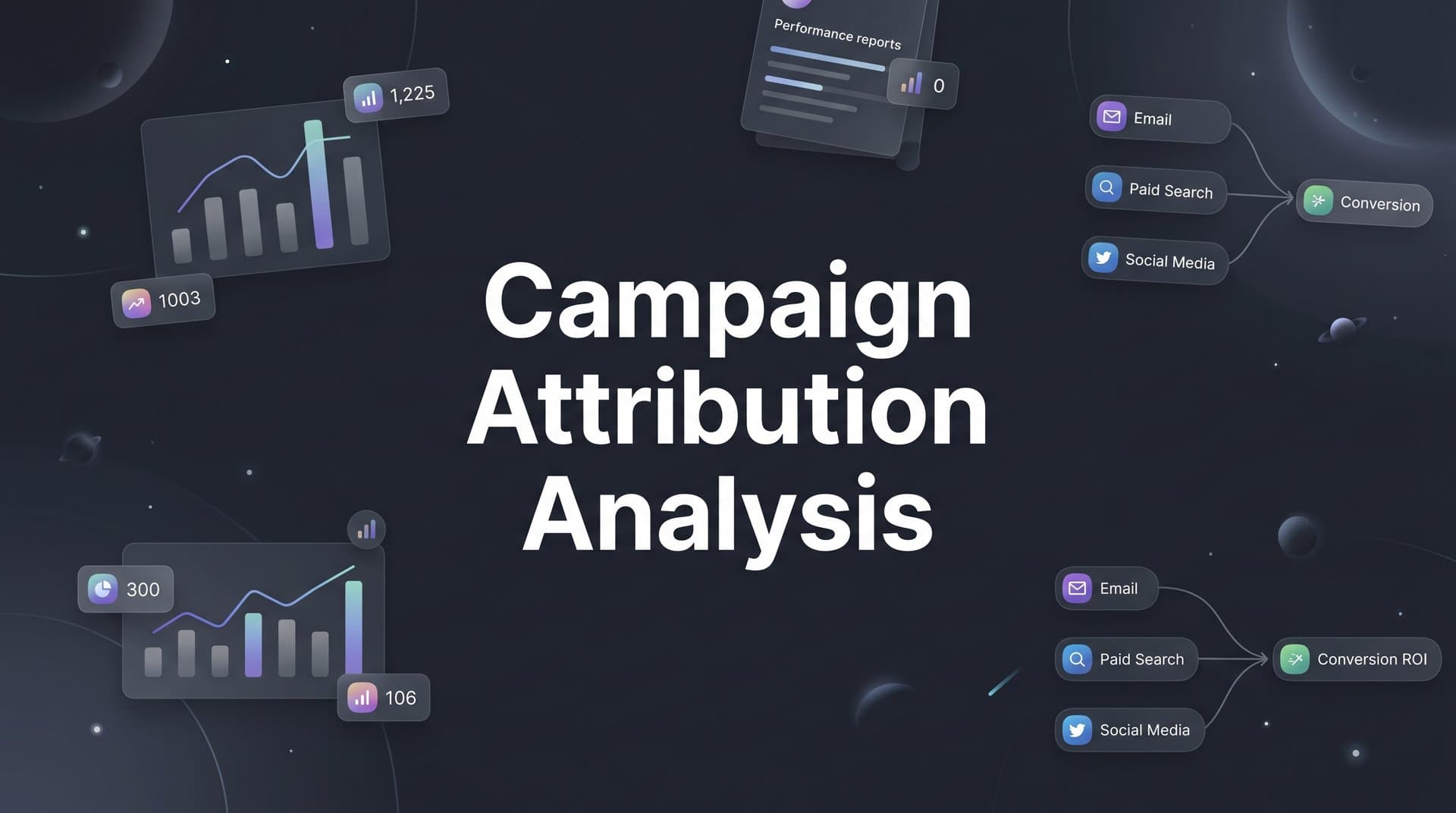
The reason this matters so much in B2B SaaS is the nature of the buying journey. B2B buyers rarely convert on a single touchpoint. A prospect might encounter a LinkedIn ad that introduces your brand, then read a comparison article through organic search, then engage with a retargeting ad on Meta, then attend a webinar, and finally convert after receiving a direct email. Each of those touchpoints played a role. If you're only measuring last-click conversions, you're crediting the email and ignoring every campaign that built the relationship leading up to it.
This is why surface-level metrics create dangerous blind spots. A campaign with a low click-through rate might be consistently present in the journeys of your highest-value customers. A campaign with a high CTR might be driving a lot of traffic that never converts to pipeline. Without attribution analysis, you can't tell the difference.
The signal that actually matters is buried in the relationship between touchpoints and outcomes. Campaign attribution analysis is the process of surfacing that signal systematically, so your budget decisions are based on revenue influence rather than engagement volume.
The Mechanics Behind Accurate Attribution
Understanding how campaign attribution analysis works mechanically helps you identify where your current setup might be creating gaps. At its core, the process involves three layers: capturing touchpoints, connecting them to conversion events, and applying a model that distributes credit across those touchpoints.
Touchpoint capture starts with UTM parameters. Every campaign URL should carry UTM tags that identify the source, medium, campaign name, and ad content. When a prospect clicks a tagged link and eventually converts, your attribution system can trace that conversion back to the specific campaign that drove the click. Consistent UTM naming conventions are non-negotiable here. Inconsistent or missing UTMs create gaps in your data that make attribution analysis unreliable.
Pixel tracking adds another layer. A tracking pixel placed on your website fires events when visitors take specific actions: viewing a pricing page, starting a trial, submitting a form. These events are sent to ad platforms and analytics tools, creating a record of what happened after the click. The challenge is that browser-based pixel tracking has become increasingly unreliable. Ad blockers, browser privacy restrictions, and iOS privacy changes all reduce the volume of events that make it back to your ad platforms.
This is where server-side event tracking becomes critical. Rather than relying on a browser to fire an event, server-side tracking sends conversion data directly from your server to ad platforms and analytics systems. This approach uses first-party data and is far less vulnerable to browser restrictions. When combined with Conversion API integrations for platforms like Meta and Google, it ensures that the conversion signals you're sending are complete and accurate.
The final layer is connecting your campaign touchpoints to your CRM. This is what separates campaign attribution analysis from standard ad reporting. When a lead converts, their touchpoint history needs to travel with them into your CRM so you can track what happens downstream: do they become an opportunity? Do they close? What was the deal value? Without this connection, you can measure cost-per-lead but never cost-per-revenue.
Once your touchpoint data is clean and connected to downstream outcomes, attribution models determine how credit is assigned across the journey. That's where the analysis gets genuinely powerful. A well-structured attribution tracking setup is the foundation that makes everything downstream reliable.
The Attribution Models That Shape Your Analysis
Attribution models are the logic layer of campaign attribution analysis. They take the same set of touchpoint data and distribute conversion credit differently depending on the question you're trying to answer. Choosing the right model is not a technical detail. It fundamentally changes what your analysis reveals and which campaigns appear to be performing.
First-Touch Attribution: This model assigns 100% of the conversion credit to the first campaign touchpoint in a buyer's journey. It's useful for understanding which campaigns are generating awareness and bringing new prospects into your funnel. For B2B SaaS teams focused on top-of-funnel demand generation, first-touch attribution helps identify which channels are most effective at introducing your brand to the right audience.
Last-Touch Attribution: This model assigns all credit to the final touchpoint before conversion. It's the default in many ad platforms and analytics tools, which makes it the most commonly used model by default rather than by design. Last-touch is useful for identifying which campaigns are closing deals, but it systematically undervalues every campaign that built the relationship earlier in the journey.
Linear Attribution: Linear models distribute credit equally across every touchpoint in the buyer's journey. A prospect who engaged with five campaigns before converting would give each campaign 20% of the credit. This approach acknowledges the multi-touch reality of B2B buying without making assumptions about which touchpoints were more influential than others.
Data-Driven Attribution: This is the most sophisticated approach. Rather than applying a fixed rule, data-driven models use algorithmic weighting based on actual conversion patterns in your data. Touchpoints that appear more frequently in journeys that convert to revenue receive more credit than touchpoints that appear in journeys that don't. This model requires sufficient conversion volume to generate reliable patterns, but it produces the most accurate picture of campaign influence.
The risk of relying on a single model is significant. A campaign that appears to be underperforming under last-touch attribution may be one of your most important pipeline drivers when viewed through a multi-touch lens. B2B SaaS sales cycles are long and complex, which means the campaigns doing the heavy lifting in the middle of the funnel are often invisible in last-touch reporting. Running your analysis through multiple models, or using a data-driven model as your primary lens, gives you a more complete view of what's actually contributing to revenue.
What Standard Reporting Leaves on the Table
Ad platform dashboards are built to show you how campaigns perform within that platform's ecosystem. Google Ads shows you what happened after someone clicked a Google ad. Meta Ads Manager shows you what happened after someone engaged with a Meta ad. Each platform reports its own contribution in isolation, and each platform has an incentive to show its own numbers in the best possible light.
The result is a fragmented picture where the total attributed conversions across all your platforms often exceeds your actual conversion volume. This is the double-counting problem. When a prospect clicks a LinkedIn ad, then a Google ad, then converts, both platforms may claim that conversion as their own. Your actual conversion happened once. Your reporting is showing it twice.
Campaign attribution analysis solves this by creating a single source of truth. Instead of accepting each platform's self-reported attribution, a unified attribution system ingests data from all channels and applies consistent credit logic across the entire journey. This gives you an accurate, cross-channel view of campaign ROI that no single platform dashboard can provide.
Beyond eliminating double-counting, attribution analysis exposes a distinction that standard reporting almost never surfaces: the difference between campaigns that drive lead volume and campaigns that drive revenue. A campaign might generate a high volume of form fills while attracting prospects who are poorly qualified and rarely convert to closed-won deals. Another campaign might generate fewer leads but consistently produce high-value opportunities. Without connecting campaign touchpoints to CRM data and downstream revenue, you can't see this difference. You might be scaling the wrong campaign and pausing the right one.
Pipeline attribution takes this further. By connecting campaign touchpoints not just to leads but to open opportunities, deal stages, and closed-won revenue, marketing teams can demonstrate their direct contribution to business outcomes. This is what gives marketing a seat at the revenue table rather than a seat at the activity-metrics table. When you can show that a specific campaign influenced a specific amount of closed revenue, the conversation about marketing budget changes entirely.
Common Gaps That Break Campaign Attribution Analysis
Even teams that understand attribution analysis conceptually often struggle with data integrity problems that undermine their results. Knowing where these gaps typically occur is the first step to fixing them.
Broken or Inconsistent UTM Tracking: UTM parameters are only useful if they're applied consistently across every campaign and every channel. A single campaign URL without proper UTM tags creates a gap in your data. When these gaps accumulate, a growing share of your traffic gets attributed to "direct" or "unknown," making it impossible to understand which campaigns drove those sessions.
Pixel Data Loss: Browser-based tracking has become less reliable as privacy protections have strengthened. Ad blockers, browser-level tracking prevention, and mobile privacy settings all reduce the number of conversion events that make it back to your ad platforms. The result is underreported conversions and ad platform algorithms that are optimizing on incomplete data.
Siloed Platform Attribution: Relying on Meta Ads Manager, Google Ads, and LinkedIn Campaign Manager as your primary attribution sources means accepting each platform's self-reported data as truth. These platforms don't communicate with each other, which means cross-channel journeys are invisible in their reporting. Every platform claims more credit than it deserves, and you have no way to reconcile the numbers.
Disconnected CRM Data: If your ad platform data and your CRM data live in separate systems with no reliable way to connect them, you can measure cost-per-lead but never cost-per-revenue. Lead records need to carry their campaign touchpoint history into your CRM so you can track what happens downstream.
Server-side tracking and Conversion API integrations address the most critical of these gaps. By sending enriched, first-party conversion events directly from your server to ad platforms, you bypass the browser-level restrictions that cause data loss. This means your ad platform algorithms are receiving more complete conversion signals, which improves their targeting and optimization. It also means your attribution data is more accurate, which improves your own analysis and budget decisions. Teams that want to go deeper on diagnosing these issues should review the most common attribution challenges in marketing before rebuilding their tracking stack.
Turning Attribution Analysis Into Campaign Decisions
Attribution analysis is only valuable if it changes how you allocate budget and manage campaigns. The goal is not a more interesting report. The goal is better decisions.
The most direct application is budget reallocation. When your attribution data shows which campaigns are generating pipeline and closed-won revenue, and which campaigns are generating lead volume without downstream conversion, you have a clear basis for budget decisions. Scale the campaigns with strong pipeline attribution. Pause or restructure the campaigns that are consuming budget without producing revenue contribution. Shift spend toward the channels and campaign types with the best cost-per-revenue metrics.
This requires connecting your attribution data to actual revenue numbers, not just lead counts. A campaign that generates leads at a low cost-per-lead might still have a poor cost-per-revenue if those leads rarely close. A campaign with a higher cost-per-lead might produce highly qualified prospects who close at a strong rate. Improving campaign performance with analytics means going all the way to closed-won revenue, giving you the data to make this distinction clearly.
AI-driven attribution platforms take this further by surfacing recommendations automatically. Rather than requiring a marketing analyst to manually query data and build reports, modern platforms can identify patterns in high-converting campaigns, flag underperformers across channels, and surface budget recommendations based on actual revenue attribution. This kind of automated intelligence makes it possible for lean marketing teams to operate with the analytical depth that previously required dedicated data resources.
There's also a compounding benefit to getting your attribution data right. When you send accurate, enriched conversion signals back to Meta, Google, and other ad platforms through server-side integrations and Conversion APIs, you're improving the quality of data those platforms use to optimize their algorithms. Better conversion signals mean better audience targeting, better bid optimization, and better campaign performance over time. Your attribution accuracy becomes a competitive advantage that compounds with every campaign you run. The best marketing attribution tools for B2B SaaS are specifically designed to close this loop between ad spend and revenue outcomes.
This is exactly what Cometly is built to enable. By connecting your ad platforms, CRM, and website into a single attribution system, Cometly captures every touchpoint across the customer journey, connects campaign data to pipeline and revenue outcomes, and gives marketing teams the visibility they need to make confident budget decisions. The AI layer surfaces campaign recommendations automatically, and server-side tracking ensures that your conversion data is complete and accurate even as browser-based tracking becomes less reliable.
Moving From Reporting to Revenue Intelligence
Campaign attribution analysis is not a reporting exercise you run at the end of the quarter. It's a revenue decision-making system that should be running continuously, informing every budget decision, every campaign adjustment, and every conversation with leadership about marketing's contribution to growth.
The progression is logical. You start by ensuring your tracking infrastructure is solid: consistent UTM parameters, server-side event tracking, and CRM integration that carries touchpoint history through the funnel. You choose attribution models that match the questions you're actually trying to answer, using multi-touch or data-driven models as your primary lens for B2B SaaS buying journeys. You connect campaign data to pipeline and closed-won revenue so your analysis reflects business outcomes rather than engagement metrics. And you use those insights to make concrete decisions about where to scale, where to pause, and where to reallocate.
When this system is working, you stop guessing about which campaigns are driving results. You know. And that knowledge compounds over time as your attribution data improves your ad platform algorithms, your budget decisions improve your campaign performance, and your marketing team builds a track record of revenue contribution that's impossible to argue with.
Cometly is purpose-built for B2B SaaS teams who want this level of clarity. It connects your ad spend to pipeline and revenue, surfaces AI-driven recommendations across every channel, and ensures your conversion data is complete and accurate from first click to closed-won deal. If you're ready to move from incomplete reporting to real revenue intelligence, Get your free demo and see how Cometly transforms your campaign attribution analysis into a system that drives measurable growth.