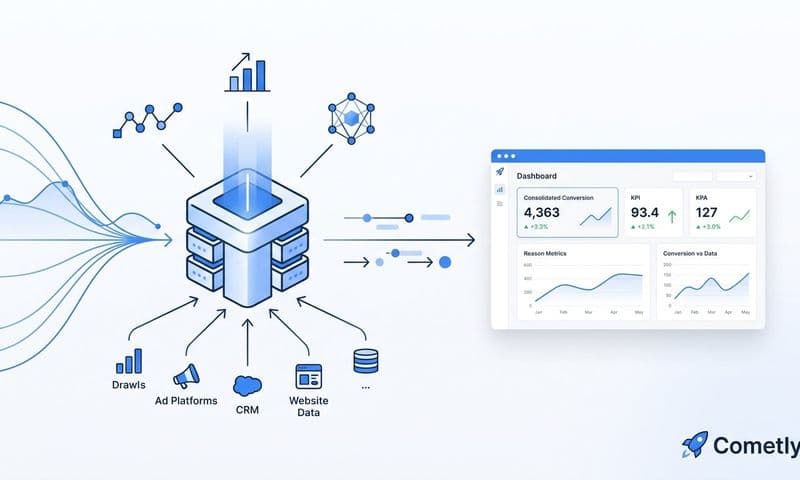

When your marketing data lives in separate silos across Google Ads, Meta, LinkedIn, your CRM, and your website, you lose visibility into what is actually driving revenue. Each platform claims credit for conversions, budgets get misallocated, and growth teams end up making decisions based on incomplete pictures. Cross platform analytics software solves this by pulling data from every channel into a single view, so you can track the full customer journey and make smarter decisions about where to invest.
This list covers the top tools available in 2026, evaluated on their ability to unify multi-channel data, track conversions accurately, support attribution modeling, and deliver actionable insights. Whether you are a B2B SaaS company trying to connect ad spend to pipeline, or an agency managing campaigns across multiple clients, there is a tool here built for your needs.
1. Cometly
Best for: B2B SaaS companies that need to connect ad spend directly to pipeline and closed-won revenue.
Cometly is a marketing attribution and analytics platform built specifically for B2B SaaS companies that want to understand exactly which campaigns drive revenue, not just clicks or leads.
 9 Best Attribution Platforms for Agencies in 2026
Where This Tool Shines
Most analytics tools stop at the lead. Cometly keeps tracking through the entire funnel, connecting ad platform data with CRM events and Stripe revenue so you can see which specific ads and channels influenced closed-won deals. This makes it particularly valuable for growth teams with longer sales cycles where last-click attribution tells almost none of the real story.
The AI ads manager adds another layer by surfacing performance recommendations across your active campaigns. Instead of manually digging through dashboards to find what is working, Cometly surfaces the signal and tells you where to scale. Combined with server-side tracking via Conversion API, it captures conversions that browser-based tracking typically misses.
Key Features
Multi-Touch Attribution: Tracks every touchpoint across paid channels and applies flexible attribution models to show which interactions actually influenced revenue.
Server-Side Conversion Tracking: Uses Conversion API integration to capture events that ad blockers and browser restrictions would otherwise miss, improving data accuracy significantly.
AI Ads Manager: Analyzes campaign performance across all connected ad platforms and delivers actionable recommendations for scaling or pausing spend.
Pipeline and Revenue Attribution: Connects directly to Stripe and CRM data so attribution extends beyond MQL to actual closed revenue.
70+ Native Integrations: Connects with major ad platforms, CRMs, and data tools without requiring a separate data layer or engineering work.
Real-Time Customer Journey Analytics: Provides a live view of how prospects move from first ad click through conversion, with full touchpoint history.
Best For
Cometly is the right fit for B2B SaaS marketing teams and growth leaders who need revenue-level attribution, not just traffic or lead volume reporting. It is especially valuable for teams running paid campaigns across multiple channels who need a single source of truth that connects ad spend to pipeline and closed revenue.
Pricing
Paid plans are available with pricing based on usage and features. Visit cometly.com for current pricing details and to explore available tiers.
2. Google Analytics 4
Best for: Teams that need free, robust web and app analytics with native Google Ads integration.
Google Analytics 4 is Google's flagship analytics platform built on an event-based data model that supports cross-device and cross-platform tracking at no cost for most teams.
 11 Best Marketing Analytics Tools to Track and Optimize Campaign Performance in 2026
Where This Tool Shines
GA4's event-based architecture is a significant upgrade from its predecessor. Every user interaction can be tracked as an event with custom parameters, giving you flexibility to model your data around your business rather than fitting your business into a rigid session-based structure. The cross-device reporting is particularly useful for understanding how users move between mobile and desktop before converting.
The native connection to Google Ads makes GA4 a natural choice for teams whose primary paid channel is Google Search or Display. Conversion data flows directly between the two platforms, and you can build custom exploration reports to analyze funnels, paths, and audience segments without needing a separate BI tool.
Key Features
Event-Based Tracking: Captures every user interaction as a configurable event across web and mobile app surfaces.
Cross-Device Journey Reporting: Stitches together user sessions across devices using Google signals and user IDs for a more complete view of the path to conversion.
Google Ads Integration: Native bidirectional connection allows conversion import and audience sharing between GA4 and Google Ads.
Exploration Reports: Custom funnel analysis, path analysis, and segment overlap reports available within the interface.
BigQuery Export: Free export of raw event data to BigQuery for advanced SQL-based analysis and data warehousing.
Best For
GA4 works well for teams primarily running Google Ads who want strong web analytics without paying for a separate tool. It is less suited as a standalone solution for teams running significant paid spend outside the Google ecosystem, where attribution gaps become more apparent.
Pricing
Free for standard use. GA4 360 (enterprise) is available at a significant premium; contact Google directly for enterprise pricing.
3. Mixpanel
Best for: Product and growth teams at SaaS companies tracking in-product user behavior and retention.
Mixpanel is an event-based product analytics platform focused on understanding how users interact with your SaaS product across web and mobile.
 9 Best Google Analytics Alternatives for Advertisers in 2026
Where This Tool Shines
Mixpanel is purpose-built for product analytics. Where GA4 focuses on marketing traffic and Google Ads, Mixpanel goes deep on what users do once they are inside your product. The funnel analysis tools make it easy to identify exactly where users drop off in onboarding flows, feature adoption paths, or upgrade sequences, and the retention cohort analysis helps you understand which behaviors correlate with long-term retention.
The flexibility of Mixpanel's event and property schema means you can track virtually any user action and slice it by any dimension you define. For product-led growth teams, this level of behavioral granularity is hard to replicate with general-purpose web analytics tools.
Key Features
Event-Based Tracking: Flexible schema allows custom events and properties to be tracked without rigid predefined structures.
Funnel Analysis: Visual drop-off analysis across any sequence of user actions, with the ability to filter by cohort or property.
Retention Cohort Analysis: Tracks how different user segments return and engage over time, broken down by behavior or acquisition source.
A/B Test Analysis: Connects experiment results to behavioral outcomes so you can measure the real impact of product changes.
Real-Time Activity Feed: Live stream of user events for debugging, QA, and immediate insight into how users are behaving.
Best For
Mixpanel is the right choice for product managers, growth engineers, and SaaS teams who want deep behavioral analytics inside their product. It is not the primary tool for paid media attribution or cross-channel marketing reporting.
Pricing
Free plan available up to a certain event volume. Paid Growth plans start at approximately $28 per month, scaling with usage. Enterprise pricing is custom.
4. Segment
Best for: Engineering and data teams that need a centralized layer for collecting and routing customer event data.
Segment is a Customer Data Platform by Twilio that acts as the infrastructure layer for collecting events from any source and routing them to any downstream tool.
 9 Best Conversion Tracking Alternatives to Pixels in 2026
Where This Tool Shines
Segment does not replace your analytics tools; it powers them. By implementing a single SDK across your web, mobile, and server environments, you create one consistent stream of customer event data that can be sent to any combination of analytics platforms, marketing tools, or data warehouses. This eliminates the inconsistency that comes from having different tracking implementations across different tools.
The unified customer profile Segment builds across all sources is particularly valuable for teams that need to connect anonymous website behavior with identified CRM records. Reverse ETL capabilities also allow you to sync enriched data from your warehouse back into operational tools, closing the loop between raw data and action.
Key Features
Single Collection SDK: One implementation captures events from web, mobile, and server, eliminating fragmented tracking setups.
300+ Destination Integrations: Routes data to analytics platforms, marketing tools, data warehouses, and CRMs without custom engineering for each connection.
Unified Customer Profiles: Resolves anonymous and identified user data into a single profile across all sources and devices.
Data Governance: Schema enforcement and tracking plan tools prevent bad data from reaching downstream systems.
Reverse ETL: Syncs enriched warehouse data back into operational tools for activation and personalization.
Best For
Segment is ideal for engineering-forward teams at growth-stage or enterprise SaaS companies that want clean, consistent data flowing to all their tools. It requires meaningful engineering resources to implement and maintain effectively.
Pricing
Free plan available for up to 1,000 monthly tracked users. Team plan starts at approximately $120 per month. Business pricing is custom based on volume and features.
5. Triple Whale
Best for: DTC and ecommerce brands that need real-time ROAS visibility across Meta, Google, and TikTok.
Triple Whale is an attribution and analytics platform built specifically for direct-to-consumer ecommerce brands, aggregating ad performance data into a real-time revenue dashboard.
 9 Best Cross Platform Analytics Software Tools in 2026
Where This Tool Shines
Triple Whale was designed to solve the attribution problem that ecommerce brands face when running ads across Meta, Google, and TikTok simultaneously. Each platform overcounts conversions, making it nearly impossible to know where revenue is actually coming from. Triple Whale's first-party pixel captures purchase data directly and reconciles it against ad platform reporting to give a more accurate picture of true ROAS.
The creative analytics feature is a standout for performance marketing teams. Instead of just reporting on campaign-level results, Triple Whale breaks down performance by individual ad creative, helping teams understand which specific images, videos, or copy angles are driving purchases. This is particularly useful for teams iterating on creative at high volume.
Key Features
First-Party Pixel: Captures purchase and conversion data directly from the storefront for more accurate attribution than relying on ad platform pixels alone.
Real-Time Revenue Dashboard: Live view of revenue, ROAS, and ad spend across all connected channels in a single interface.
Creative Analytics: Ad-level performance breakdown that identifies which creative assets are driving the strongest results.
Sonar Post-Purchase Survey: Captures self-reported attribution data from customers at checkout to supplement pixel-based tracking.
Cohort and LTV Reporting: Tracks customer lifetime value by acquisition cohort to inform long-term budget decisions.
Best For
Triple Whale is built for ecommerce and DTC brands. It is less suited for B2B SaaS companies with long sales cycles, subscription revenue models, or complex lead-to-revenue attribution needs.
Pricing
Plans start at approximately $129 per month for smaller stores. Pricing scales based on store revenue, with higher tiers unlocking additional features.
6. Amplitude
Best for: Mid-to-large SaaS companies that need deep behavioral analytics, predictive insights, and experimentation.
Amplitude is a behavioral analytics platform used by product and growth teams at SaaS companies to understand user engagement and improve product outcomes.
 9 Best Cross Platform Analytics Software Tools in 2026
Where This Tool Shines
Amplitude goes beyond basic event tracking to offer predictive analytics and experimentation features that most product analytics tools do not include at this level. The churn prediction and conversion likelihood models help teams prioritize which user segments to focus on, rather than treating all users the same. This is particularly useful for growth teams trying to identify expansion opportunities or at-risk accounts.
The pathfinding and journey visualization tools make it easy to see how users actually navigate through your product, including unexpected paths that might indicate confusion or friction. Combined with built-in A/B testing and feature flag integration, Amplitude gives product teams a closed loop from hypothesis to measurement.
Key Features
Behavioral Cohort Analysis: Segments users by specific actions taken and compares engagement, retention, and conversion across cohorts.
User Journey Visualization: Maps the actual paths users take through your product, including branching and drop-off points.
Predictive Analytics: Models churn likelihood and conversion probability based on behavioral signals.
Built-In Experimentation: A/B testing and feature flag integration for measuring the impact of product changes on behavioral outcomes.
Cross-Platform Tracking: Unified tracking across web and mobile apps for a complete view of user behavior across surfaces.
Best For
Amplitude is a strong fit for product-led SaaS companies with dedicated product and growth teams. It is more focused on in-product behavior than paid media attribution, making it complementary to rather than a replacement for a tool like Cometly.
Pricing
Starter plan is free. Growth and Enterprise plans are custom-priced based on monthly tracked users and feature requirements. Contact Amplitude for a quote.
7. HubSpot Marketing Analytics
Best for: B2B teams already using HubSpot CRM who want marketing attribution tied directly to contacts and deals.
HubSpot Marketing Analytics is the built-in analytics suite within the HubSpot platform, connecting marketing activity directly to CRM contacts, deals, and revenue.
Where This Tool Shines
The biggest advantage HubSpot Marketing Analytics has over standalone analytics tools is native CRM integration. Because HubSpot tracks every interaction a contact has with your marketing content, emails, and ads, you can see the full history of a deal from first touch to closed-won without any additional data plumbing. For teams where HubSpot is the system of record, this is a significant advantage.
The drag-and-drop report builder and custom dashboards make it accessible for marketers who are not data analysts. You can build attribution reports, campaign performance summaries, and revenue dashboards without needing SQL or engineering support, which is a practical consideration for smaller marketing teams.
Key Features
Contact-Level Attribution: Ties every marketing interaction to a specific CRM contact and the deals they are associated with.
Campaign Performance Reporting: Aggregates results across email, ads, landing pages, and social within a single campaign view.
Multi-Touch Revenue Attribution: Available on Professional and Enterprise tiers, distributing deal revenue across all contributing touchpoints.
Custom Dashboard Builder: Drag-and-drop interface for creating tailored reports without technical skills.
Native HubSpot Ads Integration: Connects directly to Facebook, Google, and LinkedIn ads managed through HubSpot.
Best For
HubSpot Marketing Analytics is the right choice for B2B teams that are fully committed to the HubSpot ecosystem. Teams that run significant ad spend outside HubSpot's native ad tools, or that need granular cross-channel attribution beyond what HubSpot tracks, may find its capabilities limiting.
Pricing
Included in HubSpot Marketing Hub. Starter begins at approximately $20 per month. Professional and Enterprise tiers are required to access advanced multi-touch attribution features.
8. Supermetrics
Best for: Agencies and analysts who need to pull raw marketing data from multiple platforms into spreadsheets or BI tools for custom reporting.
Supermetrics is a data aggregation and connector tool that pulls marketing performance data from 100+ platforms into Google Sheets, Looker Studio, BigQuery, and other destinations.
Where This Tool Shines
Supermetrics is not an analytics platform in the traditional sense. It does not provide its own dashboards or attribution logic. What it does exceptionally well is automate the data extraction process that would otherwise require manual exports or custom API integrations. For agencies managing multiple client accounts across different ad platforms, the time savings from automated data pulls into a shared reporting template are substantial.
The breadth of connector coverage is a genuine strength. Whether you need data from LinkedIn Ads, Bing, Pinterest, or a less common platform, Supermetrics likely has a connector for it. This makes it particularly useful when you need to blend data across channels that other tools do not natively support together.
Key Features
100+ Data Source Connectors: Covers all major ad platforms, social channels, SEO tools, and marketing platforms with pre-built connections.
Multi-Destination Support: Routes data to Google Sheets, Looker Studio, BigQuery, Excel, and other BI destinations.
Automated Refresh Scheduling: Keeps reports and dashboards updated on a set schedule without manual intervention.
Cross-Channel Data Blending: Combines data from multiple sources in a single query for unified reporting.
Team Collaboration: Shared query management and template libraries for agencies working across multiple client accounts.
Best For
Supermetrics is best suited for agencies, data analysts, and marketing operations teams who build custom reports in spreadsheets or BI tools. It requires a destination tool to visualize data and does not replace a dedicated analytics or attribution platform.
Pricing
Plans start at approximately $29 per month for a single destination connector. Multi-destination and agency plans scale significantly higher based on the number of connectors and users.
9. Looker Studio
Best for: Teams that need free, flexible, shareable marketing dashboards built on top of existing data sources.
Looker Studio is a free data visualization and dashboard tool from Google, formerly known as Google Data Studio, that connects to a wide range of data sources for custom cross-channel reporting.
Where This Tool Shines
The most compelling thing about Looker Studio is that it is completely free and highly flexible. You can build polished, shareable dashboards that pull from GA4, Google Ads, Search Console, and YouTube natively, with no additional cost. For teams already in the Google ecosystem, this makes it an easy choice for client-facing reporting or internal performance reviews.
Where Looker Studio becomes even more powerful is when paired with a connector like Supermetrics or a data warehouse like BigQuery. This combination allows you to build truly cross-channel dashboards that blend data from any source into a single visual layer, with the flexibility to design reports exactly the way your team or clients need to see them.
Key Features
Free to Use: No cost for creating or sharing dashboards, with no limits on the number of reports.
Native Google Connectors: Direct connections to GA4, Google Ads, Search Console, and YouTube without additional setup.
Third-Party Connectors: Partner integrations including Supermetrics expand data source coverage to non-Google platforms.
Drag-and-Drop Report Builder: Flexible canvas with a wide variety of chart types, filters, and layout options.
Shareable and Embeddable Dashboards: Reports can be shared via link, embedded in websites, or scheduled for email delivery.
Best For
Looker Studio is ideal for marketing teams, agencies, and analysts who need a free, customizable reporting layer on top of existing data sources. It is not a standalone analytics or attribution tool and works best when connected to a well-structured data layer.
Pricing
Free for standard use. Looker Studio Pro, which adds enterprise governance and team management features, is available at additional cost through Google Cloud.
Which Tool Is Right for You
The right cross platform analytics software depends on what problem you are actually trying to solve. Attribution, product analytics, and data aggregation are related but distinct needs, and the best tools on this list were each built with a specific use case in mind.
Here is a quick breakdown by use case to help you decide:
B2B SaaS growth teams: Cometly is the strongest choice if you need to connect ad spend directly to pipeline and closed-won revenue. Its combination of multi-touch attribution, server-side tracking, and Stripe revenue integration gives you a level of revenue-level clarity that general-purpose analytics tools simply cannot match.
Ecommerce and DTC brands: Triple Whale is purpose-built for this use case, with first-party pixel tracking, creative analytics, and real-time ROAS reporting designed around the ecommerce revenue model.
Product and growth teams: Mixpanel and Amplitude are both strong options, with Mixpanel leaning toward flexibility and simplicity, and Amplitude offering more advanced predictive analytics and experimentation features for larger teams.
Data infrastructure teams: Segment is the right foundation if you need a clean, consistent event data layer feeding multiple downstream tools. It is an investment in infrastructure, not a reporting tool on its own.
Reporting and visualization: Supermetrics and Looker Studio work well together. Supermetrics pulls the raw data; Looker Studio turns it into shareable dashboards. Neither replaces an attribution platform, but both are valuable for teams building custom reporting on top of existing data.
If you are a B2B SaaS company trying to understand which ads and channels are actually driving revenue, the gap between a traffic analytics tool and a true attribution platform is significant. Tracking clicks and sessions is not the same as knowing which campaigns closed deals. Get your free demo of Cometly today and see how it connects every touchpoint from first ad click to closed-won revenue in one clear view.