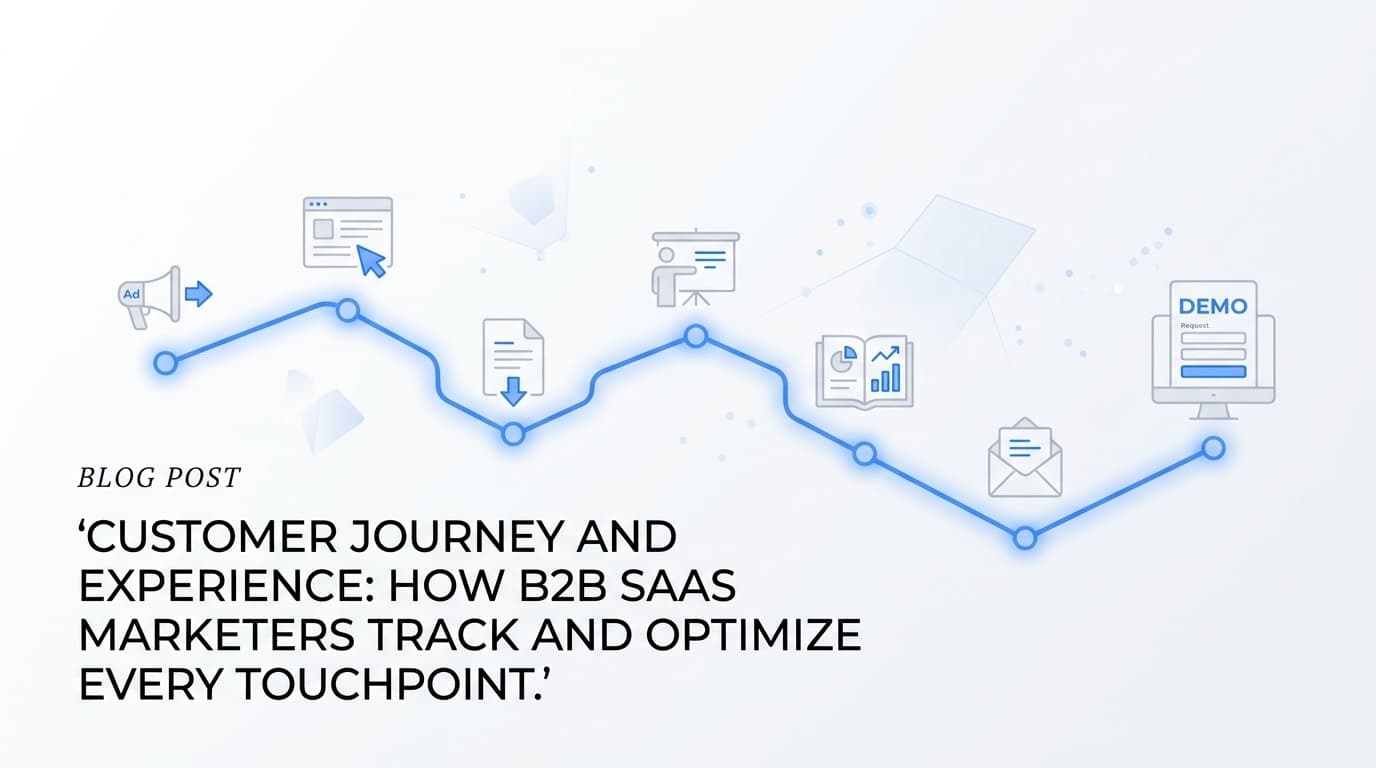
Most B2B SaaS buyers interact with your brand seven, ten, sometimes fifteen times before they ever fill out a demo form. They click a LinkedIn ad during their morning commute, read a blog post two weeks later, compare you on G2, watch a product walkthrough video, and then go quiet for a month before coming back ready to talk. By the time they convert, they have built a detailed mental picture of your product. The question is: have you built an equally detailed picture of them?
For most marketing teams, the honest answer is no. Data lives in silos. Ad platforms report their own version of performance. CRM data rarely connects back to the first ad click. And somewhere in the middle, the actual story of how a customer found you, evaluated you, and decided to buy gets lost entirely.
This fragmentation is not just a data problem. It is a customer experience problem. When you cannot see the full journey, you cannot optimize it. You send the wrong message at the wrong stage. You cut campaigns that were quietly driving pipeline. You invest in channels that look good in dashboards but do not actually close deals. This article breaks down what the customer journey and experience really means for B2B SaaS marketers, why tracking every touchpoint is a revenue strategy rather than a reporting exercise, and how to move from fragmented guesswork to a single, accurate picture of what is actually driving growth.
The Anatomy of a B2B SaaS Customer Journey
The customer journey in B2B SaaS looks fundamentally different from what most consumer marketing frameworks describe. There is no impulse purchase. There is no single decision-maker browsing on a phone and tapping "buy now." Instead, you are dealing with longer sales cycles, multiple stakeholders across different roles, and a buying process that blends self-serve research with sales-assisted evaluation.
Think about the typical path. Awareness often begins through paid ads, organic search, or social content. A VP of Marketing sees a sponsored post on LinkedIn, or a demand gen manager finds a blog post while searching for a specific problem. This is the top of the funnel, where the goal is simply to exist in the buyer's mind as a credible option.
Consideration deepens the relationship. Buyers at this stage are reading comparison pages, downloading guides, visiting review sites like G2 or Capterra, and engaging with email nurture sequences. They are not ready to talk to sales yet. They are doing the homework that most B2B buying decisions require before anyone picks up the phone.
Decision-stage behavior looks different again. Demo requests, free trial signups, pricing page visits, and direct sales conversations all signal that a buyer is moving toward a choice. This is where the handoff between marketing and sales becomes critical, and where attribution data often breaks down entirely.
Retention and expansion are stages that many marketing teams overlook from an attribution perspective, but they matter enormously in a subscription model. Understanding which channels and messages correlate with customers who expand their contracts or renew reliably is just as valuable as understanding what drives initial conversion.
Here is the part that makes all of this genuinely difficult: the journey is almost never linear. Buyers loop back. They revisit awareness-stage content while they are in late-stage conversations. They go quiet for six weeks and then re-engage after a competitor disappoints them. They research on a work laptop, click an ad on a phone, and fill out a form on a desktop. A single-session view of this journey, or a last-click attribution model that only sees the final interaction, does not just miss the nuance. It actively misleads the teams trying to make budget decisions based on it.
Understanding the full architecture of the journey, across all stages and all channels, is the prerequisite for everything else in modern B2B SaaS marketing.
Why Customer Experience Depends on Data, Not Assumptions
Customer experience is often discussed in terms of design, tone, and brand consistency. Those things matter. But in B2B SaaS marketing, the single biggest driver of a poor customer experience is irrelevance. Sending the wrong message at the wrong stage of the journey does more damage than a mediocre landing page design.
When a prospect is in early-stage awareness, they need educational content that acknowledges their problem. If your retargeting campaign immediately serves them a "book a demo" ad after a single blog visit, you are skipping several steps in the relationship. The experience feels pushy because it is not calibrated to where they actually are.
The reverse is equally damaging. When a prospect has visited your pricing page three times and attended a webinar, serving them a top-of-funnel awareness ad is a missed opportunity. They are ready for a more direct conversation, and your messaging should reflect that.
Both of these failures trace back to the same root cause: the marketing team does not have a clear view of where each prospect is in the journey. And that gap exists because attribution data is incomplete.
This is where touchpoint analysis becomes the foundation of experience optimization. When you can see that a prospect clicked a LinkedIn ad three weeks before filling out a demo form, you understand that LinkedIn played a role in initiating the journey. If you cut that campaign because last-click attribution gave all the credit to Google Search, you have removed a key part of the experience that was working. The prospect who would have seen that LinkedIn ad and eventually converted never enters your funnel at all.
Attribution gaps do not just affect reporting. They affect decisions. And those decisions directly shape the experience that future buyers will have with your brand. Teams that invest in complete journey data are not doing it for the sake of cleaner dashboards. They are doing it because relevance at every stage is only possible when you understand what every stage actually looks like.
Mapping Touchpoints Across the Full Funnel
Accurate journey mapping starts with knowing what to track. For B2B SaaS companies, the list of meaningful touchpoints is longer and more varied than most teams initially account for.
Paid ad interactions: Clicks from Google Ads, Meta, LinkedIn, and other paid channels are often the first measurable point of contact. Tracking these accurately requires more than just UTM parameters, especially as browser-level tracking becomes less reliable.
Organic search visits: A prospect finding your content through a search query is a high-intent signal. Connecting these visits to downstream conversions helps you understand which content topics and keywords are actually driving pipeline, not just traffic.
Email engagement: Opens and clicks within nurture sequences reveal where prospects are in their evaluation process and which messages resonate at which stages.
Content and product page behavior: Time spent on pricing pages, feature comparison pages, and integration documentation tells you a great deal about where a prospect is in their decision process.
Form submissions and CRM events: Demo requests, content downloads, and trial signups are the conversion events that most teams track well. The challenge is connecting these back to the earlier touchpoints that preceded them.
Sales activity: Calls, meetings, and email exchanges between prospects and sales reps are touchpoints too. In B2B, where sales cycles can span weeks or months, offline and sales-assisted interactions represent a significant portion of the journey that purely digital tracking misses entirely.
Connecting online and offline touchpoints is one of the defining challenges of B2B journey mapping. A prospect might click a paid ad, engage with three pieces of content, and then have two discovery calls with a sales rep before converting. If your attribution only captures the digital side, you are seeing roughly half the story.
First-party data and server-side tracking have become the recommended approach for improving touchpoint capture accuracy. As third-party cookies have become less reliable due to browser restrictions, iOS privacy changes, and ad blockers, marketers who rely solely on client-side tracking are seeing increasing gaps in their journey data. Server-side tracking sends event data directly from your server rather than from the browser, which means it is not subject to the same blocking and privacy limitations. The result is more complete data, which means more accurate journey maps, which means better decisions.
Attribution Models and What They Reveal About the Journey
Once you have captured touchpoint data across the full funnel, the next question is how to interpret it. This is where attribution models come in, and where many marketing teams get into trouble by treating one model as the definitive truth rather than as a lens.
First-touch attribution gives all credit to the channel or campaign that initiated the journey. It is useful when you want to understand what is driving awareness and bringing new prospects into your funnel. If you are evaluating the ROI of a top-of-funnel LinkedIn campaign, first-touch attribution tells you whether it is actually starting conversations.
Last-click attribution gives all credit to the final touchpoint before conversion. It tends to overvalue bottom-funnel channels like branded search because those are often the last thing a buyer interacts with before submitting a form. The problem is that branded search rarely creates demand on its own. It captures intent that was built by earlier touchpoints.
Linear attribution distributes credit equally across every touchpoint in the journey. It is more balanced than first or last-touch models, but it treats a quick homepage visit the same as a 20-minute product demo watch, which is not always an accurate reflection of influence.
Data-driven attribution uses algorithmic analysis to assign credit based on actual conversion patterns across your data set. It is the most sophisticated model and the most useful for teams with sufficient data volume, because it reflects the actual contribution of each touchpoint rather than applying a fixed rule.
The real value of understanding these models is not in choosing one and committing to it permanently. It is in comparing them side by side to answer different questions. First-touch attribution might show that LinkedIn is your strongest awareness driver. Last-click might show that branded Google Search closes the most conversions. Linear attribution might reveal that a particular email sequence plays a consistent role in the middle of most journeys. Together, these perspectives give you a much richer understanding of how the customer journey and experience actually unfolds than any single model could provide on its own.
For B2B SaaS teams with long sales cycles and multiple touchpoints, comparing attribution models side by side is not a luxury. It is how you make strategic budget decisions that account for the full funnel rather than optimizing only for the final click.
Turning Journey Data Into Revenue Decisions
Tracking touchpoints and running attribution models is only valuable if it leads to better decisions. The goal is not cleaner data for its own sake. The goal is understanding which parts of the customer journey and experience actually drive closed-won revenue, and investing accordingly.
Pipeline and revenue attribution is the practice of connecting journey-level data to actual business outcomes. Instead of reporting on leads generated or cost per click, revenue attribution asks: which channels, campaigns, and touchpoints are associated with the deals that actually closed? This is a fundamentally different question, and it often produces surprising answers.
A channel that generates a high volume of leads might contribute very little to closed revenue if those leads are consistently low-quality. Conversely, a channel that generates fewer leads might produce a disproportionate share of high-value deals. Without revenue attribution, you are optimizing for the wrong outcome.
This is where AI-driven analysis becomes genuinely useful. Human analysts can review reports and spot obvious patterns, but identifying which combination of touchpoints correlates with faster time-to-close or higher average contract values across thousands of journeys requires algorithmic pattern recognition. AI can surface insights like: prospects who engage with a specific case study resource during the consideration stage tend to convert at a higher rate, or deals that include a product trial in the journey close significantly faster than those that do not. These are the kinds of insights that change how you build campaigns.
Feeding enriched journey-level conversion data back to ad platforms is another critical step. Tools like the Meta Conversion API and Google Enhanced Conversions allow you to send conversion signals directly from your server to the ad platform, bypassing browser-level tracking limitations. This improves match rates and gives the platform's algorithm a more complete picture of which ad exposures are leading to real revenue events, not just form fills. The result is that the platform's optimization engine starts targeting audiences that look more like your best customers, rather than just your most frequent form submitters. Better signal in means better targeting out.
Building a Journey-Aware Marketing Stack
Understanding the customer journey and experience in theory is one thing. Building the infrastructure to track and optimize it consistently is another. Most B2B SaaS marketing teams need to connect several components to make this work in practice.
An attribution platform: This is the core layer that collects touchpoint data, applies attribution models, and connects marketing activity to revenue outcomes. Without it, you are relying on each ad platform's self-reported data, which is inherently biased toward that platform's own channels.
CRM integration: Connecting your attribution platform to your CRM is what allows you to follow the journey beyond the initial conversion. When a lead enters the sales process, you need to maintain visibility into how that journey progresses toward closed revenue, not just track the moment of form submission.
Ad platform connections: Direct integrations with Google Ads, Meta, LinkedIn, and other paid channels allow you to pull performance data into a single view and push enriched conversion signals back to those platforms for better algorithmic optimization.
Server-side event tracking: As discussed earlier, server-side tracking is increasingly important for capturing accurate touchpoint data in a privacy-first environment. It ensures that your journey data is as complete as possible, regardless of browser restrictions or ad blockers.
The common failure mode for B2B SaaS marketing teams is not that they lack data. It is that their data is fragmented across too many places. Google Ads reports one number. Meta reports another. HubSpot shows a different conversion count. Spreadsheets attempt to reconcile all of it, and the result is a team spending hours every week debating which number is right rather than acting on insights.
A single source of truth resolves this. When all journey data flows into one platform, marketing teams can stop arguing about attribution and start making decisions based on it. Cometly is built specifically for this purpose. It connects your ad platforms, CRM, and website behavior to give B2B SaaS marketing teams a real-time, end-to-end view of the customer journey and the revenue it produces. With 70-plus native integrations, pipeline and revenue attribution, AI-driven insights, and server-side conversion tracking built in, it provides the connective layer that turns fragmented data into a coherent picture of what is actually driving growth.
Putting It All Together
Understanding the customer journey and experience is not a branding exercise or a research project. For B2B SaaS marketers, it is a direct revenue strategy. When you can see every touchpoint, attribute revenue accurately across the full funnel, and act on AI-driven patterns in journey data, you stop making decisions based on incomplete information. You stop cutting campaigns that were quietly contributing to pipeline. You stop optimizing for metrics that feel good but do not connect to closed deals.
The marketers who win in this environment are the ones who invest in complete journey visibility. They know which channels initiate journeys, which channels close them, and which combinations of touchpoints produce the highest-value customers. They feed that data back to ad platforms to improve targeting. They align messaging to where each prospect actually is in the journey, creating a more relevant and effective customer experience at every stage.
The tools and frameworks to do this exist today. The question is whether your team has them connected and working together. If your data is still fragmented across platforms, or if you are relying on last-click attribution to make full-funnel decisions, there is a significant opportunity to improve both your marketing efficiency and the experience you deliver to buyers.
Get your free demo today and see how Cometly can give your team a complete view of the customer journey, connect every ad dollar to real pipeline and revenue, and help you make smarter decisions at every stage of the funnel.