Picture this: your marketing team has been running a campaign that looks like a winner. The click-through rates are strong, the cost-per-lead is trending down, and your attribution dashboard shows a healthy flow of conversions. Confident in what the data is telling you, you scale the budget. And then... pipeline stalls. Revenue flatlines. The leads keep coming, but nothing is closing. What went wrong?
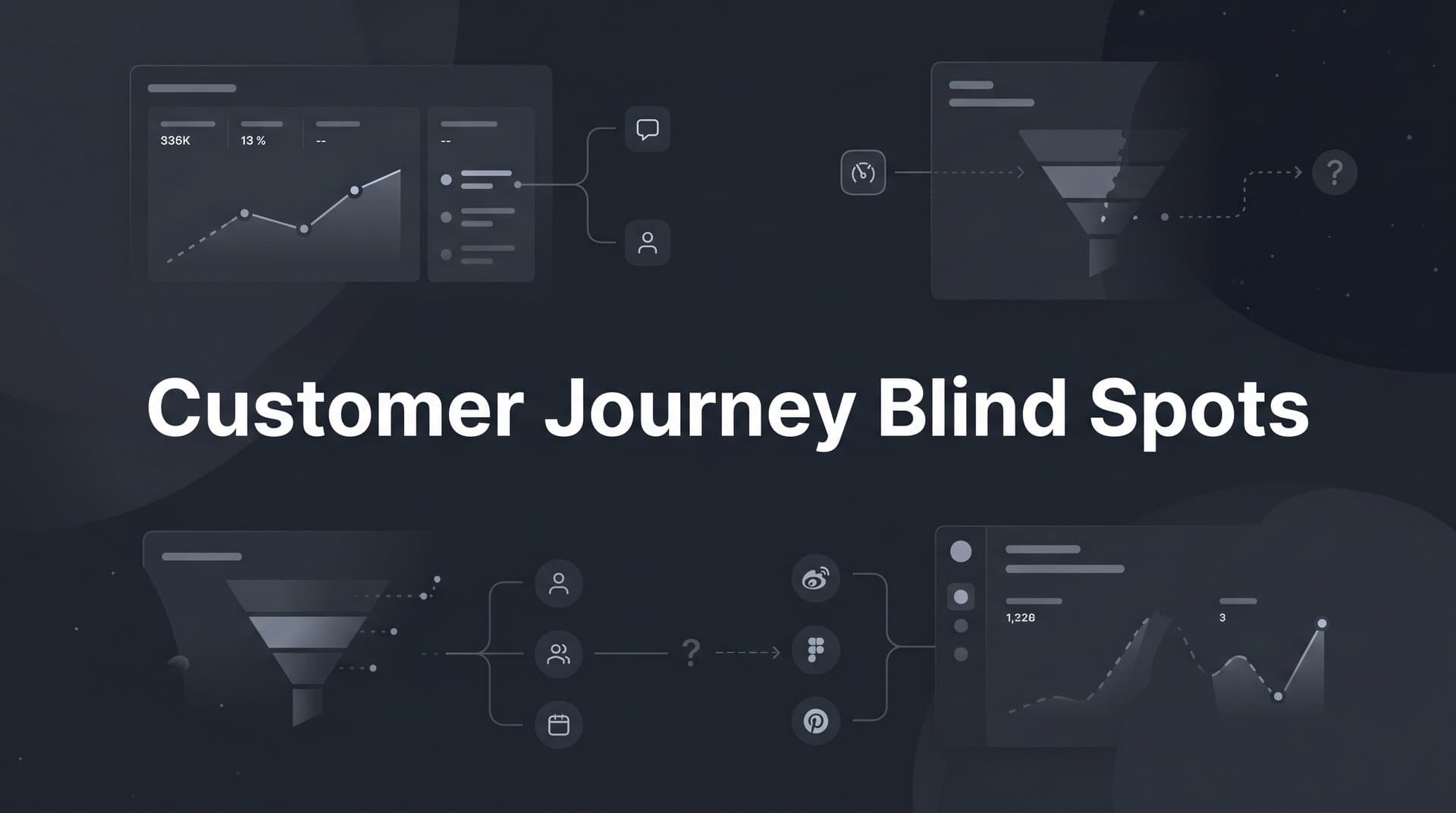
The answer is almost never the campaign itself. More often, it is what the data was not showing you. Customer journey blind spots are the hidden gaps in your tracking and attribution infrastructure that cause marketing teams to make bold, confident decisions based on fundamentally incomplete information. The reports look clean. The numbers add up. But the picture is missing entire chapters of the story.
This problem is more widespread than most teams realize, and it hits B2B SaaS companies especially hard. When your buying cycle spans weeks or months, involves multiple decision-makers across different sessions and devices, and passes through channels that standard analytics cannot see, the gap between what your data shows and what is actually happening grows quickly. You are not just missing a few data points. You are potentially missing the majority of what influences a deal.
This article breaks down exactly where these blind spots form, how they corrupt your attribution data, how to recognize the warning signs in your own setup, and what it takes to close the gaps for good.
The Hidden Gaps That Distort Your Marketing Picture
Customer journey blind spots are the touchpoints, channels, and interactions that go untracked or misattributed in your analytics stack. They create a distorted view of how buyers actually move from awareness to purchase, not by showing you nothing, but by showing you a partial version of reality that feels complete.
That last part is what makes them dangerous. A dashboard full of zeros is obviously broken. A dashboard that shows confident attribution numbers, just the wrong ones, looks perfectly healthy. Teams trust it. They act on it. And the decisions they make downstream reflect a reality that does not quite exist.
Blind spots form at the intersection of disconnected tools. Your ad platforms report conversions using their own attribution windows and pixel-based tracking. Your CRM captures leads but often has no direct connection to the ads that drove them. Your website analytics track sessions but lose the thread the moment a user switches devices, clears cookies, or comes back weeks later through a different channel. Each tool is doing its job. The problem is that none of them are talking to each other in a way that preserves the full story.
Consider the typical B2B SaaS funnel. A buyer sees a LinkedIn ad, clicks through, reads a blog post, and leaves without converting. Two weeks later, they search your brand name on Google, land on your pricing page, and fill out a demo request. In a last-click attribution model, Google Search gets full credit. LinkedIn gets nothing. The blog post gets nothing. The two-week consideration period is invisible. And if you are making budget decisions based on that data, you will systematically underinvest in the channels that are actually doing the work of building intent.
This is not just a data quality problem. It is a business risk. Budget decisions, campaign scaling, and channel investment are all downstream of what the data shows. When the data is incomplete, every decision built on top of it inherits that incompleteness. Teams scale the wrong campaigns, cut channels that are quietly driving influence, and wonder why their pipeline projections keep missing the mark.
The first step toward fixing this is recognizing that blind spots are structural. They are not the result of a misconfigured tag or a forgotten UTM parameter. They are the predictable outcome of using tools that were not designed to work together across a long, complex, multi-touch buying journey.
Where B2B SaaS Journeys Break Down in Your Data
Not all blind spots are created equal. Some are subtle, quietly distorting your attribution in ways that are hard to detect. Others create obvious gaps that show up as "unknown" source fields in your CRM. Understanding where B2B SaaS journeys most commonly break down helps you know exactly where to look.
The first major gap sits between the first ad click and the form submission. A buyer might interact with your brand several times before they ever raise their hand. Paid social, organic search, review platforms, word-of-mouth referrals, and content shares all contribute to building awareness and intent. But if your tracking only captures the session in which the form was submitted, everything that came before is invisible. The channel that closed the loop gets the credit. The channels that built the case get nothing.
The second gap opens up between lead creation and sales qualification. Once a lead enters the CRM, marketing attribution often stops. The handoff to sales creates a data boundary. What happens next, the sales touches, the email sequences, the follow-up calls, rarely gets connected back to the original marketing source. This means marketing teams cannot see which of their leads actually progress through the funnel and which ones stall at the first sales conversation. They optimize for lead volume without knowing which leads are actually worth anything.
The third and most consequential gap is the disconnect between marketing pipeline and closed-won revenue. This is where the real cost of blind spots becomes visible. A campaign might generate plenty of leads and even move deals into pipeline, but if marketing cannot see which of those deals actually close, they have no way to know whether they are generating revenue or just activity. Optimizing for pipeline without revenue data is like navigating by a map that ends halfway through the journey.
Then there is the multi-stakeholder problem. B2B deals rarely involve a single buyer. Procurement, finance, IT, and executive leadership all touch the decision at different stages, using different devices, across different sessions. Standard pixel-based tracking treats each of these interactions as separate, anonymous users. There is no way to stitch them together into a single, coherent account journey without first-party data and server-side tracking infrastructure.
Privacy changes have made all of this significantly harder. iOS App Tracking Transparency updates reduced the reliability of mobile ad attribution. Browser-level privacy protections and the gradual move away from third-party cookies have degraded the signals that pixel-based tracking depends on. Mid-funnel touchpoints that were previously captured are now frequently dropped. The result is that even teams with well-configured analytics setups are losing more signal than they were a few years ago, often without realizing it.
How Blind Spots Corrupt Attribution Models
Here is where things get particularly tricky. Blind spots do not break your attribution reports. They corrupt them silently. The reports still run. The numbers still populate. They just reflect an incomplete version of reality, and the models built on top of that incomplete data distribute credit in ways that are systematically wrong.
When touchpoints are missing, attribution models over-credit the channels they can see and under-credit the ones they cannot. This almost always works in favor of last-click channels because those are the touchpoints most reliably captured by pixel-based tracking. A buyer who clicked a branded search ad right before converting will show that search click in your data. The LinkedIn ad they saw three weeks earlier, the webinar they attended, the review they read on G2, those touchpoints are frequently invisible. The search click looks like the hero. Everything that built the intent looks like it did nothing.
The practical consequence is budget misallocation at scale. Top-of-funnel awareness channels get starved because they appear not to convert. Last-click channels get over-invested because they appear to convert everything. Over time, this creates a self-reinforcing cycle where the channels that build pipeline quietly atrophy while the channels that capture existing intent absorb more and more budget. Demand generation becomes demand capture. And when the pipeline eventually dries up, teams are often confused about why, because the data never showed them what was happening.
This is the false confidence trap. When blind spots exist, attribution reports still produce numbers. They just produce the wrong numbers. And because those numbers look authoritative, teams act on them without questioning the underlying data quality. The confidence is real. The foundation it is built on is not.
One useful diagnostic here is model comparison. If you run your attribution data through multiple models, say first-touch, last-touch, and linear, and the results are wildly different, that divergence is often a signal that blind spots are distorting the data. When models disagree significantly, it is not necessarily because one model is better than another. It is because the underlying touchpoint data is incomplete, and different models are making different assumptions about how to fill the gaps. The disagreement itself is the red flag.
Understanding this dynamic changes how you should interpret attribution reports. Rather than asking "which model is right," the better question is "what is missing from the data that is causing these models to disagree?" That reframe shifts the focus from model selection to data completeness, which is where the real problem lives.
Signals You Have Blind Spots in Your Current Setup
You do not need to run a full technical audit to get a sense of whether blind spots are affecting your attribution. There are practical warning signs that show up in the data you already have, if you know what to look for.
Leads with no source attribution: If a meaningful portion of the leads in your CRM have no campaign, channel, or source data attached to them, that is a direct indicator of gaps in your tracking infrastructure. The "lead source: unknown" problem is one of the clearest and most measurable symptoms of blind spots. It means leads are arriving through paths your tracking cannot follow.
Revenue that cannot be tied to any campaign: When closed-won deals in your CRM consistently show no marketing attribution, it means your tracking stops somewhere before the revenue event. Marketing may be contributing to those deals, but there is no data to prove it or learn from it.
Significant discrepancies between ad platform conversions and CRM pipeline: Ad platforms like Meta and Google report conversions using their own attribution windows and pixel data. These numbers frequently diverge from what appears in your CRM. A large gap between ad platform reported conversions and actual CRM-tracked outcomes is a strong signal that the two systems are measuring different things, and that blind spots exist in the middle.
High-converting channels with no CRM presence: If a channel consistently shows strong conversion numbers in your ad platform but those conversions do not appear as leads in your CRM, something is breaking in the handoff. Either the tracking is misconfigured, the attribution is wrong, or the conversions being reported are not the business outcomes you think they are.
ROAS that does not match revenue reality: When your ad platform is reporting strong return on ad spend but actual revenue is not reflecting that performance, it often means your attribution is capturing surface-level conversions, form fills, clicks, page visits, without connecting them to the downstream revenue events that actually matter. ROAS built on incomplete data is not a performance metric. It is a confidence trap.
The common thread across all of these signals is a gap between what your marketing tools report and what your business actually experiences. When those two things diverge consistently, blind spots are almost always the explanation.
Closing the Gaps with Full-Funnel Attribution
Identifying blind spots is the first step. Closing them requires a deliberate change to your tracking infrastructure, not just your reporting setup. The technical foundation matters here, and it starts with connecting the systems that are currently operating in isolation.
The most important connection is between your ad platforms and your CRM. When these two systems share data, you can trace a lead from its originating ad click all the way through the pipeline stages to closed-won revenue. This is not a default configuration in most marketing stacks. It requires intentional integration, consistent UTM parameters, and a data model that preserves the original source attribution across every stage of the funnel.
Server-side tracking is the second critical piece. Browser-based pixels are increasingly unreliable because of privacy protections, ad blockers, and cookie restrictions. Server-side tracking sends conversion events directly from your server rather than relying on the buyer's browser, which means it is not subject to the same blocking and degradation. Meta's Conversion API and Google's Enhanced Conversions are the primary implementations of this approach, and they exist specifically to recover the signals that client-side pixels miss. If you are not using server-side tracking, you are likely losing a meaningful portion of your mid-funnel data.
First-party data enrichment fills in the gaps that neither pixels nor server-side tracking can fully address. When a buyer's identity can be matched across sessions using first-party identifiers, like an email address captured at form submission, their earlier anonymous interactions can be retroactively attributed. This is how you start to stitch together the multi-session, multi-device journeys that are typical in B2B SaaS.
Multi-touch attribution across the full funnel is what turns this connected data into actionable insight. Instead of crediting only the last touchpoint or the first, multi-touch models distribute credit across every interaction that contributed to a conversion. But this only works if the underlying touchpoint data is complete. Multi-touch attribution built on incomplete data is still wrong; it just distributes the wrongness more evenly.
This is exactly the problem Cometly is built to solve. Cometly connects your ad platforms, CRM, and revenue data into a single attribution layer that tracks every touchpoint from the first ad click through pipeline stages to closed-won revenue. By integrating with Stripe and CRM systems alongside ad platforms, Cometly captures the full journey rather than stopping at the lead level. Teams can see which ads and channels are actually driving revenue, not just form fills, and they can do it in real time rather than waiting for end-of-month reports to surface the gaps.
With 70-plus native integrations and server-side tracking built in, Cometly recovers the signals that standard pixel-based setups miss and presents them in a single source of truth. The result is attribution data that reflects how your buyers actually move, not just the portion of the journey your tools happened to capture.
Turning Complete Data into Smarter Ad Decisions
Eliminating blind spots does not just improve your reports. It changes the quality of every decision your team makes downstream.
The most immediate impact is budget reallocation. When you can see which campaigns generate revenue rather than just leads, you can move budget toward what actually works with precision rather than guesswork. Top-of-funnel channels that were previously invisible in your attribution get proper credit for the role they play in building intent. Last-click channels that were absorbing disproportionate budget get evaluated on their actual contribution rather than their apparent dominance in incomplete data.
The second impact is on your ad platform machine learning. Meta, Google, and other platforms use the conversion signals you send them to optimize their targeting and bidding algorithms. If you are sending them pixel-based conversion events that stop at the form fill, their algorithms optimize toward form fills. They have no way to know which of those form fills turned into revenue. When you feed them enriched, server-side conversion data that includes downstream revenue events, their machine learning starts optimizing toward buyers rather than just leads. The targeting gets sharper. The cost per actual revenue event goes down. The quality of traffic improves.
This is the compounding benefit of complete attribution data. As the data becomes more accurate over time, the AI-driven recommendations built on top of it become more reliable. Cometly's AI ads manager uses this enriched data to surface insights about which ads and campaigns are performing across every channel, helping teams identify what to scale and what to cut with confidence rather than intuition.
The scaling decisions that follow are qualitatively different from those made on incomplete data. Instead of scaling because the cost-per-lead looks good, you scale because you can see the revenue per campaign. Instead of cutting a channel because it does not show up in last-click attribution, you keep it because you can see its influence across the full journey. The confidence is no longer borrowed from data that looks right. It is earned from data that actually is right.
Over time, teams that operate with complete attribution data develop a compounding advantage. Their ad platforms are better optimized. Their budgets are better allocated. Their pipeline is more predictable. And their ability to explain marketing's contribution to revenue becomes clear and defensible, not a matter of interpretation.
The Bottom Line on Blind Spots
Customer journey blind spots are not inevitable. They are the predictable result of disconnected tools and tracking infrastructure that was not designed for the complexity of B2B SaaS buying journeys. The core insight is simple: you cannot optimize what you cannot see. And most B2B SaaS marketing teams are operating with significant portions of their customer journey completely invisible.
The good news is that this is a solvable problem. Connecting your ad platforms to your CRM and revenue data, implementing server-side tracking, and using multi-touch attribution across the full funnel gives you a view of the customer journey that actually reflects how your buyers move. The decisions you make from that vantage point are fundamentally different from those made on partial data.
If you are ready to stop optimizing based on an incomplete picture, Cometly provides the full-funnel attribution infrastructure that connects every touchpoint to revenue. From the first ad click to closed-won deals, every stage of the journey becomes visible, measurable, and actionable. Get your free demo today and start making marketing decisions based on the complete picture, not just the parts your current tools happen to capture.