You've just wrapped up a campaign review, and the numbers look great. Low cost per acquisition, solid first-purchase ROAS, and a healthy volume of new customers. Then, three months later, you pull your cohort data and realize something uncomfortable: most of those "cheap" customers never came back. Meanwhile, that other campaign, the one you paused because the CPA seemed too high, brought in customers who've already made three more purchases and referred two friends.
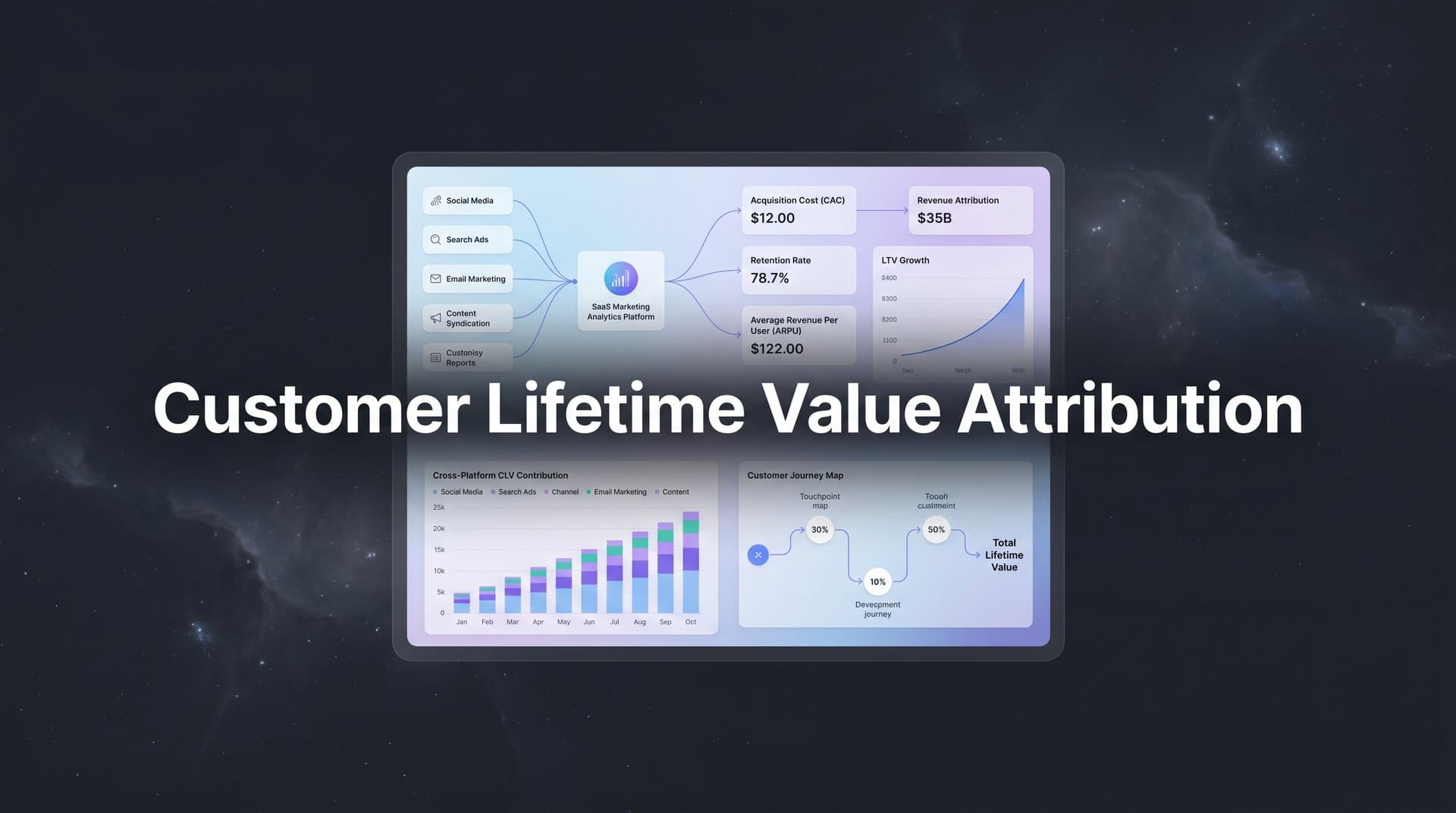
This is the core problem that customer lifetime value attribution is designed to solve. It's the practice of connecting long-term customer revenue back to the specific marketing touchpoints that originally acquired and nurtured those customers. Instead of asking "which campaign got the cheapest conversion?", CLV attribution asks "which campaign brought in customers who are actually worth the most over time?"
The stakes have never been higher. Ad costs across platforms have risen consistently, and the margin for error in budget allocation has shrunk. Optimizing for cheap first conversions is no longer a viable strategy if those conversions don't translate into lasting revenue. Marketers who understand which channels build their most valuable customer base will always outperform those who are chasing the lowest CPA.
This guide walks you through the full picture: why short-term metrics mislead, how CLV attribution actually works, the technical infrastructure required to do it right, and how to turn this data into smarter budget decisions that compound over time.
Why First-Purchase Metrics Tell an Incomplete Story
Cost per acquisition and first-purchase ROAS are useful signals. They're just not the whole story. The problem is that these metrics measure a single moment in a customer relationship that, for your best customers, might span years and dozens of purchases.
Think about what CPA actually measures: the cost of getting someone to convert once. It says nothing about whether that person will ever come back, whether they'll upgrade to a premium tier, or whether they'll refer others. A campaign with a $15 CPA that attracts deal-hunters who churn immediately is objectively worse than a campaign with a $60 CPA that attracts loyal customers who spend consistently for two years. But if you're only looking at CPA, you'll defund the second campaign every time.
This pattern plays out across channels in ways that are easy to miss. Search campaigns often capture high-intent buyers who were already close to converting, which makes their CPA look favorable. But those customers may have low long-term value because they were price-comparing and would switch to a competitor for a small discount. Meanwhile, content-driven social campaigns or email nurture sequences that take longer to convert often bring in customers who genuinely connect with the brand and stay for the long haul.
Optimizing purely for low-cost conversions also creates a self-reinforcing problem. When you feed ad platforms signals based only on who converted cheaply, their algorithms get better at finding more people like that: price-sensitive, low-commitment buyers. Over time, your customer base skews toward one-time purchasers, your retention metrics suffer, and you're stuck spending more and more on acquisition to compensate for the churn. Understanding performance marketing attribution is essential to breaking this cycle.
Customer lifetime value attribution is the bridge between the short-term data your campaigns produce and the long-term revenue reality your business depends on. It doesn't mean ignoring CPA or ROAS. It means layering in a deeper lens that shows you not just who converted, but who became genuinely valuable. That shift in perspective changes everything about how you allocate budget, evaluate channels, and set performance benchmarks.
The Core Components That Make CLV Attribution Work
Before you can connect long-term revenue to marketing touchpoints, you need a clear definition of what you're measuring and how the pieces fit together.
Customer lifetime value, in practical terms, is the total revenue a customer generates over a defined period of their relationship with your business. For an ecommerce brand, that might include their initial purchase, three seasonal repurchases, one upsell to a subscription, and a referral that brought in another customer. For a SaaS company, it's the accumulated subscription revenue over the customer's tenure, plus any expansion revenue from plan upgrades.
CLV is meaningfully different from average order value. AOV tells you how much someone spends in a single transaction. CLV tells you how much they're worth as a customer over time. A customer with a modest first order but high purchase frequency and low churn risk can have a CLV that dwarfs a one-time high-ticket buyer. That distinction matters enormously when you're deciding which acquisition channels deserve more investment.
Attribution models handle CLV differently, and choosing the right one matters. Last-touch attribution gives full credit to the final touchpoint before conversion, which makes it useless for understanding the early-journey channels that built awareness and intent. First-touch attribution has the opposite problem: it credits the initial ad click but ignores everything that nurtured the customer to conversion and beyond. A thorough comparison of attribution models can help you identify the right approach for your business.
Multi-touch attribution distributes credit across every touchpoint in the customer journey, which makes it far better suited for CLV analysis. When you're trying to understand which channels contribute to acquiring customers who stick around and spend more, you need a model that acknowledges the full sequence of interactions, not just the first or last one. Data-driven attribution goes a step further by using machine learning to weight each touchpoint based on its actual contribution to conversion, rather than applying a fixed formula.
The data requirements for CLV attribution are significant, and this is where many teams run into friction. You need to connect at least three layers of data into a unified view: ad platform data showing which campaigns drove clicks and impressions, website and behavioral data showing how prospects engaged before and after converting, and CRM or purchase history data showing what happened after the first conversion. Without all three connected, you can see pieces of the picture but never the whole thing. A customer who clicked a Facebook ad, converted via Google search three days later, and then made five more purchases over the next year is invisible to you as a high-value acquisition if your ad data and CRM data never talk to each other.
Mapping the Full Customer Journey From Click to Repeat Purchase
Here's where the concept becomes concrete. Picture a customer we'll call Sarah. She sees a Facebook ad for your product while scrolling on a Tuesday evening. She clicks through, browses for a few minutes, and leaves without buying. Four days later, she searches for your brand name on Google, clicks an organic result, reads a blog post, and still doesn't convert. A week after that, she sees a retargeting ad on Instagram, clicks through, and this time she makes a purchase.
Over the next six months, Sarah makes three more purchases, upgrades to your subscription tier, and refers a colleague. Her total revenue contribution is many times her initial order value. Now the question becomes: which touchpoints deserve credit for Sarah's lifetime value? The Facebook ad that created initial awareness? The organic content that educated her? The retargeting ad that closed the first sale? The answer is all of them, in different proportions, and the only way to see that clearly is through multi-touch marketing attribution.
The technical challenge here is substantial. Tracking a customer journey that spans weeks, multiple devices, and several platforms requires more than a standard analytics setup. Traditional browser-based tracking relies on cookies that may expire, get blocked, or fail to persist across devices. If Sarah first clicked your Facebook ad on her phone but converted on her laptop, a cookie-based system may treat those as two separate users, breaking the attribution chain entirely.
iOS privacy changes have made this worse. Apple's App Tracking Transparency framework limits the data that mobile apps and browsers can collect and share, which means a meaningful portion of mobile journeys now have gaps in them. For marketers trying to track the full customer lifecycle over six to twelve months, those gaps compound into serious attribution errors.
Server-side tracking addresses this by moving the data collection process off the browser and onto your own server infrastructure. Instead of relying on a pixel that a browser might block, your server captures and sends conversion events directly to ad platforms using first-party data. Understanding why server-side tracking is more accurate is critical for any team serious about long-term attribution.
CRM integration is the other critical piece. When your CRM records every purchase, upsell, and retention event and that data flows back to your attribution system, you can close the loop between the original ad click and everything that happens afterward. The result is a complete picture of how each marketing touchpoint contributed not just to a first conversion, but to the full customer relationship.
Turning CLV Attribution Data Into Smarter Budget Decisions
Once you can see which campaigns and channels are producing your highest-value customers, the natural next step is reallocating budget to reflect that reality. This is where CLV attribution moves from an analytical exercise to a genuine competitive advantage.
The shift in thinking is straightforward but powerful. Instead of asking "which channel has the lowest CPA?", you ask "which channel produces customers with the highest six-month or twelve-month revenue?" The answer is often different, sometimes dramatically so. A channel that looks expensive on a CPA basis might be delivering customers who spend three times as much over their lifetime, making it the most efficient channel in your portfolio when measured correctly.
Budget reallocation based on CLV attribution typically involves pulling spend from channels that attract low-retention customers and increasing investment in channels that consistently bring in high-value, repeat buyers. This doesn't mean abandoning efficiency metrics entirely. It means adding a time dimension to your efficiency analysis so that you're measuring true return on ad spend, not just first-purchase return. Knowing how to track marketing campaigns end-to-end is the foundation for making these reallocation decisions with confidence.
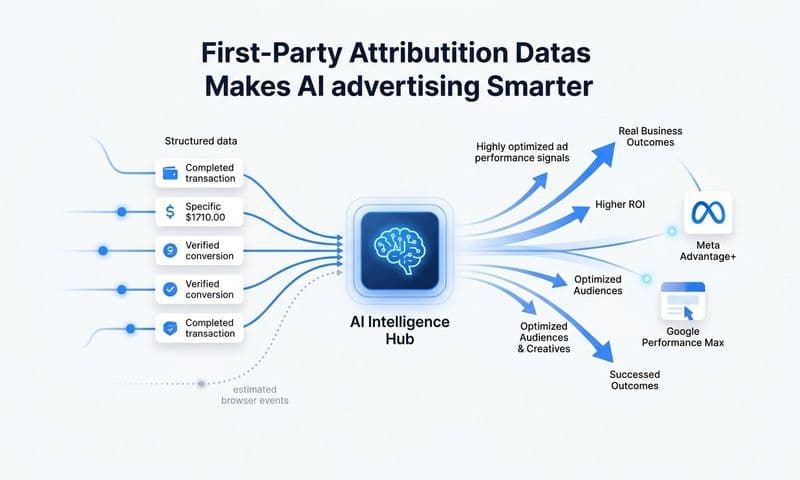
One of the most powerful applications of CLV attribution is improving the quality of conversion signals you send back to ad platforms. Meta and Google both use conversion data to train their optimization algorithms. When you send a simple "purchase" event, the platform learns to find more people who are likely to make a first purchase. But when you send CLV-weighted conversion values, where high-value customers are assigned a higher conversion value than one-time buyers, the algorithm learns to find people who resemble your best long-term customers. This is a compounding advantage: better signals lead to better targeting, which leads to higher-quality customers, which generates better signals over time.
Setting realistic ROAS targets by channel is another practical output of CLV attribution. Some channels have a longer payback window than others. Brand awareness campaigns on social may not produce direct conversions quickly, but they often warm up prospects who later convert through search and go on to become loyal customers. If you're evaluating that social campaign on a 7-day click ROAS, it looks like a poor performer. If you're evaluating it on a 90-day or 180-day CLV-weighted basis, it may be one of your most valuable investments.
A useful framework is to establish CLV benchmarks by channel and use them to set channel-specific ROAS targets that account for different payback windows. A channel that reliably produces customers with a high twelve-month CLV can justify a lower short-term ROAS target. A channel that produces mostly one-time buyers needs to hit a higher short-term ROAS to justify its spend. Building a comprehensive marketing attribution report makes it possible to communicate these nuanced targets across your team.
Common Pitfalls That Undermine CLV Attribution Accuracy
CLV attribution is powerful, but it's also easy to get wrong. Several common mistakes can undermine the accuracy of your data and lead to decisions that are just as flawed as the ones you were trying to avoid.
Choosing the wrong time window: This is one of the most frequent errors. If you measure CLV over 30 days, you're capturing almost none of the repeat purchase behavior that makes a customer genuinely valuable. For many businesses, the true value of a customer only becomes clear after six to twelve months of purchase history. But if you extend the window too far, say three or four years, the data becomes less relevant for optimizing fast-moving campaigns where creative and targeting change frequently. The right window depends on your business model, but for most ecommerce and SaaS companies, a six to twelve month CLV window strikes the right balance between capturing meaningful repeat behavior and staying relevant to current campaign decisions.
Data silos that prevent connection: Ad platform data, website analytics, and CRM or purchase history often live in completely separate systems with no native integration. When these systems don't talk to each other, it's nearly impossible to trace a customer's long-term revenue back to the original marketing touchpoints that acquired them. Many teams end up making CLV attribution decisions based on incomplete data, which can be worse than using simpler metrics because it creates false confidence in flawed analysis. Solving this requires a deliberate integration strategy, and marketing attribution CRM integration is the most critical connection to establish first.
Over-relying on predictive CLV without validation: Predictive CLV models are useful tools. They can estimate a customer's likely future value based on early purchase behavior, which lets you make faster optimization decisions without waiting months for actual data to accumulate. But predictive models are only as good as the assumptions and training data behind them. If you optimize campaigns based on predicted CLV without regularly comparing those predictions against actual observed outcomes, you risk building your entire budget strategy on a model that has drifted from reality. Leveraging marketing analytics data for ongoing validation ensures your predictions stay grounded in reality.
The common thread across these pitfalls is that CLV attribution requires more rigor and more infrastructure than standard conversion tracking. It rewards teams that invest in clean data, thoughtful methodology, and ongoing validation, and it punishes shortcuts.
Building a CLV Attribution System That Scales
Putting all of this into practice requires a systematic approach. The good news is that you don't need to build everything at once. A staged implementation that starts with the foundations and layers in sophistication over time is both more manageable and more likely to produce reliable results.
Start by integrating your ad platforms and CRM. This is the foundational step that makes everything else possible. You need a way to connect the customer identifiers in your ad platforms (click IDs, user IDs) with the customer records in your CRM so that future purchases can be traced back to original acquisition touchpoints. Without this connection, your CLV data and your attribution data will always live in separate worlds. A proper attribution tracking setup ensures these identifiers are captured and connected from day one.
Next, establish server-side tracking for reliable, persistent data collection. Browser-based pixels will continue to lose accuracy as privacy restrictions tighten. Server-side tracking ensures that your conversion events are captured and transmitted accurately regardless of browser settings, ad blockers, or iOS limitations. This is especially important for CLV attribution because you're tracking behavior over extended time windows where data gaps compound.
Once your data infrastructure is in place, define your CLV calculation methodology. Decide on your measurement window, determine which revenue events count (first purchase, repeat purchases, upsells, referrals), and establish how you'll handle customers who churn and return. Consistency in methodology is more important than perfection. A consistently applied six-month CLV calculation is far more useful for optimization than an inconsistently applied twelve-month one. Implementing closed loop attribution ensures that revenue data flows back to inform every stage of your optimization process.
Then layer in multi-touch attribution to connect CLV back to campaigns. This is where you start seeing which specific ads, audiences, and channels are producing your highest-value customers rather than just your highest volume of first-time converters.
AI-powered tools can significantly accelerate this process. Rather than manually sifting through campaign data to identify patterns in customer quality, AI can automatically surface which campaigns and creatives consistently produce high-CLV customers, flagging opportunities and inefficiencies that would take weeks to uncover through manual analysis.
This is exactly the kind of problem Cometly is built to solve. Cometly connects your ad platforms, CRM, and website data to track the entire customer journey in real time, giving you a unified view of which sources actually drive long-term revenue rather than just first-touch conversions. With Cometly's multi-touch attribution, you can see how every touchpoint contributes to customer value across the full lifecycle. Its AI-powered recommendations help you identify which campaigns are consistently producing your best customers, and its conversion sync feeds enriched, CLV-weighted signals back to Meta and Google so their algorithms can find more people like your most valuable buyers. The result is a system that doesn't just measure CLV attribution, it actively helps you act on it.
The Bottom Line on Long-Term Revenue Attribution
The campaigns that look best on paper today are not always the campaigns building your most valuable customer base over time. That's the central truth that customer lifetime value attribution makes visible. Without it, you're making budget decisions based on an incomplete version of reality, one that measures the beginning of a customer relationship while ignoring everything that comes after.
CLV attribution gives you the clarity to invest in channels and campaigns based on real, long-term revenue rather than surface-level acquisition metrics. It changes how you allocate budget, how you set performance targets, and how you communicate with ad platform algorithms. Most importantly, it aligns your optimization decisions with the thing that actually drives business growth: customers who stay, spend more, and bring others with them.
A practical starting point is to audit your current attribution setup and identify where lifetime value data is missing from your decision-making. Are your ad platform reports connected to your CRM? Are you measuring customer revenue beyond the first purchase? Are you sending enriched conversion signals back to Meta and Google, or just basic purchase events? The gaps in your answers point directly to where CLV attribution can have the biggest impact.
If you're ready to connect the dots between your campaigns and your long-term revenue, Get your free demo of Cometly today and see exactly which marketing touchpoints are building your most valuable customer relationships.