You're running campaigns across Meta, Google, TikTok, and LinkedIn. Your dashboards are full of metrics. Impressions are climbing, clicks are steady, and your reports look impressive. But here's the uncomfortable question: which of those campaigns actually drove revenue?
Most marketers are drowning in data but starving for insight. You know how many people clicked your ad, but you don't know if they're the ones who bought three weeks later after seeing your retargeting campaign and reading two blog posts. You're making budget decisions based on incomplete information, and every reallocation feels like an educated guess at best.
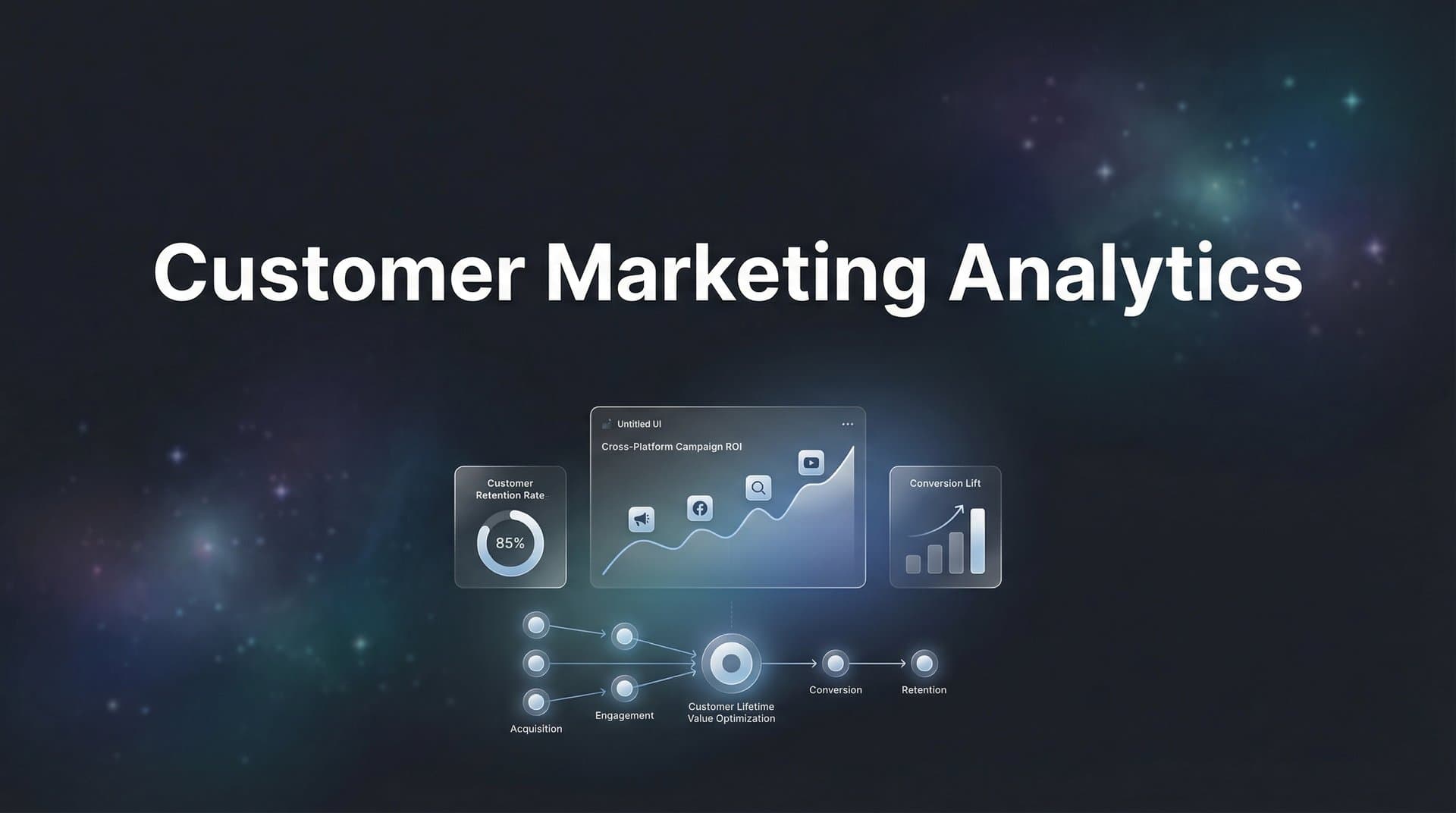
Customer marketing analytics changes that equation. It's the practice of connecting every touchpoint in your customer's journey—from that first ad impression to the final purchase and beyond—to actual revenue outcomes. When done right, it transforms your marketing from a cost center you're constantly justifying into a growth engine you can scale with confidence.
This guide will walk you through what customer marketing analytics actually measures, why traditional tracking falls short, and how to build a system that shows you exactly what's driving results. By the end, you'll understand how to move from guessing about campaign performance to knowing which channels deserve more budget and which ones are just burning cash.
Beyond Vanity Metrics: What Customer Marketing Analytics Actually Measures
Let's clear something up right away: customer marketing analytics isn't about collecting more data. You already have plenty of that. It's about collecting the right data and connecting it to outcomes that matter—specifically revenue.
Think of it as the practice of tracking, analyzing, and acting on customer behavior across the entire lifecycle. That means from the moment someone first sees your ad to when they become a repeat customer. Every interaction, every touchpoint, every channel they engage with becomes part of a complete picture.
Here's where most analytics approaches fall short. They focus on what we call vanity metrics: numbers that look good in a report but don't tell you much about business performance. Impressions hit 500,000 this month? Great. But did those impressions lead to customers, or did they just lead to clicks that went nowhere?
Customer marketing analytics distinguishes between surface-level activity and revenue-connected insights. Surface-level metrics tell you what happened. Revenue-connected insights tell you what worked.
The difference is crucial. When you're tracking impressions and clicks, you're measuring attention. When you're tracking which specific ad campaigns led to conversions, what those customers are worth over time, and which touchpoints influenced their decision, you're measuring impact. Understanding data analytics in marketing helps you make this critical distinction.
This approach has four core components working together. First, behavioral data: what actions customers take across your website, emails, and other properties. Second, channel performance: how each marketing channel contributes to conversions. Third, attribution modeling: the framework for assigning credit when multiple touchpoints are involved. Fourth, customer journey mapping: understanding the sequence and timing of interactions that lead to conversion.
The goal isn't to make your reports more complex. It's to make your decisions more confident. When you know that customers who engage with both your Facebook ads and your educational content convert at three times the rate of those who only see ads, you can structure your campaigns accordingly. When you understand that your Google campaigns generate lower-cost leads but your LinkedIn campaigns generate higher-value customers, you can allocate budget strategically rather than reactively.
Customer marketing analytics also extends beyond acquisition. It tracks customer behavior post-purchase: repeat purchase patterns, engagement with retention campaigns, and lifetime value trends. This complete view lets you optimize not just for getting customers, but for getting the right customers—the ones who stick around and generate sustainable revenue.
The shift from vanity metrics to revenue-connected analytics requires a different infrastructure. You need systems that can track users across devices and sessions, connect marketing touchpoints to CRM data, and attribute revenue to specific campaigns even when the customer journey spans weeks or months. That's where modern attribution platforms come in, but we'll get to that shortly.
The Customer Journey Puzzle: Connecting Touchpoints to Conversions
Picture this: A potential customer sees your Facebook ad on Monday morning during their commute. They don't click—they're just scrolling. Tuesday afternoon, they search for a solution to their problem on Google and find your blog post. They read it, find it helpful, but don't convert. Thursday, they see your retargeting ad on Instagram and finally click through to your landing page. They browse, add a product to cart, but abandon it. Saturday, they receive your cart abandonment email, click through, and complete the purchase.
Now the question: which marketing channel gets credit for that conversion?
If you're only looking at last-click attribution, Instagram gets all the credit. But that ignores the Facebook ad that created initial awareness, the blog post that built trust, and the email that closed the deal. Each touchpoint played a role, but traditional single-channel tracking can't see the full story.
This is the customer journey puzzle that customer marketing analytics solves. Modern buyers don't follow linear paths. They bounce between devices, platforms, and channels. They research extensively before purchasing. They might interact with your brand a dozen times across a month before converting.
Multi-touch attribution is the framework for understanding these complex journeys. Instead of giving all credit to one touchpoint, it distributes credit across the interactions that influenced the decision. Different attribution models do this differently—some weight the first touchpoint heavily, others emphasize the last, and some distribute credit evenly across all interactions. For a deeper dive into these frameworks, explore marketing attribution analytics best practices.
The model you choose depends on your business. If you have a short sales cycle and customers typically convert quickly, last-click might work fine. If you have a longer, more complex sales process with multiple stakeholders and research phases, you need a model that accounts for early and middle-funnel touchpoints.
But here's where it gets complicated: tracking these journeys has become significantly harder over the past few years. Apple's iOS privacy updates disrupted traditional tracking methods. When users opt out of tracking on iOS devices, browser-based pixels can't follow them across apps and websites. Third-party cookies, which marketers relied on for years to track user behavior, are being deprecated across major browsers.
These privacy changes aren't going away. They represent a fundamental shift in how tracking works. Browser-based tracking, which relies on cookies and pixels that live in the user's browser, is increasingly unreliable. Users delete cookies, use privacy-focused browsers, and opt out of tracking at higher rates every year. These are among the most significant attribution challenges in marketing analytics that teams face today.
This is why server-side tracking has become essential for accurate customer marketing analytics. Instead of relying on the user's browser to report back what happened, server-side tracking sends conversion data directly from your server to ad platforms and analytics tools. This approach is more reliable, more accurate, and more privacy-compliant.
When you implement server-side tracking, you capture conversion events that browser-based tracking would miss. You get a more complete picture of your customer journey because you're not dependent on cookies that can be blocked or deleted. You can track users across devices and sessions more effectively because the tracking happens on your infrastructure, not in their browser.
The practical impact is significant. Marketers who've moved to server-side tracking often discover that their actual conversion rates are higher than their browser-based tracking suggested. They find touchpoints and channels that were contributing to conversions but weren't being properly credited. They get better data to feed back to ad platforms, which improves algorithmic optimization.
Solving the customer journey puzzle requires both the right attribution framework and the right tracking infrastructure. You need to decide how to distribute credit across touchpoints, and you need reliable data about what those touchpoints actually are. Get both pieces right, and suddenly your marketing data starts telling a coherent story instead of a fragmented collection of channel-specific metrics.
Five Core Metrics That Reveal What's Really Working
Once you're tracking the full customer journey, you need to know which metrics actually matter. Here are the five that separate marketers who scale profitably from those who just scale spend.
Customer Acquisition Cost by Channel and Campaign: This is your true cost to acquire a customer, not just your cost per click or cost per lead. Calculate it by dividing your total marketing spend on a channel by the number of customers that channel generated. The key is tracking this at the campaign level, not just the channel level. Your Facebook ads might have a reasonable average CAC, but one campaign could be acquiring customers at half the cost of another. Without campaign-level granularity, you're averaging out the winners and losers and missing optimization opportunities.
For a deeper dive into this space, see our AI marketing video generator guide.
Customer Lifetime Value by Acquisition Source: Not all customers are worth the same. The ones who come from organic search might have higher lifetime value than the ones from paid social. Or vice versa. Tracking CLV by acquisition source reveals which channels bring you the most valuable customers over time, not just the most customers. This metric transforms how you think about acquisition costs. A channel with a higher CAC might be perfectly profitable if those customers have significantly higher lifetime value. Using marketing analytics software with revenue tracking makes this calculation straightforward.
Attribution-Weighted Conversion Rates: Standard conversion rate is simple: visitors divided by conversions. Attribution-weighted conversion rate accounts for the multi-touch journey. It shows you how often each channel or campaign contributes to conversions, even when it's not the final click. A channel might have a low direct conversion rate but play a crucial role in assisted conversions. This metric reveals channels that are working harder than last-click attribution suggests.
Return on Ad Spend: ROAS is straightforward but often miscalculated. It's the revenue generated divided by ad spend. The mistake marketers make is measuring ROAS too early. If your sales cycle is 30 days, measuring ROAS at 7 days will always look terrible. You need to measure ROAS over a time window that matches your actual customer journey length. For some businesses, that's a few days. For others, it's months. Get the time window wrong, and your ROAS data will consistently undervalue campaigns that drive long-term results.
Time-to-Conversion Patterns: How long does it typically take someone to convert after their first interaction with your brand? This metric reveals your sales cycle length and helps you set realistic expectations for campaign performance. It also helps you identify when something is wrong. If your typical time-to-conversion is 14 days and you're seeing a sudden shift to 30 days, that's a signal that something in your funnel or messaging has changed. Understanding these patterns also informs your attribution model choice and your patience with new campaigns.
These five metrics work together to give you a complete picture of marketing performance. CAC tells you what you're paying. CLV tells you what you're getting. Attribution-weighted conversion rates reveal which channels deserve more credit. ROAS shows overall efficiency. Time-to-conversion patterns help you interpret everything else with appropriate context.
Track these consistently, and you'll stop asking "Is this campaign working?" and start asking more sophisticated questions like "Is this campaign acquiring the right customers at a sustainable cost given their lifetime value and our growth targets?"
Building Your Analytics Stack: Essential Components
Customer marketing analytics requires three systems working in harmony: ad platform integration, CRM connection, and website tracking. Think of these as the three pillars that hold up your entire analytics infrastructure.
Ad Platform Integration: Your analytics system needs to pull data from every platform where you run ads. Meta, Google, TikTok, LinkedIn, and any other channel you use should feed into a central system. This integration does two things. First, it brings all your campaign data into one place so you can compare performance across platforms. Second, it enables you to send conversion data back to those platforms to improve their optimization algorithms. When Meta's algorithm knows which clicks led to actual customers, it can find more people like them. This feedback loop is crucial for modern advertising performance.
CRM Connection: Your CRM holds the revenue data that makes everything else meaningful. Without connecting your CRM to your analytics, you can track which ads drove leads, but you can't track which ads drove customers or revenue. The CRM connection is what transforms marketing analytics from lead tracking to revenue attribution. It's also where you capture the data needed to calculate customer lifetime value by source. When your CRM and marketing analytics talk to each other, you can see not just which campaign generated a lead, but what that lead was worth six months later.
Website Tracking: This is where you capture behavioral data: which pages people visit, how long they stay, what actions they take. Modern website tracking goes beyond basic page views. It tracks micro-conversions, engagement signals, and user behavior patterns that indicate purchase intent. Combined with ad platform and CRM data, website tracking completes the picture of the customer journey. You can see that someone clicked your Facebook ad, visited three product pages, read two blog posts, and then converted after seeing a retargeting campaign.
These three pillars need to work together seamlessly. Data should flow bidirectionally. Your ad platforms should receive enriched conversion data from your CRM. Your CRM should be tagged with the marketing source that generated each lead. Your website tracking should connect sessions to specific ad clicks and campaigns. A unified marketing data analytics platform brings all these components together.
This is where feeding enriched conversion data back to ad platforms becomes critical. Ad platforms have become increasingly reliant on conversion signals to optimize their algorithms. When you send back detailed, accurate data about which clicks led to valuable customers, the platform's AI can improve targeting, bidding, and creative optimization.
The quality of data you send back matters enormously. Basic conversion tracking tells the platform "this click converted." Enriched conversion tracking tells the platform "this click converted, the customer is worth $5,000 in lifetime value, and they're in your target industry." That additional context makes the algorithm significantly more effective at finding similar high-value prospects.
AI-powered analytics platforms take this a step further by automatically surfacing insights and recommendations. Instead of manually analyzing data to find patterns, AI can identify which campaigns are outperforming, which audiences are most valuable, and where you should reallocate budget. It can spot trends before they're obvious in the raw data and alert you to opportunities or problems early. Learn more about how AI marketing analytics drives results for modern teams.
Building this stack doesn't happen overnight, but the components are straightforward. Start with reliable tracking infrastructure. Add integrations to your key platforms. Connect your CRM. Implement server-side tracking for accuracy. The result is a system that captures every touchpoint, connects them to revenue outcomes, and gives you the insights needed to scale profitably.
From Data to Decisions: Putting Analytics Into Action
Data is only valuable when it changes what you do. The point of customer marketing analytics isn't to generate impressive dashboards. It's to make better decisions faster and scale what's working with confidence.
Start with budget reallocation. Once you have attribution data showing which channels and campaigns actually drive revenue, you can shift spend from underperformers to winners. This sounds obvious, but many marketers continue spreading budget evenly across channels because they don't have the data to justify doing otherwise. Attribution insights remove the guesswork. If your data shows that LinkedIn campaigns generate customers with 2x higher lifetime value than Facebook campaigns, even at a higher CAC, you know where to invest more aggressively.
The key is moving beyond last-click thinking. A channel might have a low direct conversion rate but play a crucial assisted role. Before you cut budget to a channel that looks weak in last-click attribution, check its assisted conversion metrics. You might discover it's actually driving significant value by introducing customers who convert through other channels later. A multi-channel marketing analytics dashboard helps you visualize these cross-channel contributions.
Comparing attribution models is equally important. Different models tell different stories about your marketing performance. Run your data through first-touch, last-touch, linear, and time-decay models. Look for patterns and discrepancies. If first-touch attribution heavily favors organic search while last-touch favors paid social, that tells you something about your funnel: awareness comes from content, conversion comes from ads. Structure your strategy accordingly.
The right attribution model depends on your sales cycle and business model. Short sales cycles often work well with last-touch or position-based models that emphasize the final interactions. Longer, more complex sales cycles benefit from models that credit early and middle touchpoints more heavily. Many businesses find that a custom weighted model, where they assign credit based on their specific customer journey patterns, works best.
Create a feedback loop between analytics and campaign strategy. Use your data to form hypotheses, test them with new campaigns, and measure the results. This test-and-learn approach compounds over time. Each cycle teaches you something new about what resonates with your audience, which messages convert, and which channels drive the best customers. Understanding how to leverage analytics for marketing strategy accelerates this learning process.
Here's what this looks like in practice. Your analytics show that customers who engage with educational content before seeing product ads have higher conversion rates and lifetime value. You create a campaign strategy that leads with educational content, then retargets engaged users with product offers. You measure the results, compare them to your direct-to-product approach, and scale the winner.
Or your data reveals that time-to-conversion is significantly shorter for customers who interact with video content. You shift creative budget toward video production and distribution. You track whether this hypothesis holds as you scale, and adjust based on results.
The confidence to scale comes from having reliable data. When you know which campaigns are profitable, which customer segments are most valuable, and which touchpoints drive conversions, you can increase spend without the nagging worry that you're just burning money faster. You're not guessing about what might work. You're scaling what already works.
This is where customer marketing analytics transforms from a reporting exercise into a growth engine. Every decision becomes data-informed. Every test teaches you something. Every winning campaign can be scaled with confidence because you know exactly what made it successful.
Your Analytics Action Plan: Connecting Data to Revenue
Let's bring this together into a framework you can implement. Customer marketing analytics boils down to four steps: capture every touchpoint, connect them to revenue, extract insights, and optimize based on what you learn.
First, ensure you're capturing complete data across the customer journey. This means implementing tracking that works across devices and sessions, integrating all your ad platforms, connecting your CRM, and using server-side tracking for accuracy. If you're missing touchpoints or relying on outdated browser-based tracking, everything built on top of that foundation will be flawed.
Second, connect those touchpoints to actual revenue outcomes. Marketing metrics only matter when they tie to business results. Make sure your analytics system can show you not just which campaigns drove clicks or leads, but which campaigns drove customers and revenue. This connection is what separates actionable insights from interesting data. Explore marketing analytics and reporting best practices to turn data into revenue-driving decisions.
Third, extract insights from your data using attribution modeling and customer journey analysis. Understand which channels deserve credit, which campaigns are most efficient, and which customer segments are most valuable. Use AI-powered analytics tools to surface patterns and opportunities you might miss in manual analysis.
Fourth, act on those insights. Reallocate budget toward what's working. Test hypotheses about what could work better. Scale winning campaigns with confidence. Create a continuous cycle of measurement, learning, and optimization.
The foundation of this entire framework is accurate data. Without it, every decision is still a guess—just a guess dressed up with charts and dashboards. Investing in reliable tracking infrastructure and comprehensive attribution isn't optional. It's the prerequisite for everything else.
As you build out your customer marketing analytics capability, start with the basics and add sophistication over time. Get reliable tracking in place first. Add attribution modeling second. Layer in predictive analytics and AI-powered recommendations third. Each step builds on the previous one, and trying to skip ahead without solid fundamentals will leave you with impressive-looking analytics that don't actually improve decisions.
Ready to elevate your marketing game with precision and confidence? Discover how Cometly's AI-driven recommendations can transform your ad strategy—Get your free demo today and start capturing every touchpoint to maximize your conversions.
The Foundation for Confident Scaling
Customer marketing analytics isn't about collecting more data. You already have more data than you can reasonably analyze manually. It's about connecting the right data to the outcomes that matter—revenue, customer lifetime value, and sustainable growth.
The marketers who win in the current landscape are the ones who understand their customer journeys completely. They know which touchpoints drive conversions. They can attribute revenue to specific campaigns with confidence. They make budget decisions based on data, not intuition. They scale what works and cut what doesn't, quickly and decisively.
This level of clarity requires infrastructure: reliable tracking, proper attribution modeling, integrated data from all your platforms and systems. It requires moving beyond last-click thinking to understand the full customer journey. It requires feeding enriched data back to ad platforms so their algorithms can optimize more effectively.
Most importantly, it requires treating accurate attribution as the foundation of your entire marketing strategy. Without it, you're flying blind. With it, every decision becomes clearer, every test more meaningful, and every dollar of ad spend more accountable.
The path forward is straightforward. Audit your current tracking setup. Identify gaps in your data. Implement the infrastructure needed to capture complete customer journeys. Connect your marketing data to revenue outcomes. Start making decisions based on what actually drives results, not what looks good in a platform dashboard.
The difference between marketers who scale profitably and those who just scale spend comes down to this: knowing what's really working. Customer marketing analytics gives you that knowledge. What you do with it determines everything else.